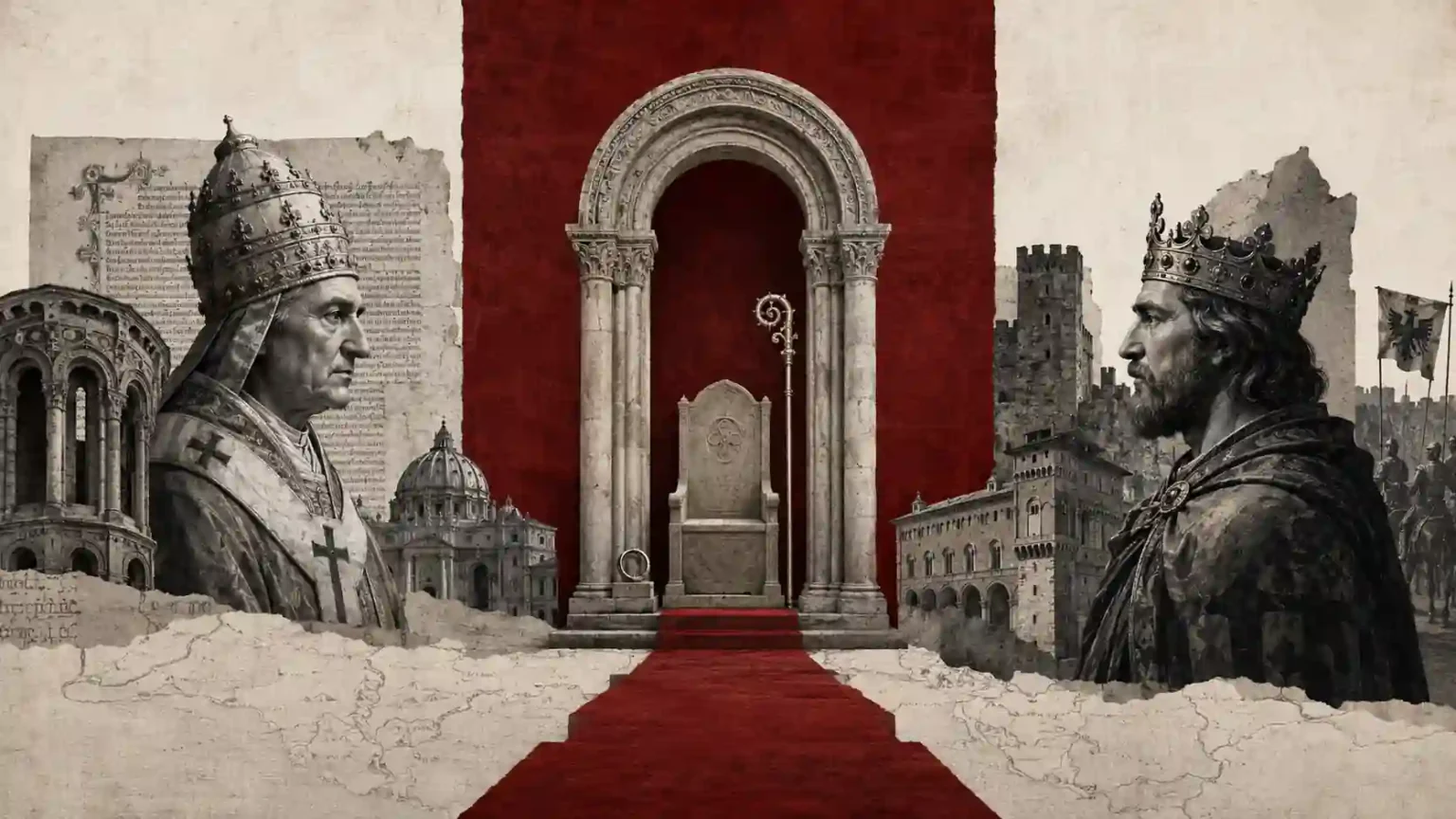
Illustration by Bookinlight Art Desk
The best books on the Investiture Controversy do not simply retell a medieval quarrel between pope and emperor. They explain how Latin Christendom learned to argue about office, sacrament, kingship, jurisdiction, conscience, and the limits of coercive power.
The dispute over who could appoint and invest bishops became a grammar of medieval political thought. At stake was not only whether Henry IV or Gregory VII controlled episcopal appointments, but whether sacred authority could be absorbed into royal government, whether ecclesiastical office could be purified from lay domination, and whether Christian society could imagine two powers without collapsing them into one.
By Bookinlight
The Reading Lens
Reading the struggle as a transformation of authority
The Investiture Controversy is best read as a crisis in the symbolic architecture of medieval Europe. Bishops were not merely churchmen; they were landholders, royal agents, ritual figures, judges, patrons, and spiritual governors. These books show why the conflict over ring, staff, election, and homage forced Europeans to distinguish between sacred office and political command more sharply than before.
Central Question
Who may mediate between sacred office and public power?
Historical Pressure
Reform, royal administration, episcopal lordship, and papal claims to liberty.
Why These Books
Together they move from synthesis to ideology, documents, biography, reform, and social meaning.
The Reading Map
| Book | Difficulty | Rating | Why It Matters |
|---|---|---|---|
| The Investiture Controversy | General to Intermediate | ★★★★★ | The clearest compact synthesis of the conflict. |
| Church State and Christian Society at the Time of the Investiture Contest | Advanced | ★★★★½ | Frames the struggle as an argument over Christian order. |
| The Crisis of Church and State 1050-1300 | General | ★★★★½ | Gives readers the primary texts behind the dispute. |
| Pope Gregory VII 1073-1085 | Advanced | ★★★★★ | The major scholarly biography of Gregory VII. |
| Henry IV of Germany 1056-1106 | Intermediate | ★★★★½ | Restores the imperial side of the crisis. |
| Reform and the Papacy in the Eleventh Century | Intermediate | ★★★★½ | Explains reform before it hardens into open conflict. |
| Power and the Holy in the Age of the Investiture Conflict | General | ★★★★½ | Broadens the topic beyond elite papal-imperial politics. |
Best books on the Investiture Controversy
The Investiture Controversy: Church and Monarchy from the Ninth to the Twelfth Century
Author: Uta-Renate Blumenthal
Best for: readers who want the most focused introductory synthesis
Difficulty: General to Intermediate
Intellectual role: the orienting map of the conflict
Bookinlight Rating: ★★★★★
Blumenthal’s study remains the natural first stop because it refuses to reduce the Investiture Controversy to a single dramatic scene at Canossa. Its strength lies in showing how the conflict grew from earlier ecclesiastical reforms, monastic ideals, royal habits of appointment, and changing assumptions about the liberty of the church. The book is concise, but it is not thin: it keeps political narrative, institutional development, and religious ideology in the same frame. For readers approaching the controversy for the first time, this matters because the conflict is often misremembered as a simple contest between “church” and “state,” categories that were themselves unstable in the eleventh century. Blumenthal helps the reader see why bishops were so central: they were spiritual officers, territorial lords, royal servants, and symbols of Christian order. The book belongs in this article because it supplies the essential chronology and vocabulary without overwhelming the reader. It is especially useful for students, historically curious general readers, and anyone who wants to move from textbook knowledge toward real medieval historiography. After reading it, Canossa appears less like an isolated humiliation and more like one episode in a wider transformation of European authority.
Bookinlight Note
Begin here if you want a serious but manageable route into Gregorian reform, lay investiture, royal episcopacy, and the Concordat of Worms.
Church, State and Christian Society at the Time of the Investiture Contest
Author: Gerd Tellenbach
Best for: readers interested in medieval political theology
Difficulty: Advanced
Intellectual role: the classic interpretive thesis
Bookinlight Rating: ★★★★½
Tellenbach’s classic is more demanding than Blumenthal’s synthesis, but it is indispensable for understanding the Investiture Contest as a dispute about the right ordering of Christian society. Its central contribution is conceptual: it treats the quarrel not as an administrative accident but as a collision between competing visions of liberty, hierarchy, sacred office, and worldly rule. The book makes clear why the language of libertas ecclesiae was so powerful. “Liberty” did not mean modern individual autonomy; it meant the church’s freedom to be governed according to its own sacred order, protected from lay domination, simony, and dynastic capture. Tellenbach belongs in this reading list because he helps readers grasp the depth beneath the visible events: synods, excommunications, anti-kings, rival bishops, and disputed elections become signs of a more profound struggle over where legitimate authority came from. This is a book for patient readers, graduate students, and anyone drawn to the intellectual history of institutions. It changes one’s understanding of the controversy by shifting attention away from personalities alone and toward the mental world in which pope, king, bishop, monk, and lay noble all imagined their duties. It is not the easiest book here, but it gives the dispute its metaphysical seriousness.
Bookinlight Note
Read Tellenbach after a narrative overview; his value lies in deepening the controversy into a theory of medieval Christian order.
The Crisis of Church and State, 1050-1300: With Selected Documents
Author: Brian Tierney
Best for: readers who want documents with interpretation
Difficulty: General
Intellectual role: the primary-source bridge
Bookinlight Rating: ★★★★½
Tierney’s volume is crucial because the Investiture Controversy was fought not only with armies, councils, and depositions, but with texts. Papal letters, imperial responses, conciliar decrees, polemical claims, and legal distinctions created the argumentative world in which later medieval church-state theory developed. The book’s great virtue is pedagogical clarity: it gives enough narrative framing to orient the reader, then lets the documents reveal the intensity and sophistication of the debate. This makes it especially valuable for readers who want to know what Gregory VII’s party, imperial defenders, canonists, and later theorists actually said. It belongs in this article because no serious understanding of the controversy can rest only on modern summary. The reader must encounter the period’s own vocabulary: sacerdotium, regnum, obedience, excommunication, deposition, election, consecration, and jurisdiction. Tierney also expands the horizon beyond 1122, showing how the conflict contributed to later disputes over papal monarchy, royal power, and corporate rights. The book suits undergraduates, teachers, historically minded lawyers, and anyone who wants a controlled entry into medieval political sources. It changes the reader’s understanding by making the controversy less like a settled episode and more like the opening of a long documentary argument over authority in the West.
Bookinlight Note
Use this alongside Blumenthal: one gives the narrative architecture, the other gives the voices and documents that made the crisis durable.
Pope Gregory VII, 1073-1085
Author: H. E. J. Cowdrey
Best for: readers seeking the definitive Gregory VII biography
Difficulty: Advanced
Intellectual role: the papal center of gravity
Bookinlight Rating: ★★★★★
Cowdrey’s biography is monumental because it treats Gregory VII not as a slogan but as a historical actor formed by Roman crisis, monastic reform, papal service, legal imagination, and a ferocious conviction about apostolic authority. Gregory can easily become either hero or villain in simplified accounts: champion of ecclesiastical liberty, architect of papal absolutism, spiritual reformer, political aggressor. Cowdrey’s achievement is to make those labels insufficient. He reconstructs Gregory’s career within the practical world of Roman factions, Norman alliances, episcopal resistance, German politics, and the administrative limits of the eleventh-century papacy. The book belongs here because the Investiture Controversy cannot be understood without entering Gregory’s mind and institutional environment. His confrontation with Henry IV was not merely personal pride; it drew on a developed view of St Peter’s authority, clerical purity, obedience, and the pope’s responsibility to discipline rulers who endangered Christian order. The book is best for advanced readers, but determined non-specialists will also benefit from its density. It changes the reader’s understanding by making Gregory’s radicalism historically intelligible. The papal claims that appear shocking in isolation become, in Cowdrey’s hands, part of a wider attempt to remake the church’s relation to power, sin, office, and reform.
Bookinlight Note
This is the book to read when Gregory VII stops being a name in a chronology and becomes the central problem of the age.
Henry IV of Germany, 1056-1106
Author: I. S. Robinson
Best for: readers who want the imperial perspective
Difficulty: Intermediate
Intellectual role: the royal and imperial counterweight
Bookinlight Rating: ★★★★½
Robinson’s biography is essential because the Investiture Controversy is too often narrated from the papal side. Henry IV appears as the ruler who defied Gregory VII, walked to Canossa, backed an antipope, and became trapped in rebellion and civil war. Robinson restores the political density behind those scenes. Henry’s reign involved Saxon unrest, aristocratic opposition, minority rule, Italian expeditions, episcopal government, contested legitimacy, and the practical needs of a monarchy that depended heavily on bishops as servants of the realm. The book’s central contribution is to show that lay investiture was not simply a corrupt habit from which reform rescued the church. For rulers such as Henry, control over bishoprics was bound to public order, territorial cohesion, and the machinery of kingship. This does not excuse imperial coercion, but it explains why the issue could not be surrendered easily. The book belongs in this article because it balances the moral drama of Gregorian reform with the administrative and dynastic pressures of the Salian monarchy. It is best for readers who already know the broad story and now want causation, contingency, and political texture. It changes one’s understanding by making the emperor less a foil for papal reform and more a ruler trying to survive a crisis in which royal, aristocratic, episcopal, and spiritual claims all converged.
Bookinlight Note
Pair Robinson with Cowdrey to keep the controversy from becoming one-sided papal morality or one-sided imperial apologetics.
Reform and the Papacy in the Eleventh Century: Spirituality and Social Change
Author: Kathleen G. Cushing
Best for: readers interested in reform before confrontation
Difficulty: Intermediate
Intellectual role: the reform context
Bookinlight Rating: ★★★★½
Cushing’s book is valuable because it asks readers to look before the famous explosion. The Investiture Controversy did not arise from nothing in 1076; it was prepared by decades of reforming energy, debates over clerical life, monastic renewal, Roman authority, simony, episcopal conduct, and the changing social imagination of sanctity. Cushing’s central contribution is to place papal reform within broader spiritual and social change, resisting the idea that everything began as a top-down Roman program. At the same time, the book takes the papacy seriously as an institution increasingly capable of organizing, articulating, and intensifying reform. This balance is important. If one treats reform only as local religious enthusiasm, the papal-imperial confrontation looks accidental. If one treats reform only as papal centralization, one misses the moral and devotional force that gave reform legitimacy. Cushing belongs here because she explains the atmosphere in which lay investiture became intolerable to reformers: not simply as bad administration, but as a symptom of polluted office, compromised sanctity, and blurred boundaries between sacred and secular power. The book suits readers who want the social and religious prehistory of the conflict. It changes one’s understanding by making the controversy less a sudden constitutional crisis and more the political climax of a long reforming revaluation of Christian life.
Bookinlight Note
This is the best corrective to any reading that begins with Canossa and forgets the reforming decades that made Canossa meaningful.
Power and the Holy in the Age of the Investiture Conflict: A Brief History with Documents
Author: Maureen C. Miller
Best for: readers who want a wider social and religious frame
Difficulty: General
Intellectual role: the social reorientation
Bookinlight Rating: ★★★★½
Miller’s brief history with documents is one of the most useful modern teaching books on the subject because it reframes the conflict as a transformation in ideas of power and holiness. The conventional story places pope and emperor at the center, and rightly so, but Miller asks what made the struggle intelligible to wider Christian society. Reform was not only a dispute about who handed over the ring and staff. It also changed expectations about clerical behavior, lay piety, monastic authority, episcopal sanctity, and the relation between visible power and sacred legitimacy. The book’s document selection makes it especially effective for readers who want to see how arguments moved across genres: polemic, narrative, decree, letter, and reforming exhortation. It belongs in this article because it provides a compact way to connect institutional crisis with cultural change. The reader who benefits most is one who wants to avoid a narrow legalistic account without losing sight of the concrete issues. Miller changes the understanding of the Investiture Conflict by making it less an elite chessboard and more a reorganization of how medieval Christians imagined power itself. After reading it, bishops, monks, rulers, reformers, and lay supporters appear within the same moral field rather than in isolated institutional boxes.
Bookinlight Note
A strong final selection for readers who want the controversy to feel socially alive, not merely constitutionally important.
Frequently Asked Questions
What was the Investiture Controversy really about?
It was about who could confer authority on bishops and abbots, but beneath that lay a larger conflict over sacred office, royal government, church reform, and the boundaries of legitimate power.
Which book should a beginner read first?
Blumenthal is the best first book because it gives a concise, serious, and historically grounded overview before moving into more specialized scholarship.
Why is Canossa so important?
Canossa dramatized the vulnerability of royal authority before ecclesiastical discipline, but it should be read as one episode in a longer struggle over reform, legitimacy, and episcopal control.
Did the Concordat of Worms end the problem?
It settled key procedures in 1122, but it did not end medieval disputes over papal authority, royal power, church property, jurisdiction, or the political meaning of sacred office.
The Last Margin
The best books on the Investiture Controversy reveal a medieval world trying to decide whether holiness could be governed like property, whether kingship could command the church without corrupting it, and whether reform could purify power without creating new forms of domination. Read together, these seven books turn a famous medieval quarrel into a demanding inquiry into authority itself.