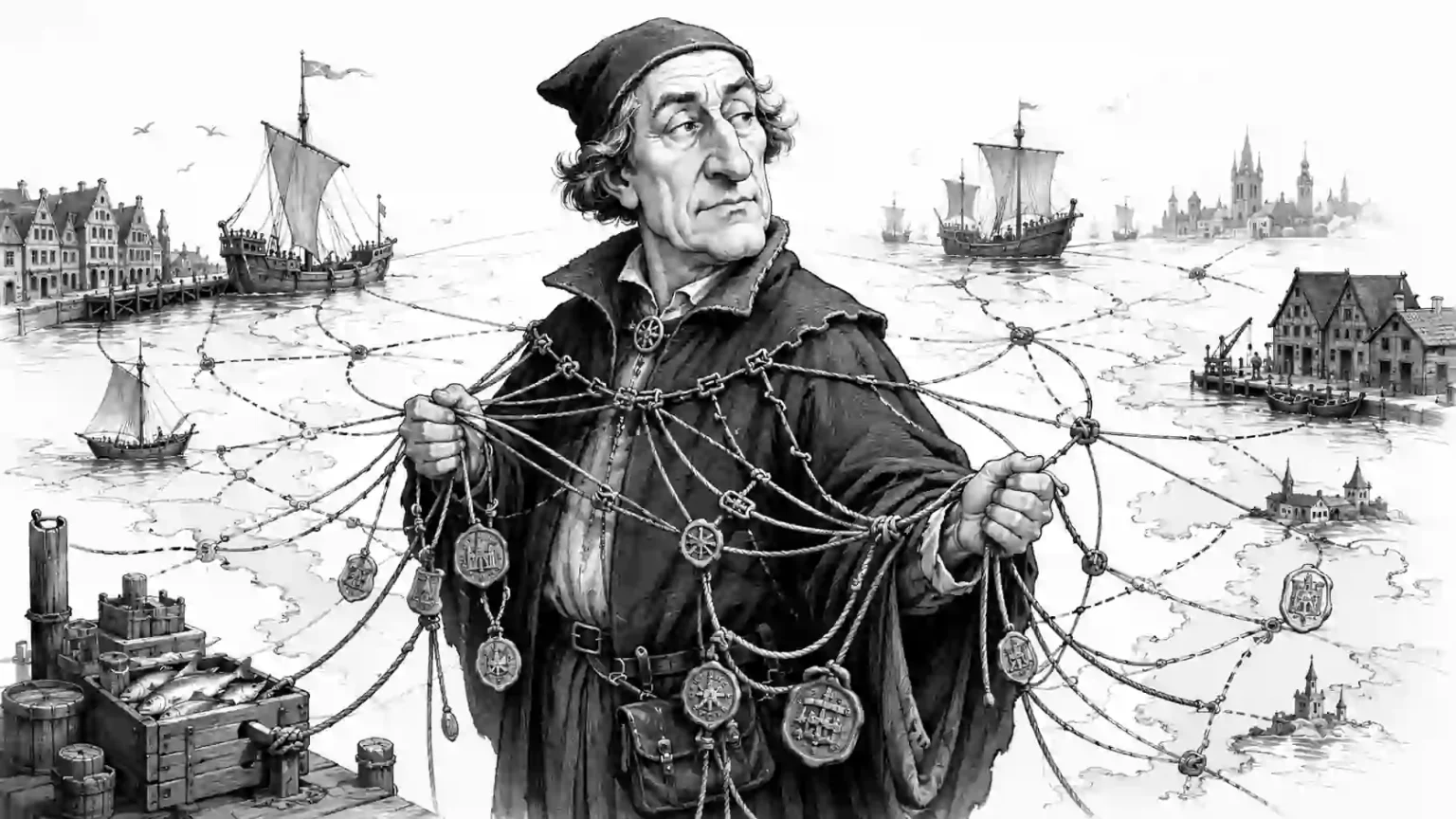
Illustration by Bookinlight Art Desk
For readers searching for the best books on the Hanseatic League, the most useful starting point is not a tale of heroic merchants or medieval free trade, but a problem of form: how did a loose, unequal, multilingual network of towns, privileges, routes, courts, and counting houses act with enough coherence to shape northern Europe for centuries?
The Hanse was not a state, not quite a federation, and never simply a business association. Its power lay in negotiated repetition: shared commercial habits, diplomatic pressure, legal privileges, urban memory, and the practical discipline of merchants who needed protection without creating a centralized government. These five books are arranged to move from the classic general synthesis to newer revisionist scholarship, then into trade diplomacy, regional depth, and the afterlife of Hanseatic institutions in early modern Europe.
By Bookinlight
The Reading Lens
How the best books on the Hanseatic League revise a merchant myth
The strongest scholarship on the Hanseatic League teaches readers to distrust overly neat categories. The Hanse becomes most intelligible when seen as a changing field of urban cooperation, legal improvisation, maritime risk, regional dependence, and political bargaining. These books matter because they replace the old picture of a single “league” with a more demanding question: how did commerce create authority without sovereignty?
Central Question
How did merchant towns convert trust, privilege, and pressure into durable power?
Historical Pressure
Baltic expansion, urban autonomy, crown diplomacy, piracy, fisheries, grain flows, and changing sea law.
Why These Books
Together they move from synthesis to revision, from network theory to local institutions.
The Reading Map
| Book | Difficulty | Rating | Why It Matters |
|---|---|---|---|
| The German Hansa | Intermediate | ★★★★★ | The classic synthesis for the whole subject. |
| A Companion to the Hanseatic League | Advanced | ★★★★½ | A state-of-the-field guide to current scholarship. |
| Die Hanse | General to Intermediate | ★★★★½ | A concise modern challenge to inherited myths. |
| The Hanse in Medieval and Early Modern Europe | Advanced | ★★★★½ | Explains the Hanse as process, not monument. |
| The German Hansa and Bergen 1100-1600 | Advanced | ★★★★½ | Shows the League through one crucial northern settlement. |
The German Hansa
Philippe Dollinger
Best for: Readers who want the classic full-scale narrative before entering specialist debates.
Difficulty: Intermediate
Intellectual role: The foundational synthesis.
Bookinlight Rating: ★★★★★
Dollinger’s The German Hansa remains the indispensable entrance to Hanseatic studies because it gives the reader the full architecture of the subject: origins in northern German commercial expansion, the rise of Lübeck, the importance of Baltic routes, the role of foreign trading stations, relations with kings and cities, and the slow weakening of Hanseatic coherence in the early modern period. Its intellectual contribution is synthetic rather than revisionist. Dollinger makes the Hanse legible as a long historical formation, not merely a sequence of commercial privileges or naval conflicts.
The book belongs here because anyone approaching the Hanseatic League needs a broad map before confronting newer scholarship that questions whether the Hanse was ever as unified as older narratives implied. Dollinger’s great strength is narrative proportion: he keeps trade, diplomacy, urban autonomy, and institutional practice in view at the same time. The reader sees how a network could become powerful without becoming a state.
Modern readers should approach the book historically as well as informationally. Some assumptions have been revised by later scholars, especially around institutional unity and German national framing. Yet that is precisely why the book still matters. It gives the classic model against which much recent Hanseatic scholarship argues. For the serious reader, it is not the last word; it is the necessary first grammar.
Bookinlight Note: Read this first for orientation, but keep asking where the narrative may make the Hanse appear more coherent than it was in practice.
A Companion to the Hanseatic League
Edited by Donald J. Harreld
Best for: Readers who want a scholarly overview of the field rather than a single narrative.
Difficulty: Advanced
Intellectual role: The research map.
Bookinlight Rating: ★★★★½
A Companion to the Hanseatic League is the most useful bridge between older general histories and the specialized debates that now define Hanseatic scholarship. As a multi-author volume, it does not offer the smoothness of Dollinger’s synthesis; instead, it gives the reader a set of analytical instruments. Its value lies in showing that the Hanseatic League cannot be adequately understood through one register alone. Trade, law, shipping, city politics, kontors, regional economies, and historiography all have to be read together.
The book belongs in this article because the Hanse is an unusually difficult historical object. It invites anachronism: modern readers are tempted to call it a federation, a trade bloc, a proto-corporation, or even a medieval European Union. The Companion helps resist those shortcuts. It situates the Hanse inside the social and economic history of pre-modern northern Europe and stresses the difference between formal institutions and practical cooperation.
This is best suited to readers who already know the basic story and want to understand what historians argue about. It changes one’s understanding of the Hanseatic League by replacing a single linear rise-and-fall account with a field of problems: what counted as membership, where authority actually resided, how privileges worked abroad, and why local institutions could matter as much as grand assemblies. It is less a door than a seminar table.
Bookinlight Note: Use this volume after Dollinger to see how the field has become more plural, local, and institutionally cautious.
Die Hanse
Carsten Jahnke
Best for: Readers comfortable with German who want a compact modern reinterpretation.
Difficulty: General to Intermediate
Intellectual role: The concise revisionist corrective.
Bookinlight Rating: ★★★★½
Carsten Jahnke’s Die Hanse is short, sharp, and conceptually important. Its central contribution is to unsettle the comfortable memory of the Hanse as a harmonious medieval association of trading cities. Jahnke writes against the polished civic myth that still surrounds “Hanseatic” identity in northern Europe. He asks what the Hanse was, how it functioned, and why it is so difficult to define without smuggling modern institutional assumptions into the past.
This book belongs here because it gives readers an unusually efficient encounter with contemporary German-language scholarship. Where older accounts may emphasize grandeur, continuity, and success, Jahnke foregrounds contingency, uneven participation, smaller towns, commercial practice, and the historical instability of the word Hanse itself. The result is not a dismissal of Hanseatic importance, but a better explanation of it. The League’s power becomes more impressive once we stop imagining it as a neat organization.
The ideal reader is someone who wants a portable but serious guide, especially after reading a broad English-language introduction. It changes the reader’s understanding by turning definition into method. Instead of asking, “What was the Hanseatic League?” in search of a single institutional answer, the reader learns to ask when, where, and for whom the Hanse existed. That shift is essential for avoiding both romantic nostalgia and textbook oversimplification.
Bookinlight Note: This is the best compact antidote to the idea of the Hanse as a medieval corporation with modern organizational clarity.
The Hanse in Medieval and Early Modern Europe
Edited by Justyna Wubs-Mrozewicz and Stuart Jenks
Best for: Readers interested in the Hanse as a flexible institution across time and region.
Difficulty: Advanced
Intellectual role: The methodological deepening.
Bookinlight Rating: ★★★★½
The Hanse in Medieval and Early Modern Europe is essential because it refuses to treat the Hanse as a closed medieval episode. Its essays place the League inside longer transitions: from medieval commerce to early modern adaptation, from urban privilege to shifting state power, from collective identity to changing strategies of negotiation. The book’s central intellectual contribution is its insistence that the Hanse was not merely a structure, but a repertoire of practices.
It belongs in this article because many readers still approach the Hanse through a simplified arc: emergence, golden age, decline. This volume complicates that rhythm. It asks how Hanseatic actors perceived themselves and others, how institutions managed conflict, and how older forms of cooperation survived, changed, or lost force under new political and economic pressures. The result is a more dynamic account of historical continuity.
This book will benefit readers who enjoy historiography, legal history, and institutional analysis. It is not the easiest point of entry, but it is one of the most rewarding works for understanding why the Hanse cannot be reduced to a medieval trade league. It changes the reader’s sense of periodization. The important question becomes not only how the Hanse rose or declined, but how its practices were remembered, redeployed, and contested across changing northern European worlds.
Bookinlight Note: Read this when you want the Hanse to become a problem of historical method rather than a finished object.
The German Hansa and Bergen 1100-1600
Arnved Nedkvitne
Best for: Readers who want a major regional study of stockfish, settlement, and power.
Difficulty: Advanced
Intellectual role: The local case that changes the whole picture.
Bookinlight Rating: ★★★★½
Nedkvitne’s The German Hansa and Bergen 1100-1600 is a massive study of one of the Hanse’s most important northern sites. Bergen matters because it shows the League not as an abstract network of cities, but as a lived system of settlement, fish, grain, credit, law, hierarchy, and daily coexistence. The book’s central contribution is to put Norwegian-Hanseatic relations at the center of the story rather than treating Bergen as a peripheral trading station attached to a German narrative.
The book belongs here because it forces the reader to understand how the Hanse worked on the ground. The Bergen Kontor was not only a commercial outpost; it was a zone of negotiation between foreign merchants, Norwegian authorities, local producers, maritime routes, and the demands of the stockfish economy. By following these relationships across five centuries, Nedkvitne shows that Hanseatic dominance was neither simple exploitation nor frictionless cooperation. It was a historically specific balance of dependency, advantage, and institutional bargaining.
This is a demanding book, but it rewards readers who want evidence-rich historical analysis. It changes the reader’s understanding of the Hanseatic League by making scale visible. The League’s general history looks different when seen from Bergen’s warehouses, wharves, courts, and fisheries. The Hanse becomes less a single organization and more a set of local arrangements held together by repeated commercial need.
Bookinlight Note: This is the book that best shows why a local study can correct the grand narrative more powerfully than another overview.
FAQ
What is the best first book on the Hanseatic League?
Start with Philippe Dollinger’s The German Hansa. It gives the broadest narrative foundation, even though later scholarship revises parts of its framing.
Was the Hanseatic League a medieval state?
No. It was a loose and changing network of towns, merchants, privileges, meetings, and foreign settlements. Its authority was practical and negotiated rather than sovereign.
Which book best explains current scholarship?
A Companion to the Hanseatic League is the strongest guide to the field because it introduces several specialized debates rather than offering a single storyline.
Why is Bergen so important to Hanseatic history?
Bergen reveals how Hanseatic power worked in a specific place: through stockfish trade, foreign settlement, local law, Norwegian politics, and long-term commercial dependency.
What Reading Still Keeps Open
The best books on the Hanseatic League do not leave the reader with a single definition. They leave a sharper historical imagination. The Hanse was powerful because it was not simple: it was urban and maritime, German and non-German, legal and informal, commercial and diplomatic, medieval and early modern. To read it well is to see how northern Europe was shaped by institutions that were strong precisely because they remained flexible.