Illustration by Bookinlight Art Desk
Ethics in Politics & Economics
Seven Books on the Philosophy of Work
From labor and craft to emotional service, antiwork politics, and the anthropology of time, these books ask what work does to human freedom, character, dignity, and imagination.
By Bookinlight



Work Is Never Only a Job
The best books on philosophy of work begin from a simple embarrassment: modern societies treat work as the ordinary price of existence, yet work is also where people seek meaning, suffer humiliation, develop skill, perform identity, encounter hierarchy, and measure their worth. To ask philosophically about work is therefore to ask about far more than employment. It is to ask how time becomes obligation, how skill becomes character, how wages become moral judgment, and how a person can be both made and diminished by what they do all day.
The seven books gathered here do not form a single doctrine. Arendt separates labor, work, and action; Weeks asks why even emancipatory politics often worships employment; Sennett and Crawford defend craft against abstraction; Hochschild shows how feeling itself enters the labor process; Suzman stretches the question across deep human time; Terkel gives the theory back to voices. Together, they make work visible as a moral institution.
Why the Best Books on Philosophy of Work Refuse Easy Answers
Work can liberate, discipline, exhaust, dignify, alienate, and educate. That is why the philosophy of work cannot be reduced to one political slogan. A world without meaningful work would be thin; a world ruled by compulsory work is cruel. The central problem is proportion: how much of life should be organized around productivity, and what forms of human excellence are lost when every activity must justify itself as economically useful?
The Reading Lens
The Moral Weight of Organized Time
Read together, these books shift the question from whether work is good or bad to how societies convert human time into duty, identity, income, status, and discipline. Their shared concern is not productivity in itself, but the moral architecture that tells people which activities count, which forms of care disappear, which skills deserve honor, and which lives are treated as wasted when they do not conform to paid employment.
Central Question
What kind of freedom remains when a life is organized primarily around the obligation to work?
Historical Pressure
Industrial capitalism, service economies, automation, and moralized employment have made work a test of character as well as income.
Why These Books
They move from political ontology and feminist critique to craft, emotion, anthropology, and lived testimony.
Seven Essential Books on Work, Meaning, and Freedom
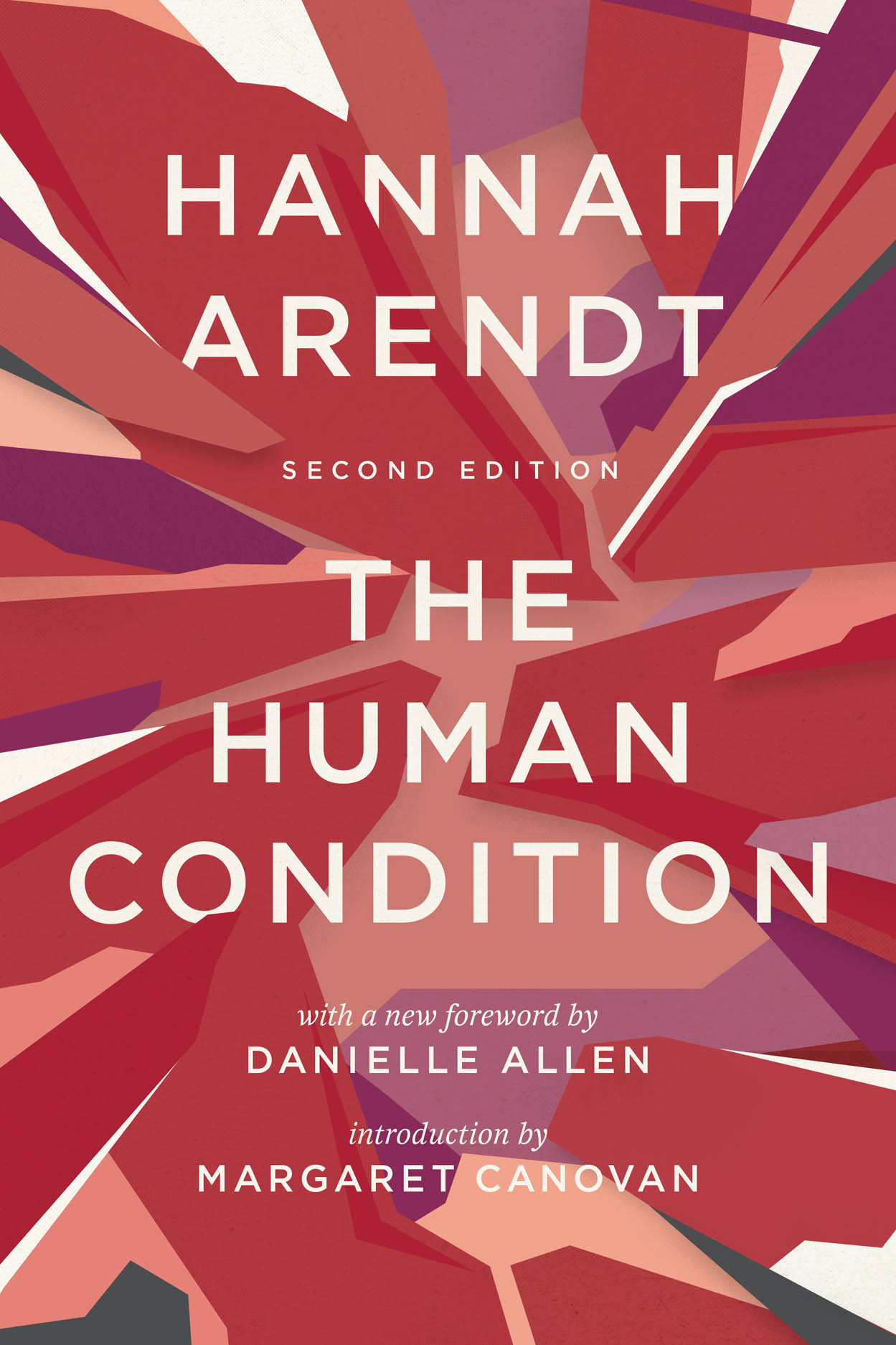
The Human Condition
Hannah Arendt
Best for: Readers seeking the philosophical architecture behind labor, work, and action.
Difficulty: Advanced
Intellectual role: The conceptual foundation of the article.
Bookinlight Rating: ★★★★★
Arendt’s distinction between labor, work, and action remains one of the decisive frameworks for thinking about human activity. Labor answers biological necessity; work builds a durable world; action discloses persons in public. This matters because modern societies often confuse all three under the single name of productivity. Arendt helps readers see why endless labor can erode worldliness, and why fabrication, speech, politics, and shared permanence belong to different dimensions of human life.
Bookinlight Note: Read Arendt beside contemporary burnout discourse; her deepest warning is not fatigue alone, but the loss of a shared world.
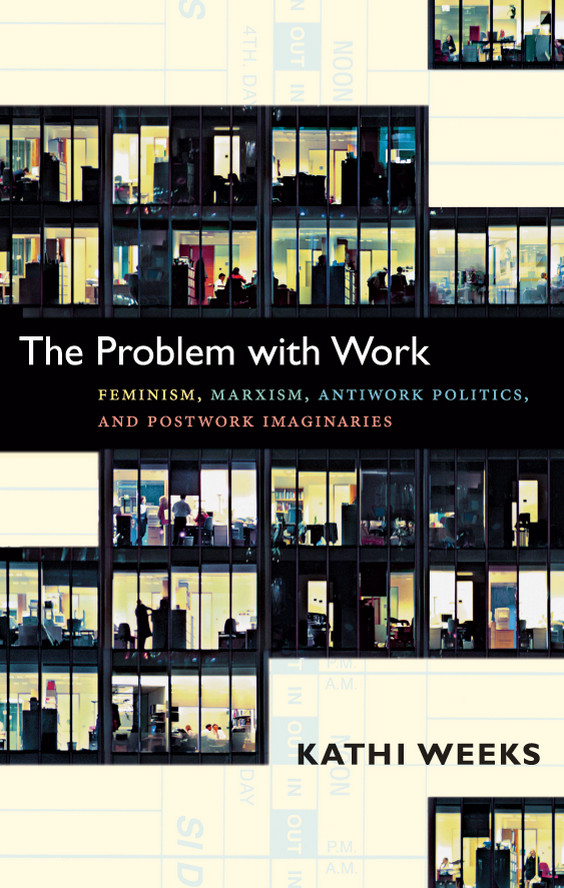
The Problem with Work
Kathi Weeks
Best for: Readers interested in feminist theory, Marxism, and postwork politics.
Difficulty: Advanced
Intellectual role: The strongest critique of work as a moral obligation.
Bookinlight Rating: ★★★★★★
Weeks refuses the sentimental assumption that more employment is always the horizon of justice. Her argument is not laziness dressed up as theory; it is a political challenge to the way paid work organizes citizenship, gender, family, time, and self-respect. By connecting Marxist antiwork traditions with feminist demands around housework and care, she makes the work ethic itself available for critique. The book is indispensable for readers who suspect that better jobs alone cannot answer the deeper problem.
Critical Reception
“Imaginative and insightful ideas in a clear and thoroughly argued format.“
Bookinlight Note: Pair Weeks with Arendt to ask whether freedom requires less labor, better work, or a larger public world beyond both.
The Craftsman
Richard Sennett
Best for: Readers drawn to skill, making, tools, and ethical formation.
Difficulty: Intermediate
Intellectual role: The defense of craft as disciplined freedom.
Bookinlight Rating: ★★★★★★
Sennett’s great contribution is to rescue craftsmanship from nostalgia. For him, craft is not limited to old trades or handmade objects; it names the impulse to do a job well for its own sake. The book moves across workshops, laboratories, music, medicine, and programming to show that skill is both technical and ethical. Its quiet radicalism lies in treating attention, repetition, material resistance, and patience as forms of human development.
Critical Reception
“A powerful meditation on the ‘skill of making things well.’“
Bookinlight Note: Use Sennett for a discussion group on why excellence can be anti-narcissistic: craft asks attention to move outward.
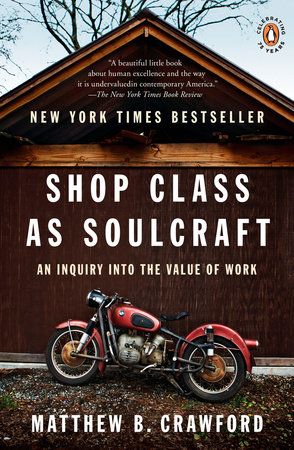
Shop Class as Soulcraft
Matthew B. Crawford
Best for: Readers questioning the prestige of abstract knowledge work.
Difficulty: General to Intermediate
Intellectual role: A modern argument for manual intelligence.
Bookinlight Rating: ★★★★★★
Crawford, a philosopher and mechanic, challenges the assumption that mental labor is inherently superior to skilled manual labor. His strongest passages show how repair work forces contact with reality: the machine either runs or it does not. Against managerial abstraction and credential inflation, he argues for the cognitive dignity of practical competence. The book is most persuasive when read not as a culture-war gesture, but as a phenomenology of attention, responsibility, and material feedback.
Critical Reception
“A deep exploration of craftsmanship by someone with real, hands-on knowledge.“
Bookinlight Note: Pair Crawford with Sennett and ask where craft ends and romanticization of labor begins.
The Managed Heart
Arlie Russell Hochschild
Best for: Readers studying emotional labor, service work, gender, and capitalism.
Difficulty: Intermediate
Intellectual role: The book that makes feeling visible as labor.
Bookinlight Rating: ★★★★★
Hochschild’s classic study changes the meaning of work by showing that service economies do not merely purchase time or bodily effort. They can also purchase smiles, tones of voice, patience, deference, reassurance, and controlled irritation. Her concept of emotional labor remains essential because it explains why some jobs exhaust the self in ways that are not easily measured. This is one of the great books for understanding work after the factory, especially where gender and customer-facing performance intersect.
Bookinlight Note: Read it before any easy discussion of passion at work; Hochschild shows how authenticity can become part of the job description.
Work: A Deep History, from the Stone Age to the Age of Robots
James Suzman
Best for: Readers who want anthropology, deep history, and automation in one argument.
Difficulty: General to Intermediate
Intellectual role: The long historical horizon.
Bookinlight Rating: ★★★★★★
Suzman widens the philosophy of work by asking whether our devotion to labor is truly natural. Moving from hunter-gatherer societies to agriculture, cities, energy systems, and automation, he argues that modern assumptions about scarcity and busyness have a history. The book is valuable because it dislodges the reader from the present. What feels like economic common sense may be a recent arrangement of energy, desire, status, and institutional habit.
Bookinlight Note: This is the best book here for readers who want to make the present seem strange before judging it.
Working
Studs Terkel
Best for: Readers who want workers’ voices before theory speaks over them.
Difficulty: General
Intellectual role: The democratic archive of lived work.
Bookinlight Rating: ★★★★★
Terkel’s oral history is not a theoretical treatise, but it may be the most philosophically necessary book in this list. It lets workers describe boredom, pride, humiliation, skill, fear, fantasy, and survival in their own words. The result is a democratic counterweight to abstraction. After Arendt, Weeks, Sennett, Crawford, Hochschild, and Suzman, Terkel reminds the reader that the meaning of work is never settled in concepts alone; it must be heard in lives.
Bookinlight Note: Begin or end with Terkel depending on your temperament: he either grounds the theory or tests it.
How These Books Speak to One Another
Arendt gives the most severe vocabulary: labor, work, action, world. Weeks politicizes the inherited reverence for paid work and asks whether liberation might require less submission to employment itself. Sennett and Crawford answer from the other side: work can also cultivate intelligence, patience, and pride when it permits real skill. Hochschild complicates craft by showing that the self can become the medium being worked upon. Suzman asks why modern societies imagine labor scarcity and endless busyness as human destiny. Terkel, finally, interrupts every theory with testimony. The result is a balanced reading path: neither work worship nor simple work rejection, but a deeper inquiry into what kinds of labor deserve our lives.
The Reading Map
| Book | Difficulty | Rating | Why It Matters |
|---|---|---|---|
| The Human Condition | Advanced | ★★★★★ | Defines labor, work, and action. |
| The Problem with Work | Advanced | ★★★★★★ | Challenges the work ethic. |
| The Craftsman | Intermediate | ★★★★★★ | Makes skill ethical. |
| Shop Class as Soulcraft | General to Intermediate | ★★★★★★ | Defends manual intelligence. |
| The Managed Heart | Intermediate | ★★★★★ | Names emotional labor. |
| Work | General to Intermediate | ★★★★★★ | Defamiliarizes modern busyness. |
| Working | General | ★★★★★ | Lets workers speak. |
Where to Begin
- Entry point: Start with Studs Terkel if you want living voices before theory.
- Historical background: Read James Suzman to see how unusual modern work culture is.
- Conceptual foundation: Move to Hannah Arendt for the deepest philosophical distinctions.
- Critical perspective: Read Kathi Weeks when you are ready to challenge the work ethic itself.
- Contemporary relevance: Use Hochschild for service work, emotion, gender, and everyday performance.
- Advanced reflection: Pair Sennett and Crawford to think about skill, craft, and dignity.
External Sources for Further Reading
University of Chicago Press: The Human Condition
The Last Margin
The best books on philosophy of work do not tell us simply to love work, escape work, dignify work, or abolish work. Their more demanding lesson is that work is one of the places where societies reveal their theory of the human being. Do we exist to produce, to make, to care, to appear before others, to serve, to master a craft, to survive, or to share a world? No single book can answer that question. But these seven books make the question harder to avoid, and much harder to answer cheaply.