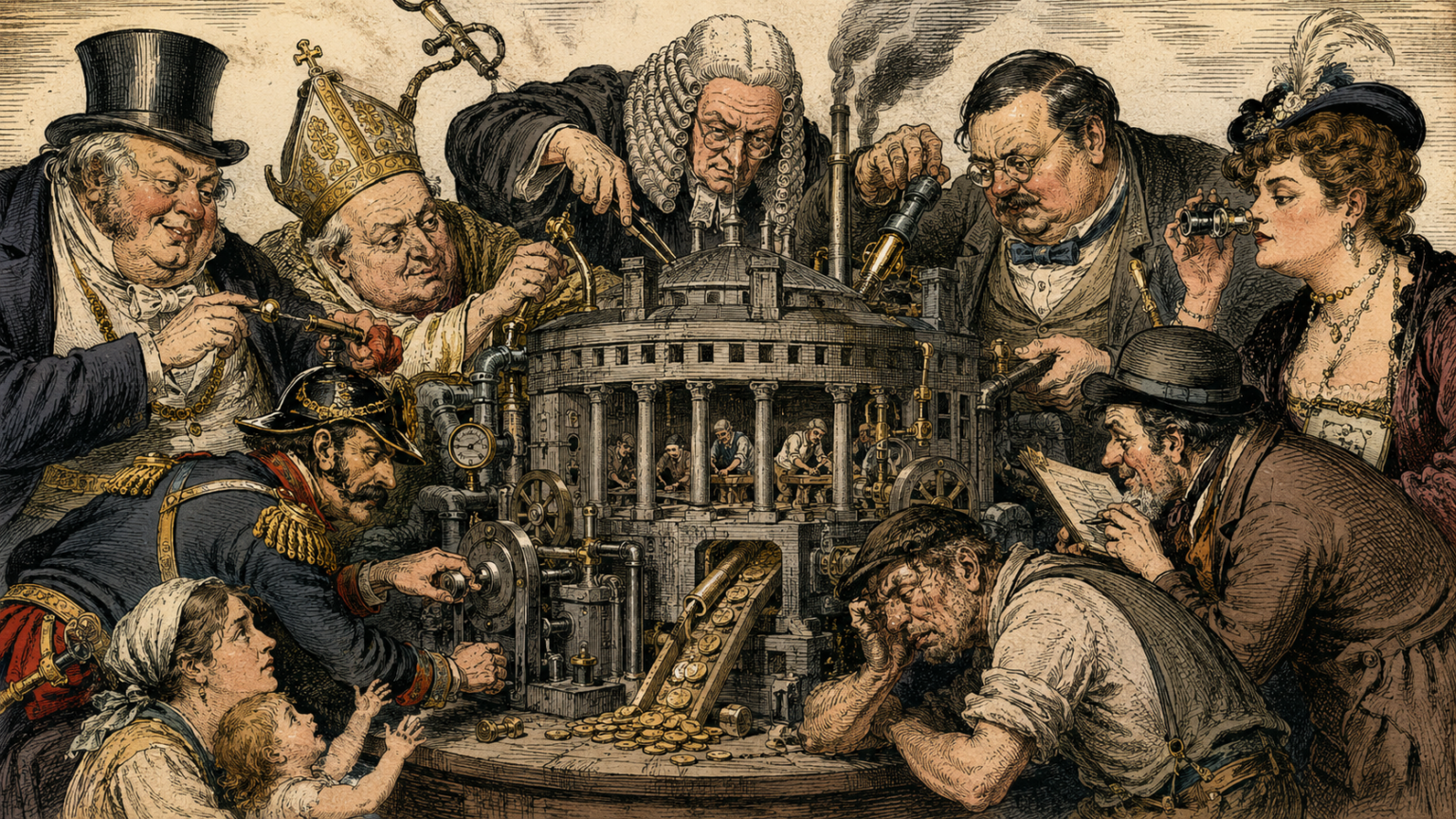
Illustration by Bookinlight Art Desk
Political Theory
Five Books on Leo Strauss and Classical Political Philosophy
A demanding guide to the books that show why Strauss’s return to Plato, Aristotle, Xenophon, and Socrates was never antiquarian nostalgia, but a challenge to modern political thought itself.
By Bookinlight
What is Political Philosophy?
Leo Strauss
Not the original published cover
Natural Right and History
Leo Strauss
Not the original published cover
The City and Man
Leo Strauss
Not the original published cover
Persecution and the Art of Writing
Leo Strauss
Not the original published cover
Leo Strauss and the Problem of Political Philosophy
Michael P. Zuckert and Catherine H. Zuckert
Not the original published cover
Why Strauss Still Sends Readers Back to the Ancients
The best books on Leo Strauss are difficult for a reason: they do not simply explain a thinker, they reopen a quarrel about the dignity of political philosophy. Strauss’s central provocation was that classical political philosophy had not been refuted by modern science, historicism, liberal progress, or social-scientific neutrality. It had been displaced, often without being understood. To read Strauss well is therefore to ask whether Plato, Aristotle, Xenophon, and the medieval philosophers still speak to the permanent problems of justice, law, nobility, prudence, and the philosophic life. The five books below are not a complete Strauss library; they are a disciplined path into the question that made his work so unsettling.
Best Books on Leo Strauss and Classical Political Philosophy
The sequence matters. Strauss should not be entered through polemic about influence, secret doctrine, or American conservatism. He is better approached through his own question: what happens to political philosophy when the search for the good life is replaced by historical explanation, scientific method, or ideological certainty? These books move from definition to natural right, from ancient texts to esoteric writing, and finally to a synoptic scholarly account of Strauss’s whole project. Together, they show a thinker less interested in nostalgia than in recovering the tension between philosophy and the city.
The Reading Lens
Strauss as a Reader of the Political Soul
Strauss’s recovery of classical political philosophy is not simply a return to old doctrines. It is a recovery of a mode of reading in which the city, the law, the philosopher, and the citizen are placed in a tense relation. The ancient question is not only “What is justice?” but also “What kind of speech can justice, philosophy, and civic order survive?” These books matter because they train the reader to see political thought as a drama of prudence, danger, education, and truth.
Central Question
Can political philosophy still ask about the good society without being reduced to history, ideology, or technique?
Historical Pressure
Strauss wrote under the shadow of historicism, positivism, modern tyranny, and the collapse of confidence in natural right.
Why These Books
They combine Strauss’s clearest statements, his deepest ancient readings, his hermeneutic method, and one major interpretive guide.
Five Essential Books
What is Political Philosophy?
Leo Strauss
Not the original published cover
What is Political Philosophy? And Other Studies
Leo Strauss
Best for: Readers who want Strauss’s clearest programmatic statement before entering the harder books.
Difficulty: General to Intermediate
Intellectual role: The gateway text for understanding what Strauss means by political philosophy.
Bookinlight Rating: ★★★★★
This collection matters because it states the problem before it dramatizes it. The title essay defines political philosophy as the search for knowledge of the good life and the good society, a search close to ordinary political life yet never identical with opinion. The volume also includes essays on classical political philosophy, Farabi, Maimonides, Hobbes, Locke, and forgotten modes of writing. It is the best first step because Strauss here becomes less mysterious: his concern is not merely ancient texts, but the conditions under which political reason can survive modern skepticism.
Critical Reception
“contains some of Leo Strauss’s most famous writings and some of his most explicit statements“
Bookinlight Note: Read the title essay with the question “What kind of knowledge does political life need but cannot easily produce by itself?”
Natural Right and History
Leo Strauss
Not the original published cover
Natural Right and History
Leo Strauss
Best for: Readers interested in natural right, historicism, and the crisis of modern political thought.
Difficulty: Advanced
Intellectual role: The central philosophical confrontation between classical natural right and modern relativism.
Bookinlight Rating: ★★★★★
This is Strauss’s most famous book because it identifies the deepest modern pressure against classical political philosophy: the belief that all standards of right are historically conditioned. Strauss’s argument does not merely defend “natural law” as a doctrine. It reconstructs a lost problem: whether the distinction between right and wrong in politics can have a rational foundation beyond convention and history. His chapters on classic natural right, Hobbes, Locke, Rousseau, and Burke make the book a compressed history of Western political rationality. It is not easy, but it remains the indispensable text for anyone trying to understand why Strauss thought modern political philosophy had become unsure of its own ground.
Critical Reception
“brings to his task an admirable scholarship and a brilliant, incisive mind“
Bookinlight Note: Pair it with Aristotle’s Nicomachean Ethics and Hobbes’s Leviathan to feel the full weight of Strauss’s ancient-modern contrast.
The City and Man
Leo Strauss
Not the original published cover
The City and Man
Leo Strauss
Best for: Readers ready to watch Strauss interpret Aristotle, Plato, and Thucydides directly.
Difficulty: Advanced
Intellectual role: The most compact demonstration of Strauss’s classical reading practice.
Bookinlight Rating: ★★★★★★
If Natural Right and History sets the crisis, The City and Man shows Strauss at work inside the classical texts themselves. The book’s essays on Aristotle’s Politics, Plato’s Republic, and Thucydides’ history form a deliberately strange constellation: law, philosophic rule, war, prudence, and the limits of civic greatness. Strauss does not read the ancients as museum pieces. He reads them as thinkers who knew that political life contains genuine nobility, yet cannot abolish opinion, conflict, necessity, or the tension between the philosopher and the city. This is the book where the classical return becomes concrete.
Critical Reception
“a brilliant attempt to use classical political philosophy as a means of liberating modern political philosophy“
Bookinlight Note: Read the Thucydides essay last, because it reveals why political philosophy must understand history without surrendering to historicism.
Persecution and the Art of Writing
Leo Strauss
Not the original published cover
Persecution and the Art of Writing
Leo Strauss
Best for: Readers interested in esoteric writing, censorship, prudence, and philosophical rhetoric.
Difficulty: Intermediate
Intellectual role: The methodological key to Strauss’s way of reading dangerous books.
Bookinlight Rating: ★★★★★★
This book is often caricatured as a manual for finding hidden meanings everywhere. It is better understood as a sober reflection on the political vulnerability of philosophy. Strauss argues that philosophers writing under conditions of persecution often developed forms of double writing: one surface intelligible and acceptable to the city, another more radical and available to careful readers. Whether one accepts the full range of Strauss’s claims or not, this book changes how one reads premodern political texts. It makes style, omission, irony, contradiction, and audience into philosophical evidence.
Critical Reception
“all deal with one problem—the relation between philosophy and politics“
Bookinlight Note: Use this book as a discipline, not a license: the strongest Straussian reading is patient, textual, and falsifiable by detail.
Leo Strauss and the Problem of Political Philosophy
Michael P. Zuckert and Catherine H. Zuckert
Not the original published cover
Leo Strauss and the Problem of Political Philosophy
Michael P. Zuckert and Catherine H. Zuckert
Best for: Readers who want a comprehensive scholarly map after reading Strauss himself.
Difficulty: Intermediate
Intellectual role: The major secondary guide to Strauss’s whole intellectual career.
Bookinlight Rating: ★★★★★★
The Zuckerts’ book is valuable because it refuses both hagiography and journalistic reduction. It follows Strauss through positivism, historicism, Plato, Aristotle, Machiavelli, Locke, Heidegger, Nietzsche, and the problem of education. Its central advantage is architecture: it treats “the problem of political philosophy” as the thread joining Strauss’s ancient and modern readings. For readers who find Strauss dazzling but fragmentary, this book supplies a map without removing the difficulty. It is especially useful after reading two or three primary texts, when the deeper pattern of Strauss’s questions begins to emerge.
Bookinlight Note: Treat this as the companion volume for rereading Strauss, not as a substitute for the primary books.
How These Books Speak to One Another
These five books form an argument in stages. What is Political Philosophy? defines the vocation: political philosophy seeks knowledge of the good society. Natural Right and History explains why that vocation became precarious under historicism and value-neutral social science. The City and Man returns the reader to the classical works themselves, where politics appears as a field of noble aspiration, danger, opinion, and partial wisdom. Persecution and the Art of Writing then asks how philosophy speaks when the city is suspicious of philosophy. The Zuckerts’ study gathers these threads into a broad account of Strauss’s career. Together they make Strauss visible as a thinker of philosophical recovery rather than political slogan.
The Reading Map
| Book | Difficulty | Rating | Why It Matters |
|---|---|---|---|
| What is Political Philosophy? | General to Intermediate | ★★★★★ | Defines the question. |
| Natural Right and History | Advanced | ★★★★★ | Confronts historicism. |
| The City and Man | Advanced | ★★★★★★ | Reads the ancients. |
| Persecution and the Art of Writing | Intermediate | ★★★★★★ | Explains hidden writing. |
| Leo Strauss and the Problem of Political Philosophy | Intermediate | ★★★★★★ | Maps the whole project. |
Where to Begin
- Entry point: Begin with What is Political Philosophy? And Other Studies, especially the title essay.
- Historical background: Move to Natural Right and History for Strauss’s critique of historicism and modern natural right.
- Conceptual foundation: Read The City and Man with Plato’s Republic nearby.
- Critical perspective: Use Persecution and the Art of Writing to understand Strauss’s hermeneutic assumptions.
- Contemporary relevance: Read Leo Strauss and the Problem of Political Philosophy to separate Strauss’s philosophy from public myth.
- Advanced reflection: Return to the ancients themselves and ask whether Strauss has changed how you read them.
External Sources for Further Reading
What is Political Philosophy? And Other Studies at University of Chicago Press
Natural Right and History at University of Chicago Press
The City and Man at University of Chicago Press
Persecution and the Art of Writing at University of Chicago Press
Leo Strauss and the Problem of Political Philosophy at University of Chicago Press
The Last Margin
The enduring value of the best books on Leo Strauss is that they restore seriousness to the act of reading political philosophy. They remind us that the classical texts are not primitive versions of modern theory, and that modern theory is not automatically wiser because it comes later. Strauss remains difficult because he asks readers to inhabit an older possibility: that politics is inseparable from opinion, yet not closed to truth; that philosophy needs the city, yet cannot simply serve it; and that the question of the good life may still be the most radical question political thought can ask.