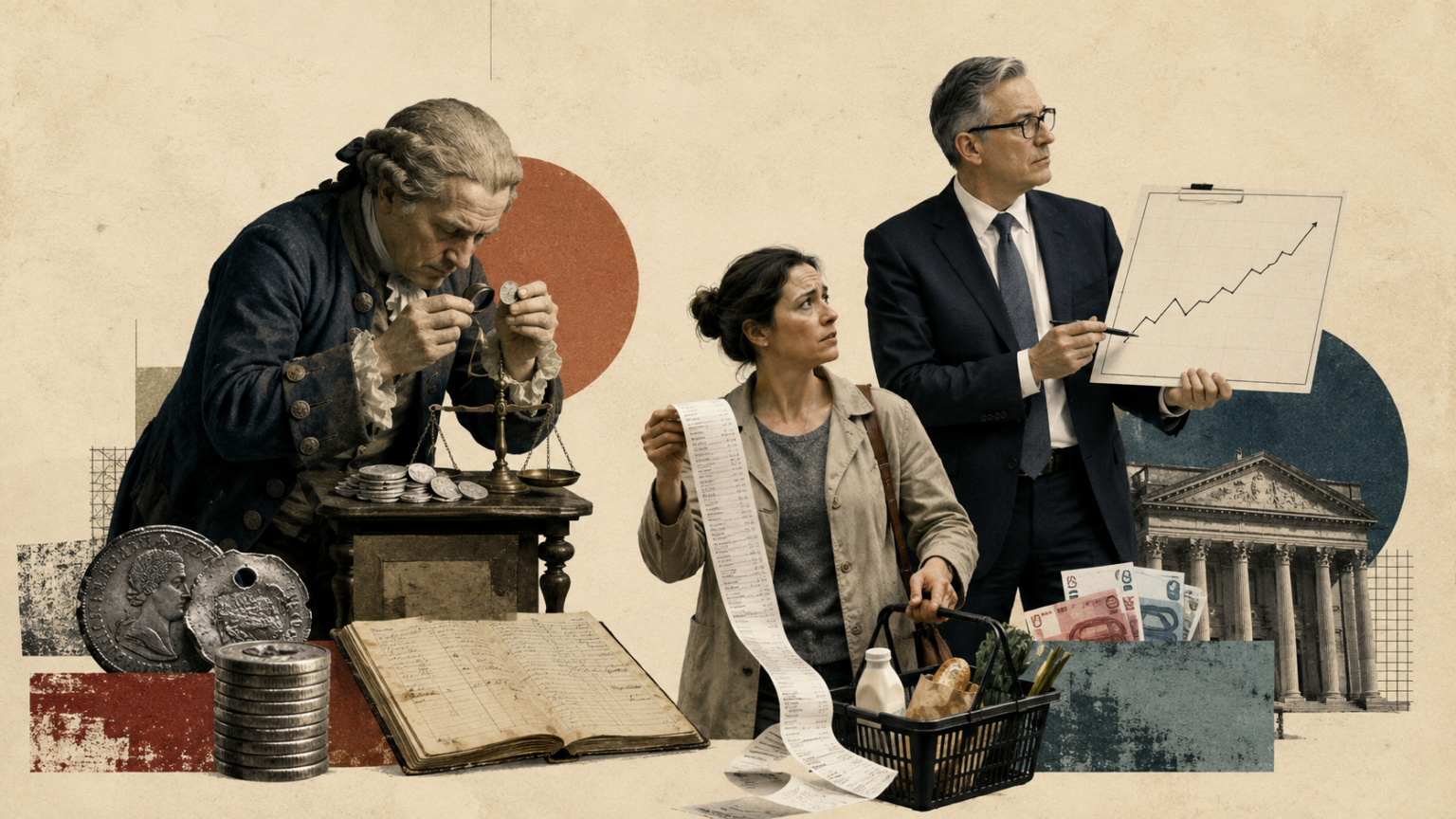
Illustration by Bookinlight Art Desk
Economic History
Five Books on the Economic History of Inflation
Inflation is never only a rise in prices. These books show it as a long historical drama of money, debt, state power, social conflict, and public memory.
By Bookinlight
The Great Wave
David Hackett Fischer
Not the original published cover

A Monetary History of the United States, 1867–1960
Milton Friedman and Anna J. Schwartz
Not the original published cover

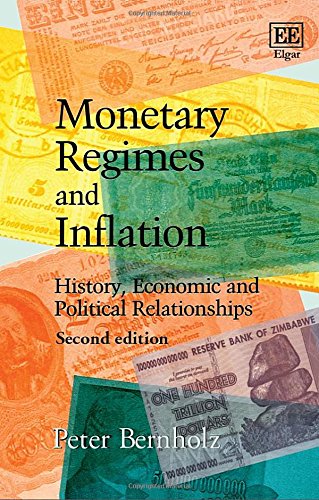
Monetary Regimes and Inflation
Peter Bernholz
Not the original published cover
The Great Inflation and Its Aftermath
Robert J. Samuelson
Not the original published cover
This Time Is Different
Carmen M. Reinhart and Kenneth S. Rogoff
Not the original published cover

Inflation as a Historical Force
For readers searching for books on inflation history, the deepest question is not simply why prices rise. It is why societies repeatedly discover, too late, that money is a political institution as much as an economic instrument. Inflation alters contracts, savings, wages, public trust, class relations, and the authority of the state. It can appear as monetary mismanagement, wartime finance, debt liquidation, speculative overconfidence, institutional weakness, or social bargaining under pressure.
The five books gathered here belong together because they refuse to treat inflation as a narrow technical problem. Each widens the frame: from medieval price revolutions to American monetary policy, from monetary regimes to the 1970s, from national episodes to eight centuries of financial folly. Together, they form a serious reading path through the economic history of inflation.
Why Books on Inflation History Still Matter
Inflation is often discussed in the language of central-bank targets, interest rates, and consumer-price indexes. That language is necessary, but it can conceal the older drama. Long before modern central banking, rulers debased coinage, wars broke fiscal systems, harvest shocks moved grain prices, and creditors and debtors fought over the meaning of money. Modern inflation did not abolish these conflicts; it reorganized them through paper money, bond markets, democratic politics, and global finance.
The best books on inflation history therefore teach a double discipline. They show the reader how to read prices as data, but also how to read them as historical evidence: signs of institutional design, fiscal strain, political credibility, social distribution, and collective expectation.
The Reading Lens
Prices Remember What Politics Tries to Forget
These books are best read as a history of monetary memory. Inflation repeatedly appears when political systems promise more than their fiscal, productive, or institutional foundations can sustain. Yet its meaning changes across regimes: metallic money, gold standards, central banks, fiat currency, sovereign debt, and global capital all create different forms of fragility. The common thread is credibility. Once money becomes a site where governments, markets, and households test one another’s expectations, inflation becomes a record of political trust under stress.
Central Question
What does inflation reveal about the promises a society makes and the institutions it trusts to keep them?
Historical Pressure
Wars, debts, welfare expectations, financial innovation, and political delay repeatedly convert monetary systems into pressure chambers.
Why These Books
They move from long-run price history to monetary institutions, political economy, and modern crisis memory.
Five Essential Books
The Great Wave
David Hackett Fischer
Not the original published cover
The Great Wave: Price Revolutions and the Rhythm of History
David Hackett Fischer
Best for: Readers who want the longue durée of price movements.
Difficulty: Intermediate
Intellectual role: The broad historical canvas.
Bookinlight Rating: ★★★★★
Fischer’s great achievement is to make prices historically legible. Instead of treating inflation as a modern statistical category, he follows waves of price revolution across Western history and links them to wages, inequality, social disorder, political upheaval, and cultural mood. The book is especially valuable because it resists a single-cause explanation. Population pressure, monetary conditions, war, production, and institutional disorder all enter the story. For humanities readers, it is a reminder that economic history can be a history of fear, time, and social imagination.
Bookinlight Note: Read this book beside a timeline of wars, harvest crises, and constitutional change; the pattern of prices becomes a map of pressure beneath political events.
A Monetary History of the United States, 1867–1960
Milton Friedman and Anna J. Schwartz
Not the original published cover
A Monetary History of the United States, 1867–1960
Milton Friedman and Anna J. Schwartz
Best for: Readers ready for the classic monetarist interpretation.
Difficulty: Advanced
Intellectual role: The institutional and statistical foundation.
Bookinlight Rating: ★★★★★
This is not merely a book about inflation; it is a book about how monetary institutions make history. Friedman and Schwartz trace nearly a century of American monetary development, giving special attention to banking crises, gold, silver politics, Federal Reserve behavior, wartime inflation, and the Great Contraction. Its central legacy is the claim that money supply matters profoundly for economic fluctuations. Even readers skeptical of strict monetarism should read it, because the book established a way of arguing historically with monetary data.
Bookinlight Note: The most productive way to read it today is not as doctrine, but as a model of how economic theory can be tested against a long institutional record.
Monetary Regimes and Inflation
Peter Bernholz
Not the original published cover
Monetary Regimes and Inflation: History, Economic and Political Relationships
Peter Bernholz
Best for: Readers interested in regimes, hyperinflation, and public choice.
Difficulty: Advanced
Intellectual role: The comparative regime analysis.
Bookinlight Rating: ★★★★★★
Bernholz is invaluable because he places inflation inside the design of monetary regimes. His central interest is not only whether money grows too fast, but why particular political systems and fiscal structures produce pressures toward money creation. The book compares historical cases from Roman times onward and pays special attention to hyperinflation, budget deficits, fiat money, metallic currencies, and the institutional possibility of stable regimes. It is a demanding but rewarding book for readers who want inflation treated as a political-economic structure.
Bookinlight Note: Pair this with contemporary debates about central-bank independence; Bernholz helps explain why credibility is built politically before it is defended technically.
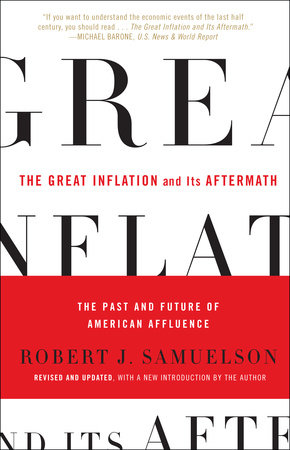
The Great Inflation and Its Aftermath
Robert J. Samuelson
Not the original published cover
The Great Inflation and Its Aftermath: The Past and Future of American Affluence
Robert J. Samuelson
Best for: Readers seeking a political history of the 1970s inflation crisis.
Difficulty: General to Intermediate
Intellectual role: The modern American case study.
Bookinlight Rating: ★★★★★
Samuelson’s book is strongest when read as political history rather than technical macroeconomics. He presents the Great Inflation of the 1960s and 1970s as an event that transformed expectations about American competence, government promise-making, living standards, and presidential politics. The book also follows the paradox of success: the defeat of high inflation helped produce a long period of confidence, and that confidence later fed financial overreach. Its central virtue is narrative clarity.
Critical Reception
“Samuelson’s clear-eyed focus on the rise and fall of inflation remains relevant today.“
Bookinlight Note: Use this book to ask how an economic disorder becomes a moral story about discipline, promise, patience, and national decline.
This Time Is Different
Carmen M. Reinhart and Kenneth S. Rogoff
Not the original published cover
This Time Is Different: Eight Centuries of Financial Folly
Carmen M. Reinhart and Kenneth S. Rogoff
Best for: Readers who want inflation inside the larger history of crisis.
Difficulty: Intermediate
Intellectual role: The global crisis archive.
Bookinlight Rating: ★★★★★
Reinhart and Rogoff do not write a book only about inflation, but inflation is central to their account of how states and markets misremember risk. Their archive of crises covers sovereign defaults, banking panics, currency crashes, debt cycles, debasement, and high inflation. The book’s famous warning is that crisis actors regularly imagine themselves outside history. For the economic history of inflation, its value lies in showing how inflation often functions as a debt event, a credibility event, and a political-memory failure.
Bookinlight Note: A useful seminar question: when a government inflates away debt, is it avoiding default, disguising default, or changing the moral language of default?
How These Books Speak to One Another
The sequence matters. Fischer begins with price revolutions as civilizational rhythms; Friedman and Schwartz narrow the lens to monetary institutions and policy in the United States; Bernholz asks why some regimes are structurally more vulnerable to inflation; Samuelson turns inflation into a political and cultural history of late twentieth-century America; Reinhart and Rogoff place inflation among the recurrent tools and symptoms of financial crisis.
Together they show that inflation is neither purely exogenous shock nor purely policy error. It is a historical outcome produced where fiscal need, monetary authority, political legitimacy, creditor-debtor conflict, and public expectation meet. That is why the economic history of inflation belongs not only to economics, but also to political history, sociology, and the history of ideas.
The Reading Map
| Book | Difficulty | Rating | Why It Matters |
|---|---|---|---|
| The Great Wave | Intermediate | ★★★★★ | Makes prices a civilizational archive. |
| A Monetary History of the United States, 1867–1960 | Advanced | ★★★★★ | Defines monetary history as institutional evidence. |
| Monetary Regimes and Inflation | Advanced | ★★★★★★ | Connects inflation to regime design. |
| The Great Inflation and Its Aftermath | General to Intermediate | ★★★★★ | Shows inflation as political memory. |
| This Time Is Different | Intermediate | ★★★★★ | Places inflation within crisis recurrence. |
Where to Begin
- Entry point: Begin with Samuelson for a clear narrative of modern inflation as politics, policy, and public experience.
- Historical background: Move to Fischer for the deeper rhythm of price revolutions before modern central banking.
- Conceptual foundation: Read Friedman and Schwartz to understand how monetary history became an explanatory discipline.
- Critical perspective: Add Bernholz to see why regimes, deficits, and institutions matter as much as policy tools.
- Contemporary relevance: Use Reinhart and Rogoff to connect inflation with debt, crisis, and the recurring illusion of exception.
- Advanced reflection: Return to Fischer and ask whether inflation is better understood as a cycle, a failure, or a warning signal.
External Sources for Further Reading
NBER page for A Monetary History of the United States, 1867–1960
Oxford University Press page for The Great Wave
Edward Elgar page for Monetary Regimes and Inflation
Penguin Random House page for The Great Inflation and Its Aftermath
The Last Margin
The most important lesson in these books on inflation history is that prices are never mute. They speak in wages, rents, savings, debts, elections, defaults, and ordinary anxieties. Inflation is felt at the cash register, but it is made in deeper structures: fiscal promises, monetary authority, creditor-debtor relations, institutional credibility, and the stories governments tell about what can be afforded.
To read the economic history of inflation seriously is therefore to read the history of trust. Each of these books shows a different moment when that trust was stretched, weakened, defended, or rebuilt. Their shared warning is quiet but severe: societies that forget the history of money often rediscover it through crisis.