Illustration by Bookinlight Art Desk
International Law & Human Rights
Five Books on the Geneva Conventions
A serious reading path through the law that tries to keep war from becoming pure permission: wounded soldiers, prisoners, civilians, occupied territories, non-state conflict, and the fragile authority of humanitarian restraint.
By Bookinlight



The Law That Begins After Catastrophe
Five books on the Geneva Conventions are never merely books about treaties. They are books about the strange ambition to place grammar around suffering: who counts as wounded, who counts as captured, who remains civilian, what occupation permits, what no commander may authorize, and why even the enemy must not be reduced to raw material. The Geneva Conventions matter because they refuse one of war’s most dangerous fantasies: that violence dissolves obligation. These five books belong together because they move from historical formation to doctrinal interpretation, from interpretation to practice, and from practice to crisis. They show the Conventions not as a static monument but as a living legal architecture constantly tested by detention, terrorism, asymmetrical war, urban siege, and political contempt.
Why the Geneva Conventions Still Need Readers
The modern reader often encounters the Geneva Conventions through scandal: torture, mistreatment of prisoners, attacks on hospitals, starvation, deportation, collective punishment, or the deliberate weakening of civilian distinction. Yet the deeper question is not simply whether the law was violated. It is how a legal tradition built from Solferino, Hague restraint, Red Cross practice, and post-1945 reconstruction continues to distinguish military necessity from mere cruelty. A serious reading path must therefore include historical introductions, practical handbooks, doctrinal commentaries, and critical essays. Together, these works explain why humanitarian law is neither pacifism nor permission. It accepts that war occurs, then imposes limits on conduct so that victory does not become a license to annihilate the vulnerable.
The Reading Lens
Humanity as a Legal Form Under Pressure
The Geneva Conventions are best read not as moral consolation but as institutional imagination. They convert battlefield vulnerability into legal categories: wounded, shipwrecked, prisoner, civilian, occupied person, protected person. The books below show how difficult that conversion remains. Each asks, in a different register, whether law can keep its authority when armed conflict becomes fragmented, technological, urban, ideological, or deliberately lawless.
Central Question
Can legal protection survive when war tries to turn human status into tactical inconvenience?
Historical Pressure
The pressure comes from the shift from inter-state war to mixed conflicts, detention systems, counter-terror operations, occupation, and remote violence.
Why These Books
They combine authoritative commentary, practical doctrine, historical grounding, and political critique of humanitarian law under assault.
Five Books for Reading the Geneva Conventions Seriously
The 1949 Geneva Conventions: A Commentary
Andrew Clapham, Paola Gaeta, and Marco Sassòli, editors
Best for: Readers who want the most substantial modern gateway into the treaty architecture.
Difficulty: Advanced
Intellectual role: The doctrinal anchor of the reading list.
Bookinlight Rating: ★★★★★
This commentary is the obvious first monument in the field because it treats the four 1949 Conventions as legal texts whose meanings have been altered by practice, litigation, human rights law, international criminal law, and the blurred boundary between international and non-international armed conflict. Its value lies in scale and method: it does not merely summarize the provisions, but asks how they operate when the categories of 1949 meet new conflicts, new actors, and new forms of detention.
Critical Reception
“The first commentary in over fifty years on the four 1949 Geneva Conventions.“
Bookinlight Note: Read this book slowly, article by article, as a map of how humanitarian law becomes jurisprudence rather than memory.
The Geneva Conventions Under Assault
Sarah Perrigo and Jim Whitman, editors
Best for: Readers interested in Guantanamo, torture debates, counter-terrorism, and the politics of derogation.
Difficulty: Intermediate
Intellectual role: The crisis diagnosis.
Bookinlight Rating: ★★★★★★
This collection matters because it refuses to let the Geneva Conventions be treated as ceremonial language. Its essays focus on the pressure placed on humanitarian law after the rise of the “war on terror,” especially the temptation to describe new enemies as outside inherited legal categories. The book’s central force is political rather than merely doctrinal: it asks what happens when powerful states normalize exception, and whether exceptionalism corrodes the whole legal culture that makes humanitarian restraint plausible.
Critical Reception
“Few international instruments are more necessary today than the Geneva Conventions.“
Bookinlight Note: Pair this with the 1949 commentary to see the gap between legal architecture and political evasion.
The Oxford Guide to International Humanitarian Law
Ben Saul and Dapo Akande, editors
Best for: Readers who want a structured, contemporary overview before moving into specialized commentaries.
Difficulty: General to Intermediate
Intellectual role: The field guide.
Bookinlight Rating: ★★★★★★
This guide is valuable because it situates the Geneva Conventions inside the broader field of international humanitarian law: sources, classification of armed conflicts, conduct of hostilities, weapons, detention, and protected persons. It is especially useful for readers who want to understand why the Conventions cannot be isolated from customary law, human rights law, and debates over terrorism or new technologies. Its strength is synthesis: it offers enough doctrine to orient the reader without burying the argument under commentary detail.
Critical Reception
“An authoritative and practical overview of this important area of law.“
Bookinlight Note: Use it as a bridge between moral concern and legal taxonomy: who is protected, when, and under which body of rules?
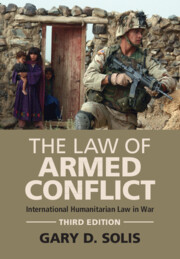
The Law of Armed Conflict: International Humanitarian Law in War
Gary D. Solis
Best for: Readers who want doctrine connected to military practice, rules of engagement, targeting, and command responsibility.
Difficulty: Intermediate
Intellectual role: The practitioner-facing legal manual.
Bookinlight Rating: ★★★★★★
Solis writes with the discipline of someone attentive to how law is used by soldiers, commanders, lawyers, and courts. The Geneva Conventions appear here as part of the broader operational law of armed conflict. That orientation is crucial: humanitarian law does not live only in tribunals after atrocities; it must shape decisions before and during operations. The book is particularly useful for understanding targeting, combatant status, detention, war crimes, cyber warfare, terrorism, and the difficult relation between legal norm and battlefield judgment.
Critical Reception
“Provides an accessible introduction to the basics of international humanitarian law.“
Bookinlight Note: Read Solis when you want to know how a legal rule becomes a decision under pressure.
Constraints on the Waging of War
Frits Kalshoven and Liesbeth Zegveld
Best for: Readers who want historical foundations and the relation between Geneva law, Hague law, and enforcement.
Difficulty: General to Intermediate
Intellectual role: The historical and conceptual foundation.
Bookinlight Rating: ★★★★★★
This compact classic is indispensable because it places the Geneva Conventions inside the longer history of restraining warfare. Kalshoven and Zegveld show how humanitarian law emerged from both the protection of war victims and the regulation of means and methods of warfare. Its clarity makes it unusually powerful: the book reminds us that jus in bello does not justify war. It sets limits once war exists, and those limits are meant to preserve a minimum of human dignity when political order has already failed.
Critical Reception
“Considers the development of the principal rules of international humanitarian law.“
Bookinlight Note: This is the best book for seeing why restraint in war is not weakness but civilization’s emergency grammar.
How These Books Speak to One Another
The sequence matters. Kalshoven and Zegveld explain why war needed legal constraint at all. Saul and Akande map the field in its contemporary breadth. Solis brings law closer to operational judgment. Clapham, Gaeta, and Sassòli give the reader the deep structure of the 1949 treaty system. Perrigo and Whitman then ask what happens when that system is attacked politically, rhetorically, and practically. Together, these books show that the Geneva Conventions are not self-enforcing moral artifacts. They depend on interpretation, training, institutional memory, public pressure, and legal courage.
The Reading Map
| Book | Author | Difficulty | Rating | Why It Matters |
|---|---|---|---|---|
| The 1949 Geneva Conventions: A Commentary | Clapham, Gaeta, Sassòli | Advanced | ★★★★★ | The most detailed modern interpretive anchor. |
| The Geneva Conventions Under Assault | Perrigo, Whitman | Intermediate | ★★★★★★ | Shows the politics of undermining restraint. |
| The Oxford Guide to International Humanitarian Law | Saul, Akande | General to Intermediate | ★★★★★★ | Connects the Conventions to the wider field. |
| The Law of Armed Conflict: International Humanitarian Law in War | Solis | Intermediate | ★★★★★★ | Shows doctrine in operational context. |
| Constraints on the Waging of War | Kalshoven, Zegveld | General to Intermediate | ★★★★★★ | Explains the historical logic of restraint. |
Where to Begin
- Entry point: Begin with Kalshoven and Zegveld to see why constraint became a legal project.
- Historical background: Use the same book to connect Geneva law with the wider Hague tradition.
- Conceptual foundation: Move to the Oxford Guide to understand sources, protected persons, and conflict classification.
- Critical perspective: Read Perrigo and Whitman to see how political exception threatens the Geneva tradition.
- Contemporary relevance: Read Solis for operational questions: targeting, detention, rules of engagement, and war crimes.
- Advanced reflection: End with the Clapham, Gaeta, and Sassòli commentary as the major interpretive reference.
External Sources for Further Reading
ICRC: The Geneva Conventions and their Commentaries
The Last Margin
The best books on the Geneva Conventions leave the reader with a demanding kind of sobriety. They do not promise that law will humanize war by itself. They show that legal categories must be interpreted, taught, defended, and applied before the moment of cruelty becomes irreversible. The Geneva Conventions survive only when institutions, soldiers, judges, scholars, humanitarian workers, and citizens treat them not as pious relics but as active restraints on power. Their deepest lesson is austere: even in war, the human being must remain legally visible.