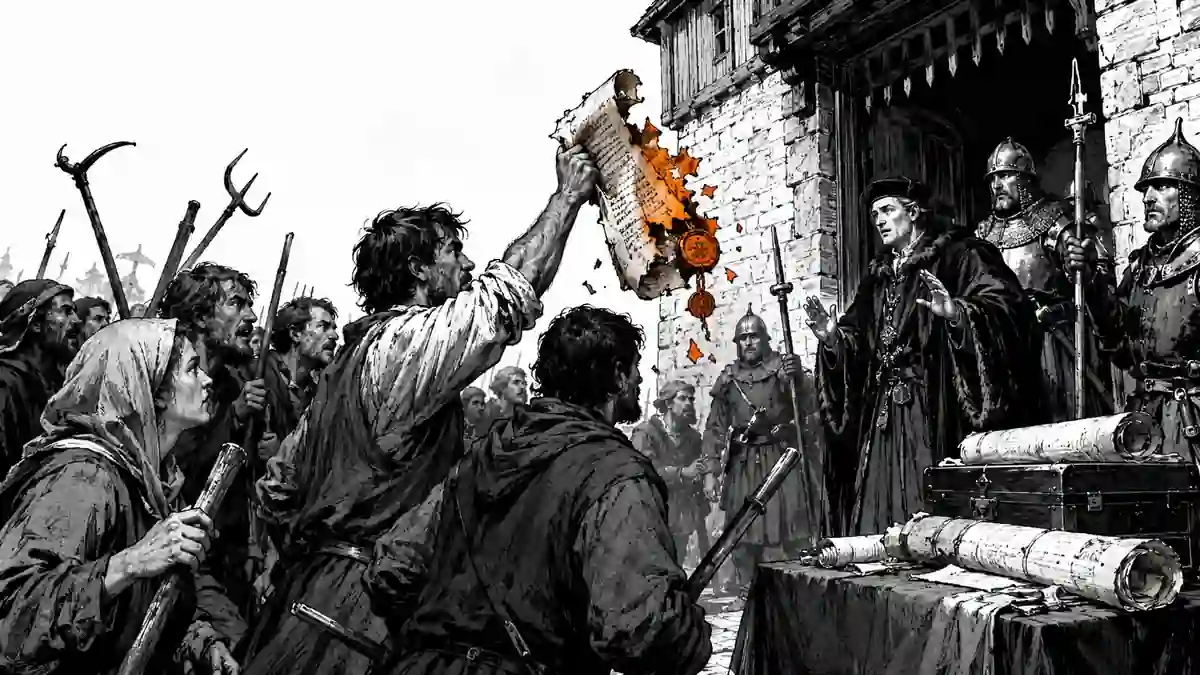
Illustration by Bookinlight Art Desk
Curated by Bookinlight
For readers looking for books on the Peasants’ Revolt, the difficulty is not scarcity but orientation. The uprising of 1381 can appear as a tax riot, a labor revolt, a crisis of lordship, a political theology of the commons, a war over written records, or a violent rehearsal of later popular revolution. The best books do not flatten those possibilities. They show why the revolt was both local and national, practical and ideological, disciplined and explosive.
This reading packet moves from documents to class structure, from literate rebellion to political narrative, and finally to the social world that made the revolt intelligible. Together, these five works make 1381 less like a medieval anomaly and more like a concentrated argument about power: who owns labor, who speaks for the realm, who writes the record, and what happens when ordinary people decide that obedience has become politically irrational.
The Reading Lens
Why books on the Peasants’ Revolt should be read together
The 1381 rising cannot be understood through one explanatory key. Poll taxes mattered, but so did post-plague labor markets, villeinage, local courts, clerical authority, royal legitimacy, written archives, and the political imagination of “the true commons.” These books belong together because each one changes the scale of inquiry: the archive, the village, the statute, the sermon, the crowd, the courtroom, and the kingdom.
Central Question
Was 1381 a failed revolt, a political manifesto, or a social rupture whose effects outlived defeat?
Historical Pressure
Black Death labor scarcity, coercive wage law, fiscal crisis, war taxation, and legal dependence.
Why These Books
They balance primary evidence, social history, literary culture, and narrative reconstruction.
The Reading Map
| Book | Difficulty | Rating | Why It Matters |
|---|---|---|---|
| The Peasants’ Revolt of 1381 | Advanced | ★★★ ★★ | The documentary foundation. |
| Bond Men Made Free | Intermediate | ★★★ ★½ | Places revolt inside class conflict. |
| Writing and Rebellion | Advanced | ★★★ ★★ | Recasts 1381 as literate politics. |
| The Great Rising of 1381 | General to Intermediate | ★★★ ★ | A clear political synthesis. |
| 1381 | General to Intermediate | ★★★ ★½ | Restores ordinary lives to the event. |
The Peasants’ Revolt of 1381
R. B. Dobson
Best for: Readers who want the evidentiary base before interpretation.
Difficulty: Advanced
Intellectual role: Documentary foundation and historiographical anchor.
Bookinlight Rating: ★★★★★
Dobson’s collection remains indispensable because it refuses to let the Peasants’ Revolt become a free-floating legend. Its value lies in the pressure it places on readers to face the texture of evidence: indictments, chronicles, royal responses, legal proceedings, local disturbances, and the language by which authority described those it later punished. The book is not a smooth narrative. It is closer to a working archive, and that is precisely why it belongs at the beginning of any serious reading sequence on 1381. It teaches the reader how uneven the sources are, how hostile many witnesses were, and how difficult it is to reconstruct popular politics from documents often produced by the victors. For students, teachers, and historically disciplined readers, Dobson clarifies the difference between knowing the event and repeating its mythology. The revolt appears here not simply as Wat Tyler’s march on London, but as a dispersed and legally traceable upheaval whose meaning must be built from fragments. Reading it changes the subject from “what happened?” to “how can we know what happened when the archive itself is part of the conflict?” That question is central to the humanities value of the revolt.
“a basic handbook to the story, significance and problems”
Bookinlight Note: Begin here if you want the revolt to appear as a historical problem rather than as inherited folklore.
Bond Men Made Free: Medieval Peasant Movements and the English Rising of 1381
Rodney Hilton
Best for: Readers interested in class, labor, lordship, and medieval social structure.
Difficulty: Intermediate
Intellectual role: Structural interpretation of peasant resistance.
Bookinlight Rating: ★★★★½
Hilton’s classic study gives the 1381 rising its wider social grammar. Rather than treating the revolt as a sudden fiscal spasm produced only by the poll tax, Hilton situates it within long-running conflicts over labor services, customary obligations, manorial jurisdiction, wages, and the balance of power between landlords and producers after the demographic shock of the Black Death. The book’s Marxist inheritance is visible, but its continuing usefulness lies less in doctrinal vocabulary than in its insistence that revolt has material roots. Hilton asks readers to see medieval peasants not as passive sufferers but as historical actors who understood exploitation through local institutions: the manor court, the bond of villeinage, the labor statute, the rent roll, the lord’s officer. This makes the revolt intelligible as both resistance to immediate taxation and a broader struggle against social subordination. The reader who benefits most is one who wants to connect 1381 to European patterns of late-medieval peasant movements without losing sight of English specificity. Hilton changes the event’s meaning by making it less episodic. Defeat in London does not exhaust the subject; the revolt becomes part of a larger history of coercion, bargaining, and social transformation in which the decline of serfdom appears as historical process rather than royal concession.
“remains a classic, widely read and admired”
Bookinlight Note: Hilton is essential for understanding why the rebels’ demands were not merely angry but historically structured.
Writing and Rebellion: England in 1381
Steven Justice
Best for: Readers interested in literacy, political language, archives, and literary culture.
Difficulty: Advanced
Intellectual role: Reinterpretation of rebellion as textual and political practice.
Bookinlight Rating: ★★★★★
Justice’s book is one of the most intellectually transformative studies of 1381 because it asks what rebellion means when rebels attack documents, circulate letters, invoke written authority, and force institutions to confront a politically articulate commons. The central contribution is to overturn the lazy contrast between literate rulers and inarticulate peasants. Justice argues that the revolt was not simply hostile to writing; it was a struggle over what writing authorized, whose documents counted, and how textual power could be seized, burned, mocked, or redeployed. This makes the book indispensable not only to historians but also to readers of medieval literature, especially those concerned with vernacular authority and the afterlives of rebellion in texts such as Piers Plowman. The reader who benefits most is ready for a dense, theory-aware argument that treats charters, records, letters, and literary traces as politically charged material. Justice changes the reader’s understanding of the Peasants’ Revolt by replacing the picture of blind violence with one of tactical literacy. Archives were not accidental targets. They were instruments of lordship, debt, service, identity, and legal memory. Once the revolt is read through writing, 1381 becomes a conflict over the conditions of political speech itself.
“an informed and tactical claim to literacy and rule”
Bookinlight Note: This is the book that most forcefully explains why burning records can be a political act, not merely an act of destruction.
The Great Rising of 1381: The Peasants’ Revolt and England’s Failed Revolution
Alastair Dunn
Best for: Readers who want a concise account of causes, spread, suppression, and political stakes.
Difficulty: General to Intermediate
Intellectual role: Narrative synthesis of revolt as failed political transformation.
Bookinlight Rating: ★★★★
Dunn’s study is useful because it keeps the revolt’s dramatic movement in view without reducing it to drama alone. The book follows the escalation from taxation and local resistance into a coordinated challenge to royal government, ecclesiastical privilege, legal coercion, and the personnel of power. Its strength lies in synthesis: readers can see how separate pressures became a national crisis, how Essex, Kent, London, East Anglia, and other localities formed overlapping theatres of action, and why the rebellion’s defeat should not be mistaken for political insignificance. Dunn is especially valuable for readers who need a clear bridge between archival complexity and larger interpretation. He emphasizes the revolt as England’s most serious medieval mass rebellion and reads its failure as historically revealing: the rebels could force negotiation, extract promises, and terrify governing elites, but they could not institutionalize their demands after the crown recovered coercive control. This book changes the reader’s understanding by clarifying the revolt’s tempo. 1381 was not one crowd and one confrontation; it was a sequence of local grievances, communications, targets, claims, and retaliations. That sequence matters because it reveals political intelligence inside what hostile chroniclers often portrayed as disorder. Dunn helps the reader see why the revolt was defeated militarily yet remained conceptually unsettling.
Bookinlight Note: Read Dunn when you need the event’s shape: its build-up, spread, climax, and failure as a political revolution.
1381: The Year of the Peasants’ Revolt
Juliet Barker
Best for: Readers who want a vivid, socially textured reconstruction of the world of 1381.
Difficulty: General to Intermediate
Intellectual role: Social panorama and narrative reassessment of the revolt.
Bookinlight Rating: ★★★★½
Barker’s book is the most accessible broad reconstruction in this sequence, but accessibility does not mean superficiality. Its contribution is to make the social world of 1381 legible before the revolt breaks open. Barker attends to townspeople, laborers, tenants, women, officials, clergy, household economies, local rivalries, and the everyday frictions through which political anger gathered form. In doing so, she corrects the phrase “Peasants’ Revolt” without discarding the event: many participants were not simple rural serfs, and the rebellion drew on skilled workers, village officers, artisans, urban networks, and people with specific grievances against named authorities. The reader who benefits most is one who wants the uprising populated by real social types rather than flattened into a confrontation between “peasants” and “lords.” Barker changes understanding by shifting attention from anonymous mass to differentiated commons. Her narrative shows why 1381 could feel both unprecedented and deeply rooted. The violence was shocking, but the conditions that made it possible were embedded in familiar institutions: tax collection, labor control, ecclesiastical lordship, litigation, rents, and war finance. Read after Dobson, Hilton, Justice, and Dunn, Barker gives human density to their arguments. The revolt becomes not only a constitutional crisis, but a social world reaching the limit of obedience.
“puts faces on the men who rebelled”
Bookinlight Note: Barker is the best final read in this list because she returns structure, documents, and politics to lived experience.
A Compact FAQ on Reading 1381
What is the best first book on the Peasants’ Revolt?
For most readers, Barker is the most approachable first full narrative. For academic work, Dobson should come first because it grounds interpretation in primary evidence.
Was the Peasants’ Revolt only about the poll tax?
No. The poll tax was a trigger, but the deeper pressures included labor regulation, villeinage, local lordship, war finance, legal coercion, and resentment toward royal officials.
Why do some historians prefer “English Rising of 1381”?
The phrase avoids implying that the movement consisted only of peasants. The revolt involved rural workers, artisans, village officials, townspeople, and politically conscious local actors.
Which book is best for literary and cultural interpretation?
Steven Justice’s Writing and Rebellion is the strongest choice for readers interested in literacy, documentary power, vernacular politics, and the revolt’s relation to medieval literature.
The Last Margin
The most rewarding books on the Peasants’ Revolt do not ask us merely to admire a dramatic rebellion or regret its suppression. They ask how ordinary people learned to name power, target institutions, challenge records, invoke the king against his own government, and imagine a social order beyond inherited bondage. The revolt failed as immediate revolution, but in these books it survives as a problem that keeps unsettling the boundaries between obedience, justice, memory, and political speech.