Illustration by Bookinlight Art Desk
The best books on philosophy of technology do not treat tools as neutral instruments waiting for human instruction. They ask a more disturbing question: what happens when machines, systems, infrastructures, and technical habits begin to reorganize perception, labor, politics, time, and even the meaning of freedom?
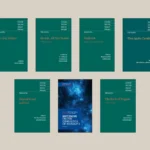
This reading packet gathers five works that make technology visible as a form of civilization. Together they move from the historical rise of technics to the ontological problem of revealing, from the autonomy of technique to the inner life of technical objects, and finally to the political architecture built into systems that often appear merely practical.
By Bookinlight
The Reading Lens
Why Technology Becomes a Philosophical Problem
Technology becomes philosophical when it stops being only a set of devices and becomes a way of arranging the world. These books ask how modern life is formatted by efficiency, automation, infrastructure, expertise, and control. Their shared claim is not that technology is evil, but that technological systems quietly decide what counts as knowledge, value, work, attention, and political possibility.
Central Question
Can human judgment survive when technical systems define the terms of action?
Historical Pressure
Industrial modernity, bureaucratic management, cybernetics, automation, and digital mediation.
Why These Books
They connect machines to culture, metaphysics, social order, technical objects, and power.
The Reading Map
| Book | Difficulty | Rating | Why It Matters |
|---|---|---|---|
| Technics and Civilization | General to Intermediate | ★★★★★ | Shows technology as a historical form of civilization, not a recent gadget culture. |
| The Question Concerning Technology and Other Essays | Advanced | ★★★★★ | Recasts modern technology as a way the world is disclosed and ordered. |
| The Technological Society | Intermediate | ★★★★½ | Explains how efficiency becomes an autonomous social logic. |
| On the Mode of Existence of Technical Objects | Advanced | ★★★★½ | Gives technical objects their own structure, history, and mode of being. |
| The Whale and the Reactor | General to Intermediate | ★★★★½ | Makes the politics of artifacts and infrastructures impossible to ignore. |
Technics and Civilization
Author: Lewis Mumford
Best for: Readers who want the long civilizational history behind modern machines.
Difficulty: General to Intermediate
Intellectual role: Historical foundation for thinking about technics as culture.
★★★★★
Mumford’s great achievement is to make technology historical before making it moral. Technics and Civilization refuses the comforting modern story that machines simply appeared with steam, factories, and industrial capitalism. Mumford traces the machine age back through medieval clocks, monastic discipline, mining, urban organization, and the slow cultural preparation of a world that could imagine time, labor, and nature as measurable systems. The result is not a simple anti-machine argument. It is a history of technics as a social order: machines express habits, institutions, symbols, and power relations long before they become visible as hardware.
This book belongs here because it gives philosophy of technology an indispensable historical ground. Without Mumford, the field risks becoming either abstract ontology or contemporary anxiety about digital life. He shows that every technical regime carries a moral atmosphere: some technologies intensify domination and speed, while others might serve organic, humane, and communal ends. Readers interested in urban history, industrial modernity, cultural criticism, or the genealogy of mechanical time will find the book especially rewarding. It changes the theme by shifting the question from “What do machines do?” to “What kind of civilization had to exist for these machines to become thinkable?”
Bookinlight Note
Begin here if you want philosophy of technology to feel rooted in clocks, cities, workshops, labor systems, and cultural memory rather than only in abstract concepts.
The Question Concerning Technology and Other Essays
Author: Martin Heidegger
Best for: Readers ready for a difficult but decisive philosophical encounter.
Difficulty: Advanced
Intellectual role: Ontological account of technology as a mode of revealing.
★★★★★
Heidegger’s essay is unavoidable because it gives the philosophy of technology its most famous provocation: the essence of technology is not itself technological. That sentence can sound mystical until one sees the argument at work. Heidegger is not primarily asking whether machines are useful, dangerous, or morally neutral. He asks how modern technology makes beings appear. Under the regime he calls enframing, the world is disclosed as standing-reserve: a stock of energy, data, matter, labor, and capacity awaiting ordering. A river becomes hydroelectric potential; a field becomes yield; a person becomes resource.
The book belongs in this article because it names the deepest philosophical pressure beneath technical modernity. It teaches readers to notice that technology is not merely something humans operate; it can become the horizon within which humans interpret reality. The difficulty is real: Heidegger’s vocabulary is compressed, etymological, and demanding. Yet readers concerned with metaphysics, environmental thought, artificial intelligence, design, or digital culture will find that the essay changes the level of the question. Instead of asking only whether a technology has good or bad effects, Heidegger asks what kind of world must already be assumed for such effects to appear as manageable problems.
Bookinlight Note
Read slowly, and do not reduce the argument to nostalgia. Its force lies in showing how modern ordering can become invisible because it feels rational.
The Technological Society
Author: Jacques Ellul
Best for: Readers interested in efficiency, bureaucracy, propaganda, and modern social systems.
Difficulty: Intermediate
Intellectual role: Sociological theory of technique as autonomous social logic.
★★★★½
Ellul’s key term is not technology in the narrow sense but technique: the ensemble of methods organized around maximum efficiency. That distinction gives The Technological Society its continuing power. Ellul argues that modern societies become technological not simply because they possess machines, but because efficiency becomes the hidden criterion by which politics, education, administration, labor, medicine, communication, and even leisure are reorganized. Technique expands by presenting itself as necessity. It does not need a tyrant; it advances through expert procedure, rationalization, measurement, optimization, and the promise that every problem has a technical solution.
The book belongs here because it places technology inside institutions and collective behavior. Where Heidegger clarifies the ontological horizon, Ellul shows the sociological machinery: bureaucratic systems, mass communication, managerial reason, and the narrowing of human freedom under the pressure of what works. Some readers will find Ellul severe, and his tone can feel totalizing. Yet the severity is part of the diagnostic force. The book benefits readers trying to understand algorithmic governance, productivity culture, surveillance, managerial language, or the reduction of politics to administration. It changes the reader’s understanding by showing that the technological problem is not limited to devices; it is a civilization-wide demand that everything become calculable, adjustable, and efficient.
Bookinlight Note
Ellul is most useful when read as a diagnostician of modern rationalization, not as a prophet of simple technological doom.
On the Mode of Existence of Technical Objects
Author: Gilbert Simondon
Best for: Readers interested in objects, systems, individuation, and technical becoming.
Difficulty: Advanced
Intellectual role: Philosophical rehabilitation of technical objects and their evolution.
★★★★½
Simondon offers a necessary correction to any philosophy of technology that sees machines only as threats, tools, or symptoms of alienation. On the Mode of Existence of Technical Objects argues that technical objects have a history and coherence of their own. They are not inert instruments pasted onto human intention. They develop through processes of concretization, where parts become more internally coordinated, more integrated with their milieu, and less dependent on accidental external supports. To understand a technical object is therefore to understand a mode of becoming.
This book belongs in the sequence because it gives dignity and precision to the technical object itself. Mumford sees technics historically; Heidegger sees technological revealing; Ellul sees social technique. Simondon asks what kind of being a technical object has, and what kind of culture would be capable of understanding it without superstition or contempt. The reader who benefits most is one willing to move slowly through conceptual argument: designers, media theorists, philosophers, engineers with humanities interests, and readers drawn to material culture. The book changes the field by refusing both technophobia and naive enthusiasm. It suggests that alienation from technology may arise not only because machines dominate us, but because culture fails to understand the internal logic by which technical realities exist and evolve.
Bookinlight Note
Simondon is the most technically patient book in this list; it rewards readers who want to think with machines rather than merely judge them from outside.
The Whale and the Reactor
Author: Langdon Winner
Best for: Readers who want the politics of technology stated clearly and forcefully.
Difficulty: General to Intermediate
Intellectual role: Political theory of artifacts, infrastructure, design, and power.
★★★★½
Winner’s book is the most politically direct work in this selection. Its central claim is that artifacts can have politics: bridges, factories, power systems, urban plans, and technical standards may embody forms of authority, exclusion, dependency, or democratic possibility. This does not mean that every tool secretly contains an ideology in a crude symbolic sense. Winner’s point is sharper. Technical arrangements can make some forms of life easier and others harder; they can distribute power before citizens ever arrive at a formal political debate.
The book belongs here because it brings the philosophy of technology into public life. After Mumford’s history, Heidegger’s ontology, Ellul’s social diagnosis, and Simondon’s technical ontology, Winner asks who gets to decide which systems are built, whose interests they serve, and what kinds of social order they stabilize. The prose is accessible, but the implications are demanding. Readers interested in democracy, infrastructure, environmental politics, urban planning, platform governance, or artificial intelligence policy will find it especially useful. It changes the reader’s understanding by making neutrality harder to believe. A technical system is not only a means to an end; it can also be a constitutional arrangement, silently organizing the conditions under which collective life becomes possible.
Bookinlight Note
Winner is the most immediately useful author here for readers asking how design choices become political facts.
Best Books on Philosophy of Technology: How to Read Them Together
The strongest route through these five books is historical, then ontological, then social, then material, then political. Mumford teaches the reader that technical systems emerge from cultural forms. Heidegger asks what kind of revealing governs modern technical reason. Ellul shows how efficiency becomes a social imperative. Simondon brings attention back to the technical object itself. Winner then asks how artifacts and systems distribute power.
Read together, they resist two weak interpretations: that technology is merely neutral, and that technology is merely destiny. The more demanding view is that technical systems are made, but once made they shape the horizons within which human beings perceive, choose, govern, and imagine freedom.
FAQ
What is the best first book on the philosophy of technology?
For most readers, Mumford or Winner is the best starting point. Mumford gives historical depth; Winner gives political clarity and accessible examples.
Is Heidegger necessary for understanding technology?
Heidegger is not easy, but he is central because he shifts the issue from machines to the modern way reality is ordered and revealed.
Which book is most relevant to digital platforms and artificial intelligence?
Winner is especially relevant for platform governance and infrastructure, while Ellul helps explain optimization, automation, and the rule of efficiency.
Are these books anti-technology?
Not simply. They are critical of technological reductionism, but they also ask how technology might be understood, limited, democratized, or integrated into humane forms of life.
What Reading Still Keeps Open
These best books on philosophy of technology do not settle the question of modern technical life. They make the question harder and more honest. After them, technology can no longer be reduced to gadgets, progress, danger, or convenience. It appears as history, metaphysics, social technique, objecthood, and political order. That is why they remain essential: they teach readers to see the systems that shape seeing itself.