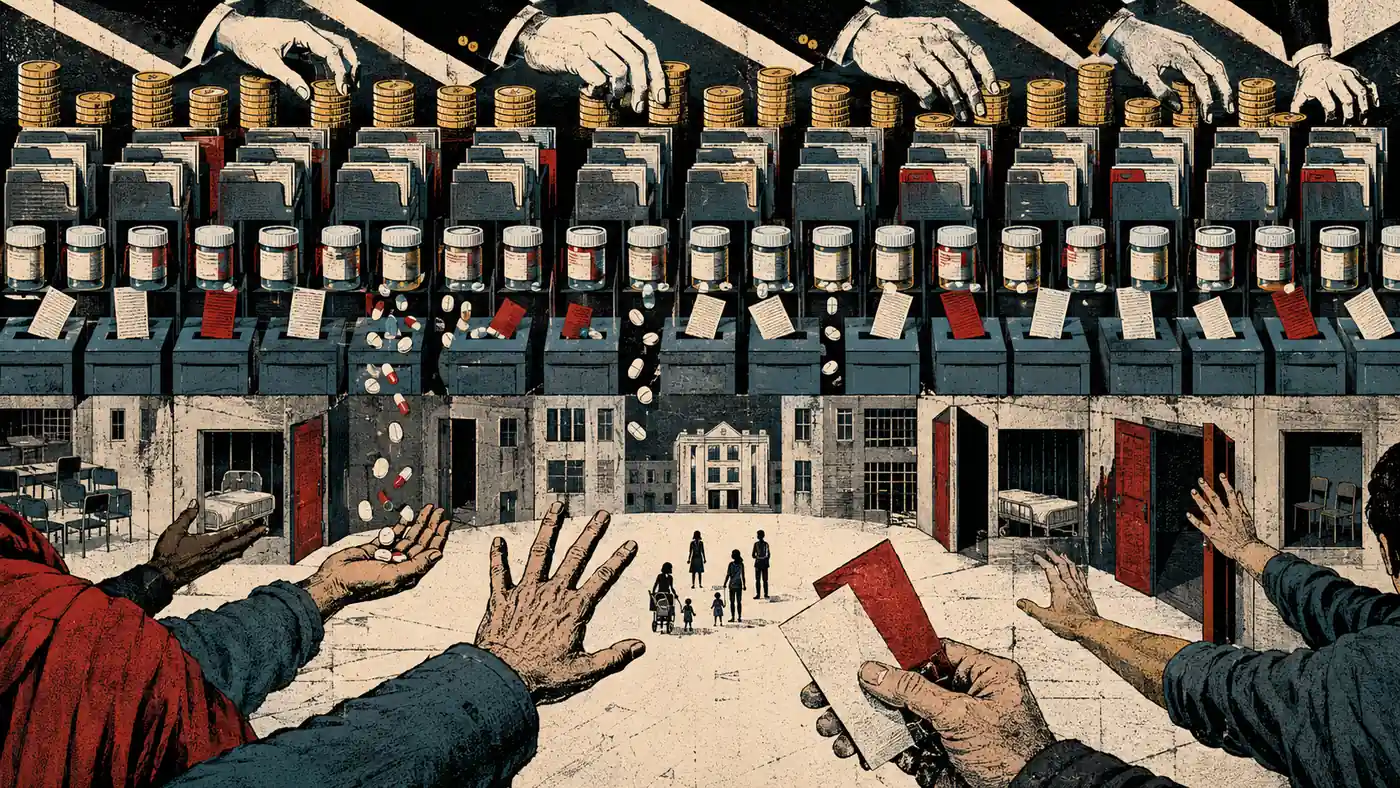
Illustration by Bookinlight Art Desk
The best books on austerity politics do more than explain budget cuts. They show how fiscal discipline becomes a political language: a way of defining responsibility, disciplining labor, reorganizing welfare, narrowing democratic choice, and deciding whose suffering counts as necessity.
This Bookinlight reading packet treats austerity not simply as an economic policy but as a historical and moral regime. The seven books below move from the intellectual history of austerity to its public-health consequences, from the Eurozone crisis to the hollowing of party democracy. Read together, they show that austerity politics is never only about scarcity. It is about authority, legitimacy, creditor power, class conflict, public value, and the boundaries of democratic imagination.
By Bookinlight
The Reading Lens
Austerity as a Political Theory of Sacrifice
Austerity is often presented as technical housekeeping: reduce deficits, restore confidence, reassure markets. These books ask a harder question. What kind of society is being built when collective life is reorganized around cuts, restraint, and creditor credibility? The answer is historical, institutional, and ethical: austerity changes what governments can promise, what citizens can demand, and what democracy is allowed to mean.
Central Question
Who is asked to pay for crisis, and who gains from calling payment inevitable?
Historical Pressure
Financial crisis, state debt, labor conflict, welfare retrenchment, and European monetary constraint.
Why These Books
They connect ideas, institutions, bodies, markets, parties, and democratic legitimacy.
Best Books on Austerity Politics
The sequence begins with the modern argument against austerity, then moves backward to its interwar intellectual origins and outward to its consequences for health, Europe, democratic capitalism, neoliberalism, and representation. The point is not to choose one explanatory master key. It is to see how austerity travels: through economic doctrines, central banks, budget offices, international institutions, party systems, and everyday lives.
Austerity: The History of a Dangerous Idea
Author: Mark Blyth
Best for: Readers who want the clearest modern entry point into anti-austerity political economy.
Difficulty: General to Intermediate
Intellectual role: The foundational contemporary critique of austerity as policy, ideology, and political blame-shifting.
Bookinlight Rating: ★★★★★
Mark Blyth’s book remains the essential starting point because it turns austerity from a word of fiscal common sense into an object of political suspicion. His central argument is direct: austerity is repeatedly sold as prudence, but it often fails economically and succeeds politically by transferring the burden of financial crisis onto those least responsible for it. Blyth traces the idea through liberal political economy, liquidationist thinking, German ordoliberal inheritance, and the post-2008 turn from stimulus to cuts. What makes the book powerful is not only its anger but its institutional memory. It refuses the convenient story that public debt was simply the result of reckless welfare states. Instead, it asks readers to follow the banking crisis, sovereign debt, bailout politics, and the moral narrative of “living beyond our means.” This belongs in any list of books on austerity politics because it gives the reader the vocabulary to challenge inevitability. It is especially useful for students, journalists, policy readers, and politically serious general readers who need a lucid map of how economic ideas enter public debate. After Blyth, austerity looks less like neutral repair and more like a contested theory of responsibility, class, and crisis management.
Bookinlight Note
Begin here if you want one book that explains why austerity is both an economic doctrine and a political story about guilt.
The Capital Order: How Economists Invented Austerity and Paved the Way to Fascism
Author: Clara E. Mattei
Best for: Readers interested in the deep history of austerity, technocracy, labor discipline, and interwar Europe.
Difficulty: Advanced
Intellectual role: A historical excavation of austerity as a project of capitalist stabilization.
Bookinlight Rating: ★★★★★
Clara E. Mattei’s book shifts the austerity debate from the aftermath of 2008 to the aftermath of the First World War. Her central claim is sharply historical: austerity was not merely invented as an emergency response to debt but as a political technology for restoring capitalist order after moments of democratic and working-class pressure. Through Britain and Italy, Mattei follows economists, treasury officials, central bankers, industrial elites, and policy experts as they elevated balanced budgets, wage restraint, monetary discipline, and reduced consumption into a program of social stabilization. The book matters because it gives austerity a genealogy before neoliberalism. It shows how “expert” economics can depoliticize decisions that are intensely political: who works, who consumes, who owns, who commands, and who must accept sacrifice. Readers who already know the post-2008 debate will benefit from Mattei’s archival depth and her refusal to treat fiscal policy as a self-contained technical field. The book changes the reader’s understanding of austerity politics by revealing that the language of solvency can conceal a larger defense of hierarchy. It is demanding, sometimes polemical, and historically ambitious, but its ambition is precisely why it belongs here. It makes austerity legible as an episode in the long struggle over democracy inside capitalism.
Bookinlight Note
Read Mattei after Blyth: the first explains the contemporary crisis; the second asks why the doctrine was available in the first place.
The Body Economic: Why Austerity Kills
Authors: David Stuckler and Sanjay Basu
Best for: Readers who want to understand the bodily and public-health consequences of fiscal choices.
Difficulty: General
Intellectual role: The evidence-based account of austerity’s social cost in health, mortality, and collective resilience.
Bookinlight Rating: ★★★★½
David Stuckler and Sanjay Basu bring austerity down from the level of fiscal aggregates to the level of clinics, households, unemployment offices, mental health, epidemics, and mortality. The book’s central contribution is methodological as well as moral: it compares policy responses to financial crisis and asks why some societies protect life during downturns while others amplify suffering. Its case studies range across the Great Depression, post-Soviet transition, East Asian crisis, Iceland, Greece, Britain, Spain, and the United States. The result is a stern reminder that “the economy” is not a separate object from the body politic. Budget cuts can become medical events. Welfare withdrawal can become psychological injury. Public-health spending can become a form of democratic protection. This book belongs in the article because austerity politics is often debated as if the primary injured party were the bond market. Stuckler and Basu force the reader to ask what is being measured and what is being ignored. It is especially useful for readers in public policy, health humanities, social epidemiology, and political economy who want evidence without losing sight of ethical stakes. After reading it, austerity appears not only as a theory of the state but as a distribution of vulnerability across bodies, neighborhoods, and generations.
Bookinlight Note
This is the book that makes “cuts” feel inadequate as a word; what is being cut may be social life itself.
And the Weak Suffer What They Must?: Europe’s Crisis and America’s Economic Future
Author: Yanis Varoufakis
Best for: Readers focused on the Eurozone crisis, Greece, monetary union, and creditor politics.
Difficulty: General to Intermediate
Intellectual role: A polemical insider account of European monetary design and anti-austerity conflict.
Bookinlight Rating: ★★★★½
Yanis Varoufakis writes with the urgency of someone for whom austerity is not an abstract doctrine but a confrontation at the center of European power. The book’s argument is that the Eurozone crisis cannot be understood as a morality play about irresponsible national debtors. It must be understood through the design of monetary union, the recycling of surpluses, the asymmetry between creditor and debtor states, and the political role of institutions that can impose adjustment without ordinary democratic accountability. Varoufakis is a partisan writer, and the book’s energy comes from that partisanship. It belongs in this list because austerity politics in Europe became one of the clearest modern examples of technocratic government under financial pressure. Greece appears not simply as a national case but as a test of what happens when democratic mandates collide with monetary architecture. Readers who want detached neutrality may prefer Blyth or Streeck first; readers who want to feel the drama of Eurozone constraint will find Varoufakis indispensable. The book changes the theme by making austerity spatial and institutional. It asks who owns the rules of a currency zone, how solidarity can collapse into punishment, and whether European integration can survive when adjustment is demanded from the weak more than from the strong.
Bookinlight Note
Use this as the Eurozone companion to the more theoretical works: it gives austerity a geography, a currency, and a negotiating table.
Buying Time: The Delayed Crisis of Democratic Capitalism
Author: Wolfgang Streeck
Best for: Readers who want a sociological theory of the conflict between democracy and capitalism.
Difficulty: Advanced
Intellectual role: The structural account of how states moved from tax politics to debt politics to consolidation politics.
Bookinlight Rating: ★★★★½
Wolfgang Streeck’s book is less a narrow study of austerity than a theory of the historical conditions that make austerity politically thinkable. Based on his Adorno Lectures, it describes a sequence in postwar capitalism: inflation, public debt, private debt, and finally consolidation. In Streeck’s account, governments repeatedly “buy time” for a social order whose promises become harder to reconcile: capitalist profitability, democratic legitimacy, welfare commitments, and the expectations of voters. Austerity enters as the politics of the consolidation state, where obligations to creditors increasingly constrain obligations to citizens. The book belongs here because it gives fiscal retrenchment a longue durée institutional setting. Austerity is not merely the bad idea of a finance minister or the moralism of a party platform; it is part of a wider transformation in the relationship between states and markets. Readers will benefit from Streeck if they want austerity politics connected to political sociology, democratic theory, and the history of postwar capitalism. It is denser than Blyth and less immediately empirical than Stuckler and Basu, but it rewards slow reading. It changes the reader’s understanding by showing that austerity can be interpreted as a symptom of democratic capitalism’s delayed crisis: a way of postponing contradiction while narrowing the field of political choice.
Bookinlight Note
Streeck is the structural theorist in this list: he explains why austerity feels less like an episode than a regime.
A Brief History of Neoliberalism
Author: David Harvey
Best for: Readers who want austerity placed inside the broader remaking of state, market, and class power.
Difficulty: Intermediate
Intellectual role: The classic account of neoliberalism as political project and institutional transformation.
Bookinlight Rating: ★★★★★
David Harvey’s classic does not treat austerity as its sole subject, but it is indispensable because austerity politics rarely appears alone. It arrives with privatization, deregulation, anti-union restructuring, financialization, welfare conditionality, and the moral elevation of market discipline. Harvey’s central argument is that neoliberalism should be understood not merely as a doctrine of efficient markets but as a political project that reorganizes power in favor of capital. That frame makes austerity intelligible as one part of a wider transformation in the state. The state does not disappear; it is retooled. Public authority is used to create market conditions, protect property claims, discipline labor, and limit redistributive demands. This belongs in the list because readers need to see austerity not only at the point of budget crisis but also within the ideology that makes public spending suspect and market allocation appear natural. Harvey is especially useful for students of geography, political economy, sociology, and critical theory. The book changes the reader’s understanding by dissolving the false opposition between state and market. Austerity is not simply the state withdrawing. It can be the state acting powerfully to protect a certain social order while calling that action necessity, realism, or reform.
Bookinlight Note
Harvey supplies the ideological architecture: without neoliberalism, austerity is easier to mistake for mere accounting.
Ruling the Void: The Hollowing of Western Democracy
Author: Peter Mair
Best for: Readers who want to understand why austerity can survive electoral discontent.
Difficulty: Intermediate
Intellectual role: The democratic-institutional account of party decline, depoliticization, and elite insulation.
Bookinlight Rating: ★★★★½
Peter Mair’s final book is not a book about austerity in the narrow fiscal sense, but it is crucial for understanding the political environment in which austerity becomes durable. Mair argues that party democracy in Western Europe has been hollowed out from both sides: citizens withdraw from parties, while parties withdraw from society and relocate themselves inside the state. The result is a political class increasingly skilled at governing but less rooted in representation. This matters for austerity because cuts often persist even when they are unpopular. If parties become professionalized, cartelized, and detached from mass membership, they can administer constraint while offering voters little real alternative. Mair’s analysis also helps explain the appeal of anti-establishment movements that treat austerity not only as bad policy but as evidence that democracy has been evacuated. Readers of political theory, comparative politics, and European studies will benefit from this institutional perspective. It changes the theme by showing that austerity politics requires more than economic doctrine; it requires a representative structure weak enough to absorb discontent without transforming policy. The book gives the final place in this list a democratic grammar. The question is no longer only whether austerity works, but why political systems can keep reproducing it.
Bookinlight Note
Mair completes the packet by asking why austerity can outlast protest: the answer lies partly in the hollowing of representation.
The Reading Map
The Reading Map
| Book | Difficulty | Rating | Why It Matters |
|---|---|---|---|
| Austerity: The History of a Dangerous Idea | General to Intermediate | ★★★ ★★ | Defines austerity as failed economics and successful blame politics. |
| The Capital Order | Advanced | ★★★ ★★ | Reconstructs austerity as a defense of capitalist order. |
| The Body Economic | General | ★★★ ★½ | Shows how fiscal policy becomes public-health fate. |
| And the Weak Suffer What They Must? | General to Intermediate | ★★★ ★½ | Turns the Eurozone crisis into a study of creditor power. |
| Buying Time | Advanced | ★★★ ★½ | Frames austerity within the crisis of democratic capitalism. |
| A Brief History of Neoliberalism | Intermediate | ★★★ ★★ | Places austerity inside a larger project of market rule. |
| Ruling the Void | Intermediate | ★★★ ★½ | Explains why unpopular constraint can survive weak representation. |
FAQ
What is the best first book on austerity politics?
Mark Blyth’s Austerity is the best first book because it is clear, historically informed, and directly focused on the modern policy debate.
Which book gives the deepest history of austerity?
Clara E. Mattei’s The Capital Order gives the deepest historical genealogy, especially for readers interested in interwar Britain, Italy, labor conflict, and technocratic economics.
Are austerity books mainly about economics?
No. The strongest austerity books cross political economy, history, public health, sociology, democratic theory, and European studies.
Which book best explains austerity and democracy?
Buying Time and Ruling the Void are the strongest pair: one explains creditor constraints, the other explains weakened representation.
What Reading Still Keeps Open
The best books on austerity politics do not end the argument; they sharpen it. They show that every fiscal settlement carries a theory of society. Austerity asks citizens to accept limits, but these books ask who designed the limits, who benefits from them, and what alternatives were made to seem impossible. That is why the subject remains central not only to economics but to the humanities of political life: it is a debate over memory, obligation, suffering, and democratic possibility.