
Illustration by Bookinlight Art Desk
History of Economic Thought
Five Books on Ordoliberalism
A guided reading path through the German tradition that tried to make markets depend on law, competition, moral order, and institutional discipline rather than on laissez-faire mythology.
By Bookinlight


Markets Do Not Govern Themselves
Ordoliberalism is often misread as a German variant of market fundamentalism. These five books show why that description is too blunt. The tradition that emerged around Freiburg in the 1930s did not imagine markets as natural forces best left alone. It treated markets as fragile institutional achievements that require legal form, anti-monopoly discipline, monetary restraint, social legitimacy, and a state strong enough to prevent private power from becoming political power. The best books on ordoliberalism therefore ask a sharper question than whether the state should intervene. They ask what kind of order makes economic freedom politically possible.
Five Books on Ordoliberalism and the Architecture of Economic Order
Read together, these books move from foundation to critique. Walter Eucken supplies the methodological core: the economy must be understood through its ordering principles, not through isolated events. Michel Foucault makes ordoliberalism central to the genealogy of neoliberal governmentality. Biebricher and Vogelmann recover primary texts and connect them to austerity. Hien and Joerges show how law became the language through which ordoliberalism entered European debates. Raphaël Fèvre then reconstructs the tradition as a political economy of power. The sequence matters: ordoliberalism begins as a theory of order, becomes a theory of government, and returns today as a dispute over Europe’s institutional imagination.
The Reading Lens
The Market as a Legal Construction
The most revealing way to read ordoliberalism is not as a doctrine of less state, but as a doctrine of disciplined form. Its central anxiety is power: cartels, monopolies, discretionary states, inflationary politics, and social disorder. The books below show a tradition trying to convert political conflict into rules, competition into an institution, and freedom into a constitutional arrangement. That ambition explains both its force and its danger.
Central Question
Can markets restrain power only when they are themselves designed by law?
Historical Pressure
Ordoliberalism was shaped by Weimar instability, dictatorship, postwar reconstruction, and later European crisis governance.
Why These Books
They connect original theory, governmentality, primary texts, legal critique, and recent intellectual history.
The Five Essential Readings
The Foundations of Economics
Walter Eucken
Best for: Readers who want ordoliberalism at its methodological source.
Difficulty: Advanced
Intellectual role: The founding architecture of economic order.
Bookinlight Rating: ★★★★★
Eucken’s book is not a manifesto in the usual polemical sense. It is a methodological intervention into how economic reality should be understood. Against historical relativism and against abstract theory detached from institutions, Eucken develops the idea of economic orders: patterned arrangements in which legal forms, competitive structures, money, prices, firms, and state authority interact. For ordoliberalism, this is the crucial beginning. Freedom is not simply an absence of state action; it is a structure of constraints that prevents concentrations of public and private power from destroying competition.
Critical Reception
“He became, among German economists, the foremost opponent of the Historical School.“
Bookinlight Note: Read Eucken as a theorist of institutional visibility: he wants readers to see the hidden constitutional form of economic life.
The Birth of Biopolitics
Michel Foucault
Best for: Readers approaching ordoliberalism through political theory and governmentality.
Difficulty: Advanced
Intellectual role: The conceptual bridge from economic order to governing reason.
Bookinlight Rating: ★★★★★
Foucault’s 1978-1979 lectures remain indispensable because they refuse to treat German neoliberalism as a mere policy package. He reads it as a new art of government: a rationality that does not simply withdraw the state, but asks the state to organize conditions under which competition can function as a regulatory principle. This makes ordoliberalism legible to historians of power, not only to economists. Foucault is strongest when he shows that the market becomes a site of truth, a standard against which political action is judged.
Bookinlight Note: Pair Foucault with Eucken and ask whether competition is being described, protected, or produced.
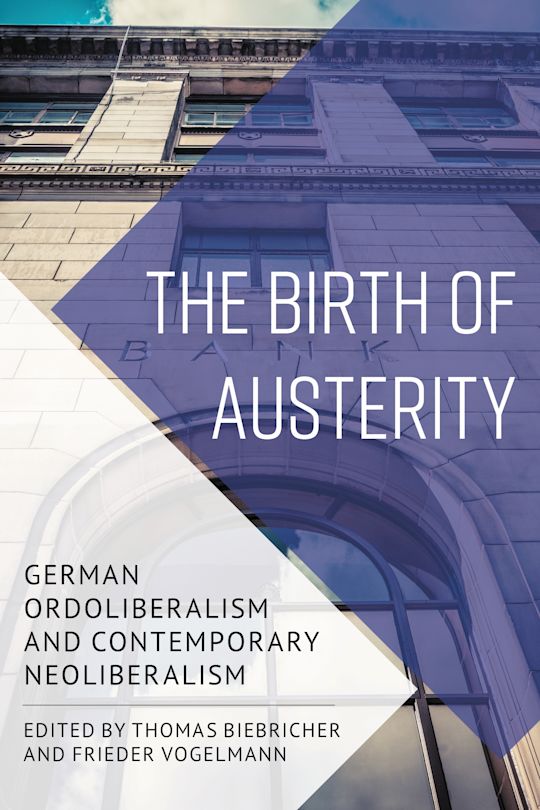
The Birth of Austerity
Thomas Biebricher and Frieder Vogelmann
Best for: Readers who want primary ordoliberal texts beside contemporary critique.
Difficulty: Intermediate
Intellectual role: The bridge between classical ordoliberalism and European austerity politics.
Bookinlight Rating: ★★★★★★
This collection is especially useful because it refuses to let ordoliberalism remain an abstract label in Eurozone polemics. Its first half gives readers access to translated texts by Eucken, Böhm, Rüstow, and others; its second half tests those ideas against crisis management and austerity. The book is therefore both archive and argument. It shows why ordoliberalism can appear as a doctrine of order, an ethic of responsibility, a defense of competition, and a hard language of fiscal discipline.
Critical Reception
“An excellent handbook on the influential and peculiar German version of neoliberalism.“
Bookinlight Note: Use this book to test whether austerity is a betrayal of ordoliberalism or one possible extension of it.
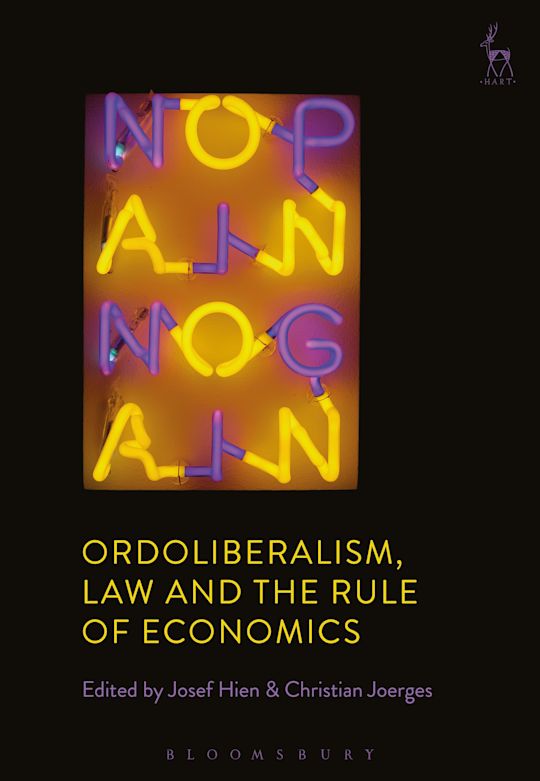
Ordoliberalism, Law and the Rule of Economics
Josef Hien and Christian Joerges
Best for: Readers interested in law, European integration, and economic constitutionalism.
Difficulty: Advanced
Intellectual role: The legal and institutional critique of ordoliberal inheritance.
Bookinlight Rating: ★★★★★★
This volume is demanding, but it is one of the best ways to understand why ordoliberalism matters beyond German economic thought. Its central problem is the rule of economics: the moment when legal order begins to speak in the grammar of competition, fiscal discipline, and market compatibility. The book’s contributors are not united by a single verdict. That is its strength. They examine ordoliberalism as tradition, ideology, legal project, theological residue, European misunderstanding, and crisis vocabulary.
Critical Reception
“this is a crucial book if one really wants to understand the evolving debate“
Bookinlight Note: Read the book as a debate over whether law restrains the economy or becomes captured by economic reason.
A Political Economy of Power
Raphaël Fèvre
Best for: Readers seeking the strongest recent intellectual history of ordoliberalism.
Difficulty: Intermediate
Intellectual role: The contextual reconstruction of ordoliberalism as a theory of power.
Bookinlight Rating: ★★★★★
Fèvre’s book is essential because it restores ordoliberalism to its historical and intellectual setting between 1932 and 1950. Rather than flattening the tradition into a slogan about austerity or German discipline, he reconstructs its concern with economic and political power. Eucken, Röpke, Böhm, Rüstow, Miksch, and Lutz appear here as participants in an effort to tame private power, rebuild liberalism after catastrophe, and make competition into an institutional defense against domination. This is the best single-volume contemporary entry into the field.
Bookinlight Note: A superb discussion question: is ordoliberalism best understood as anti-power liberalism or as power translated into rules?
How These Books Speak to One Another
The deepest tension among these books concerns the meaning of order. For Eucken, order is the precondition of freedom; for Foucault, it becomes a governmental rationality; for Biebricher and Vogelmann, it is recoverable through texts but politically entangled with austerity; for Hien and Joerges, it turns into a contested legal vocabulary; for Fèvre, it is inseparable from the problem of power. This is why ordoliberalism remains intellectually productive. It forces readers to stop asking whether markets or states should win, and to ask instead how markets, states, law, and society are arranged before political conflict even begins.
The Reading Map
| Book | Author | Difficulty | Rating | Why It Matters |
|---|---|---|---|---|
| The Foundations of Economics | Walter Eucken | Advanced | ★★★★★ | Establishes the idea of economic order. |
| The Birth of Biopolitics | Michel Foucault | Advanced | ★★★★★ | Turns ordoliberalism into a theory of governing reason. |
| The Birth of Austerity | Biebricher and Vogelmann | Intermediate | ★★★★★★ | Links primary texts to austerity debates. |
| Ordoliberalism Law and the Rule of Economics | Hien and Joerges | Advanced | ★★★★★★ | Shows how law absorbs economic reason. |
| A Political Economy of Power | Raphaël Fèvre | Intermediate | ★★★★★ | Reconstructs ordoliberalism around the problem of power. |
Where to Begin
- Entry point: Begin with Fèvre for the clearest contemporary map.
- Historical background: Move to Eucken to understand the founding logic of economic order.
- Conceptual foundation: Read Foucault after Eucken to see how order becomes governmentality.
- Critical perspective: Use Biebricher and Vogelmann to connect primary texts with austerity.
- Contemporary relevance: Turn to Hien and Joerges for law, Europe, and crisis governance.
- Advanced reflection: Return to Fèvre and ask why power remains the unresolved center.
External Sources for Further Reading
The Freiburg School: Walter Eucken and Ordoliberalism
The Last Margin
The enduring value of these five books on ordoliberalism is that they make economic life visible as an institutional design. They do not let readers hide behind the simple opposition of market and state. Instead, they reveal a more difficult terrain: law that produces competition, state power that claims to restrain itself, monetary discipline that becomes moral language, and freedom that depends on rules whose democratic status remains contested. Ordoliberalism survives because it is both an answer and a problem.