Illustration by Bookinlight Art Desk
Philosophy of History & Sociology
Five Books on Paul Ricoeur and Historical Memory
A serious reading path through Ricoeur’s philosophy of memory, narrative, truth, selfhood, and action: five works that show why the past is never merely behind us.
By Bookinlight


The Past as a Problem of Interpretation
To search for books on Paul Ricoeur and memory is to enter a question larger than biography, commemoration, or even historiography. Ricoeur’s central problem is not simply that human beings remember badly. It is that memory, history, and forgetting form a fragile triangle in which every claim about the past must pass through testimony, narrative, documentation, interpretation, and moral judgment. The past is absent, yet it insists. It cannot be touched directly, yet it can wound, accuse, orient, and reconcile. Ricoeur’s achievement was to make this difficulty philosophically legible without reducing it to skepticism.
These five books are best read as a sequence. They begin with the monumental architecture of memory itself, move through narrative time and historical truth, pass into the identity of the remembering subject, and end with the movement from interpretation to public action. Together they show that historical memory is never just a storehouse of images. It is a discipline of recognition, a struggle with distortion, and an ethical relation to those whose lives can no longer answer for themselves.
Why Books on Paul Ricoeur and Memory Still Matter
Ricoeur’s philosophy speaks with unusual force to cultures saturated with memorial politics, archival disputes, apology, denial, trauma, and competing narratives of national identity. He refuses two temptations: the positivist fantasy that history can escape memory altogether, and the sentimental fantasy that memory is morally pure simply because it is lived. For Ricoeur, memory needs critique, but critique must not humiliate memory into silence. Historical knowledge begins in testimony, yet it must pass through documents, explanation, debate, and the discipline of distance.
That balance gives his work its continuing authority. Ricoeur does not treat remembrance as a private psychological act alone. He asks how societies recognize injuries, how narratives configure time, how subjects remain answerable across change, and how public action can follow interpretation without becoming propaganda. The best books on Paul Ricoeur and memory therefore belong not only to philosophy departments. They matter for historians, theologians, political theorists, literary scholars, museum workers, transitional justice researchers, and anyone who asks how a community should live with a difficult past.
The Reading Lens
Memory Becomes Historical When It Accepts Mediation
Ricoeur’s importance lies in his refusal to let memory remain either sacred immediacy or unreliable residue. Memory becomes historically serious only when it accepts mediation: language, narrative, archives, institutions, criticism, and the claims of others. Yet these mediations do not abolish memory’s ethical demand. They protect it from manipulation while keeping alive its fragile promise of truth. The books below trace that movement from remembered absence to public responsibility.
Central Question
How can the past be truthfully remembered when every act of remembering is already interpretive?
Historical Pressure
Modern societies inherit archives, wounds, denials, and commemorations that demand judgment without allowing final possession of the past.
Why These Books
They show Ricoeur moving from memory and narrative to truth, selfhood, and the civic consequences of interpretation.
Five Essential Ricoeur Books for Historical Memory
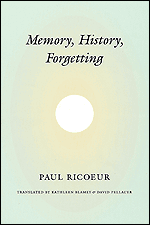
Memory, History, Forgetting
Paul Ricoeur
Best for: Readers who want Ricoeur’s definitive philosophy of historical memory.
Difficulty: Advanced
Intellectual role: The central architecture of memory, historiography, forgetting, and forgiveness.
Bookinlight Rating: ★★★★★
This is the indispensable starting point, though not the easiest one. Ricoeur organizes the book around three great philosophical regions: the phenomenology of memory, the epistemology of history, and the hermeneutics of forgetting. His governing question is deceptively simple: how can memory claim truth when it presents something absent? From that question he moves toward testimony, archives, explanation, representation, blocked memory, commanded memory, amnesty, and forgiveness.
The book matters because it refuses to let historical memory collapse into either documentary objectivity or private recollection. Ricoeur insists that historians remain dependent on memory even when they subject memory to rigorous critique. For readers concerned with atrocity, public apology, monuments, denial, or transitional justice, this work offers a vocabulary for thinking about memory as both fragile and accountable.
Critical Reception
“Ricoeur writes the best kind of philosophy—critical, economical, and clear.“
Bookinlight Note: Read this beside a public controversy over a monument or official apology; Ricoeur helps distinguish forgetting, denial, pardon, and political amnesty.
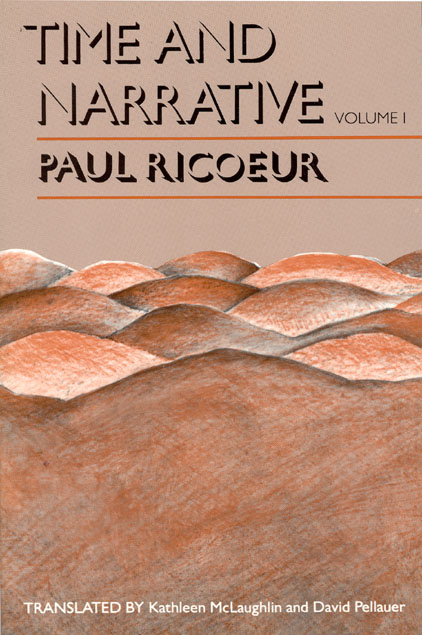
Time and Narrative, Volume 1
Paul Ricoeur
Best for: Readers interested in narrative, time, plot, and philosophy of history.
Difficulty: Advanced
Intellectual role: The theory of narrative mediation behind Ricoeur’s later work on memory.
Bookinlight Rating: ★★★★★
If Memory, History, Forgetting asks how the absent past can be remembered, Time and Narrative asks how human beings make time intelligible at all. Ricoeur’s famous dialogue with Augustine and Aristotle leads to a theory of emplotment: narrative does not merely decorate experience after the fact; it configures temporal experience into a meaningful whole. This is why historical writing cannot be reduced to chronology. It must arrange events into intelligible relations without pretending that the arrangement is identical with the past itself.
For historical memory, the book is crucial because collective remembrance always takes narrative form. A nation, family, survivor, archive, or movement does not simply list events. It configures beginnings, ruptures, responsibilities, and possible futures. Ricoeur gives readers the conceptual discipline to ask when such configuration clarifies experience and when it falsifies it.
Critical Reception
“Puts the whole problem of narrative on a new and higher plane of discussion.“
Bookinlight Note: Use this book to test public history: what kind of plot does a museum, memorial, or national holiday impose on time?
History and Truth
Paul Ricoeur
Best for: Readers seeking Ricoeur’s early essays on truth, objectivity, and historical meaning.
Difficulty: Intermediate
Intellectual role: The bridge between historical objectivity and the singularity of lived human lives.
Bookinlight Rating: ★★★★★★
History and Truth is less architectonic than Ricoeur’s later masterpieces, but it is indispensable for seeing the ethical and epistemological tensions that animate them. Ricoeur is already concerned with the antinomy between historical universality and the singularity of persons. The historian seeks intelligibility, pattern, and explanation; yet the lives under study resist being absorbed into a single system. The book’s essays on objectivity, subjectivity, civilization, violence, and political paradox reveal Ricoeur thinking history as both knowledge and action.
For readers of historical memory, this book is a corrective against two errors: treating truth as a cold system detached from human suffering, and treating singular suffering as immune to interpretation. Ricoeur’s concern is the hard middle: historical truth must be disciplined enough to resist fantasy and humane enough to preserve plurality.
Critical Reception
“Ricoeur investigates the antinomy between history and truth.“
Bookinlight Note: Pair this with debates over universal history: Ricoeur helps ask whether general explanation can coexist with the dignity of singular lives.
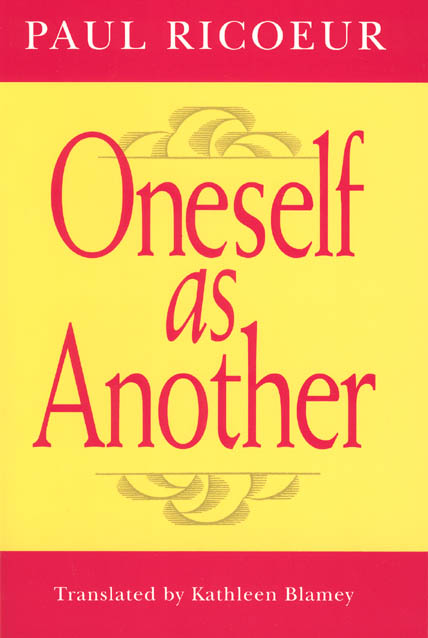
Oneself as Another
Paul Ricoeur
Best for: Readers interested in narrative identity, responsibility, and ethical selfhood.
Difficulty: Advanced
Intellectual role: The account of the self capable of remembering, promising, narrating, and answering.
Bookinlight Rating: ★★★★★★
Historical memory is never only about events; it is also about the subjects who inherit, recount, deny, transmit, and answer for them. Oneself as Another gives the philosophical anthropology that memory requires. Ricoeur distinguishes identity as sameness from selfhood as constancy, developing the idea of narrative identity without reducing the self to a fictional construction. The self persists through change by becoming intelligible in stories, promises, actions, and ethical relations with others.
This matters for historical memory because collective narratives are always carried by selves and institutions capable of responsibility. Ricoeur helps readers see why remembrance is not merely cognitive. To remember well is also to recognize oneself as implicated in a world shared with others, including the dead, the injured, and the excluded.
Bookinlight Note: Read the chapters on narrative identity after Time and Narrative; they show why memory belongs to the grammar of responsibility.
From Text to Action
Paul Ricoeur
Best for: Readers who want to connect hermeneutics with ideology, politics, and public action.
Difficulty: Intermediate
Intellectual role: The movement from interpretation to social and political responsibility.
Bookinlight Rating: ★★★★★★
From Text to Action is the best companion for readers who want to understand why Ricoeur’s philosophy of interpretation never remains confined to books. The essays move from hermeneutical phenomenology to the model of the text, meaningful action, ideology, utopia, ethics, and politics. The crucial insight is that action can be interpreted in a manner analogous to text: it becomes detached from its immediate situation, enters public meaning, and remains open to later readings.
For historical memory, this is decisive. Public remembrance consists of actions, speeches, documents, rituals, omissions, and institutional gestures that become readable beyond their original moment. Ricoeur’s work helps explain why memory politics is always interpretive, but also why interpretation has consequences. To read the past is already to prepare forms of action in the present.
Critical Reception
“Ricoeur has single-handedly redefined and revitalized the hermeneutic tradition.“
Bookinlight Note: This is the book to read after a truth commission report, museum exhibition, or public apology; it clarifies how interpretation becomes civic practice.
How These Books Speak to One Another
The sequence matters. Memory, History, Forgetting gives the most explicit account of historical memory, but it becomes clearer when read through the earlier logic of Time and Narrative. Narrative explains why the past reaches us through configured meaning rather than raw sequence. History and Truth supplies the pressure of objectivity and singularity: history must seek truth, yet it must not crush the plurality of lives under an abstract system. Oneself as Another then asks who can bear memory, promise, guilt, and recognition across time. From Text to Action completes the arc by showing how interpretation leaves the page and enters public life.
The five books therefore form a philosophy of mediated remembrance. Ricoeur’s historical memory is not nostalgia. It is not commemoration as spectacle. It is a difficult practice in which testimony becomes archive, archive becomes narrative, narrative becomes self-understanding, and self-understanding becomes responsibility. This is why Ricoeur remains so valuable in a century haunted by contested pasts.
The Reading Map
| Book | Difficulty | Rating | Why It Matters |
|---|---|---|---|
| Memory, History, Forgetting | Advanced | ★★★★★ | The definitive account of memory, history, forgetting, and forgiveness. |
| Time and Narrative, Volume 1 | Advanced | ★★★★★ | Shows how narrative makes historical time intelligible. |
| History and Truth | Intermediate | ★★★★★★ | Frames the tension between historical universality and singular lives. |
| Oneself as Another | Advanced | ★★★★★★ | Explains the self capable of narrative, promise, and responsibility. |
| From Text to Action | Intermediate | ★★★★★★ | Connects interpretation with ideology, politics, and civic action. |
Where to Begin
- Entry point: Begin with History and Truth if you want a shorter path into Ricoeur’s philosophy of history.
- Historical background: Move next to Time and Narrative, Volume 1 to understand how narrative configures historical time.
- Conceptual foundation: Read Memory, History, Forgetting slowly; it is the masterwork behind this entire theme.
- Critical perspective: Use From Text to Action to connect interpretation with ideology, institutions, and politics.
- Contemporary relevance: Return to Memory, History, Forgetting when thinking about public apology, amnesty, denial, and forgiveness.
- Advanced reflection: Read Oneself as Another last to see how memory requires a self capable of responsibility.
External Sources for Further Reading
Stanford Encyclopedia of Philosophy: Paul Ricoeur
The Last Margin
The most valuable books on Paul Ricoeur and memory do not offer a simple method for settling the past. They teach a harder discipline: to honor memory without idolizing it, to practice historical criticism without cruelty, to narrate without mythmaking, and to act without pretending that interpretation has ended. Ricoeur’s thought remains powerful because it accepts the wounded complexity of historical life. The past is absent, but not gone; mediated, but not meaningless; contested, but not beyond truth. To read Ricoeur well is to learn that remembrance becomes humane only when it becomes responsible.