Illustration by Bookinlight Art Desk
Ethics & Moral Philosophy
Seven Books on the Philosophy of Hope
Hope is not simply a bright feeling about the future. These books treat it as a discipline of imagination, a moral risk, a theological horizon, and sometimes a fragile civic art.
By Bookinlight


Hope After Easy Optimism
The best books on the philosophy of hope begin by refusing a comforting mistake: hope is not the same as cheerfulness, prediction, or progress talk. Hope becomes philosophically serious only when the future is uncertain, the present is damaged, and the available evidence does not yet justify confidence. That is why the books gathered here move across Marxist utopianism, Christian existentialism, theology, moral psychology, ethics after cultural devastation, literary criticism, and civic history. They belong together because each asks how human beings can remain answerable to the future without falsifying the present.
Why the Best Books on the Philosophy of Hope Resist Optimism
Optimism usually imagines the future as an extension of present probabilities. Hope is stranger and more demanding. It may require waiting without passivity, acting without guarantee, grieving without surrender, or imagining goods that cannot yet be described in full. The most interesting philosophers of hope therefore treat it as a practice of orientation: toward the not-yet, toward transcendence, toward repair, toward political possibility, or toward courage under civilizational pressure. Read in sequence, these books show that hope is less a mood than a form of disciplined attention.
The Reading Lens
Hope as a Moral Relation to the Unfinished
The strongest books on hope do not ask readers to believe that things will improve. They ask how one can live responsibly when improvement is neither guaranteed nor impossible. Hope names a relation to unfinished reality: it preserves desire without fantasy, judgment without cynicism, and action without mastery. Across these works, hope appears as anticipation, fidelity, courage, imagination, and public memory.
Central Question
How can one remain open to the future without turning away from loss, injustice, or uncertainty?
Historical Pressure
Modern hope is written under the pressure of war, secularization, colonial devastation, ecological fear, and political disappointment.
Why These Books
Together they move hope from metaphysical longing to ethical action, from private endurance to public imagination.
Seven Essential Books on Hope
The Principle of Hope
Ernst Bloch
Best for: Readers seeking the grand philosophical architecture of utopian desire.
Difficulty: Advanced
Intellectual role: The foundational modern account of the not-yet.
Bookinlight Rating: ★★★★★
Bloch’s immense work treats hope as the hidden motor of human culture: dreams, myths, art, politics, religion, and everyday longing all contain anticipatory traces of a world not yet realized. Its difficulty is part of its force. Bloch does not reduce hope to belief that things will turn out well; he makes it a mode of ontological attention, a way of noticing unfinished possibilities buried inside reality itself.
Bookinlight Note: Read Bloch slowly beside works of art, political speeches, and childhood memories; his philosophy becomes clearest when the ordinary world begins to look unfinished.
Homo Viator: Introduction to the Metaphysic of Hope
Gabriel Marcel
Best for: Readers interested in existentialism, faith, and lived experience.
Difficulty: Intermediate
Intellectual role: The personalist and existential account of hope as fidelity.
Bookinlight Rating: ★★★★★★
Marcel’s hope is intimate rather than systematic. It arises where the person refuses to treat existence as a closed inventory of problems. Against despair, possession, and technocratic reduction, Marcel describes hope as availability to mystery and fidelity to another. The book is indispensable because it turns hope away from abstraction and toward the drama of being a vulnerable person among other vulnerable persons.
Bookinlight Note: Pair Marcel with a diary or letter collection; his language of hope is best understood as a philosophy of presence, promise, and encounter.
Theology of Hope
Jürgen Moltmann
Best for: Readers exploring eschatology, political theology, and postwar thought.
Difficulty: Advanced
Intellectual role: Hope as the horizon of Christian historical consciousness.
Bookinlight Rating: ★★★★★★
Moltmann’s classic changed modern theology by arguing that Christian faith is fundamentally oriented toward promise, future, and transformation. Written in the shadow of catastrophe, it refuses a merely inward piety. Hope becomes historical, public, and restless. Even secular readers can learn from Moltmann’s insistence that the future is not an appendix to belief but the field in which suffering, justice, and expectation are interpreted.
Bookinlight Note: Read Moltmann after Bloch to see how utopian expectation changes when it is reframed as promise rather than projection.
Radical Hope: Ethics in the Face of Cultural Devastation
Jonathan Lear
Best for: Readers concerned with collapse, courage, and ethical imagination.
Difficulty: Intermediate
Intellectual role: The clearest account of hope when inherited meanings fail.
Bookinlight Rating: ★★★★★
Lear’s study of Plenty Coups and the Crow Nation asks what kind of ethical life remains possible when a culture’s central forms of meaning have been destroyed. Its power lies in the phrase “radical hope”: hope directed toward a future good one cannot yet adequately understand. This is one of the most precise modern works on hope because it links imagination, courage, vulnerability, and historical devastation without sentimentalizing any of them.
Critical Reception
“a deeply revealing, and deeply moving, philosophical inquiry“
Bookinlight Note: Use Lear as a discussion text for climate anxiety, migration, and political defeat; the book asks how meaning can be renewed after inherited narratives break.
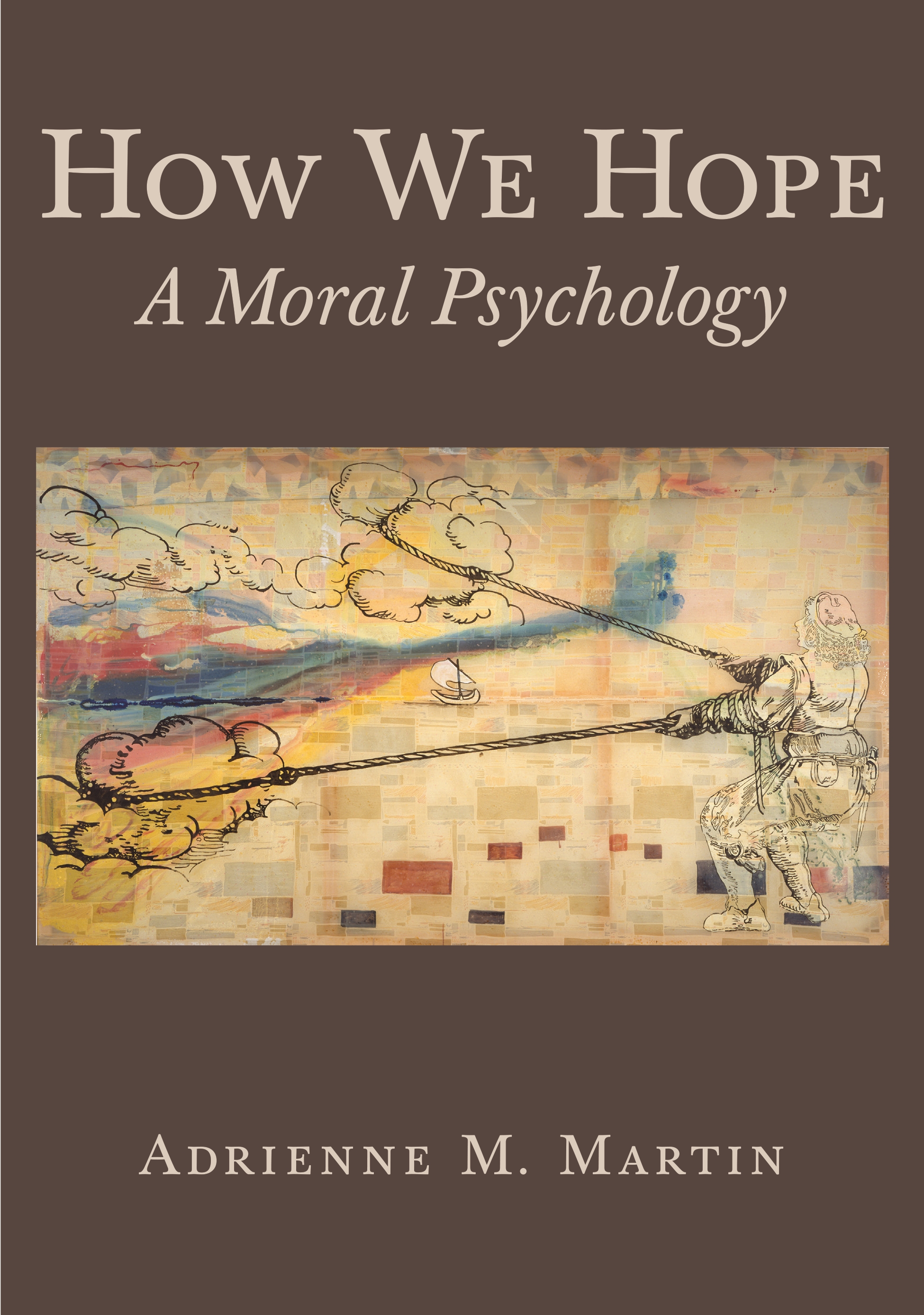
How We Hope: A Moral Psychology
Adrienne M. Martin
Best for: Readers seeking analytic clarity about what hope is.
Difficulty: Intermediate
Intellectual role: The moral psychology that distinguishes hope from desire and optimism.
Bookinlight Rating: ★★★★★
Martin’s book gives hope a careful analytic anatomy. Rather than treating hope as a vague positive attitude, she examines how hoping shapes agency, attention, practical reasoning, and self-understanding. The book is especially valuable because it explains why hope can matter even when probability is low. It gives readers a vocabulary for everyday cases: illness, ambition, waiting, moral repair, and the struggle to remain engaged when success is uncertain.
Critical Reception
“the most sophisticated and extensive philosophical analysis of hope available“
Bookinlight Note: This is the best bridge between philosophical theory and ordinary life; read it when you want conceptual rigor without losing emotional intelligence.
Hope Without Optimism
Terry Eagleton
Best for: Readers who distrust motivational rhetoric but still resist despair.
Difficulty: General to Intermediate
Intellectual role: The literary and theological critique of shallow positivity.
Bookinlight Rating: ★★★★★★
Eagleton’s sharp, humane book separates hope from the cultural industry of optimism. Drawing on literature, theology, tragedy, and politics, he argues that genuine hope is compatible with darkness because it does not depend on pleasant evidence. The result is a compact intellectual antidote to both cynicism and motivational cheer. Eagleton is especially helpful for readers who want hope to remain ethically serious, tragic, and historically informed.
Critical Reception
“a brilliantly engaged, impassioned chronicle of human belief and desire“
Bookinlight Note: Pair Eagleton with tragedy: he helps explain why the most serious art often refuses optimism while preserving a deeper form of expectation.
Hope in the Dark: Untold Histories, Wild Possibilities
Rebecca Solnit
Best for: Readers interested in activism, public memory, and civic imagination.
Difficulty: General
Intellectual role: The public humanities account of hope as historical attention.
Bookinlight Rating: ★★★★★★
Solnit’s book is the most accessible work in this list, but it is not simple. Her central insight is historical: despair often comes from forgetting how unpredictable change has always been. By recovering neglected victories, partial transformations, and unexpected solidarities, she gives hope a civic practice. Hope becomes the discipline of attending to uncertainty as a space of action rather than as an excuse for withdrawal.
Bookinlight Note: Solnit is the ideal final book in a reading group: she turns philosophical hope outward, toward movements, memory, and public courage.
How These Books Speak to One Another
Bloch gives hope its maximal philosophical range; Marcel makes it interpersonal; Moltmann gives it eschatological pressure; Lear tests it at the edge of cultural collapse; Martin clarifies its moral psychology; Eagleton defends it against cheap optimism; Solnit returns it to public action. Their disagreement is productive. Is hope grounded in metaphysics, faith, moral agency, historical memory, or political struggle? The answer offered by this reading sequence is that hope is not one thing. It is a family of practices by which human beings keep the future morally available.
The Reading Map
| Book | Difficulty | Rating | Why It Matters |
|---|---|---|---|
| The Principle of Hope | Advanced | ★★★★★ | Defines hope as the not-yet within reality. |
| Homo Viator | Intermediate | ★★★★★★ | Shows hope as fidelity and presence. |
| Theology of Hope | Advanced | ★★★★★★ | Places hope at the center of history. |
| Radical Hope | Intermediate | ★★★★★ | Tests hope after cultural devastation. |
| How We Hope | Intermediate | ★★★★★ | Clarifies hope as moral psychology. |
| Hope Without Optimism | General to Intermediate | ★★★★★★ | Separates hope from cheerful illusion. |
| Hope in the Dark | General | ★★★★★★ | Turns uncertainty into public action. |
Where to Begin
- Entry point: Begin with Hope in the Dark for an accessible civic vocabulary.
- Historical background: Move to Radical Hope to confront loss, collapse, and ethical imagination.
- Conceptual foundation: Read How We Hope for analytic precision.
- Critical perspective: Use Hope Without Optimism to remove sentimental consolation.
- Contemporary relevance: Read Theology of Hope for the relation between future, suffering, and transformation.
- Advanced reflection: Finish with Homo Viator and The Principle of Hope for existential and metaphysical depth.
External Sources for Further Reading
Stanford Encyclopedia of Philosophy: Hope
The Last Margin
The best books on the philosophy of hope do not promise consolation. They ask for more difficult habits: attention to what is unfinished, fidelity to persons and communities, courage before cultural loss, and refusal of cynical finality. Hope matters because the future is not simply something that arrives; it is something human beings prepare for, imagine, suffer toward, and sometimes help make possible. These seven books remind us that hope is not escape from reality. At its deepest, it is one of the ways reality remains open.