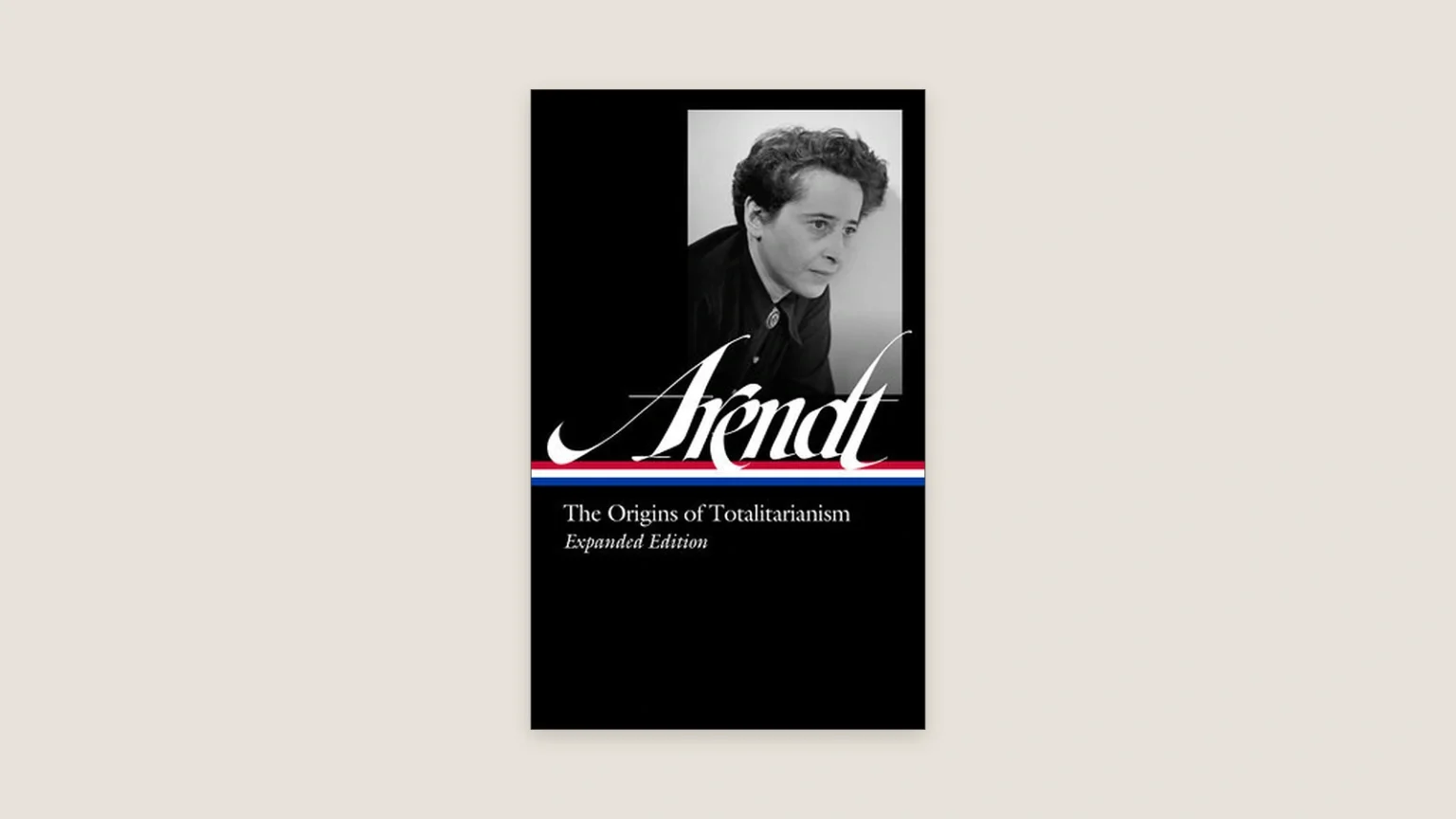
The Origins of Totalitarianism is Hannah Arendt’s attempt to understand a form of rule that sought not merely obedience but the destruction of spontaneity, factual reality, and political personhood. Scholarly articles on The Origins of Totalitarianism are represented here by ten carefully selected journal studies, each assessed separately for its question, argument, method, evidence, relation to Arendt’s book, legal access status, and author background. The guide also recommends a current annotated edition suited to sustained research.
The Book and the Recommended Edition

Hannah Arendt: The Origins of Totalitarianism, Expanded Edition
Library of America No. 389
Edition Details
- Author
- Hannah Arendt
- Original title
- The Origins of Totalitarianism
- Original publication
- New York: Harcourt, Brace and Company, 1951
- Original language
- English
- Editors
- Jerome Kohn and Thomas Wild
- Publisher
- Library of America
- Publication date
- April 22, 2025
- Format
- Hardcover; acid-free paper; Smyth-sewn binding
- Extent
- 891 pages in the publisher’s catalogue; the distributor record lists 900 pages
- ISBN-13
- 978-1-59853-806-9
- Language
- English
Why this edition
This is the most useful single-volume research edition currently available. It is based on the final version Arendt revised during her lifetime, but it also restores two historically important texts later removed from the main sequence: the 1951 “Concluding Remarks” and her account of the Soviet suppression of the Hungarian Revolution of 1956. Those restorations let readers see how the book’s treatment of rights, political beginnings, and post-Stalinist revolt changed across editions.
More important for close work, it is the first annotated edition, with concise glosses on historical names and references and a newly researched chronology. The apparatus does not settle the book’s disputes, but it reduces avoidable bibliographical confusion. Scholarly articles on The Origins of Totalitarianism often cite different printings and omitted materials; this apparatus makes those differences easier to track. The exact Library of America catalogue record gives the authoritative extent and contents; the Penguin Random House distribution page supplies the exact cover shown here.
Total Domination, Statelessness, and the Ruins of the Nation-State
Hannah Arendt (1906–1975) wrote The Origins of Totalitarianism as a German-Jewish refugee who had escaped Nazi Europe and rebuilt her intellectual life in New York. The book appeared in 1951, after the Holocaust and during the consolidation of Stalin’s rule, when inherited categories—tyranny, dictatorship, despotism—seemed inadequate to describe regimes that combined mass organization, ideological logic, bureaucratic administration, police terror, camps, and the systematic production of people treated as superfluous. The Hannah Arendt Papers at the Library of Congress document the scale of the political, historical, and philosophical work behind that diagnosis.
Its architecture is famously difficult. Three large parts—antisemitism, imperialism, and totalitarianism—do not form a simple chain in which one event mechanically causes the next. Arendt instead tracks “elements” that crystallized under specific conditions: racial thinking, overseas and continental imperialism, the expansionist logic of bourgeois power, the decay of the nation-state, mass denationalization, statelessness, the alliance of elites and mobs, ideological consistency, loneliness, and terror. The book’s culminating claim is that totalitarian domination seeks more than political control. It attacks plurality itself by making action unpredictable, rights unenforceable, experience untrustworthy, and human beings interchangeable.
That ambition made the book influential, but never uncontested. Historians have challenged particular causal links and sources; Marxist readers have disputed the relation between capitalism, imperialism, fascism, and Stalinism; postcolonial scholars have tested Arendt’s Africa chapters against colonial archives; political theorists continue to debate whether comparing Nazism and Stalinism clarifies their novelty or obscures decisive differences. Edition history matters too, because the 1951 ending, the later “Ideology and Terror” chapter, and the Hungarian Revolution material do not produce exactly the same intellectual horizon.
A responsible reading therefore needs argument-by-argument guidance rather than reverence or dismissal. The Stanford Encyclopedia of Philosophy, the Internet Encyclopedia of Philosophy, the Hannah Arendt Center at Bard College, and Jerome Kohn’s Library of Congress essay on totalitarianism as an inversion of politics provide reliable orientation. The ten studies below then reopen the book from distinct scholarly angles without reducing them to one collective verdict.
Scholarly articles on The Origins of Totalitarianism: Ten Essential Studies
The following list identifies the ten articles exactly as discussed in the individual cards:
- “Hannah Arendt and Marxist Theories of Totalitarianism” — Nicholas Devlin
- “When the Nation Conquered the State: Arendt’s Importance Today” — Kathleen R. Arnold
- “‘The nation has conquered the state’: Arendtian insights on the internal contradictions of the nation-state” — Peter J. Verovšek
- “Illusions of Sovereignty: Understanding Populist Crowds with Hannah Arendt” — Lars Rensmann
- “Carl Schmitt’s Confrontation with the Work of Hannah Arendt: A Debate on Totalitarianism, Power, and Banality of Evil” — Ville Suuronen
- “Arendt and Algeria” — Adam Y. Stern
- “Statelessness as a Political-Existential Predicament in the Lives and Writings of Three German-Jewish Intellectuals” — Sebastian Musch
- “Revisiting the Arendt-Voegelin Debate: Totalitarianism and Moral Reality” — Thomas Holman
- “From Expansionist Power to the Erosion of Bios in Arendt’s Interpretation of Hobbes” — Meghan Robison
- “Rethinking the Mob: An Analysis of Hannah Arendt’s Concept of the Mob” — Casper Verstegen
Article 1 of 10
“Hannah Arendt and Marxist Theories of Totalitarianism”
Nicholas Devlin
- Journal
- Modern Intellectual History
- Publisher
- Cambridge University Press
- Publication
- Vol. 20, no. 1 (March 2023), pp. 247–269; online November 16, 2021
- Affiliation
- Robinson College, University of Cambridge, at publication
- Article type
- Research article
- Approach
- Contextual intellectual history and conceptual genealogy
- DOI
- 10.1017/S1479244321000603
- Access
- Open-access full text examined; CC BY 4.0
Argument and Scope
Devlin relocates Arendt inside a history from which she is often detached. Rather than treating Origins as an isolated philosophical breakthrough or a straightforward Cold War theory, he argues that its early conceptual languages remained substantially continuous with interwar Marxist debates. Two idioms matter especially: imperialism and Bonapartism. Marxists used them to ask whether fascism and emerging totalitarian forms were primarily products of capitalist crisis, autonomous political domination, or unstable combinations of both.
Method and Evidence
The study practices contextual intellectual history in the Pocockian sense: it reconstructs the vocabularies available to Arendt rather than reading her concepts only through later canonical categories. Devlin compares interwar Marxist theorists, wartime controversies over the primacy of politics or economics, Arendt’s early essays, and successive formulations of her totalitarianism argument.
Relation to the Book
For readers of Origins, the payoff is twofold. The article clarifies why imperial expansion and bourgeois power occupy so much of the book, while also showing that the later “classical” theory of totalitarianism does not perfectly unify its three parts. It is especially useful against readings that make Arendt simply anti-Marxist or treat the book’s genealogy as politically unlocated. Scholarly articles on The Origins of Totalitarianism rarely reconstruct this Marxist genealogy so directly.
About the Author
Devlin is now a Fellow in Government at the London School of Economics. His official profile identifies political theory and intellectual history as his training, with study at York, Edinburgh, and Cambridge.
Article 2 of 10
“When the Nation Conquered the State: Arendt’s Importance Today”
Kathleen R. Arnold
- Journal
- Political Theory
- Publisher
- SAGE Publications
- Publication
- Vol. 51, no. 2 (April 2023), pp. 355–381; first published online August 25, 2022
- Affiliation
- Department of Political Science and Refugee and Forced Migration Studies, DePaul University
- Article type
- Research essay
- Approach
- Political-theoretical reconstruction with United States applications
- DOI
- 10.1177/00905917221104510
- Access
- Publisher abstract and official bibliographic record examined; full text restricted
Argument and Scope
Arnold asks what happens when Arendt’s analyses of racialized sovereignty, migration, camps, and statelessness are turned toward the United States. Her argument is deliberately double-edged. Arendt often denied or minimized structural connections between American racism and the European political disasters she analyzed; nevertheless, Arnold contends that Arendt’s own categories illuminate linked oppositions between prison and camp, citizen and stateless person, and external and internal displacement.
Method and Evidence
Because independent access was limited to the official abstract, bibliographic record, references, and author information, the method should be described cautiously. The article appears to combine conceptual interpretation of Arendt with historical and contemporary material on American racial formation, incarceration, migration policy, and forced displacement. Its intervention is critical rather than merely applicative: it uses Arendt against some of Arendt’s own exclusions.
Relation to the Book
The central bridge is the claim in Origins that the nation’s conquest of the state subordinates universal law to membership in a racialized or national community. Arnold presses that claim beyond its European frame. Readers interested in the “right to have rights,” denationalization, camps, and the racial boundaries of citizenship will find the article especially consequential.
About the Author
Arnold directs DePaul University’s graduate program in Refugee and Forced Migration Studies and teaches political theory, immigration law, human rights, political development, and political economy. Her institutional profile connects this article to a sustained research program on statelessness, poverty, displacement, race, and migration.
Editorial Note: The account above is confined to claims established by the official abstract and publisher record; it does not attribute unverified subsidiary arguments to the restricted text.
Article 3 of 10
“‘The nation has conquered the state’: Arendtian insights on the internal contradictions of the nation-state”
Peter J. Verovšek
- Journal
- Review of International Studies
- Publisher
- Cambridge University Press
- Publication
- Vol. 50, no. 4 (July 2024), pp. 682–699; online August 22, 2023
- Affiliation
- Department of History and Theory of European Integration, University of Groningen
- Article type
- Research article
- Approach
- Conceptual analysis, constitutional theory, and contemporary international politics
- DOI
- 10.1017/S0260210523000384
- Access
- Open-access full text examined; CC BY 4.0
Argument and Scope
Verovšek isolates a contradiction embedded in the hyphenated nation-state. The state claims universal legal authority over all inhabitants; the nation privileges belonging by origin, descent, or inherited identity. He argues that this instability helps explain why democratic statism repeatedly slides toward national sovereigntism: the particular nation can present itself as the authentic owner of institutions formally committed to equality.
Method and Evidence
The article reconstructs Arendt’s chapter “The Decline of the Nation-State and the End of the Rights of Man,” then tests its explanatory force through the 2015 European migration crisis and illiberal political developments in Central and Eastern Europe, especially Poland and Hungary. Verovšek treats Arendt’s historically saturated examples as a way to bridge description and prescription in international theory.
Relation to the Book
Unlike scholarship centered primarily on stateless persons’ claims to rights, this study foregrounds the institutional contradiction that produces their vulnerability. It helps readers see why the nation-state chapter is not a detachable human-rights interlude but a hinge between imperialism and totalitarianism: once national interest outranks law, legal universality becomes conditional.
About the Author
Verovšek is Assistant Professor in History and Theory of European Integration at the University of Groningen. His profile places his work across political science, international relations, philosophy, European integration, political thought, and collective memory.
Article 4 of 10
“Illusions of Sovereignty: Understanding Populist Crowds with Hannah Arendt”
Lars Rensmann
- Journal
- The Review of Politics
- Publisher
- Cambridge University Press
- Publication
- Vol. 85, special issue 4 (Fall 2023), pp. 450–473; online August 17, 2023
- Affiliation
- Chair of Political Science, Comparative Government, University of Passau
- Article type
- Research article
- Approach
- Conceptual reconstruction and comparative analysis of authoritarian populism
- DOI
- 10.1017/S0034670523000232
- Access
- Open-access full text examined; CC BY 4.0
Argument and Scope
Rensmann assembles concepts scattered across Arendt’s writings into a framework for authoritarian-populist crowds. The central claim is that organized mobs, fantasies of an indivisible sovereign people, leader worship, and indifference to factual truth are mutually reinforcing. Populist crowds do not simply express an already unified people; they imagine themselves as its exclusive embodiment and authorize the exclusion of those cast as alien, fraudulent, or traitorous.
Method and Evidence
The article reconstructs Arendt’s categories of mob, masses, sovereignty, public freedom, organized lying, and common world, then places them beside contemporary populist rhetoric and political mobilization. Its procedure is theoretical rather than quantitative: current examples test whether the conceptual relations Arendt identified can explain antipluralism, election denial, conspiracy narratives, and violence directed against constitutional restraints.
Relation to the Book
The essay draws most directly on Origins’ treatment of the mob, totalitarian movements, propaganda, tribal nationalism, and the destruction of the boundary between fact and fiction. It also brings later Arendtian objections to sovereignty into the analysis. The result is valuable for readers asking how concepts forged for totalitarian movements can be used without simply labeling every populist constituency totalitarian.
About the Author
Rensmann is Professor of Political Science and Comparative Government at the University of Passau. His research addresses democratic crisis, authoritarian populism, the radical right, nationalism, antisemitism, and global political theory.
Article 5 of 10
“Carl Schmitt’s Confrontation with the Work of Hannah Arendt: A Debate on Totalitarianism, Power, and Banality of Evil”
Ville Suuronen
- Journal
- Global Intellectual History
- Publisher
- Taylor & Francis
- Publication
- Vol. 8, no. 3 (2023), pp. 270–305; online June 30, 2022
- Affiliation
- Centre of Excellence in Law, Identity and the European Narratives, University of Helsinki, at publication
- Article type
- Research article
- Approach
- Archival intellectual history and comparative conceptual analysis
- DOI
- 10.1080/23801883.2022.2074866
- Access
- Publisher open-access full text examined
Argument and Scope
Suuronen reconstructs a debate that never occurred face to face. Carl Schmitt read and annotated Arendt extensively, and those traces reveal a sustained confrontation over totalitarianism, political power, responsibility, and the banality of evil. Schmitt’s initial enthusiasm for Origins was bound to selective and often self-serving interpretations; his later responses shifted as Arendt’s account of responsibility became harder to appropriate.
Method and Evidence
The article’s distinctive strength is archival. It draws on Schmitt’s marginalia, comments, reading notes, and related materials, placing them beside Arendt’s published works and the political circumstances of their reception. That evidence allows Suuronen to distinguish genuine conceptual proximity from Schmitt’s attempts to make Arendt’s analysis serve his own postwar self-understanding.
Relation to the Book
This study is less a general interpretation of Origins than a reception history with unusually revealing evidence. It shows how a compromised jurist of dictatorship read Arendt’s account of totalitarianism and where the book’s concepts of power, law, culpability, and ideological rule resisted his appropriation. It is indispensable for readers interested in the political uses made of Arendt after 1945.
About the Author
Suuronen is a Postdoctoral Researcher in Political Science at the Turku Institute for Advanced Studies, University of Turku. His research crosses political theory, political history, legal history, authoritarianism, and twentieth-century European thought.
Article 6 of 10
“Arendt and Algeria”
Adam Y. Stern
- Journal
- Modern Intellectual History
- Publisher
- Cambridge University Press
- Publication
- Vol. 20, no. 2 (June 2023), pp. 460–483; online May 26, 2022
- Affiliation
- Department of German, Nordic, and Slavic and Center for Jewish Studies, University of Wisconsin–Madison
- Article type
- Research article
- Approach
- Intellectual history, postcolonial close reading, and analysis of colonial law
- DOI
- 10.1017/S147924432200021X
- Access
- Open-access full text examined; CC BY 4.0
Argument and Scope
Stern identifies Algeria as a persistent but understudied site in Arendt’s writing. He follows it from her 1943 essay on the Crémieux Decree through Origins and “On Violence,” arguing that Arendt’s engagement with French imperialism is both sustained and ambivalent. She repeatedly slips into apologetic language about the French imperial nation-state, yet her distinctions also expose the legal and temporal structure of colonial domination.
Method and Evidence
The article combines close reading with intellectual and colonial history. Its evidence includes Arendt’s major and minor texts, French imperial legal regimes, the differential operation of assimilation and rule by decree, and a conceptual recasting of power and violence. Stern’s striking emphasis on speed asks how colonial law established different temporalities for settlers, assimilated subjects, and governed populations.
Relation to the Book
For Origins, Algeria becomes more than an example within a general theory of imperialism. It reveals how naming, territory, legal status, decree, and racialized administration organize colonial space-time. The article is especially useful for testing Arendt’s imperialism chapters against postcolonial criticism without assuming that their Eurocentrism exhausts what the concepts can disclose.
About the Author
Stern is Associate Professor of German and Jewish Studies at the University of Wisconsin–Madison. His research works across German studies, Jewish thought, political theology, and intellectual history.
Article 7 of 10
“Statelessness as a Political-Existential Predicament in the Lives and Writings of Three German-Jewish Intellectuals”
Sebastian Musch
- Journal
- The Historical Journal
- Publisher
- Cambridge University Press
- Publication
- Vol. 68, special issue 3 (June 2025), pp. 608–626; online April 15, 2025
- Affiliation
- Department of History and Institute for Migration Research and Intercultural Studies, Osnabrück University
- Article type
- Research article
- Approach
- Comparative intellectual history and biographical-textual analysis
- DOI
- 10.1017/S0018246X24000748
- Access
- Open-access full text examined; CC BY 4.0
Argument and Scope
Musch compares Hannah Arendt, Kurt Grossmann, and Günther Anders as German-Jewish intellectuals whose statelessness was simultaneously a legal condition, a biographical rupture, and a political-existential predicament. All three attempted to imagine a common refugee polis, yet their efforts to recover agency also turned historical and philosophical writing into a renegotiation of their own displaced lives.
Method and Evidence
The article joins life-writing, exile history, and comparative intellectual history. It reads autobiographical and political texts against the institutional realities of denationalization, refuge, and migration. Arendt’s “We Refugees” and the statelessness chapters of Origins are set beside Grossmann’s and Anders’s attempts to represent refugee agency and community.
Relation to the Book
Musch helps readers understand that Arendt’s analysis of rightlessness was not produced from a neutral distance. Her theory emerges from—and transforms—an experience of exclusion from political membership. The comparison prevents biography from becoming a key that mechanically explains the text, while showing how the “right to have rights” carries the pressure of exile, self-representation, and the search for a political world. Scholarly articles on The Origins of Totalitarianism often treat statelessness conceptually; this study restores its biographical and existential pressure.
About the Author
Musch is a historian at Osnabrück University whose research includes German-Jewish history, Holocaust studies, forced migration, Jewish intellectual history, and transnational migration regimes.
Article 8 of 10
“Revisiting the Arendt-Voegelin Debate: Totalitarianism and Moral Reality”
Thomas Holman
- Journal
- The Review of Politics
- Publisher
- Cambridge University Press
- Publication
- Vol. 88, no. 2 (Spring 2026), pp. 202–220; online March 26, 2026
- Affiliation
- Department of Politics, The Catholic University of America
- Article type
- Research article
- Approach
- Diachronic comparative intellectual history
- DOI
- 10.1017/S0034670526100576
- Access
- Official abstract and bibliographic record examined; full text restricted
Argument and Scope
Holman revises the familiar account of Arendt and Eric Voegelin as offering irreconcilable interpretations of totalitarianism in their 1953 exchange. By widening the temporal frame beyond the published debate, he argues that their later thought converges around questions of “moral reality”: how human beings participate in a reality that totalitarian ideology distorts, and how guilt, responsibility, and political judgment become possible after catastrophe.
Method and Evidence
The verified abstract indicates a diachronic comparison of the thinkers’ development, especially Arendt’s language of “reality as such,” Voegelin’s “first reality,” and their treatments of German guilt in the early 1960s. Because the full text was not independently available, finer claims about textual sequence and subsidiary evidence are deliberately withheld here.
Relation to the Book
The article returns readers to one of the earliest substantial disputes over Origins. Voegelin objected to Arendt’s historical and philosophical account; Arendt defended the need to understand totalitarianism’s unprecedented reality without deducing it from spiritual decline. Holman’s intervention suggests that disagreement over explanation may coexist with a shared concern for the moral devastation produced when participation in reality is lost.
About the Author
Holman is an Adjunct Professor in the Department of Politics at The Catholic University of America. His official profile identifies communication, debate, twentieth-century totalitarian crises, and the Arendt-Voegelin exchange as central research concerns.
Editorial Note: This summary remains limited to the intervention established by the official abstract and publisher metadata; it does not reconstruct the restricted article beyond that evidence.
Article 9 of 10
“From Expansionist Power to the Erosion of Bios in Arendt’s Interpretation of Hobbes”
Meghan Robison
- Journal
- Arendt Studies
- Publisher
- Philosophy Documentation Center
- Publication
- Vol. 6 (2022), pp. 169–195; first published online October 28, 2021
- Affiliation
- Department of Philosophy, Montclair State University
- Article type
- Research article
- Approach
- Developmental close reading and conceptual reconstruction
- DOI
- 10.5840/arendtstudies2021102742
- Access
- Publisher full text examined through the official PDCNet record
Argument and Scope
Robison traces a development in Arendt’s reading of Thomas Hobbes from “Expansion and the Philosophy of Power” and Origins to The Human Condition. Hobbes matters not only as the philosopher of an expansionist concept of power and an imperialist political economy. Through the idea of process, he also becomes central to Arendt’s diagnosis of modernity’s elevation of biological life—the “life-process”—into its highest value.
Method and Evidence
The method is developmental close reading. Robison compares Arendt’s 1946 essay, the imperialism section of Origins, and the later analysis of labor, process, and the modern vita activa. Attention to recurring terms—power, accumulation, process, life, and expansion—shows how a political-economic critique becomes a broader account of modern world alienation.
Relation to the Book
The article offers a strong route into the chapter “The Political Emancipation of the Bourgeoisie.” It explains why Arendt makes Hobbes the philosophical representative of a society in which power must endlessly accumulate to secure future power. By connecting that argument to the later critique of biological process, Robison reveals continuity between Origins and The Human Condition without treating the two books as identical projects.
About the Author
Robison is Associate Professor of Philosophy at Montclair State University. She specializes in political philosophy, early modern philosophy, and feminist theory, with research on embodiment and authority in early modern political thought.
Article 10 of 10
“Rethinking the Mob: An Analysis of Hannah Arendt’s Concept of the Mob”
Casper Verstegen
- Journal
- Arendt Studies
- Publisher
- Philosophy Documentation Center
- Publication
- Vol. 6 (2022), pp. 197–221; first published online February 19, 2022
- Affiliation
- University of Amsterdam, as identified in the published article
- Article type
- Research article
- Approach
- Conceptual analysis and textual reconstruction
- DOI
- 10.5840/arendtstudies202221846
- Access
- Publisher full text examined through the official PDCNet record
Argument and Scope
Verstegen recovers a concept that is central to Origins but often collapsed into Arendt’s better-known account of the masses. The mob is not simply a poor crowd or a synonym for mass society. It is composed of the residue of all classes, stands outside ordinary representation, is drawn to violence and scandal, and can be mistaken for “the people” precisely because it cuts across class boundaries.
Method and Evidence
The paper reconstructs Arendt’s definitions across Origins, later essays, lectures, and correspondence. It traces the mob’s social origins, its alliance with elites, its ideological tendencies toward tribal nationalism and rebellious nihilism, and its transformation within totalitarian movements. Verstegen also engages Robert Paxton’s objection to theories that describe fascism as arising from atomized mass society.
Relation to the Book
This is the most tightly focused conceptual study in the selection. It clarifies a thread running from the Dreyfus Affair and imperialist politics to pan-movements and totalitarian organization. The distinction between mob and masses also disciplines contemporary analogy: a mobilized, cross-class group hostile to institutions is not automatically identical with the isolated mass individuals whom totalitarian movements seek to organize.
About the Author
The published article identifies Verstegen with the University of Amsterdam. A current academic profile associates him with Utrecht University and lists Hannah Arendt as an area of specialization; the distinction is preserved here rather than treating publication-time and current affiliations as interchangeable.
Related BookInLight Reading Guides
- Power, Evil, and the Common World: A Six-Book Path into Hannah Arendt — a staged route through judgment, action, total domination, authority, revolution, and responsibility.
- When Words Stop Accusing: Orwell and the Bureaucracy of Moral Evasion — a companion inquiry into official language, agency, and the disappearance of responsibility.
- How Politics Works: Twenty Books from First Questions to Serious Study — a broader reading map placing Arendt inside political science and political thought.
- BookInLight’s research guide to Fanon’s The Wretched of the Earth — ten article-by-article studies of colonial violence, decolonization, national culture, and political subjectivity.
Professional Editorial Note
This article was researched and written by the BookInLight Department of Political Thought and Intellectual History. Preparation included bibliographical review of the book’s publication and edition history, article and DOI verification, access-status review, institutional-profile checking, source verification, and editorial fact-checking. Readers are invited to submit factual corrections, overlooked scholarly sources, interpretive suggestions, and constructive ideas that may strengthen a future revision.
The BookInLight Art Department developed the editorial art direction, visual composition, cover selection, and image presentation. Rights in the displayed third-party cover remain with the relevant publisher, designer, artist, and other rights holders. Complete republication, reproduction, translation, or reuse of this article requires prior written permission from BookInLight.
Sources and Further Reading
Recommended Edition and Publication History
- Library of America, The Origins of Totalitarianism, Expanded Edition — authoritative contents, editors, ISBN, series number, extent, restored texts, annotation statement, and physical specifications.
- Penguin Random House edition record — publication date, format, distribution metadata, editors, ISBN, and exact cover asset.
Book and Author
- Library of Congress, Hannah Arendt Papers — archival scope, chronology, correspondence, manuscripts, and career context.
- Stanford Encyclopedia of Philosophy, “Hannah Arendt” — philosophical orientation and the relations among totalitarianism, action, plurality, judgment, and modernity.
- Jerome Kohn, “Totalitarianism: The Inversion of Politics” — concise institutional account of Arendt’s concept of total domination.
- Hannah Arendt Center at Bard College — scholarly programming, archival interpretation, and current work on Arendt’s political thought.
Ten Selected Articles
- Nicholas Devlin, “Hannah Arendt and Marxist Theories of Totalitarianism”, Modern Intellectual History 20, no. 1 (2023): 247–269.
- Kathleen R. Arnold, “When the Nation Conquered the State: Arendt’s Importance Today”, Political Theory 51, no. 2 (2023): 355–381.
- Peter J. Verovšek, “‘The nation has conquered the state’: Arendtian insights on the internal contradictions of the nation-state”, Review of International Studies 50, no. 4 (2024): 682–699.
- Lars Rensmann, “Illusions of Sovereignty: Understanding Populist Crowds with Hannah Arendt”, The Review of Politics 85, special issue 4 (2023): 450–473.
- Ville Suuronen, “Carl Schmitt’s Confrontation with the Work of Hannah Arendt: A Debate on Totalitarianism, Power, and Banality of Evil”, Global Intellectual History 8, no. 3 (2023): 270–305.
- Adam Y. Stern, “Arendt and Algeria”, Modern Intellectual History 20, no. 2 (2023): 460–483.
- Sebastian Musch, “Statelessness as a Political-Existential Predicament in the Lives and Writings of Three German-Jewish Intellectuals”, The Historical Journal 68, special issue 3 (2025): 608–626.
- Thomas Holman, “Revisiting the Arendt-Voegelin Debate: Totalitarianism and Moral Reality”, The Review of Politics 88, no. 2 (2026): 202–220.
- Meghan Robison, “From Expansionist Power to the Erosion of Bios in Arendt’s Interpretation of Hobbes”, Arendt Studies 6 (2022): 169–195.
- Casper Verstegen, “Rethinking the Mob: An Analysis of Hannah Arendt’s Concept of the Mob”, Arendt Studies 6 (2022): 197–221.
Scholar Profiles and Access Records
- Official institutional profiles for Nicholas Devlin, Kathleen R. Arnold, Peter J. Verovšek, Lars Rensmann, and Ville Suuronen — current positions and research fields.
- Official or authoritative profiles for Adam Y. Stern, Sebastian Musch, Thomas Holman, Meghan Robison, and Casper Verstegen — affiliations, specialization, and publication context.
Image Credits
- Hannah Arendt: The Origins of Totalitarianism, Expanded Edition, Library of America No. 389, 2025, ISBN 978-1-59853-806-9. Cover image supplied through the exact Penguin Random House edition page. Cover rights remain with the publisher, designer, artist, and other respective rights holders.