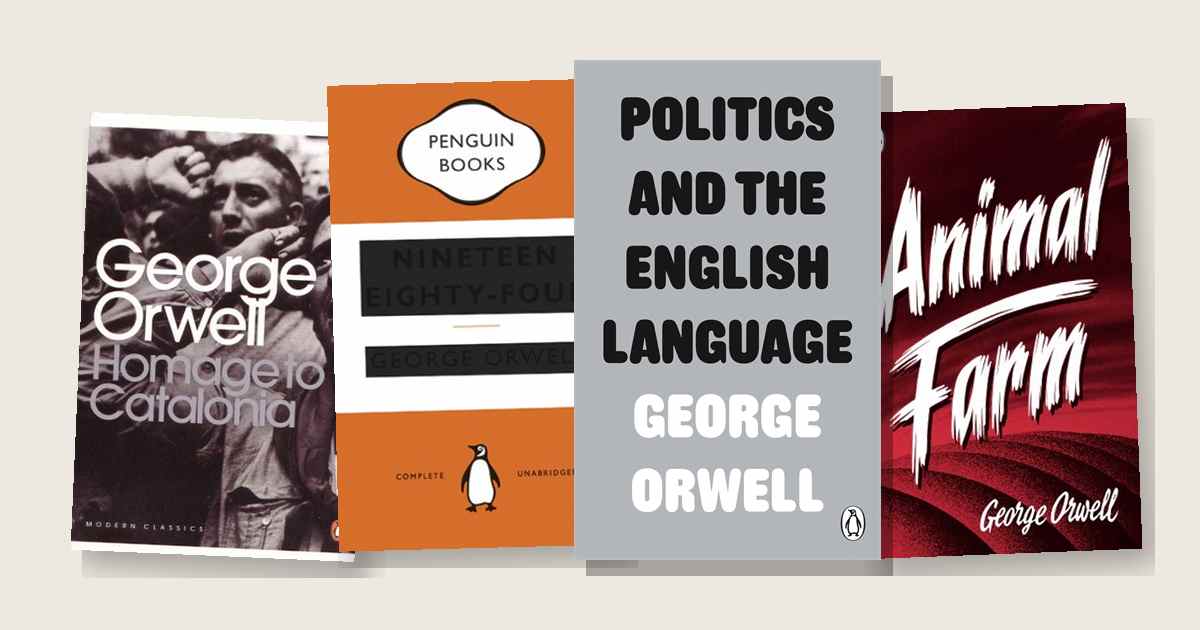
Orwell on Political Language begins from a harder claim than the familiar demand for clear prose. Political cruelty becomes easier to defend when sentences hide agents, replace bodies with abstractions, and convert decisions into procedures. Orwell’s central insight is therefore moral before it is stylistic: bureaucratic language can weaken judgment by making human acts appear as impersonal necessities. Yet his remedy—the recovery of concrete words and visible responsibility—remains powerful precisely because it is incomplete.
“Politics and the English Language” is often taught as a manual against clichés, inflated diction, and the passive voice. That reading is not wrong, but it is too small. The essay’s famous rules matter because Orwell believed certain habits of prose altered the conditions under which a person could recognize what he or she was doing. Bad political language did not merely communicate badly. It dulled the imagination at the point where imagination was needed to connect an official phrase with a wounded body, a signed order with a death, or an institutional objective with the people sacrificed to it.
The key passage in Orwell’s 1946 essay is not the list of six rules. It is his claim that modern political prose frequently exists to defend what would sound intolerable if stated plainly. Euphemism, abstraction, and prefabricated phrases create distance between the speaker and the event. They do not abolish moral knowledge in a single stroke. They make evasion habitual, and habit gradually changes what the speaker can bear to see.
That argument arose from a distinctive sequence of experiences: imperial administration in Burma, factional propaganda during the Spanish Civil War, wartime broadcasting at the BBC, censorship and ideological conformity on the British left, and the rise of states that treated factual truth as politically disposable. Orwell did not produce a systematic theory of bureaucracy. He produced something more literary and, in one respect, more intimate: an anatomy of how official language enters the conscience. The bureaucratic destruction of moral judgment begins when the sentence ceases to say who did what to whom.
The Wars That Taught Orwell to Distrust Abstraction
Orwell’s suspicion of official language was not born in a seminar on rhetoric. From 1922 to 1927, as Eric Blair, he served in the Indian Imperial Police in Burma. The later essays “A Hanging” and “Shooting an Elephant” turn imperial power into scenes of compromised agency: a condemned prisoner steps around a puddle on the way to the gallows; a police officer kills an elephant because the expectations of the crowd trap him inside the role of the sahib. These are not simple memoirs of awakening. They show an institution distributing coercion through offices, uniforms, racial hierarchy, and ritual until no single participant seems fully sovereign over the act.
The importance of Burma for Orwell’s language lies in the collision between administrative description and sensory fact. Empire prefers categories—native, prisoner, order, discipline, prestige. Orwell’s essays restore gait, mud, skin, breath, fear, and embarrassment. The movement from category to particular is already a moral method. The extensive manuscripts, correspondence, and publishing records preserved in the George Orwell Archive at UCL help place this method within a career repeatedly shaped by institutions he distrusted but also inhabited.
Spain made the problem more urgent. Orwell went to Barcelona in late 1936 intending to fight fascism and joined the militia of the anti-Stalinist POUM. After the political conflict within the Republican camp intensified in May 1937, the POUM was suppressed and denounced as a fascist agency; Orwell and his wife Eileen escaped arrest. In Homage to Catalonia and “Looking Back on the Spanish War”, the lesson is not merely that propaganda lies. It is that political allegiance can reorganize perception so thoroughly that fabricated accusations become more usable than witnessed events.
Spain also taught Orwell that falsehood is rarely sustained by one dictator speaking into a microphone. Newspapers repeat party claims; editors suppress awkward reports; intellectuals excuse “their” side; administrative bodies classify inconvenient comrades as enemies. The lie acquires solidity through circulation. Once embedded in files, headlines, minutes, and authorized histories, it becomes difficult to challenge because each participant can point to another source. Bureaucracy turns repetition into evidence.
The Second World War added a further complication. Orwell worked for the BBC’s Eastern Service from 1941 to 1943, preparing cultural and political broadcasts aimed chiefly at Indian audiences. He opposed fascism and supported the war, yet he knew that he was participating in imperial propaganda. This experience matters because it prevents a comfortable division between the truthful independent writer and the dishonest state official. Orwell understood the institutional pressure from inside: deadlines, scripts, policy aims, supervisory approval, target audiences, and the quiet conversion of political judgment into “output.” His later statement in “Why I Write”—that he wrote to expose a lie or draw attention to a fact—was not a claim of innocence. It was a discipline adopted by someone who knew how easily prose could become a function.
Orwell on Political Language: The Sentence as Moral Evidence
Orwell on Political Language is most persuasive when read as a theory of moral attention. He begins by arguing that corrupt thought and corrupt language reinforce one another. The relationship is reciprocal: foolish or dishonest ideas produce ugly prose, while habitual ugliness makes it easier to continue thinking dishonestly. This reversibility matters. If language were only the passive symptom of ideology, stylistic reform would be cosmetic. Orwell instead treats revision as a modest political act because a sentence can be forced to disclose what a formula conceals.
His targets are familiar: dying metaphors, verbal false limbs, pretentious diction, meaningless words, and passages assembled from ready-made phrases. Their common defect is not simply verbosity. They reduce the writer’s need to picture the event. A phrase such as “transfer of population” can be repeated without imagining a family forced from a house. “Pacification” can suppress the sight of burned villages. “Elimination of unreliable elements” turns people into a residue. The bureaucratic sentence protects the writer from the picture that ordinary nouns and active verbs would produce.
Political language can “make lies sound truthful and murder respectable.”
The moral force of that sentence lies in its verbs. Lies are made to sound truthful; murder is made respectable. Language performs laundering. It does not usually command the violent act by itself, and Orwell never claims that grammar causes massacre. The stronger and more defensible claim is that language creates an atmosphere in which the act can be proposed, processed, justified, and remembered without its full meaning remaining present.
The passive voice is therefore a political problem only under certain conditions. “Mistakes were made” is objectionable not because every passive construction is weak, but because agency disappears exactly where accountability is needed. Abstract nouns produce a similar effect. They allow policies to appear as natural processes: displacement happens, casualties occur, targets are neutralized, services are rationalized. The sentence resembles a weather report. No one chooses; no one suffers; no one is answerable.
Orwell’s preference for concrete language should not be confused with hostility to theory. His own essays make broad judgments about imperialism, class, nationalism, socialism, and totalitarianism. What he resists is abstraction that has ceased to answer to experience. In “The Prevention of Literature”, he connects intellectual freedom to the ability to report what one has seen, heard, and felt. Truth begins not in neutrality but in fidelity: the refusal to replace an inconvenient perception with the formula demanded by a party, publisher, ministry, or cause.
The decisive distinction: clear language does not guarantee moral judgment, but evasive institutional language can make judgment harder by severing actions from agents, consequences, and visible persons.
From Euphemism to Office Procedure
The title phrase “bureaucratic destruction of moral judgment” must be handled carefully. Bureaucracy is not inherently immoral. Large societies require records, procedures, expertise, continuity, and offices whose authority does not depend on private favoritism. Orwell’s target is not administration as such. It is the point at which administrative form becomes a shelter from responsibility.
That shelter has several layers. Work is divided, so each official performs only a fragment. Rules define the fragment as a technical duty. Documents move upward and downward through a hierarchy, while decisions are translated into standardized categories. The vocabulary of the institution then describes success in terms internal to the process: cases completed, targets met, risks managed, populations moved, objections cleared. A person may contribute to a harmful outcome without ever encountering the outcome as a whole.
Nineteen Eighty-Four gives this mechanism its most memorable fictional form. Winston Smith does not spend his working day shouting slogans at prisoners. He revises old newspaper reports in the Records Department of the Ministry of Truth. The work is clerical, exact, and endless. A name is removed; a prediction is corrected; a document is rewritten; the superseded record enters the memory hole. The horror lies in the compatibility between conscientious office work and systematic falsification. Winston’s skill does not protect him from the institution’s purpose. It helps the purpose operate.
The ministries’ names—Truth, Peace, Love, Plenty—are often treated as examples of crude inversion. They are more disturbing than that. Each name provides an official vocabulary within which the institution’s activity can be discussed without using morally accurate terms. Torture becomes the work of Love; war belongs to Peace; scarcity is administered by Plenty. The lie is not merely a slogan placed over reality. It is the organizational language through which tasks are assigned and reports become legible.
This is where “Notes on Nationalism” deepens the argument. Orwell defines nationalism broadly as identification with a power unit and the desire to place it beyond ordinary moral standards. The nationalist intelligence does not necessarily lack facts. It sorts them according to loyalty. Atrocities committed by the opposing camp remain vivid; atrocities committed by one’s own become doubtful, necessary, exaggerated, or irrelevant. Bureaucratic language supplies the sorting mechanism with respectable terms.
Moral judgment is destroyed less by ignorance than by partition. The official knows one procedure, the partisan knows one set of facts, the editor knows one permissible emphasis, and the citizen hears one authorized vocabulary. Each fragment may appear defensible. The whole remains unseen.
The Contradiction in the Plain Style
Orwell’s remedy is clarity, but clarity is not innocence. A demagogue can use short sentences. A bureaucracy can issue a perfectly lucid order. A propagandist can choose concrete nouns and active verbs. Plain language may reveal responsibility, yet it may also deliver cruelty with brutal efficiency. Any serious reading of Orwell must therefore resist turning style into a moral test.
This is the contradiction inside Orwell on Political Language. He sometimes writes as though fresh wording can break political conformity, but his own examples show that the deeper forces are institutional and ideological. A writer may understand every rule in the essay and still choose to deceive. Conversely, difficult prose is not necessarily dishonest. Philosophy, law, science, and administration sometimes require technical distinctions unavailable to ordinary speech. The question is whether the terminology sharpens responsibility or disperses it.
Alex Woloch’s account of Orwell’s prose is especially useful here because it challenges the myth of effortless transparency. Orwell’s writing is not merely “plain.” It is structured by irony, self-correction, shifts of scale, documentary detail, and formal tension. The voice that appears direct often stages an argument between observation and inherited language. Orwell’s achievement was not the elimination of rhetoric. It was the use of rhetoric to expose rhetoric’s evasions.
His rules themselves acknowledge the limit. The final instruction permits the writer to break any rule rather than say something “outright barbarous.” Moral judgment precedes the style guide. A sentence must be tested not only for length, image, voice, or diction but for what it asks the reader to accept. The plain style is valuable when it restores the scene of action: an actor, an act, a consequence, a person affected. It fails when it becomes another ready-made badge of honesty.
Orwell’s own political vocabulary also had blind spots. His appeals to decency and common sense could rely on an imagined English moral culture whose exclusions he did not always examine. His hostility to intellectual jargon occasionally encouraged a false opposition between ordinary experience and conceptual thought. Later admirers often intensify this weakness, presenting Orwell as the solitary honest man facing all ideology from outside. John Rodden’s history of Orwell’s reputation shows how readily “Orwell” became a moral possession claimed by rival camps. The saint of clarity can become a substitute for argument.
Weber, Arendt, and What Orwell Left Unsystematic
Two later comparisons clarify Orwell’s argument, provided they are treated as comparisons rather than claims of direct influence. Max Weber’s analysis of modern bureaucracy explains why the office can be efficient, predictable, and morally dangerous at the same time. Rule-bound administration replaces personal discretion with competence, hierarchy, files, and defined jurisdiction. That transformation can restrain arbitrary power. It can also produce officials who understand responsibility as correct performance within a role.
The useful Weberian point is not that bureaucracy makes everyone evil. It is that rationalized institutions separate technical judgment from judgment about ends. An official may ask whether an action is authorized, efficient, or procedurally valid without asking whether the action is just. The Stanford Encyclopedia of Philosophy’s account of Weber emphasizes his distinction between an ethic of conviction and an ethic of responsibility. Orwell adds a linguistic question: what forms of speech allow an institution to misdescribe the consequences for which its agents remain responsible?
Hannah Arendt offers the sharper supplement. Her later analysis of totalitarianism, bureaucracy, and judgment does not simply repeat Orwell. She is less confident that factual clarity alone can preserve moral independence. In her account of Adolf Eichmann, the danger lies partly in a failure to think from the standpoint of another person—a collapse of judgment expressed through clichés, official formulas, and careerist obedience. The famous phrase “banality of evil” has often been flattened into the claim that evil is ordinary. Arendt’s more exact point concerns thoughtlessness: the inability or refusal to examine the meaning of one’s acts outside the vocabulary of the role.
The Stanford Encyclopedia’s overview of Arendt places judgment within her larger distinction between genuine political action and bureaucratic administration. Read retrospectively beside Orwell, Arendt reveals what his account leaves unresolved. Naming the act plainly is necessary, but a person must also be willing to judge without the protection of the institution’s categories. Language can reopen perception; it cannot compel courage.
Victor Klemperer’s study of the language of the Third Reich supplies another essential correction. Political language does not operate only through spectacular lies. It works through repetition, tonal habits, abbreviations, slogans, metaphors, and words that slowly alter ordinary sensibility. Orwell’s Newspeak dramatizes deliberate vocabulary reduction by a totalitarian state; Klemperer documents the more diffuse process by which a regime’s language enters daily speech. Together they show that moral judgment can be weakened before a person consciously endorses the doctrine carried by the words.
The Afterlife of an Easily Misused Orwell
Orwell’s reputation now creates the very problem his essays warned against. “Orwellian” has become a prefabricated adjective applied to surveillance, censorship, euphemism, ideological pressure, digital tracking, institutional opacity, and almost any disliked form of authority. The word often ends discussion rather than beginning it. Once attached to an opponent, it permits the speaker to borrow Orwell’s moral prestige without identifying the precise mechanism at work.
The right has often detached Orwell’s anti-Stalinism from his democratic socialism; parts of the left have minimized the severity of his attack on Soviet apologetics; liberals have turned him into a general patron of moderation; journalists invoke him as the guardian of factual sanity. Each appropriation captures something and simplifies something. His proposed preface to Animal Farm, published as “The Freedom of the Press”, is especially inconvenient to partisan ownership because it criticizes voluntary intellectual conformity in democratic Britain, not only censorship imposed by dictators.
The strongest contemporary use of Orwell on Political Language is therefore diagnostic rather than prophetic. He did not predict every later technology or administrative form. He identified a recurring relation: institutions generate vocabularies that make their operations appear necessary, neutral, and morally weightless. Those vocabularies deserve suspicion whenever they remove agents, hide consequences, convert contested choices into technical inevitabilities, or describe harmed persons only as categories in a process.
The survival of Orwell’s manuscripts and papers—recognized by UNESCO’s Memory of the World register—also reminds us that his authority rests on a body of drafts, letters, journalism, broadcasts, and arguments, not on a handful of slogans. Returning to that archive is one way to rescue Orwell from “Orwellian.”
Moral Judgment Begins with Naming the Act
Orwell’s most durable insight is not that simple words are always true. It is that moral evasion often leaves a linguistic trace. The agent vanishes. The verb weakens. The person becomes a category. The consequence becomes an outcome. The decision becomes a process. By the time the sentence reaches the public, an act that required choice appears to have happened by itself.
Against that drift, Orwell asks the writer to reconstruct the scene. Who decided? What was done? To whom? Under which description would the act appear intolerable? Which abstraction prevents the reader from picturing it? These are grammatical questions only because grammar is one place where responsibility is either preserved or lost.
The limit of Orwell on Political Language is equally important. Clear description cannot by itself overcome obedience, loyalty, fear, careerism, or institutional fragmentation. A person may see accurately and still comply. Moral judgment requires more than verbal honesty: it requires the willingness to refuse an authorized description when that description falsifies the human meaning of the act.
Orwell nevertheless gives judgment its indispensable first step. Before responsibility can be accepted, the act must be named. Before a policy can be judged, its consequences must be imaginable. Before bureaucracy can be held answerable, its passive procedures must be translated back into human decisions. Political language becomes dangerous when it makes that translation unnecessary. Orwell’s work remains severe because it insists that the sentence is never merely a sentence when it helps a person avoid knowing what he has done.
Related BookInLight Reading Guides
- Six Essential Books on Dystopian Fiction and Totalitarianism places Nineteen Eighty-Four beside Zamyatin, Huxley, Koestler, Atwood, and Arendt to compare different architectures of total power.
- Seven Essential Books on Soviet Dissident Literature extends Orwell’s concern with truthful description into fiction, memoir, camp testimony, suppressed archives, and moral witness.
- Seven Essential Books on Gramsci and Cultural Hegemony offers a contrasting account of how language, institutions, education, and common sense organize political consent.
This article was researched and written by the BookInLight Department of Political Thought and Intellectual History. Its preparation included bibliographical review, source verification, and editorial fact-checking. Readers are invited to send factual corrections, overlooked sources, interpretive suggestions, and constructive ideas for revision.
Editorial typography, visual composition, text hierarchy, and presentation were developed by the BookInLight Art Department. The article is intentionally text-only. Complete republication, reproduction, translation, or reuse requires prior written permission from BookInLight.
Sources and Further Reading
Primary Texts
- George Orwell, “Politics and the English Language”, Horizon, April 1946. The principal text for Orwell’s account of euphemism, abstraction, ready-made prose, and political evasion.
- George Orwell, “The Prevention of Literature”, Polemic, 1946. Supports the discussion of intellectual liberty, bureaucracy, monopoly, and the writer’s fidelity to experience.
- George Orwell, “Notes on Nationalism”, Polemic, 1945. Provides Orwell’s analysis of power-unit loyalty, selective fact, and moral double standards.
- George Orwell, “Looking Back on the Spanish War”, New Road, 1943. Establishes the connection between witnessed reality, propaganda, and the political manufacture of false memory.
- George Orwell, Homage to Catalonia, Secker & Warburg, 1938. The primary narrative of Orwell’s Spanish experience and his confrontation with factional falsification.
- George Orwell, Animal Farm, Secker & Warburg, 1945. Supports the analysis of ideological revision, slogan, and the political alteration of memory.
- George Orwell, Nineteen Eighty-Four, Secker & Warburg, 1949. The central fictional study of records, bureaucratic falsification, Newspeak, and institutional control of reality.
Editions and Archives
- George Orwell, The Complete Works of George Orwell, 20 vols., edited by Peter Davison, with Ian Angus and Sheila Davison on volumes 10–20, Secker & Warburg, 1986–1998. Used for textual chronology, publication context, correspondence, and the relation among essays, journalism, and fiction.
- The George Orwell Archive, University College London. The principal institutional archive for manuscripts, letters, notebooks, photographs, and publishing records.
Scholarly Studies
- Bernard Crick, George Orwell: A Life, Secker & Warburg, 1980. A foundational political biography used for chronology, institutional experience, and the development of Orwell’s democratic socialism.
- Michael Shelden, Orwell: The Authorized Biography, HarperCollins, 1991. Supports biographical detail and the literary context of Orwell’s essays and final novels.
- John Newsinger, Orwell’s Politics, Palgrave Macmillan, 1999. Clarifies the development of Orwell’s socialism, anti-imperialism, anti-fascism, and anti-Stalinism.
- John Rodden, The Politics of Literary Reputation: The Making and Claiming of “St. George” Orwell, Oxford University Press, 1989. Supports the analysis of Orwell’s posthumous appropriation by competing political traditions.
- Peter Marks, George Orwell the Essayist: Literature, Politics and the Periodical Culture, Continuum, 2011. Provides the periodical, editorial, and genre context for Orwell’s political essays.
- Alex Woloch, Or Orwell: Writing and Democratic Socialism, Harvard University Press, 2016. Central to the interpretation of Orwell’s “plain” style as formally complex, ironic, and politically self-questioning.
- Robert Colls, George Orwell: English Rebel, Oxford University Press, 2013. Supports the discussion of Englishness, common culture, political identity, and Orwell’s contradictions.
Bureaucracy, Language, and Judgment
- Max Weber, Economy and Society, edited by Guenther Roth and Claus Wittich, University of California Press, 1978. Supplies the comparative framework of rationalization, office, hierarchy, jurisdiction, and rule-bound administration.
- Hannah Arendt, Eichmann in Jerusalem: A Report on the Banality of Evil, revised and enlarged edition, Viking Press, 1965. Supports the distinction between linguistic cliché, role obedience, thoughtlessness, and the failure of judgment.
- Victor Klemperer, LTI—Lingua Tertii Imperii: A Philologist’s Notebook, translated by Martin Chalmers, Athlone Press, 2000. Documents how authoritarian language enters ordinary speech through repetition, abbreviation, tone, and metaphor.
- Zygmunt Bauman, Modernity and the Holocaust, Cornell University Press, 1989. Extends the institutional analysis of divided labor, technical rationality, distance, and dispersed responsibility.