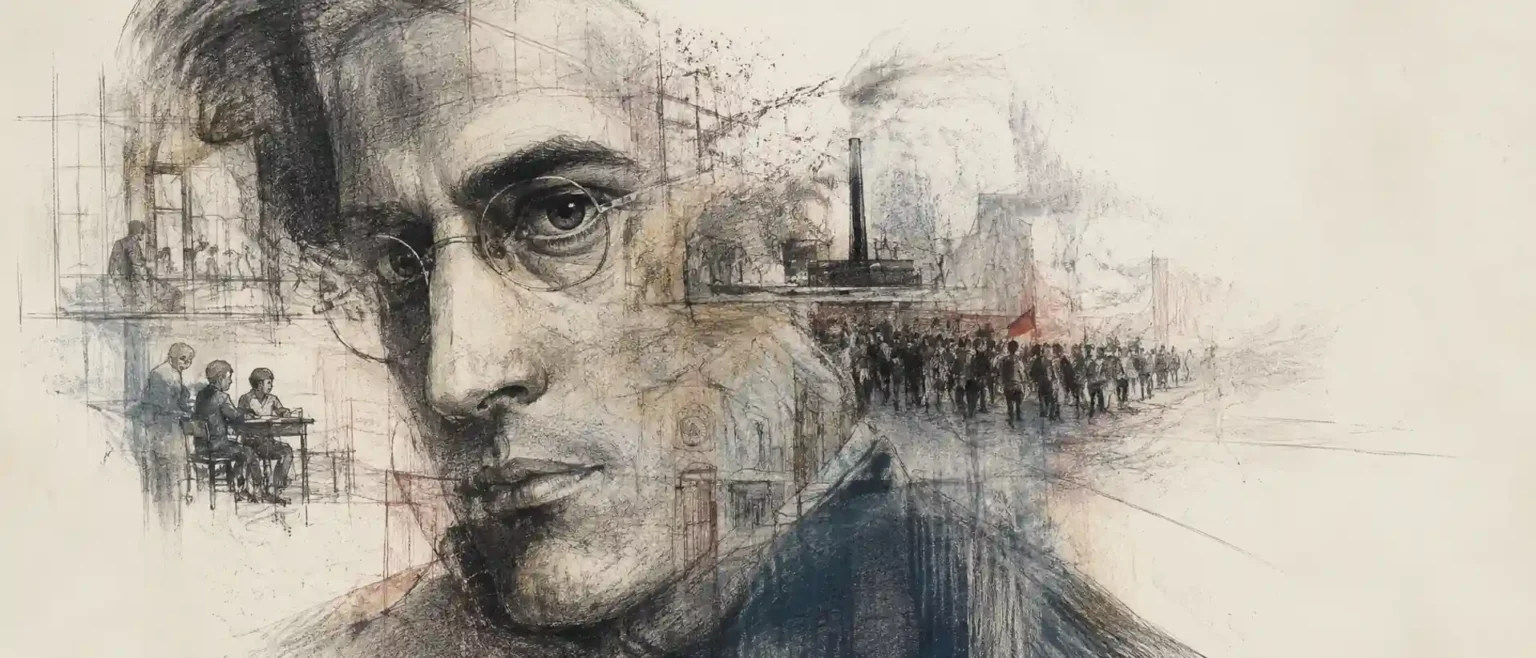
Illustration by Bookinlight Art Desk
For readers searching for books on Gramsci and hegemony, the difficulty is not scarcity but sequence. Antonio Gramsci has become one of the most cited figures in political theory, cultural studies, sociology, anthropology, media theory, and Marxist philosophy, yet his central concepts are often detached from the historical and strategic problems that gave them force. Cultural hegemony is not simply domination by ideas. It is the organized production of consent inside schools, newspapers, churches, parties, popular culture, language, law, and everyday common sense.
This reading packet treats Gramsci less as a slogan than as a problem of interpretation: how does power become ordinary, how do subaltern groups learn to name their world, and why does political transformation require a struggle over culture as well as institutions? The seven books below move from Gramsci’s own notebooks to introductions, disciplinary extensions, linguistic readings, rigorous Marxist reconstruction, and the post-Marxist afterlife of hegemony.
By Bookinlight
The Reading Lens
How Cultural Hegemony Turns Consent into Structure
Gramsci matters because he refused the easy division between coercion and culture. The state is never only police, law, or parliament; it also lives in institutions that train people to experience a social order as natural. These books show hegemony as leadership, pedagogy, translation, organization, and historical struggle.
Central Question
How does political power become common sense?
Historical Pressure
Fascism, failed revolution, mass parties, Fordism, and the crisis of liberal society.
Why These Books
They move from primary texts to interpretation, application, and debate.
Books on Gramsci and Hegemony: A Reading Sequence
The sequence begins with Gramsci’s own prison writings because every later argument depends on how those fragmentary notebooks are edited, translated, and reconstructed. It then moves toward readers and introductions that make the conceptual architecture legible, before turning to culture, language, philosophy, and democratic strategy. Read in order, the books clarify why cultural hegemony is not a decorative supplement to politics but one of the central terrains on which modern power is formed and contested.
1
Selections from the Prison Notebooks of Antonio Gramsci
Antonio Gramsci; edited and translated by Quintin Hoare and Geoffrey Nowell Smith
Best for: Readers who want the indispensable primary text behind hegemony, civil society, intellectuals, and the modern prince.
Difficulty: Advanced
Intellectual role: The founding archive of Gramscian political and cultural theory.
Bookinlight Rating: ★★★★★
This is the unavoidable starting point because it gives readers Gramsci not as a polished system but as a thinker working under prison conditions, censorship, illness, and political defeat. The book’s importance lies in the way it gathers the dispersed notes on hegemony, civil society, intellectuals, education, folklore, party formation, and the state into a usable English-language architecture. Its central contribution is to show that domination in modern societies depends on a dense field of consent-making institutions. The ruling class does not rule only by force; it leads, teaches, organizes, and universalizes its interests through culture and common sense. That is why this volume belongs at the head of any serious list on Gramsci and cultural hegemony. It lets the reader see the conceptual movement from economic reductionism toward a more supple theory of politics, where schools, newspapers, religion, language, and everyday belief become strategic sites. The reader who benefits most is patient, historically alert, and willing to read fragments slowly rather than demand a textbook definition. The book changes one’s understanding of hegemony by making it inseparable from organization, intellectual labor, and historical blocs. It also reveals why Gramsci has been so generative: his incompletion is not a weakness to be hidden but the form through which modern political thought keeps encountering unresolved tensions.
Bookinlight Note: Read the sections on intellectuals, the state, civil society, and the modern prince together; they form the conceptual spine of Gramsci’s theory of hegemony.
2
The Antonio Gramsci Reader: Selected Writings 1916–1935
Antonio Gramsci; edited by David Forgacs
Best for: Readers who want Gramsci’s journalism, political writing, and prison reflections in one coherent pathway.
Difficulty: General to Intermediate
Intellectual role: A navigable entrance into Gramsci’s life, concepts, and historical range.
Bookinlight Rating: ★★★★★
David Forgacs’s reader is valuable because it prevents Gramsci from being reduced to the prison notebooks alone. By bringing together writings from 1916 to 1935, it shows the continuity between militant journalism, party strategy, cultural criticism, and prison reflection. The central contribution of the volume is editorial: it makes Gramsci’s development readable without flattening the tension between activism and theory. For the theme of cultural hegemony, this matters enormously. Readers see that Gramsci’s later concepts emerge from concrete problems: the failure of revolution in the West, the rise of fascism, the weakness of liberal institutions, the role of education, and the need to create a new political culture. This book belongs here because it is often the best first serious encounter with Gramsci. It gives enough historical framing to help non-specialists avoid turning hegemony into a vague synonym for influence, while still preserving the texture of Gramsci’s voice. Students, cultural theorists, political organizers, and humanities readers will all benefit from its range. The book changes one’s understanding of hegemony by showing that it is not merely a theory of ruling-class domination but a practical question of how groups become capable of leadership. It also reminds the reader that Gramsci wrote across genres. His political theory is inseparable from journalism, pedagogy, literary criticism, and the daily labor of forming collective intelligence.
Bookinlight Note: This is the most teachable single-volume Gramsci for readers who need both accessibility and intellectual seriousness.
3
Gramsci’s Political Thought: An Introduction
Roger Simon
Best for: Readers who want a concise explanation of hegemony, civil society, party, and socialist strategy.
Difficulty: General to Intermediate
Intellectual role: The clearest short introduction to Gramsci as a political strategist.
Bookinlight Rating: ★★★★½
Roger Simon’s introduction remains useful because it treats Gramsci as a political thinker rather than merely a cultural theorist. Its central argument is that Gramsci’s scattered notes can be understood through the problem of socialist transformation in advanced capitalist societies. Hegemony, in this reading, is not a soft cultural supplement to economic struggle; it is the work of building moral, intellectual, and political leadership before and after institutional power is won. This is why the book belongs in a reading list on cultural hegemony. Simon makes concepts such as civil society, war of position, organic intellectuals, and historical bloc accessible without stripping them of strategic meaning. The reader who benefits most is someone who has heard the term hegemony in cultural studies or media theory but wants to know why it originally belonged to revolutionary political analysis. The book changes the reader’s understanding by reconnecting culture to organization. It shows that common sense is not simply false consciousness imposed from above; it is a contested field in which people live contradictions, absorb ruling ideas, and sometimes assemble counter-hegemonic possibilities. Simon’s prose is economical, which makes the book especially effective as a bridge between Gramsci’s difficult notebooks and later theoretical debates. Its limitation is also its virtue: it simplifies without pretending that the subject is simple, giving readers a disciplined first map before they enter denser scholarship.
Bookinlight Note: Use Simon as a conceptual primer before returning to the primary texts; the notebooks become much less opaque afterward.
4
Gramsci, Culture and Anthropology
Kate Crehan
Best for: Readers interested in culture, everyday life, anthropology, and the politics of common sense.
Difficulty: Intermediate
Intellectual role: The best disciplinary bridge between Gramsci’s theory of culture and anthropological practice.
Bookinlight Rating: ★★★★½
Kate Crehan’s book is indispensable for readers who want to understand why Gramsci became so important beyond political science and Marxist theory. Its central contribution is to place Gramsci’s reflections on culture against anthropological assumptions about community, tradition, and meaning. Crehan is especially good at resisting a comfortable idea of culture as a shared symbolic world. For Gramsci, culture is not a harmonious inheritance but a field of inequality, education, contradiction, and struggle. Common sense contains fragments of ruling ideology, religious memory, practical knowledge, and emergent criticism. That makes it politically unstable and analytically rich. The book belongs in this article because cultural hegemony is often misunderstood as the manipulation of passive people by dominant media. Crehan’s reading is subtler: hegemony works through lived practices, social relations, language, and institutions that make certain views feel self-evident. Anthropologists, sociologists, cultural historians, and humanities readers will benefit from the way she translates Gramsci into the study of ordinary life without making him merely fashionable. The book changes one’s understanding of hegemony by shifting attention from abstract ideology to the uneven textures of everyday culture. It also helps readers see why subalternity is not simply marginality. Subaltern groups possess knowledge, but that knowledge is often fragmented, constrained, and denied institutional force. Crehan therefore makes Gramsci useful for reading the politics of culture without romanticizing popular life or treating domination as total.
Bookinlight Note: This is the strongest book here for readers who approach Gramsci from anthropology, cultural studies, or ethnographic questions.
5
Language and Hegemony in Gramsci
Peter Ives
Best for: Readers interested in language, translation, intellectuals, pedagogy, and the linguistic roots of hegemony.
Difficulty: Intermediate
Intellectual role: The book that makes language central to Gramsci’s politics of consent.
Bookinlight Rating: ★★★★½
Peter Ives gives readers a decisive correction to one of the common simplifications of Gramsci. Hegemony is often treated as a theory of institutions, ideology, or culture in general, while Gramsci’s sustained interest in language is left in the margins. Ives shows that language is not a secondary topic. It is one of the places where Gramsci thinks through national formation, intellectual leadership, translation, education, and the production of shared political horizons. The central contribution of the book is to connect Gramsci’s early linguistic interests to his mature reflections on hegemony, organic intellectuals, passive revolution, civil society, and subalternity. This belongs in the article because cultural hegemony always depends on forms of articulation: which vocabularies become authoritative, which dialects are disciplined, which concepts travel between social groups, and how political movements translate experience into collective language. Readers in political theory, linguistics, cultural studies, education, and media studies will benefit most. The book changes the reader’s understanding by making hegemony less static and more communicative. Consent is not simply produced by institutions; it is also made through speech, grammar, translation, pedagogy, and the struggle to define reality. Ives also helps explain why Gramsci travels so widely across disciplines. Once hegemony is seen as a linguistic and cultural process, Gramsci becomes essential for thinking about how people learn to inhabit a world and how they might learn to redescribe it.
Bookinlight Note: Pair this with Crehan to see how everyday culture and language work together in the formation of common sense.
6
The Gramscian Moment: Philosophy, Hegemony and Marxism
Peter D. Thomas
Best for: Advanced readers who want the major contemporary reconstruction of Gramsci’s Marxism.
Difficulty: Advanced
Intellectual role: A rigorous defense of Gramsci as a philosopher of praxis and Marxist strategist.
Bookinlight Rating: ★★★★★
Peter D. Thomas’s book is the most demanding work in this sequence, but it is also one of the most important for readers who want to understand the stakes of interpreting Gramsci. Its central argument is that Gramsci should not be dissolved into liberal pluralism, culturalism, or a vague theory of discourse. Thomas reconstructs him as a thinker of the philosophy of praxis, deeply engaged with Marxism’s philosophical, strategic, and historical problems. The book belongs here because the meaning of cultural hegemony depends on whether Gramsci is read as a theorist of general social influence or as someone trying to rethink revolutionary politics in complex Western societies. Thomas pushes against readings that detach hegemony from class power, the integral state, passive revolution, and the formation of political will. Advanced readers, graduate students, and scholars of political theory will benefit most, especially if they have already read the prison writings. The book changes one’s understanding by making hegemony more rigorous and less fashionable. It asks readers to attend to Gramsci’s concepts as historically situated interventions rather than portable keywords. Thomas also restores the philosophical ambition of Gramsci’s work: hegemony is not merely about who controls culture but about how a collective subject can form a new conception of the world. The reward is substantial. After this book, Gramsci appears not as an author of useful fragments but as a thinker whose incompletion demands careful reconstruction.
Bookinlight Note: This is the book to read when introductory accounts begin to feel too smooth; it returns difficulty to the center of interpretation.
7
Hegemony and Socialist Strategy: Towards a Radical Democratic Politics
Ernesto Laclau and Chantal Mouffe
Best for: Readers interested in post-Marxism, radical democracy, discourse theory, and the afterlife of Gramsci.
Difficulty: Advanced
Intellectual role: The major post-Gramscian reworking of hegemony for democratic theory.
Bookinlight Rating: ★★★★½
Laclau and Mouffe’s book is not a straightforward introduction to Gramsci; it is a dramatic reworking of one of his most influential concepts. Its central argument is that political identities are not fixed expressions of economic position but are constructed through articulation, antagonism, and contingent alliances. Hegemony becomes the logic through which social demands are joined, named, and organized into a political project. This book belongs in the article because cultural hegemony did not remain confined to Gramsci scholarship. It became one of the key concepts through which late twentieth-century theory reconsidered class, democracy, feminism, social movements, discourse, and the limits of orthodox Marxism. The reader who benefits most is already comfortable with theory and wants to understand why Gramsci mattered so much to post-Marxist and radical democratic thought. The book changes one’s understanding of hegemony by shifting emphasis from cultural leadership within a historical bloc to the contingent construction of political identities. For some readers, that shift is liberating; for others, it risks detaching hegemony from the material and class analysis central to Gramsci. Either way, the book is essential because it shows the productive conflict inside Gramsci’s legacy. It turns cultural hegemony into a modern theory of articulation, but it also forces readers to ask what may be lost when Gramsci’s Marxist framework is translated into discourse theory.
Bookinlight Note: Read this after Thomas, not before, if you want to understand the dispute between Marxist reconstruction and post-Marxist extension.
The Reading Map
| Book | Difficulty | Rating | Why It Matters |
|---|---|---|---|
| Selections from the Prison Notebooks | Advanced | ★★★ ★★ | The primary archive for hegemony, civil society, and intellectuals. |
| The Antonio Gramsci Reader | General to Intermediate | ★★★ ★★ | The best single pathway through Gramsci’s range. |
| Gramsci’s Political Thought | General to Intermediate | ★★★ ★½ | A concise guide to hegemony as political strategy. |
| Gramsci, Culture and Anthropology | Intermediate | ★★★ ★½ | Connects hegemony to ordinary culture and common sense. |
| Language and Hegemony in Gramsci | Intermediate | ★★★ ★½ | Shows why hegemony is also a problem of language. |
| The Gramscian Moment | Advanced | ★★★ ★★ | A major reconstruction of Gramsci’s Marxist philosophy. |
| Hegemony and Socialist Strategy | Advanced | ★★★ ★½ | Extends hegemony into post-Marxist democratic theory. |
FAQ
What is the best first book on Gramsci and cultural hegemony?
The Antonio Gramsci Reader is usually the best first serious volume because it combines accessibility, historical range, and key concepts without isolating hegemony from Gramsci’s political context.
Should I read the Prison Notebooks first?
Advanced readers can begin there, but most readers benefit from reading a guide such as Roger Simon or David Forgacs before entering the notebooks directly.
Is cultural hegemony the same as ideology?
No. Ideology is part of the story, but Gramsci’s hegemony also involves institutions, leadership, education, language, consent, organization, and everyday common sense.
Why include Laclau and Mouffe in a Gramsci reading list?
Their book shows how Gramsci’s concept of hegemony was transformed in post-Marxist theory, making it essential for understanding the later debate.
What Reading Still Keeps Open
The best books on Gramsci and hegemony do not leave the reader with a single formula. They open a problem: how does a society teach itself to accept its own arrangements, and how can another form of common sense be built? Gramsci’s enduring power lies in that unfinished question. He asks readers to think of culture not as ornament, but as struggle; not as a surface above politics, but as one of the places where political reality is made.