Political Science
Five Books That Explain Television and the Transformation of Democratic Politics
From pseudo-events and campaign image-making to entertainment news and political satire, these books show how television changed democracy from a forum of argument into a theatre of mediated presence.
By Bookinlight


Disclosure: This article may contain affiliate links. If you buy through these links, the website may earn a small commission at no extra cost to you.
When Politics Learned to Face the Camera
Books on television and democratic politics are often treated as warnings about distraction. That is too simple. Television did not merely shorten attention spans or make candidates more photogenic. It altered the social grammar of democracy. It changed what counted as public presence, how authority appeared, how voters encountered political conflict, and how journalism mediated the distance between government and citizen. The deepest transformation was not the arrival of entertainment in politics. It was the conversion of democratic legitimacy into a visible performance that had to be staged, repeated, compressed, and emotionally managed.
The five books gathered here belong together because each identifies one layer of that transformation. Daniel J. Boorstin gives us the pseudo-event, the manufactured happening designed for circulation. Joe McGinniss takes us inside the television campaign and shows how the candidate became a product. Neil Postman explains why public discourse bends when it must survive inside the form of entertainment. Douglas Kellner restores political economy to the story by placing television among state power, business, and hegemony. Jeffrey P. Jones complicates the decline narrative by showing that satirical television can become a strange but real site of civic knowledge. Together, they suggest that modern democracy was not simply televised. It was reorganized around the conditions of television.
Why Television and Democratic Politics Still Matter
The age of platforms has not made television obsolete. It has made television’s political logic portable. The television studio taught politics to value speed, personality, conflict, visibility, intimacy, and recurring spectacle. Social media intensified these habits, but it did not invent them. To understand contemporary campaign clips, debate moments, cable outrage, viral gaffes, leader branding, and satirical news fragments, readers still need the older literature on television and democratic politics. These books show that the screen is not a neutral window onto democracy. It is an institution that shapes time, attention, authority, and the emotional texture of citizenship.
A Voice Worth Hearing
“What happens when media and politics become forms of entertainment?“
Five Books for Reading the Televised Republic
The Image: A Guide to Pseudo-Events in America
Daniel J. Boorstin
Best for: Readers who want the conceptual prehistory of televised politics.
Difficulty: General to Intermediate
Intellectual role: The theory of manufactured public reality.
Bookinlight Rating: ★★★★★★
Boorstin’s great contribution is the concept of the pseudo-event: an event created because it can be reported, photographed, televised, circulated, and consumed. That concept remains indispensable for reading democratic politics after television. Press conferences, staged town halls, debate moments, campaign backdrops, commemorative gestures, and controlled leaks all become political acts shaped by their media destiny. Boorstin’s prose sometimes belongs to the moral anxiety of the early 1960s, but his diagnosis is more durable than his tone. He shows that image-making is not merely deception. It becomes a public environment in which citizens must struggle to distinguish between political action and political appearance.
Bookinlight Note: Read Boorstin before the campaign books. He gives the vocabulary for seeing why a televised political event may be real in consequence while artificial in origin.
The Selling of the President
Joe McGinniss
Best for: Readers interested in campaign communication, image management, and presidential marketing.
Difficulty: General
Intellectual role: The anatomy of the candidate as television product.
Bookinlight Rating: ★★★★★★
McGinniss’s account of Richard Nixon’s 1968 campaign remains one of the most vivid books on the professionalization of televised democracy. Its importance lies less in scandal than in ordinary procedure. The candidate is rehearsed, lit, framed, protected from uncontrolled exposure, and translated into images that can survive the living room. The book shows how television altered the relation between political substance and political presentation. A campaign no longer simply communicates a candidate’s views. It manufactures an encounter in which citizens feel they have seen the candidate directly, even when the encounter has been engineered by consultants, advertising men, and television specialists.
Bookinlight Note: Pair this with Boorstin and ask a simple question: when does democratic persuasion become product design?
Amusing Ourselves to Death
Neil Postman
Best for: Readers seeking the classic media-ecology critique of television and public discourse.
Difficulty: General to Intermediate
Intellectual role: The critique of politics as entertainment form.
Bookinlight Rating: ★★★★★
Postman’s argument is famous because it is simple enough to remember and deep enough to keep returning to. Television, for him, is not just a delivery system for messages. It is a form with its own epistemology. It prefers speed, image, affect, personality, interruption, and entertainment. When politics enters that form, it does not remain unchanged. The problem is not that citizens laugh or enjoy spectacle. The problem is that political judgment becomes habituated to the rhythms of amusement. Postman can be too sweeping about television’s effects, yet his book remains essential because it asks what happens to reasoned public discourse when seriousness must appear in forms designed for pleasure.
Critical Reception
“a prophetic look at what happens when politics becomes entertainment“
Bookinlight Note: Postman is strongest when read as a theorist of form rather than a nostalgist for print. His real question is how media environments train democratic attention.
Television and the Crisis of Democracy
Douglas Kellner
Best for: Readers ready for political economy, critical theory, and institutional analysis.
Difficulty: Advanced
Intellectual role: The structural account of television, state power, and business.
Bookinlight Rating: ★★★★★★
Kellner prevents the conversation from becoming merely cultural. Television is not only a symbolic environment. It is also a set of institutions embedded in ownership structures, advertising economies, regulatory choices, state interests, and ideological struggle. His book is especially valuable because it links television to hegemony without treating the audience as passive clay. Television serves power, but it can also dramatize conflict and open spaces of social criticism. That dialectical view makes the book an important correction to more purely elegiac accounts of television’s democratic damage. It asks not only what television does to politics, but who controls television, who benefits from its forms, and where resistance appears inside the medium itself.
Bookinlight Note: Use Kellner as the bridge between media criticism and political economy. He moves the question from television’s effects to television’s institutional power.
Entertaining Politics
Jeffrey P. Jones
Best for: Readers interested in political satire, civic engagement, and late television culture.
Difficulty: Intermediate
Intellectual role: The counterargument to simple democratic decline.
Bookinlight Rating: ★★★★
Jones’s book is essential because it refuses the most comfortable version of media pessimism. Satirical television, political comedy, and entertainment talk do not simply dumb down the citizen. They can question the authority of official news, expose the theatricality of politics, and provide citizens with interpretive tools unavailable in conventional reporting. This does not make satire a replacement for journalism or institutions. It does make it part of the democratic field. After Postman, readers may assume that entertainment is democracy’s enemy. Jones asks a subtler question: under conditions in which politics is already theatrical, can satire become one of the few forms honest enough to reveal the performance?
Bookinlight Note: Read Jones last. He prevents the sequence from ending in despair and turns the television problem into a question about democratic interpretation.
How These Books Speak to One Another
The sequence matters. Boorstin shows the event becoming image. McGinniss shows the candidate becoming campaign product. Postman shows public discourse adapting to entertainment form. Kellner reveals the institutional and economic power beneath the screen. Jones shows how citizens may still use entertainment forms critically. Read together, these books refuse two easy myths: that television simply corrupted an otherwise rational democracy, and that mediated politics is just ordinary politics with better technology. They show instead that television remade democratic politics by changing the unit of political experience. The citizen no longer encounters politics primarily as a long argument among institutions, parties, and interests. The citizen increasingly encounters politics as a sequence of staged appearances, affective signals, narrative fragments, and mediated judgments.
The Reading Map
| Book | Author | Difficulty | Rating | Why It Matters |
|---|---|---|---|---|
| The Image | Daniel J. Boorstin | General to Intermediate | ★★★★★★ | Defines the pseudo-event as the basic unit of mediated public life. |
| The Selling of the President | Joe McGinniss | General | ★★★★★★ | Shows how presidential campaigning became television packaging. |
| Amusing Ourselves to Death | Neil Postman | General to Intermediate | ★★★★★ | Explains how television form reshapes public discourse. |
| Television and the Crisis of Democracy | Douglas Kellner | Advanced | ★★★★★★ | Connects television to ownership, state power, and ideology. |
| Entertaining Politics | Jeffrey P. Jones | Intermediate | ★★★★ | Shows how satire can become civic interpretation. |
Where to Begin
- Entry point: Begin with Amusing Ourselves to Death for the clearest statement of the medium’s pressure on public discourse.
- Historical background: Read The Image to understand pseudo-events before the full professionalization of television campaigns.
- Conceptual foundation: Move to The Selling of the President for the concrete mechanics of political packaging.
- Critical perspective: Use Television and the Crisis of Democracy to place media form inside ownership, regulation, and power.
- Contemporary relevance: Read Entertaining Politics to understand satire, truth, and civic engagement after traditional news authority weakens.
- Advanced reflection: Return to all five through one question: what does democratic judgment become when politics must be visible before it can be credible?
External Sources for Further Reading
The Last Margin
The strongest books on television and democratic politics do not ask us to hate the screen. They ask us to understand the screen as a political institution. Television made politics more intimate and less deliberative, more visible and less patient, more emotional and less procedurally legible. Yet these books also show that citizens are not condemned to passivity. To read television politically is to recover some freedom inside mediated life. It means asking who staged the event, who benefits from the image, what form of attention is being trained, and whether spectacle can still be turned toward democratic judgment.
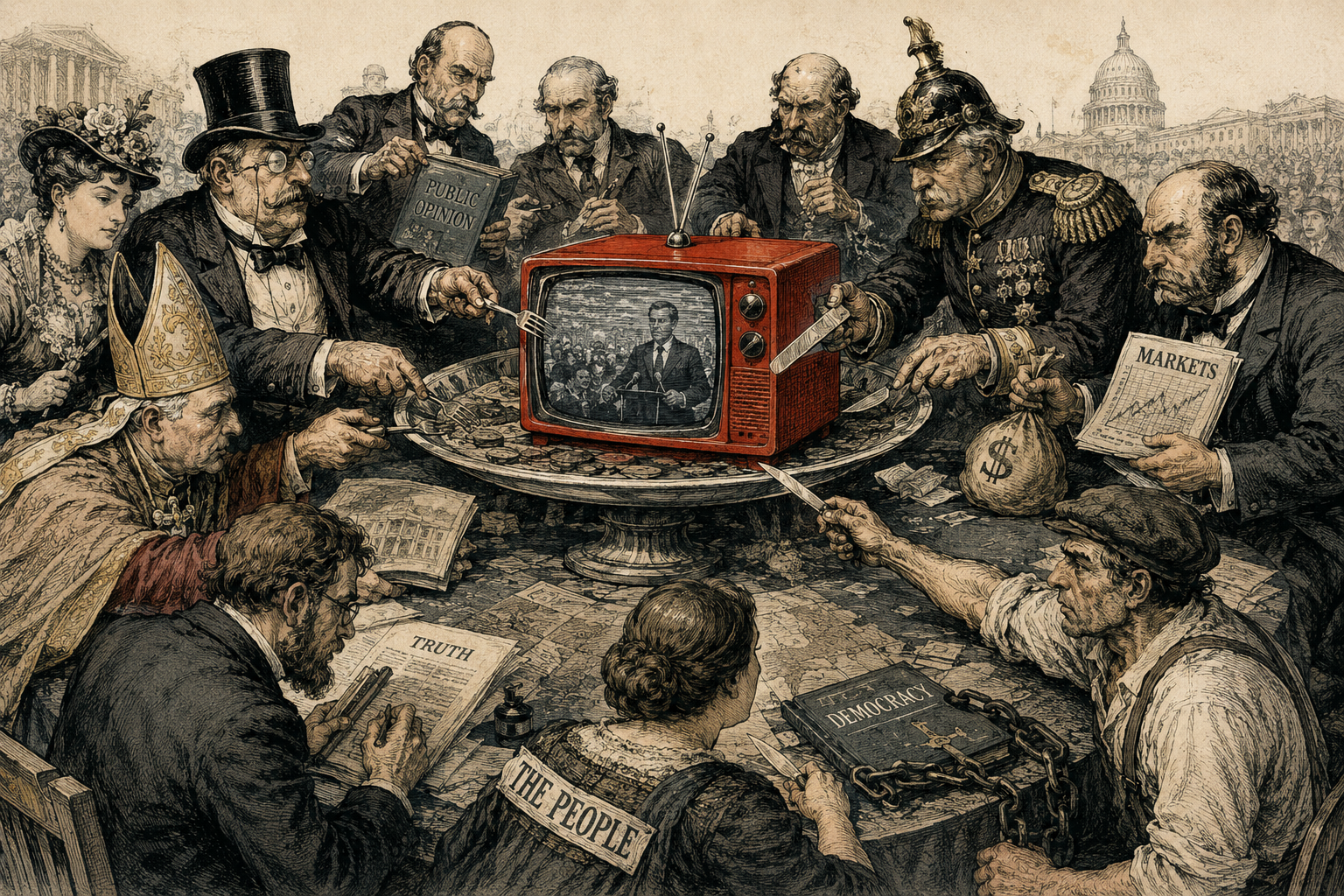
Illustration the Bookinlight Art Desk