Before Quine’s “Two Dogmas of Empiricism,” distinguish logical truth from analyticity and see why an apparently tidy boundary became controversial.
“Modern empiricism has been conditioned in large part by two dogmas.” — W. V. O. Quine, “Two Dogmas of Empiricism”, 1951.
Quine’s first sentence tells you what kind of paper this is. “Two Dogmas of Empiricism” is not an introduction to empiricism; it is an internal attack on distinctions that had been doing heavy work in twentieth-century empiricist philosophy. The minimum preparation is therefore historical and conceptual rather than technical. You need to know what “analytic” was supposed to accomplish, why logical empiricists wanted it, and why reductionism seemed attractive.
Before Two Dogmas of Empiricism: What Was Analyticity Supposed to Do?
Begin with the historical sections of the Stanford Encyclopedia’s current “Analytic/Synthetic Distinction” entry. Kant’s formulation matters because “analytic” originally names a contrast within judgments, not merely a synonym for “obvious” or “a priori.” Frege then changes the logical setting; twentieth-century empiricists give analyticity a new epistemological burden by using it to account for logic and mathematics without treating them as empirical discoveries.
Do not try to master every proposed definition. Your prerequisite question is narrower: what explanatory job is analyticity being asked to perform? If logic and mathematics are not revised in the same way as ordinary empirical claims, the logical empiricist wants an account of their special status compatible with empiricism.
Then read logical empiricism as a movement, not a single doctrine
The Stanford entry on logical empiricism is preferable to a compressed textbook paragraph because it emphasizes disagreement inside the movement. Carnap, Schlick, Neurath, Reichenbach, and others did not share one fixed verificationist creed. Analyticity, linguistic frameworks, scientific method, and the status of metaphysics changed across authors and across time.
This matters for reading Quine fairly. If “logical empiricism” is flattened into the claim that every meaningful sentence is directly reducible to sense data, Quine’s second dogma can look like a victory over a position no sophisticated opponent held in exactly that form. The historical target is more complicated.
Read Quine before Quine: “Truth by Convention”
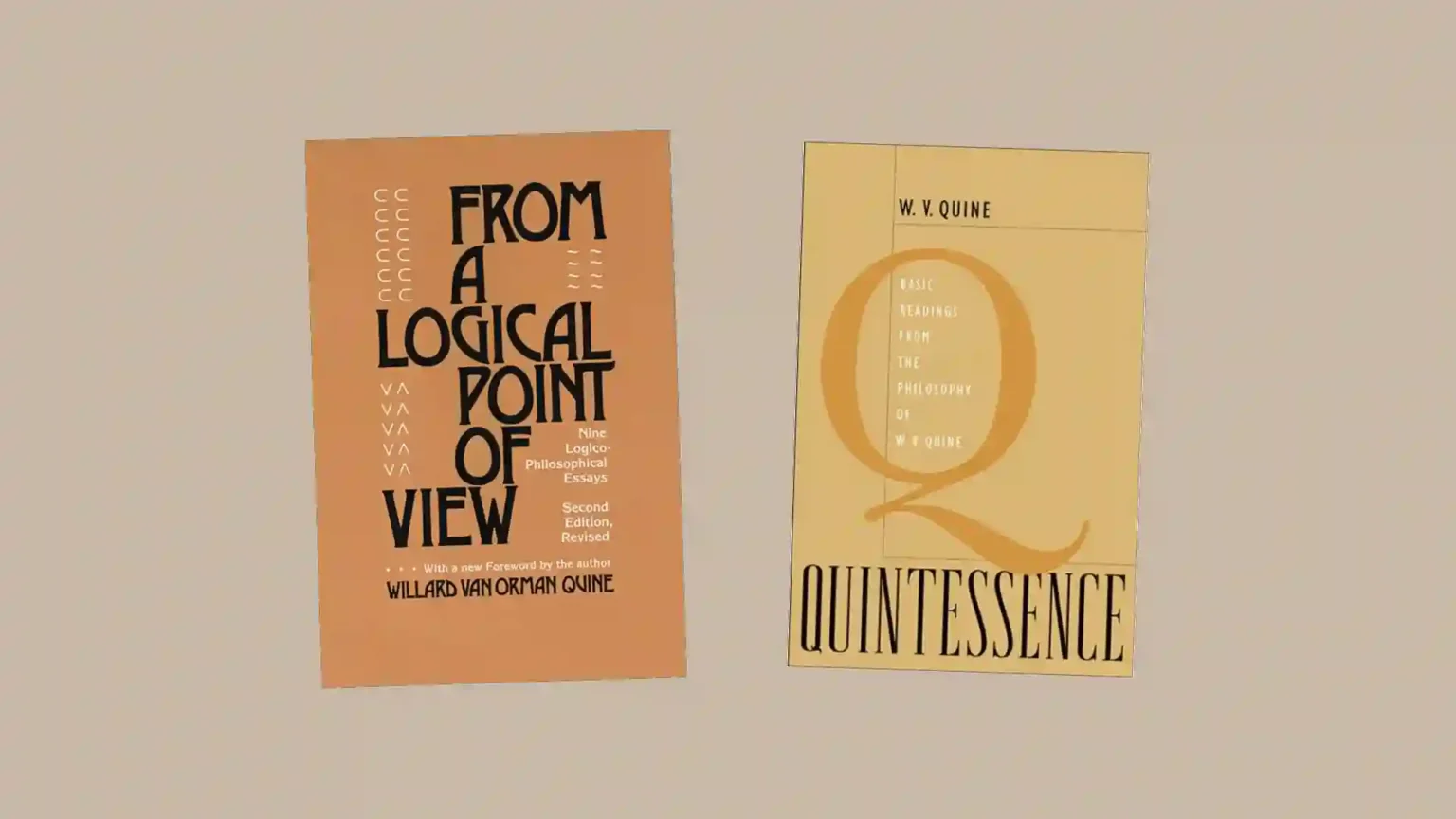
The most useful primary-text preparation is Quine’s earlier “Truth by Convention,” now conveniently reprinted in the JSTOR collection Quintessence. It shows Quine already worrying about the idea that logical truth can be explained simply by linguistic stipulation. That background makes “Two Dogmas” feel less like a sudden conversion and more like a developed pressure against assigning local statements a special conventional status.
If time is limited, read the opening and conclusion rather than every technical passage. Track one question: can a convention explain logical truth without presupposing logical inference in the act of applying the convention?
Only now locate the Carnap–Quine disagreement
Before reading Quine, skim the Stanford supplement “Carnap vs. Quine on the Analytic-Synthetic Distinction”, but do not let it settle the dispute for you. Its main corrective is historiographical: later scholarship has increasingly argued that Quine and Carnap were sometimes addressing different projects—natural language and general criteria on one side, deliberately constructed linguistic frameworks on the other.
That distinction prevents a common misreading. Quine’s objections are powerful even if they do not simply refute every Carnapian use of “analytic.” Your task in the original paper is to identify which version of the distinction each argument reaches.
Then read the 1951 article, not only the later collection
The original appeared in The Philosophical Review 60(1), January 1951, pages 20–43; the JSTOR issue record preserves that placement. Quine later reprinted and revised the essay in From a Logical Point of View. The Harvard/JSTOR record for the revised collection is useful, but for historical reading it is worth knowing which textual environment you are using.
Edition caution: the 1951 journal article and later anthology versions are not textually identical. From a Logical Point of View first appeared in 1953, and its revised second edition appeared in 1961. If you are tracing Quine’s argument historically, cite the version you have actually read. Sources: original journal citation; version comparison.
While reading, separate the two attacks. The first challenges a principled analytic–synthetic boundary. The second challenges reductionism—the idea that meaningful statements can be assigned distinct empirical content in isolation. The famous holistic ending then changes the unit of empirical testing: our claims confront experience in a network rather than one by one.
The first half of the paper deserves slower reading than its reputation sometimes receives. Quine considers several familiar routes to analyticity—definition, synonymy, interchangeability, semantic rules—and repeatedly asks whether the proposed explanation actually illuminates the distinction or merely presupposes it in another vocabulary. The point is methodological before it is doctrinal: a label is not yet an account. Definition typically records or abbreviates prior synonymy; interchangeability may depend on what language and modal resources are available; appeal to semantic rules risks telling us which sentences a system calls analytic without explaining analyticity in general. Keeping these moves separate prevents the first “dogma” from being reduced to the later slogan about holism.
The second half then changes scale. Quine links the reductionist picture of sentence-by-sentence confirmation to a broader empiricist inheritance and replaces it with the image of a web of belief whose statements face experience collectively. This does not mean every belief is equally revisable or that evidence becomes irrelevant. It means that experience underdetermines which particular sentence should be surrendered when prediction fails; adjustment can occur at different points in the network, constrained by simplicity, conservatism, and the rest of our theory.
What to read immediately after
Read H. P. Grice and P. F. Strawson’s 1956 “In Defense of a Dogma” next. The Cambridge record of the article’s bibliographic reception confirms the Philosophical Review publication, volume 65, pages 141–158. Their response is useful because it forces the reader to ask whether Quine has shown that the distinction is incoherent or only that certain proposed explanations of it are circular or inadequate.
The calibrated judgment is this: you need Kant-to-Carnap background to see what is at stake, and Quine’s earlier conventionalism to see where the attack came from. You do not need an entire history of analytic philosophy. With those pieces in place, “Two Dogmas” becomes legible as a dispute over the architecture of empiricism rather than a collection of isolated objections.
Cover artwork: credits and source records
- From a Logical Point of View: Nine Logico-Philosophical Essays — Harvard University Press (source record)
- Quintessence: Basic Readings from the Philosophy of W. V. Quine — Harvard University Press / Belknap Press (source record)