These six books on logic trace competing ideas of logical form, from Aristotle’s syllogisms through Boole and Peirce to Frege’s formal language.
A history of logic can be made to look falsely inevitable. Aristotle invents syllogistic; symbolic methods arrive; Frege completes the transition to modern logic. That story is convenient and wrong in two ways. It hides rival ancient traditions, medieval Latin and Arabic developments, and nineteenth-century paths that do not simply converge on Frege. It also makes “logic” seem to be one stable object whose notation gradually improves.
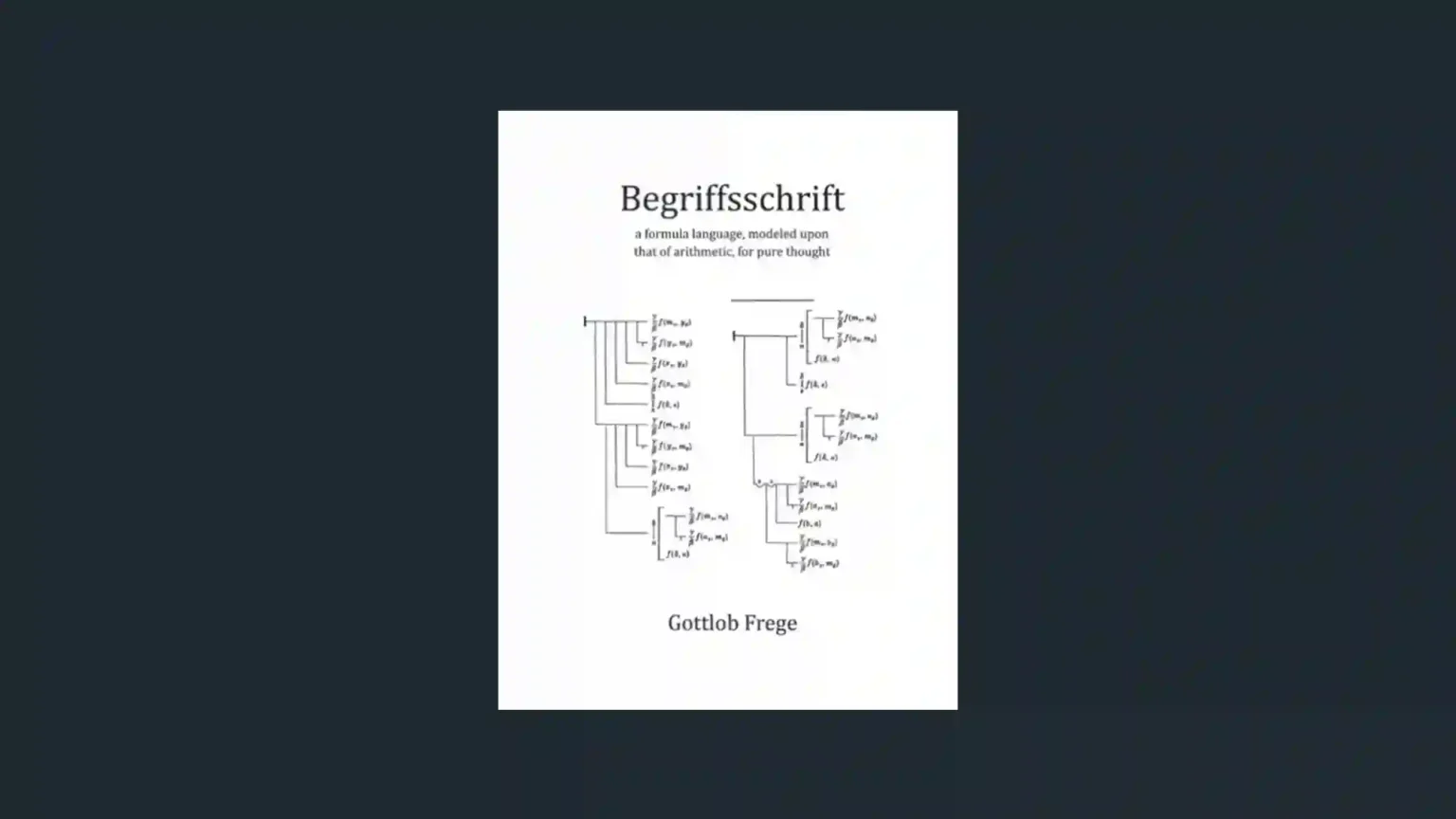
The featured image depicts Frege’s Begriffsschrift, the final stop on the six-work route. It is a representative cover rather than a montage of all six books.
The six books below are therefore not a complete canon. They are a deliberately narrow route through one Western sequence in which the question what counts as logical form? changes repeatedly. Read them as six different answers, not six rungs on a ladder.
Books on Logic, Part 1: Aristotle’s Prior Analytics
Begin where deduction becomes an object of systematic theory. In the Prior Analytics, Aristotle studies patterns in which a conclusion follows of necessity from premises. The Stanford Encyclopedia’s account of Aristotle’s logic is a good orientation because it stresses both the enormous later influence of syllogistic and a corrective often omitted in textbook histories: Stoic logic was a major rival in antiquity, and Aristotle’s later dominance should not be projected backward as inevitability.
What to notice is the architecture. The syllogistic classifies valid forms using categorical propositions and term relations. Logic is not yet an algebra of arbitrary propositions or a quantificational language in Frege’s sense. But it is already metatheoretical: Aristotle is not merely advising people to argue well; he is asking which forms preserve necessity and why.
2. Arnauld and Nicole — Logic or the Art of Thinking
The Port-Royal Logic (first published in French in 1662) is useful precisely because it does not look like a pre-Frege formal system waiting to happen. Its four-part organization moves through ideas, judgments, reasoning, and method. The modern Cambridge edition edited by Jill Vance Buroker makes the work readily locatable, while the Cambridge chapter on ideas shows how tightly logic is tied to a theory of mental representation.
This is the counterexample to a purely formal history. Port-Royal treats logic as an art of directing thought and judgment. Its interest in language, definition, ideas, error, and method reminds the reader that early modern “logic” often occupied territory now divided among logic, epistemology, semantics, and methodology.
3. Augustus De Morgan — Formal Logic
De Morgan’s 1847 Formal Logic: or, The Calculus of Inference, Necessary and Probable belongs to a nineteenth-century moment when inherited syllogistic was being pressed, extended, and mathematized. A digitized 1847 edition is catalogued by Open Library, with its original Taylor and Walton publication data and downloadable scan.
Read De Morgan for strain rather than triumph. The traditional forms are still visible, but relations, quantified reasoning, and the possibility of a genuine calculus are pushing against the old term logic. The most revealing question is not “How close is this to today’s notation?” It is “Which inferences become awkward if logic is forced to stay inside the old subject–predicate mold?”
4. George Boole — An Investigation of the Laws of Thought
With Boole’s 1854 Laws of Thought, mathematical operation becomes a method for logical analysis. The complete public-domain text is available from Project Gutenberg. Boole’s system is historically important, but it is worth resisting a retrospective simplification: his algebra is not just the familiar two-valued Boolean algebra dropped into a Victorian book. It is a distinctive logical calculus with its own interpretation and restrictions.
The conceptual jump is nonetheless dramatic. Logical relations can be represented and transformed symbolically. Once that is possible, questions about validity become questions about operations in a formal system rather than only about the verbal shape of syllogisms. Aristotle’s project survives—the study of consequence—but its working medium changes.
5. Charles S. Peirce and the Johns Hopkins Circle — Studies in Logic
Studies in Logic by Members of the Johns Hopkins University (1883), edited by Charles S. Peirce, is the least predictable choice here and therefore one of the most useful. Open Library’s record and scan preserve the collection as a historical object rather than reducing Peirce to a footnote on the road to someone else.
Peirce’s work on relations and quantification is one reason the story “Aristotle, then Frege” is too clean. The nineteenth century contained several powerful symbolic programs. Reading Peirce near Frege makes a methodological point: major conceptual innovations can arise in parallel, under different notational and philosophical commitments. A history of logic should compare solutions, not merely award priority.
6. Gottlob Frege — Begriffsschrift
Frege’s 1879 Begriffsschrift is the point at which this route becomes recognizably modern in a new sense. The Stanford chronological catalogue of Frege’s work records the original Halle publication and the principal complete English translations. A full-view scan of the 1879 German edition is also available through Google Books.
What changes is not merely typography. Frege replaces the traditional primacy of subject–predicate form with a function–argument analysis and develops resources for generality that are ancestors of modern quantification. The Stanford entry on Frege’s logic is particularly valuable here because it reconstructs the mechanics of Begriffsschrift without pretending that Frege’s later distinctions—especially sense and reference—were already fully present in 1879.
The Comparison That Matters
Aristotle asks which categorical forms guarantee a conclusion. Port-Royal embeds valid reasoning inside a theory of ideas and judgment. De Morgan probes the limits of inherited form. Boole turns classes and logical operations into a calculus. Peirce expands the symbolic treatment of relations and quantification. Frege builds a formal language in which generality and function–argument structure displace the old grammatical picture.
That is why the sequence should not be read as six increasingly “correct” books. Each rearranges the boundary between logic and its neighbors. If you want a broader map before or after this route, BookInLight’s guide to philosophy of language is useful once Frege’s formal innovations begin to spill into questions of meaning and reference.
The best final judgment is therefore comparative: Frege is not simply Aristotle with stronger symbols. By the time you reach Begriffsschrift, the unit of analysis, the notation, the treatment of generality, and the relation between grammar and logic have all changed. The history is a sequence of reconceptions, not a polishing operation.
Cover artwork: credits and source records
- Begriffsschrift — Edition shown in sourced cover (source record)