Aristotle sets out the four kinds of cause in Physics Book II, chapter 3, at 194b16–195b30; the compact fourfold enumeration begins at about 194b23 and runs to 195a3. The Four Causes in Aristotle’s Physics are therefore not a separate essay or chapter called “The Four Causes.” For most readers, C. D. C. Reeve’s complete 2018 Hackett translation is the strongest single-volume choice; scholars concentrating on this passage should also consult William Charlton’s commentary on Books I and II.

DIRECT ANSWER
Where the Text Appears
Exact location: Physics II.3, Bekker 194b16–195b30. The four principal explanatory roles are introduced at 194b23–195a3; II.7, 198a14–b9 applies them specifically to natural inquiry.
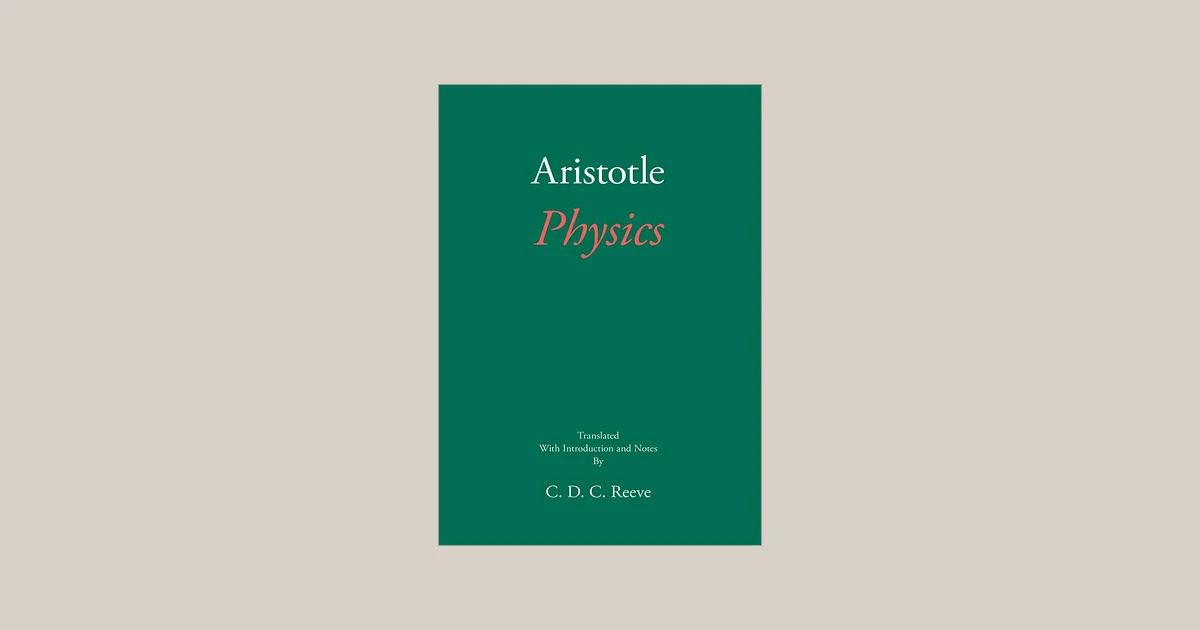
Recommended edition: Aristotle, Physics, translated with introduction and notes by C. D. C. Reeve, Hackett Publishing, 2018. Paperback ISBN 978-1-62466-691-9.
Completeness and use: This is the complete eight-book treatise, not an anthology extract. Its modern vocabulary, extensive notes, and consistent cross-references make it the best overall edition for readers who want one dependable English volume.
Where The Four Causes in Aristotle’s Physics First Appeared
The familiar phrase names a doctrine, not an independently titled work. Its primary location is Book II, chapter 3 of the Greek Physics, traditionally called Φυσικὴ ἀκρόασις (Physikē akroasis), “lecture on nature.” Other titles include τὰ φυσικά, Latin Physica, “Natural Hearing,” and, in Thomas Taylor’s 1806 English version, Physical Auscultation. All identify the larger treatise, never a standalone “Four Causes.”
The work belongs to Aristotle’s fourth-century BCE teaching corpus; no modern publication date can responsibly be assigned. The textual history of the Aristotelian corpus connects akroasis with oral teaching and allows for layers of revision and school use. Book and chapter divisions are inherited editorial structures. The stable modern locator is Bekker pagination.
At 194b16 Aristotle connects knowledge with grasping the “why,” then distinguishes what later became the material, formal, efficient, and final causes. The list occupies only part of II.3. The chapter continues by distinguishing prior and posterior, general and particular, potential and actual causes. Stopping at 195a3 gives the list, not the full account.
A near-parallel appears in Metaphysics V.2. Physics II.7 then tells the investigator of nature to seek the relevant causes. The Stanford Encyclopedia’s account of Aristotle on causality accordingly treats II.3 and Metaphysics V.2 as parallel statements, with II.7–9 supplying the natural and teleological development.
There was no first English collection of “The Four Causes” as a short work; it entered English inside translations of Physics. The Greek Physica appeared in Aldus Manutius’s Venice volume of February 1497. Complete English versions were circulating by the early nineteenth century, notably Taylor’s 1806 translation. Modern editions keep the same chapter and Bekker coordinates despite changing page numbers.
The Main English Collections and Editions
Reeve is the most balanced current choice: a complete translation with substantial notes and a terminology index, neither a line-by-line commentary nor a classroom extract. Read all of II.3, then II.7–9, where causal plurality becomes a method for studying nature.

ALTERNATIVE MODERN TRANSLATION
Physics: The Readable Oxford Choice
Edition: Translated by Robin Waterfield; introduction and notes by David Bostock. Oxford World’s Classics, 2008. ISBN 978-0-19-954028-0.
Text: Complete eight-book translation; II.3 contains the full causal discussion. Waterfield’s prose is generally smoother than the more technical alternatives, and Bostock’s apparatus supplies philosophical orientation without turning the volume into a specialist commentary.
Best for: First-time readers and teaching. Its limitation is precisely its fluency: readers tracking repeated Greek terms should compare a closer commentary or the Greek text.

GUIDED STUDY
Aristotle’s Physics: Greek Texture with Commentary
Edition: Translated by Joe Sachs. Rutgers University Press, 1995. ISBN 978-0-8135-2192-3.
Text: A complete translation with a long introduction, running explication, and glossary. The contents explicitly group Book II, chapters 1–3 under “Causes,” making the locator unusually clear.
Best for: Readers who want an interpretive guide and who value English designed to preserve conceptual connections in Aristotle’s Greek. Sachs’s deliberately uncommon vocabulary can illuminate the text, but it is less convenient when a course or article cites conventional terminology.
For concentrated scholarship, William Charlton’s Clarendon Physics: Books I and II is more useful. It covers only two books but supplies close commentary, philosophical analysis, and bibliography. Cite by Bekker number and identify the translation. The bilingual Loeb, translated by P. H. Wicksteed and F. M. Cornford, helps check Greek against an influential older English version, though its idiom is dated.
| Edition | Profile | Main advantage | Best for |
|---|---|---|---|
| Reeve, 2018 | Complete, modern, heavily noted | Best balance of precision and usability | Most readers |
| Waterfield, 2008 | Complete and fluent | Clear first reading with Bostock’s notes | Students, courses |
| Charlton, rev. 1992 | Books I–II only; close commentary | Detailed analysis of the exact chapter | Academic citation |
| Sachs, 1995 | Complete, guided, lexically distinctive | Running explanation and glossary | Slow, interpretive study |
Why the English Title and Translation Change
“The Four Causes” is useful classroom shorthand, but Aristotle is not listing four modern mechanical causes. Greek aitia and aition answer a “why?” question and may be understood as causes, reasons, or explanatory factors. The standard nouns “material,” “formal,” “efficient,” and “final” are inherited labels. Aristotle speaks more concretely of what something comes from, what it is, the source of change, and the end for which it occurs.
Reeve preserves “cause” while supplying a controlled modern vocabulary and notes. Waterfield favors readable sentences and can feel less schematic. Sachs deliberately resists some familiar philosophical English in order to keep recurring Greek relations visible. Charlton is closer and more argumentative because the translation is designed to be read with a commentary. These are not different versions of the doctrine; they are different balances among lexical consistency, idiomatic English, and philosophical explanation.
The practical rule is to search for Book II, chapter 3, or 194b16—not only for a heading called “The Four Causes.” Compare how translations handle aitia, “that for the sake of which,” and the source of change. “Efficient cause” is convenient, but narrower modern associations can distort Aristotle’s wording.
Legal Online and Library Access
For legal access to The Four Causes in Aristotle’s Physics, use one of the following routes according to whether you need English, Greek, or a bilingual scholarly text.
FREE FULL TEXT
The MIT Internet Classics Archive provides the complete public-domain Hardie–Gaye translation. It is legal and searchable, but its editorial apparatus is minimal.
OPEN GREEK TEXT
The Scaife Viewer’s Physica supplies an open Greek text for checking the Bekker passage.
SUBSCRIPTION TEXT
Loeb Classical Library Online presents Greek and English together; access normally requires an individual or institutional subscription.
Hackett offers Reeve in print and ebook formats. Oxford Scholarly Editions Online carries Waterfield–Bostock and Charlton for subscribing institutions. Catalogues can locate borrowable copies, but a record is not full-text access and digital-loan availability varies.
Which Edition Should You Choose?
RECOMMENDED EDITION
For The Four Causes in Aristotle’s Physics, choose Reeve’s 2018 Hackett Physics for the best overall balance. Choose Waterfield for the easiest continuous first reading, Charlton when your work centers on II.3 and requires detailed commentary, Sachs for a guided vocabulary-sensitive reading, and Loeb or Scaife when you need the Greek beside an English rendering.
For academic citation, use the Bekker reference rather than a commercial page number: “Aristotle, Phys. II.3, 194b23–195a3,” followed by the translation in the bibliography. The locator remains stable across editions.
Do not treat anthology selections as complete unless they include all of II.3. Hackett’s Readings in Ancient Greek Philosophy contains substantial portions of Physics II, but selections cannot replace the eight-book work when context matters. Lecture handouts often reproduce only the four-item list.
What Else Is in the Recommended Collection?
Reeve’s volume contains all eight books. Within Book II, chapters 1–2 define nature and natural science; 4–6 distinguish luck, chance, and spontaneity; 7 turns the fourfold account into a research program; 8–9 defend explanation by ends and distinguish material necessity from hypothetical necessity.
Books III and V–VI analyze change and motion; Book IV treats place, void, and time; Book VIII argues toward an unmoved source of motion. The causal passage is therefore not an isolated taxonomy but part of an account of natural beings, intelligible change, and adequate answers to “why?” The complete volume is worth using even when the four causes are the entry point.
Frequently Asked Questions
What book contains Aristotle’s four causes?
The principal source is Physics II.3. A near-parallel appears in Metaphysics V.2. Continue to Physics II.7–9 for Aristotle’s application and defense of the causal framework in natural science.
What is the exact Bekker reference?
Use Physics II.3, 194b16–195b30 for the full discussion. The compact enumeration runs approximately 194b23–195a3. Bekker numbers remain stable while ordinary page numbers vary.
Is “The Four Causes” a separate essay?
No. It is a later descriptive title for a passage and doctrine. Syllabi and anthologies may use that heading, but Aristotle’s transmitted work is Physics, and the unit is Book II, chapter 3.
What is the best English translation?
Reeve is the best all-purpose modern edition: complete, terminologically controlled, and well annotated. Waterfield is more readable, Sachs more guided, and Charlton strongest for scholarship on Books I–II. The criterion determines the choice.
Is there a legal free version online?
Yes. MIT hosts the complete public-domain Hardie–Gaye translation, while Scaife supplies open Greek. Both help with access and searching; neither replaces a current edition’s notes and translation rationale.
Why do some books say “explanations” rather than “causes”?
Greek aitia is broader than a modern mechanical cause: it answers a relevant “why?” Translators use “cause,” “reason,” or “explanatory factor” to stress different aspects of the same framework.
Final Recommendation
For The Four Causes in Aristotle’s Physics, most readers should use Reeve’s 2018 Hackett translation and read Physics II.3 in full, followed by II.7–9. Scholars should pair it with Charlton and cite Bekker numbers. Waterfield is the easiest first encounter; Sachs is the most guided alternative. MIT’s legal public-domain English text is a useful supplement, not the best working edition. The full Physics is worth obtaining because the doctrine gains force from the surrounding accounts of nature, chance, necessity, motion, and purpose.
Related BookInLight Reading Guides
The Mean in Its Proper Place: Aristotle’s Doctrine in Book II — a parallel locator for the doctrine of the mean in Nicomachean Ethics II, with attention to Bekker citation and translation choice.
Oxford World’s Classics: A Complete Guide to the Series — useful context for judging the Waterfield–Bostock paperback as a series edition rather than simply as a translation.
What Should You Read Before Heidegger’s “Being and Time”? — explains why Aristotle’s analyses of motion and time remain a live background for twentieth-century ontology.
This article was researched and written by the BookInLight Department of Philosophy and Intellectual History. Its editorial process included bibliographical review, comparison of complete and partial editions, verification of translators and ISBNs against publisher and scholarly records, inspection of the Greek and Bekker locations, source checking, and final factual review. Readers are invited to submit corrections, overlooked editions, source suggestions, translation observations, or constructive ideas that could improve the guide.
The BookInLight Art Department directed the visual composition, edition selection, and presentation of the cover images. Rights in the original covers remain with the relevant publishers, artists, designers, institutions, and other rights holders; BookInLight does not claim authorship of those designs. Complete republication, reproduction, translation, or reuse of this article requires prior written permission from BookInLight.
Sources and Further Reading
Original Text and Transmission
Aristotle, “Physica,” Scaife Viewer. Greek text and Bekker structure.
Marwan Rashed, “The Textual Transmission of the Aristotelian Corpus,” Stanford Encyclopedia of Philosophy. Teaching context and title history.
University of Glasgow, “Aristoteles: Physica [Greek]”. Catalogue description of the Aldine Venice printing of February 1497.
Causality and Natural Philosophy
Andrea Falcon, “Aristotle on Causality,” Stanford Encyclopedia of Philosophy. II.3, II.7–9, and Metaphysics V.2.
István Bodnár, “Aristotle’s Natural Philosophy,” Stanford Encyclopedia of Philosophy. Nature, motion, and teleology.
English-Language Editions
Aristotle, Physics, trans. C. D. C. Reeve, Hackett, 2018. Publisher record for the principal recommendation and ISBN.
Aristotle, Physics, trans. Robin Waterfield, intro. and notes David Bostock, Oxford World’s Classics, 2008. Publisher record for the complete modern alternative.
Aristotle, Physics: Books I and II, trans. and comm. William Charlton, Clarendon Aristotle Series. Scholarly record for the focused commentary edition.
Aristotle, Aristotle’s Physics: A Guided Study, trans. Joe Sachs, Rutgers University Press, 1995. Publisher contents and edition data.
Aristotle, Physics, Volume I: Books 1–4, trans. P. H. Wicksteed and F. M. Cornford, Loeb Classical Library 228. Bilingual edition record.
Legal and Institutional Access
Aristotle, Physics, trans. R. P. Hardie and R. K. Gaye, Internet Classics Archive. Free public-domain English text.
Loeb Classical Library Online, Aristotle, Physics Book II. Subscription Greek–English text and edition-specific access.
Aristotle, Physics: Books I and II, William Charlton edition, Google Books. Bibliographic record and preview availability where permitted.
Image Credits
Aristotle, Physics, translated by C. D. C. Reeve, Hackett paperback, 2018, ISBN 978-1-62466-691-9. Cover delivered from the exact-edition Amazon product asset; edition correspondence verified against Hackett Publishing.
Aristotle, Physics, translated by Robin Waterfield, Oxford World’s Classics paperback, 2008, ISBN 978-0-19-954028-0. Cover delivered from the exact-edition Amazon product asset; edition correspondence verified against Oxford University Press.
Aristotle, Aristotle’s Physics: A Guided Study, translated by Joe Sachs, Rutgers University Press paperback, 1995, ISBN 978-0-8135-2192-3. Cover from the Rutgers University Press exact-edition page.