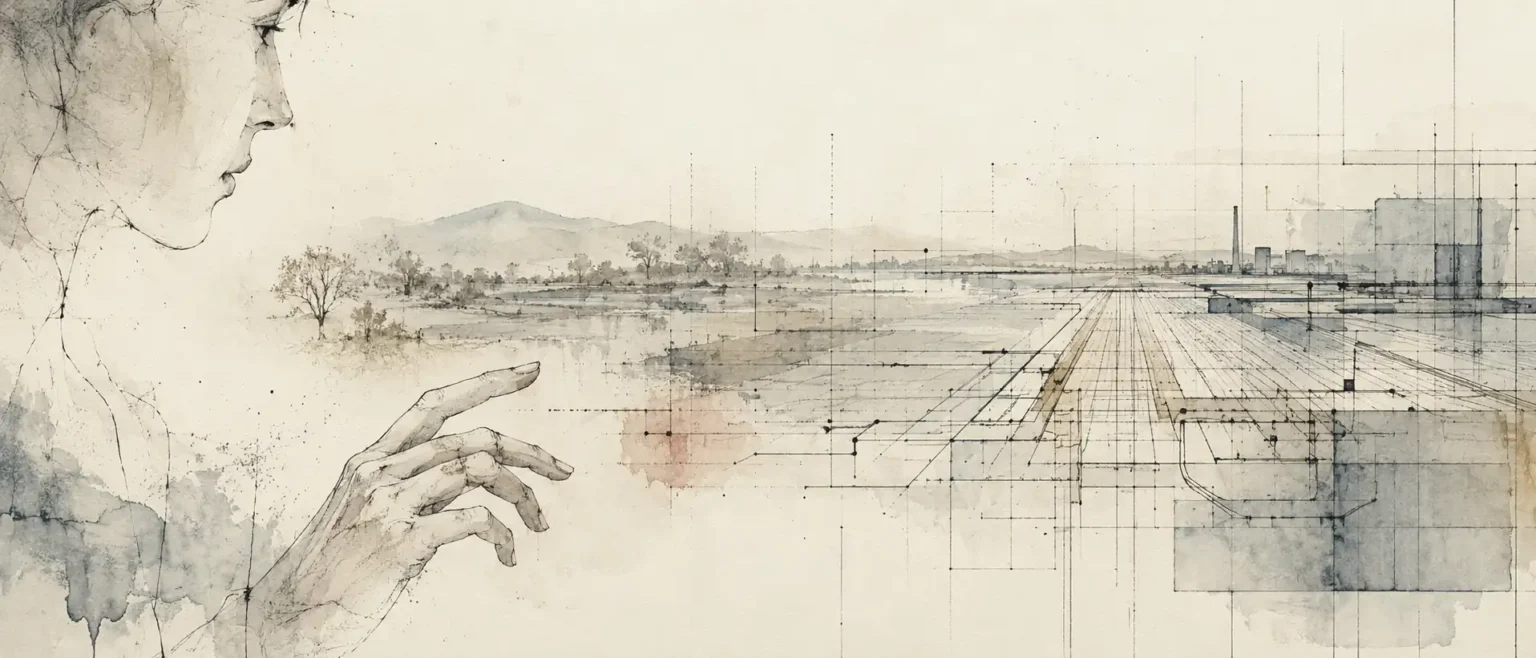
The best books on philosophy of technology do not treat machines as neutral instruments waiting for human purposes. They ask a sharper question: what kind of world becomes thinkable when technical systems organize perception, labor, politics, time, and desire?
This reading packet gathers five foundational works that belong together because each refuses the easy division between “technology” and “culture.” Heidegger gives the ontological problem: technology is a way of revealing the world. Ellul gives the sociological danger: technique becomes a self-expanding system of efficiency. Mumford gives the historical scale: machines arise from institutions, rituals, clocks, and power. Borgmann gives the ethical vocabulary of everyday life: convenience can thin experience. Winner gives the political claim: artifacts and infrastructures can embody authority. Read in sequence, these books form a serious humanities route through modern technological life.
The Reading Lens
How Technology Becomes a Form of Life
These books are not merely about tools, inventions, or engineering. They investigate technology as a civilizational grammar: a set of habits that orders what counts as knowledge, efficiency, freedom, nature, and human flourishing. Their shared concern is not whether technology is good or bad, but whether societies can still deliberate about the forms of life their technical systems make normal.
Central Question
Can modern societies choose their technologies, or do technical systems quietly choose for them?
Historical Pressure
Industrial discipline, bureaucratic rationality, mass media, computing, and infrastructure reshape public and private life.
Why These Books
Together they connect ontology, history, ethics, social theory, and political judgment.
The Best Books on Philosophy of Technology
Author: Martin Heidegger
Best for: Readers who want the deepest philosophical starting point
Difficulty: Advanced
Intellectual role: The ontological foundation of modern philosophy of technology
Bookinlight Rating: ★★★★★
Heidegger’s famous essay remains difficult because it does not begin where most debates about technology begin. It does not ask whether machines are useful, dangerous, liberating, or alienating. It asks what modern technology discloses about the world before any particular tool is praised or condemned. His central term, “enframing,” names a mode of revealing in which nature, labor, and even human beings appear as standing-reserve: available, orderable, measurable, and ready for extraction. That argument makes the book indispensable for this article because it shifts technology from the category of object to the category of worldview.
The reader who benefits most is one willing to move slowly through dense philosophical prose. Heidegger’s language can be severe, but the reward is conceptual precision. After this essay, technology can no longer be understood as a collection of devices. It becomes a historical way of arranging reality itself. The book also helps explain why purely moral language often feels insufficient in technological debates: the issue is not simply bad use, but the prior disclosure of everything as usable. For readers interested in artificial intelligence, climate crisis, automation, or digital attention, Heidegger supplies a vocabulary for asking what kind of world is being revealed when everything becomes data, resource, and system.
Bookinlight Note
Read Heidegger first not because he is easy, but because later debates inherit his central suspicion: technology is never merely technical.
Author: Jacques Ellul
Best for: Readers interested in technology, bureaucracy, efficiency, and social power
Difficulty: Intermediate to Advanced
Intellectual role: The great critique of technique as social system
Bookinlight Rating: ★★★★½
Ellul’s contribution is to widen the meaning of technology beyond machines. His key word is “technique”: the drive to find the most efficient method in every field of action. Technique appears in factories and weapons, but also in administration, education, propaganda, economics, entertainment, and state planning. This makes The Technological Society one of the most powerful books for understanding why technological modernity can feel compulsory even when no single person commands it. The system advances through optimization, not through a visible tyrant.
The book belongs here because it supplies the sociological counterpart to Heidegger’s ontology. Where Heidegger asks how technology reveals the world, Ellul asks how modern institutions reproduce technical necessity. Readers interested in platform economies, algorithmic management, productivity culture, or managerial language will recognize Ellul’s world immediately. His analysis can be overstated, and his pessimism is part of the book’s pressure, but the severity is also its force. He teaches the reader to notice how efficiency becomes a moral vocabulary: what works becomes what is right; what can be optimized becomes what should be reorganized. After Ellul, technology is not simply a collection of innovations. It is a social atmosphere that rewards calculability, speed, standardization, and control. The book changes the reader’s understanding of technology by making modern life itself appear as a technical environment.
Bookinlight Note
Ellul is most useful when read as a diagnostician of compulsion: he shows how systems can dominate without needing a single master plan.
Author: Lewis Mumford
Best for: Readers who want a historical and civilizational account
Difficulty: General to Intermediate
Intellectual role: The historical anatomy of the machine age
Bookinlight Rating: ★★★★½
Mumford’s classic is essential because it refuses the myth that the machine age begins only with industrial hardware. He traces modern technics through monasteries, clocks, mines, cities, armies, capitalism, and scientific discipline. The result is a history in which machines are inseparable from forms of organization, habits of time, and cultural imagination. Mumford is not simply narrating invention; he is asking how civilization learned to live according to mechanical regularity.
This book belongs in a philosophy of technology list because philosophical clarity often requires historical depth. Heidegger and Ellul give powerful abstractions, but Mumford shows the long formation of those abstractions inside institutions and daily routines. Readers who find purely theoretical works too compressed may find Mumford the most hospitable entry point. His prose is expansive, sometimes polemical, and often strikingly synthetic. He also gives readers a way to distinguish technology from technological determinism. Human cultures build machines, but machines in turn stabilize habits, expectations, and political orders. After Mumford, the question is not only what a device does, but what social world had to exist before that device became plausible. For contemporary readers, his historical method is invaluable: smartphones, platforms, and artificial intelligence are not isolated novelties. They are heirs to older regimes of timing, measurement, power, and abstraction.
Bookinlight Note
Mumford’s lasting value is historical imagination: he makes technology readable as culture before it becomes equipment.
Author: Albert Borgmann
Best for: Readers interested in ethics, daily life, and meaningful practice
Difficulty: Intermediate
Intellectual role: The ethical account of the device paradigm
Bookinlight Rating: ★★★★½
Borgmann brings the philosophy of technology into the texture of ordinary life. His central idea, the “device paradigm,” describes how modern devices tend to make commodities available while concealing the practices, skills, materials, and communal contexts that once gave them depth. A heating system provides warmth without the focal activity of tending a fire; recorded music provides sound without the same social discipline of performance; digital convenience can deliver outcomes while thinning engagement. The argument is not nostalgia for inconvenience. It is an ethical inquiry into what kinds of presence, attention, and shared practice disappear when technology separates goods from the conditions that make them meaningful.
The book belongs here because it corrects an overly dramatic view of technological danger. For Borgmann, the problem is often subtle: not catastrophe, but disengagement. Readers interested in consumer life, domestic convenience, digital platforms, or the philosophy of everyday experience will find this book especially useful. It changes the reader’s understanding by moving the debate from abstract domination to lived impoverishment. The key question becomes: what practices still gather people, things, skills, and attention into a shared world? Borgmann’s vocabulary remains powerful for thinking about smartphones, streaming media, delivery apps, automated homes, and frictionless services. He shows that the ethical stakes of technology appear not only in laboratories and governments, but at the dinner table, in leisure, in attention, and in the slow disappearance of focal practices.
Bookinlight Note
Borgmann is the best guide in this list for readers asking how technology changes the moral atmosphere of daily life.
Author: Langdon Winner
Best for: Readers focused on politics, infrastructure, democracy, and power
Difficulty: General to Intermediate
Intellectual role: The political theory of technological artifacts
Bookinlight Rating: ★★★★★
Winner gives the list its most explicit political turn. His famous question is whether artifacts can have politics. The answer, developed through essays on infrastructure, nuclear power, technological choice, and democratic responsibility, is yes: technical systems can embody forms of authority, exclude some users, centralize power, require specific institutions, or make certain political arrangements more likely. The point is not that every object secretly contains ideology. It is that some technological arrangements are inseparable from social order.
This book belongs here because it connects philosophy of technology to public life. Heidegger reveals the world, Ellul analyzes technique, Mumford historicizes the machine, Borgmann studies everyday practice, and Winner asks what all this means for democracy. His prose is clearer than Heidegger’s and less totalizing than Ellul’s, making the book an excellent bridge between academic theory and civic judgment. Readers concerned with smart cities, algorithmic governance, transport systems, energy grids, surveillance, and platform power will find Winner’s approach immediately usable. He changes the reader’s understanding by making design a political matter before it becomes a consumer preference. The relevant question becomes: who must obey the system once it is built, and who had a voice before it was built? That question remains central in an age of artificial intelligence, automated administration, and infrastructures that quietly distribute freedom and constraint.
Bookinlight Note
Winner is the book to give readers who suspect that design, infrastructure, and governance are more closely linked than public debate admits.
The Reading Map
| Book | Difficulty | Rating | Why It Matters |
|---|---|---|---|
| The Question Concerning Technology and Other Essays | Advanced | ★★★★★ | Defines technology as a way the world becomes available. |
| The Technological Society | Intermediate to Advanced | ★★★★½ | Shows efficiency becoming a social system. |
| Technics and Civilization | General to Intermediate | ★★★★½ | Places machines inside long cultural history. |
| Technology and the Character of Contemporary Life | Intermediate | ★★★★½ | Explains how convenience can weaken meaningful practice. |
| The Whale and the Reactor | General to Intermediate | ★★★★★ | Makes technical design a question of democratic power. |
Questions Readers Often Ask
What is the best first book on the philosophy of technology?
For accessibility, begin with Winner or Mumford. For philosophical depth, begin with Heidegger, but read slowly and with secondary support if needed.
Are these books still relevant to artificial intelligence?
Yes. They do not predict specific tools; they clarify systems, rationality, power, attention, and the transformation of human judgment.
Which book is most political?
Winner is the most directly political, especially for readers interested in infrastructure, democracy, design, and institutional authority.
Which book is best for everyday ethical reflection?
Borgmann is the strongest choice for thinking about convenience, attention, domestic life, leisure, and meaningful practice.
What Reading Still Keeps Open
The best books on philosophy of technology do not offer a simple verdict on modern machines. They keep open a more demanding field of judgment: how societies reveal the world, organize efficiency, inherit mechanical habits, preserve meaningful practices, and decide which infrastructures deserve democratic consent. Their shared lesson is not anti-technology. It is anti-sleepwalking. To read them together is to recover the possibility that technical life can still be interpreted, questioned, and chosen.