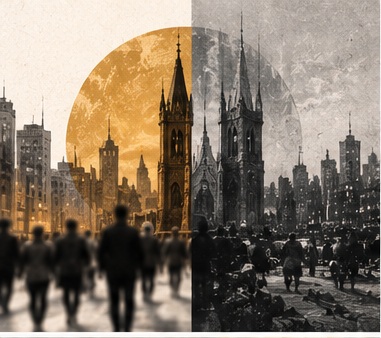
A society can have churches, believers, public religious argument, and still be secular in Charles Taylor’s strongest sense. That sounds paradoxical only if “secular” means one thing. In A Secular Age, Taylor separates several meanings that are often collapsed together, then gives most of his attention to the most difficult one: the historical conditions under which belief becomes one option among others.
Three secularities answer three different questions
Secularity 1: where does religious authority operate?
The first sense concerns institutions and public space. Political offices, law, schools, administration, and other domains can become differentiated from direct ecclesiastical control or theological authority. A society can move in this direction even when most people remain religious. For a secondary account of how the concept has been developed or contested, see Notre Dame Philosophical Reviews — A Secular Age.
Secularity 2: how much religious belief and practice is there?
The second sense is the familiar sociological one: changes in attendance, affiliation, doctrine, ritual, or the social power of religious organizations. Surveys and demographic data are relevant here.
Secularity 3: what is it like to believe?
Taylor’s distinctive focus is the background condition of belief. In much of the premodern Latin Christian world, belief in God could function as the taken-for-granted horizon within which alternatives were difficult to inhabit as stable social options. In modern North Atlantic societies, belief can remain deep and sincere while also being experienced as one possibility among competing possibilities. Unbelief, likewise, is not a neutral view from nowhere; it too becomes a historically available stance.
THE KEY SHIFT: Taylor changes the question from “How many people believe?” to “Under what background conditions do belief and unbelief become plausible ways to live?”
A thought experiment: the same creed, a different social experience
Imagine two equally devout Christians separated by five centuries. Both pray, worship, and understand their lives through God. Yet the modern believer encounters visible alternatives—atheism, agnosticism, rival religions, individualized spirituality, therapeutic self-cultivation, scientific naturalism, and many hybrid positions. The doctrinal proposition may be similar. The social experience of holding it is not.
This is what “conditions of belief” helps us see. Taylor is not measuring conviction from the outside. He is describing the field in which conviction has to sustain itself.
The immanent frame is not a synonym for atheism
Taylor’s “immanent frame” names a social world in which ordinary life can be understood through this-worldly causes, institutions, and goods without requiring constant reference to transcendence. But the frame does not logically force atheism. It can be inhabited as open to transcendence or interpreted as closed against it.
That distinction is central. A modern believer and a modern unbeliever may share the same institutions, sciences, markets, political procedures, and ordinary causal explanations. Their disagreement concerns how that shared world is interpreted and whether it is sufficient.
Cross-pressure explains why modern positions can feel both committed and fragile
Modernity does not simply replace one settled worldview with another. Taylor emphasizes “cross-pressures”: forces that make rival possibilities experientially present. A believer can feel the power of naturalistic explanation or moral individualism. An unbeliever can still encounter wonder, ritual attachment, moral depth, or dissatisfaction with purely instrumental accounts of life.
Fragility here does not mean insincerity. It means awareness that one’s position is contestable because alternatives are socially and intellectually real.
Why Taylor rejects a simple “subtraction story”
A common story of secularization says that modernity stripped away superstition, clerical authority, and metaphysical illusion, leaving autonomous reason underneath. Taylor thinks that picture is too simple. Modern unbelief had to be historically produced just as modern belief was transformed. New moral orders, disciplines, understandings of the self, forms of social imagination, and ideals of authenticity helped create positions that did not previously exist in the same way.
The mechanism in four moves
1. Institutional differentiation reduces the assumption that one religious authority organizes every public domain.
2. Pluralization makes rival religious and nonreligious possibilities visible in ordinary life.
3. The modern self increasingly describes commitment through choice, authenticity, and personal conviction.
4. Belief and unbelief become reflexive: each is lived in awareness of alternatives and must often explain itself in their presence.
What not to turn Taylor into
Not a prediction that modernization everywhere produces the same level of unbelief.
Not the claim that religion simply retreats into private life.
Not a survey theory in which “conditions of belief” can be reduced to one measurable variable.
Not a universal history of all religions. A Secular Age is explicitly centered on Western/Latin Christian trajectories, a scope that critics have repeatedly examined.
Why the concept matters for sociology
Two societies can report similar levels of religious affiliation while placing belief inside very different institutional and moral ecologies. “Conditions of belief” directs attention to the background: what counts as a respectable reason, which options are socially available, how public institutions speak, what forms of doubt are normal, and what kinds of spiritual aspiration remain intelligible.
That makes Taylor useful precisely where survey percentages stop. The framework is strongest when used to interpret the social ecology of commitment, not when treated as a substitute for empirical measures.
A practical reading path through A Secular Age
Start with the introduction and the three senses of secularity. Then learn the immanent frame, cross-pressure, and Taylor’s critique of subtraction stories. Only after those concepts are stable should you enter the book’s long historical middle. The narrative then becomes easier to follow because you know what it is trying to explain: how a social world emerged in which faith and unbelief are both live, contested possibilities. For a book-length route through Taylor and the secularization debate, BookInLight’s Charles Taylor and secularism reading guide is the natural next step.
What later scholarship does with the concept
Later scholarship is useful here because it shows what happened when a portable concept was taken beyond its original text. First, Notre Dame Philosophical Reviews — A Secular Age offers an explicit critical assessment rather than another summary. Second, Peter E. Gordon — review of A Secular Age offers an explicit critical assessment rather than another summary. Finally, Charles Taylor — A Secular Age (Google Books record) adds an independent point of comparison to the article’s framing. Taken together, the sources separate the canonical formulation from later operationalization, criticism, and extension—exactly the distinction needed if the concept is to function as analysis rather than as a label.
That reporting-led method keeps three layers apart: the concept in its original setting, the ways later researchers have operationalized or extended it, and the synthesis offered on this page. Where later scholarship changes the scale or meaning of the original concept, that change is made explicit. This is more useful than presenting the theory as if it had travelled unchanged across disciplines and decades.