Bookinlight · Untranslated Books
Antonio Escohotado’s vast Spanish trilogy, begun in 2008 and completed in 2016, follows the moral struggle over property and exchange from antiquity to modern communism. Admired for its erudition and attacked for its liberal asymmetry, it became a major Spanish-language intervention in the history of political economy. No complete English translation, or officially announced forthcoming edition, was located as of 14 July 2026.
Book at a Glance
Book at a glance
Original title: Los enemigos del comercio: Una historia moral de la propiedad
Author: Antonio Escohotado
Original language: Spanish
Country: Spain
Original publisher: Espasa
First published: Volume I, 11 November 2008; trilogy completed in 2016
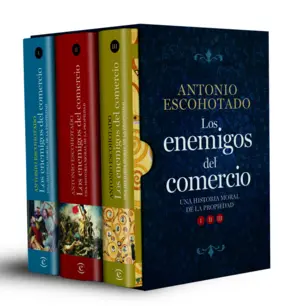
Current edition: 2019 three-volume box set, ISBN 978-84-670-5762-1
Format and length: Pack, 15 × 23 cm, 2,056 pages
Current price: €75.00 from the publisher listing, checked 14 July 2026
Introducing the Book
The supplied title can denote the first volume or Escohotado’s whole project. Because the subtitle belongs to all three volumes and the current boxed edition presents them as a single work, this article treats Los enemigos del comercio as the completed trilogy. It began with a 616-page first volume in 2008, continued in 2013, and reached completion with the third volume in 2016.
The Los enemigos del comercio English Translation question matters because this is not a conventional history of Marxism. Escohotado asks why hostility to private property and voluntary exchange repeatedly acquires moral prestige. He follows that hostility through religious poverty movements, utopian schemes, revolutionary doctrines and communist states, while setting it against the growth of commercial institutions. The intended reader is not only the specialist: the trilogy is written as a large public argument about freedom, prosperity, equality and coercion.
What the Book Is About
Escohotado’s governing thesis is genealogical. Modern communism, he argues, did not suddenly begin with industrial capitalism. It inherited a much older moral suspicion of trade, money, individual possession and material difference. Volume I therefore moves back to Sparta, Plato, ancient communal ideals, the Essenes and early Christian traditions of holy poverty. It then follows medieval millenarian movements, Reformation-era upheavals, the recovery of commerce, the Enlightenment and the French Revolution.
Volume II enters the nineteenth century, when religious and utopian impulses become political economy. Saint-Simon, Fourier, Proudhon, Marx and their contemporaries appear beside industrialization, changing labor relations and the emergence of mass parties. Escohotado repeatedly compares promises of collective emancipation with the institutional results of ownership, contract, enterprise and technological accumulation.
Volume III concentrates on revolutionary power: Leninism, Bolshevik rule, the Soviet system and later communist experiences, followed by the afterlives of communist language in post-Soviet and populist politics. Across the trilogy, biography, doctrinal history, statistics, economic comparison and close readings of primary texts are made to serve one argument: projects that abolish private economic autonomy tend to replace unequal exchange with political command.
The trilogy’s distinctive intervention is to treat communism not merely as a modern economic program, but as the latest form of a recurring moral revolt against commerce—and then to test that revolt against its institutional consequences.
That architecture is also the source of the book’s vulnerability. Its range is extraordinary, but the organizing opposition between commercial freedom and coercive anti-commercialism can flatten differences among religious asceticism, egalitarian reform, democratic socialism and totalitarian rule. The book is strongest as a provocative synthesis, not as an ideologically neutral survey.
About the Author

Antonio Escohotado (Madrid, 1941–Ibiza, 2021) was a Spanish jurist, philosopher and sociologist whose work crossed intellectual history, philosophy of science, religion, drugs, political economy and autobiography. He also translated figures including Hobbes, Newton and Jefferson.
His best-known earlier achievement, Historia general de las drogas, used the same signature method later expanded here: an enormous chronological canvas, primary documentation, institutional comparison and an unwillingness to respect disciplinary borders. Other major books include La conciencia infeliz, De physis a polis, Realidad y substancia and Caos y orden.
The trilogy belongs to the late phase of his career, when his defense of individual liberty and commercial society became explicit. It is therefore both historical investigation and intellectual self-revision: a former radical examining the traditions that had once shaped his own political imagination.
Why the Book Matters
Few contemporary works addressed to a general readership attempt a two-thousand-page moral and institutional history of communism, property and exchange. The trilogy matters first because of that scale. It connects ancient theology, medieval sects, modern philosophy, economic development and revolutionary government rather than treating twentieth-century communism as an isolated ideological episode.
It also changed the terms of debate around Escohotado. The question was no longer simply whether his conclusions were liberal or anti-communist, but whether the moral vocabulary of poverty, equality and redemption had been too readily separated from the institutions created in its name. Supporters found a vast documentary defense of open societies; critics saw a brilliantly learned but selective history that treated market relations more generously than their alternatives.
That dispute is intellectually productive. The trilogy forces readers to separate intentions from outcomes, voluntary association from state command, and criticism of capitalism from endorsement of revolutionary rule. Its importance does not depend on accepting its thesis. It lies in making the historical relationship among property, religion, resentment, freedom and political violence impossible to discuss casually.
How the Book Was Received
Spanish criticism broadly agreed on the trilogy’s ambition, readability and extraordinary accumulation of material. The disagreement concerned method and moral symmetry. Admirers regarded the documentation as a decisive challenge to romantic accounts of communism. More skeptical readers argued that Escohotado’s liberal commitments shaped his selection of evidence, blurred distinctions among anti-market traditions and left coercion inside market societies comparatively underexamined.
REVISTA DE LIBROS
Reviewer: Nieves San Emeterio · 1 October 2009
Assessment: The review treats Volume I as an exceptionally ambitious fusion of economic history and the history of ideas, while questioning whether those strands fully cohere and whether the changing legal meaning of private property receives enough analytical precision.
REVISTA DE LETRAS
Reviewer: Anna Maria Iglesia · 20 November 2013
Assessment: Iglesia recognizes a fundamental contribution to understanding capitalism’s survival, yet rejects the author’s claim to simple description. Her adversarial interview identifies an unmistakable defense of unrestricted liberalism and presses Escohotado on utopia, public property, utility and financial power.
EL ESTADO MENTAL
Critics: César Rendueles and Antonio Escohotado · June 2014
Assessment: This extended correspondence turns reception into argument. Rendueles grants markets a capacity to coordinate plural societies but challenges their effects on democracy and justice; Escohotado answers through historical comparison and a defense of commerce against projects that subordinate means to redemptive ends.
REVISTA DE LIBROS
Reviewer: Juan Antonio Rivera · 25 October 2017
Assessment: Rivera presents the completed trilogy as an anomalous, lucid and immensely learned liberal work whose pages continually generate ideas. His reservations concern disproportionate digressions, uneven treatment of communist experiences beyond the Soviet center and occasional failures of critical distance.
EL HUFFPOST
Reviewer: Luis Miguel Andrés Llatas · 11 August 2017
Assessment: An openly enthusiastic response praises the trilogy’s narrative momentum, density of primary-source material and capacity to make more than two thousand pages feel novelistic. Its admiration is politically sympathetic, but it records the unusually intense readerly loyalty the project inspired.
Why It Should Be Translated into English
A complete Los enemigos del comercio English Translation would give Anglophone readers access to a major Spanish intervention in debates they usually encounter through Marxist, social-democratic, conservative or Anglo-American liberal traditions. Escohotado’s synthesis is different: it places political theology, religious poverty, economic institutions and revolutionary state-building inside one argumentative history.
The absence is especially conspicuous because English readers can already approach Escohotado through translations of other works, while the Planeta rights catalogue supplies English descriptors for the trilogy without documenting a published English edition. Library and publisher checks located Spanish editions, but no complete English publication and no officially confirmed forthcoming translation as of the date above.
Translation would not certify the book’s conclusions. It would make them testable. Historians of communism could challenge its chronology; scholars of religion could assess its genealogy of poverty; economists and political theorists could examine its claims about property, contract and coercion. A critical introduction, translator’s notes and a chronology would be essential, particularly where the trilogy compresses contested traditions into a single anti-commercial lineage.
The case for a Los enemigos del comercio English Translation is not that Escohotado settled the history of property and communism, but that he constructed an argument too consequential—and too contestable—to remain largely unavailable to English-language debate.
The ideal edition would be complete, issued in three volumes, and aimed at serious trade and university readers in intellectual history, political economy, European studies, religious history and political theory. Its scale raises costs, but the work’s polemical energy and durable questions give it long-term value beyond immediate ideological fashion.
English-Language Publishers That Should Consider It

Candidate 1
Princeton University Press
Country: United States
Why it fits: Its history list explicitly spans intellectual, religious and economic history, matching the trilogy’s long-range method.
Relevant catalogue comparison: Walter Scheidel’s The Great Leveler, another global synthesis joining inequality, institutions and revolutionary violence.
Best edition type: Complete, annotated three-volume scholarly-trade edition.
Likely readership: Historians, political economists and serious general readers.
Possible limitation: Length, translation cost and the need for substantial critical apparatus.

Candidate 2
Yale University Press
Country: United States / United Kingdom
Why it fits: Yale combines major history publishing with an established institutional commitment to bringing overlooked foreign-language works into English.
Relevant catalogue comparison: The Margellos World Republic of Letters, whose remit includes culturally significant works neglected by translators.
Best edition type: Three-volume translation with a critical introduction and full notes.
Likely readership: Humanities scholars, translation readers and political-intellectual history courses.
Possible limitation: Margellos is predominantly literary, making this trilogy’s scale and disciplinary character atypical.

Candidate 3
Liberty Fund
Country: United States
Why it fits: Its programme centres on liberty, political economy, property and the moral foundations of market order.
Relevant catalogue comparison: Paul Heyne’s “Are Economists Basically Immoral?”, which directly joins economics, ethics and religion.
Best edition type: Complete print-and-digital scholarly set with durable reference apparatus.
Likely readership: Historians of economic thought, classical liberals and political-theory programmes.
Possible limitation: Strong ideological alignment could narrow the framing and reduce crossover beyond already sympathetic readers.
Sources
Bibliographic and publisher sources
- Los enemigos del comercio I, PlanetadeLibros / Espasa — verifies the first-volume date, ISBN, format, dimensions and pagination.
- Los enemigos del comercio II, PlanetadeLibros / Espasa — verifies the second volume’s publication on 2 October 2013.
- Los enemigos del comercio III, PlanetadeLibros / Espasa — verifies the final volume and the trilogy’s completion in 2016.
- Trilogía Los enemigos del comercio, PlanetadeLibros / Espasa — verifies the 2019 boxed edition, ISBN, length, cover and publisher description.
Price and edition sources
- Official boxed-edition listing, PlanetadeLibros — verifies the €75.00 publisher price checked on 14 July 2026.
- Three-volume boxed set, Librería Polifemo — corroborates the format, page count, dimensions and retail price.
Author sources
- Antonio Escohotado author profile, PlanetadeLibros — verifies biographical details, major works and the portrait.
Reviews and critical reception
- “Propiedad: historia e ideas”, Revista de Libros — Nieves San Emeterio’s review of Volume I.
- “Escohotado sin límites”, Revista de Letras — Anna Maria Iglesia’s critical interview on Volume II.
- “Sobre los enemigos del comercio”, El Estado Mental — the Rendueles–Escohotado correspondence on markets and democracy.
- “La propiedad y sus enemigos”, Revista de Libros — Juan Antonio Rivera’s assessment of the completed trilogy.
- “Los enemigos del comercio: una reseña”, El HuffPost — an enthusiastic original-language appraisal by Luis Miguel Andrés Llatas.
English-translation verification sources
- Antonio Escohotado rights catalogue, Planeta Book & Film Rights — lists English descriptive titles for the three volumes but does not document a published English edition.
- Antonio Escohotado bibliography, Open Library — records the Spanish trilogy and provides no complete English edition record.
Amazon edition sources
- Trilogía Los enemigos del comercio, Amazon España — exact product page for the 2019 Spanish boxed edition.
Publisher-comparison sources
- History catalogue, Princeton University Press, and The Great Leveler, JSTOR — support the first publisher comparison.
- The Margellos World Republic of Letters, Yale University Press — verifies the series’ translation remit.
- “Are Economists Basically Immoral?”, Online Library of Liberty — supports the Liberty Fund comparison.
Image Credits
- 2019 Spanish three-volume boxed-edition cover: PlanetadeLibros / Espasa.
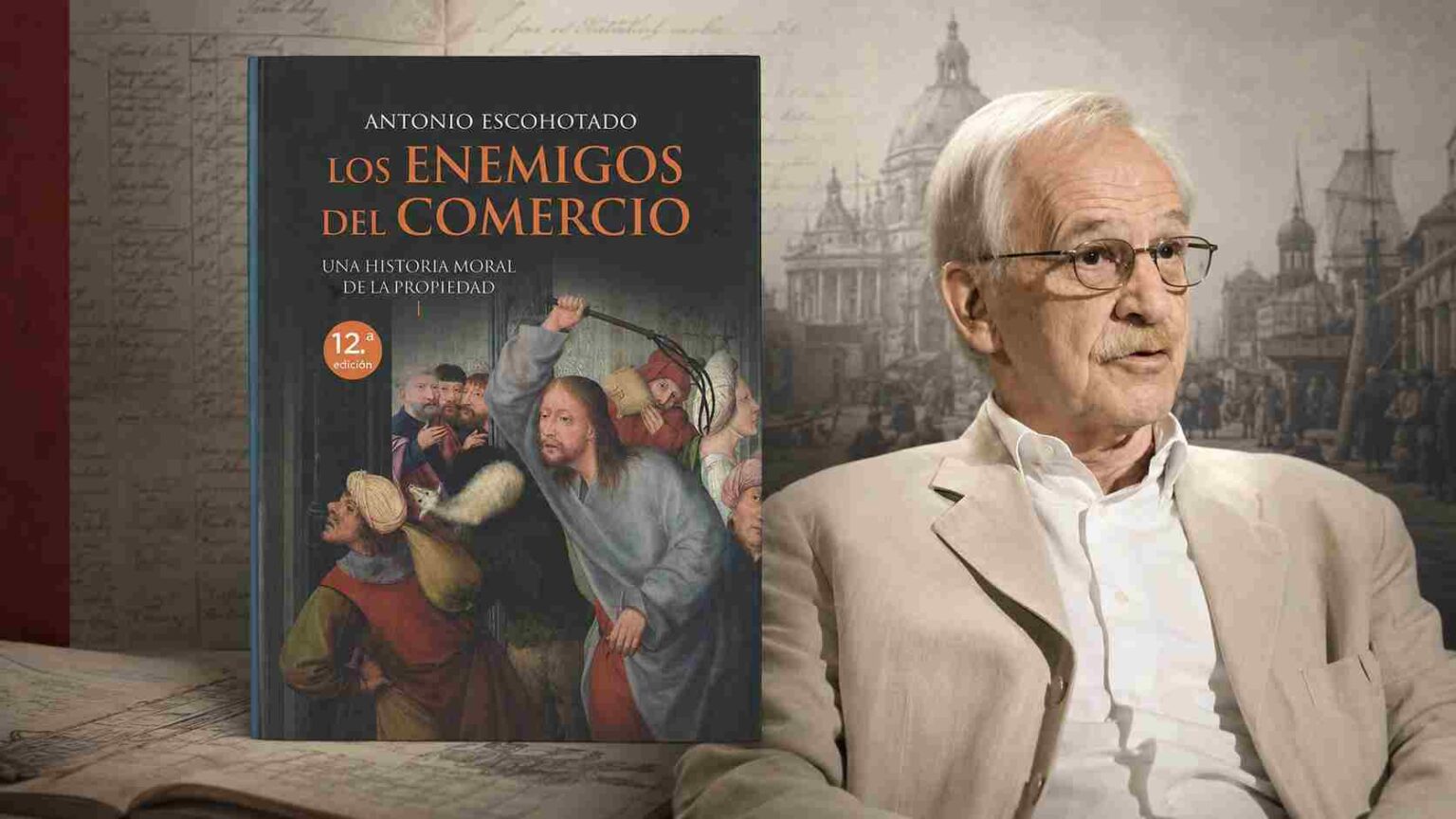
- Antonio Escohotado portrait: PlanetadeLibros author profile; photographer not identified on the source page.
- Princeton University Press logo: Wikimedia Commons file page; public-domain text and geometric logo, trademarked.
- Yale University Press logo: Wikimedia Commons file page; 2009 text logo, public domain and trademarked.
- Liberty Fund logo: Wikimedia Commons file page — design by Liberty Fund, Inc., sourced from its official website.