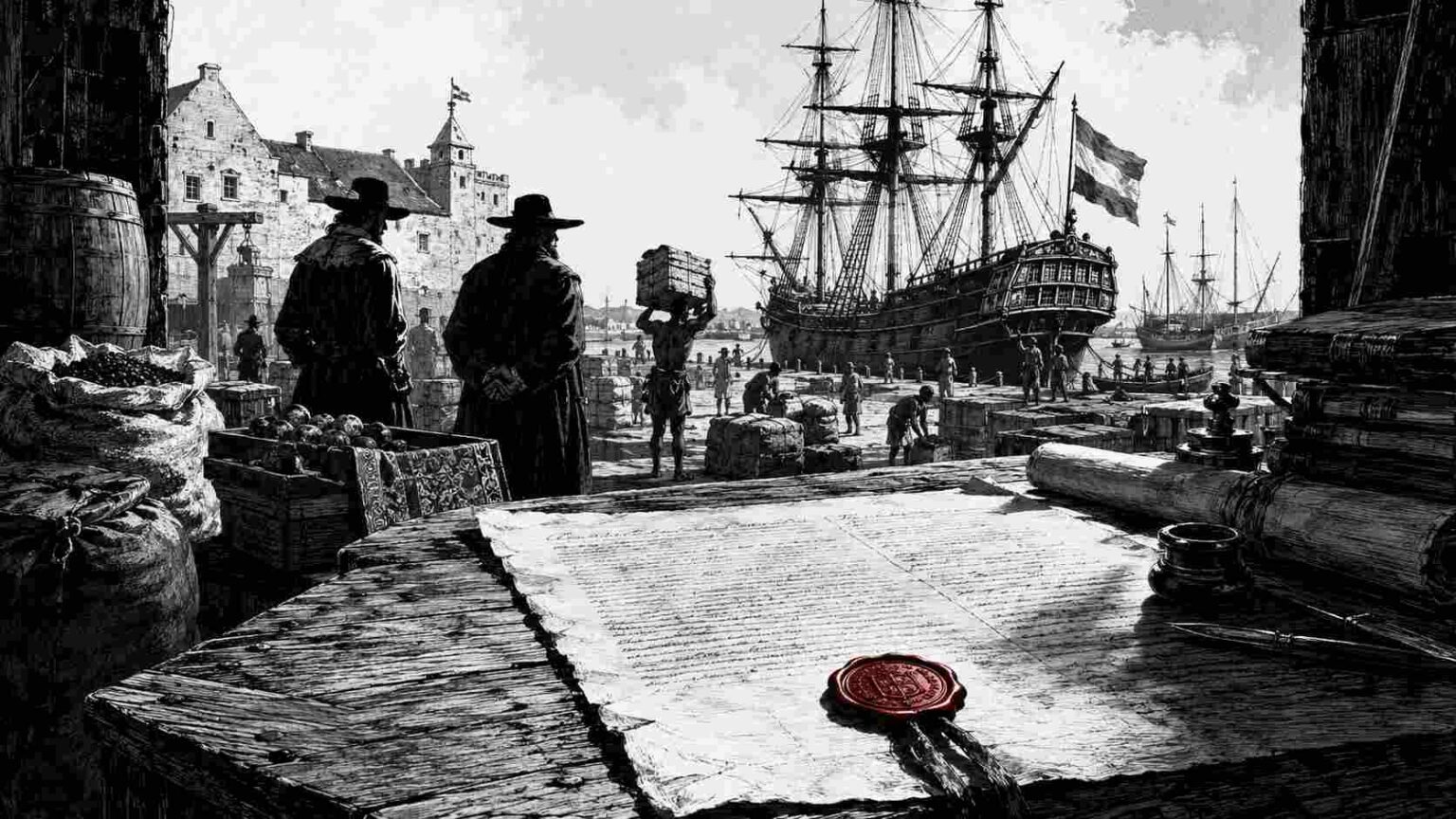
The best books on the Dutch East India Company refuse the reassuring myth of a modern corporation born ahead of its time. Read together, these five studies show the VOC as a commercial machine, a maker of legal claims, a negotiator with Asian powers, a manager of forced mobility, and a regulator of colonial social life.
The Short Answer
Start with Femme Gaastra for the institutional map, then read Adam Clulow before moving into the denser studies. These five books belong together because they treat the VOC as more than a trading firm: they reconstruct its organization, legal self-justification, negotiated sovereignty, coercive movement of people, and governance of households. The sequence is argumentative rather than chronological.
Gaastra explains how the machine worked. Martine van Ittersum then shows how legal argument helped authorize expansion. Clulow tests that confidence against Tokugawa Japan, where Dutch claims to sovereign standing repeatedly failed. Kerry Ward shifts the center of gravity from commerce to forced migration, while Sophie Rose brings rule into marriage, sexuality, family status, and everyday conflict. Taken together, the Company looks less like a corporate ancestor than an unstable form of delegated empire.
Why books on the Dutch East India Company need more than a business story
The VOC received its charter in 1602 and combined monopoly rights with powers that modern readers normally associate with public authority: treaty-making, fortification, armed force, adjudication, and war. The Dutch National Archives makes that institutional mixture unusually visible, while UNESCO’s Memory of the World record emphasizes the geographic breadth of the surviving archives.
That archive is also the reason no single explanatory vocabulary is enough. “Company” captures directors, capital, shipping, and monopoly; “empire” captures conquest, jurisdiction, coercion, and settlement; neither alone explains how Dutch agents depended on Asian rulers, brokers, soldiers, sailors, enslaved people, migrants, and mixed households. The strongest histories therefore keep scale shifting. They move between the Amsterdam boardroom and Batavia, between legal theory and local submission, between oceanic networks and intimate life.
Read the VOC as delegated power under pressure
The useful question is not whether the VOC was “really” a company or “really” a state. Its historical force came from moving between those positions. Commercial privileges could become military demands; contractual language could accompany coercion; sovereignty could be asserted in one port and surrendered in another. These books are strongest when read for those transitions. They show authority being assembled through paperwork, violence, negotiation, mobility, and household regulation rather than simply possessed in advance. That instability is itself part of the historical explanation, not a taxonomic inconvenience.
The Dutch East India Company: Expansion and Decline
Author: Femme S. Gaastra
Recommended edition: Walburg Pers, English edition, 2003; translated by Peter Daniels; ISBN 9789057302411
Best for: First orientation to organization, shipping, trade, war, and decline
Difficulty: General to Intermediate
Intellectual role: Institutional baseline
BookInLight Rating: ★★★★★
Gaastra is the least theoretically ambitious book here and therefore the right place to begin. Its strength is proportion. Finance, chambers, fleets, personnel, Asian trade, military force, and administrative growth appear as parts of one organization rather than as separate specialist subjects. The reader gains the vocabulary needed to understand why later historians can argue about sovereignty without losing sight of payrolls, cargoes, routes, and institutional procedure.
BookInLight note: Treat this as a map, not a verdict. Its synthetic clarity is precisely what the next four books complicate.
Profit and Principle
Author: Martine Julia van Ittersum
Recommended edition: Brill hardback, 2006; ISBN 9789004149793
Best for: Law, political thought, and the ideological work of empire
Difficulty: Advanced
Intellectual role: Legal genealogy
BookInLight Rating: ★★★★★
Van Ittersum reconstructs Hugo Grotius’s early arguments not as detached contributions to timeless international law but as interventions entangled with VOC interests. De Jure Praedae and Mare Liberum emerge from disputes over prize-taking, commerce, contract, and Dutch entry into Iberian imperial spaces. The book’s value is methodological: ideas do political work because they are made inside concrete conflicts.
Read after Gaastra, it changes the meaning of “commercial expansion.” Monopoly and violence were not merely practical excesses around a neutral business core; they were accompanied by justificatory languages about rights, freedom of trade, possession, and legitimate force.
BookInLight note: This is the densest volume in the set. Postpone it if you want narrative first, but do not skip it if the legal vocabulary of empire matters to your question.
Rijksmuseum Research Library record · Google Books edition record
The Company and the Shogun
Author: Adam Clulow
Recommended edition: Columbia University Press paperback, 2016; ISBN 9780231164290
Best for: Diplomacy, sovereignty, and Asian constraints on European power
Difficulty: Intermediate
Intellectual role: The corrective to automatic European dominance
BookInLight Rating: ★★★★★
Clulow’s central move is simple and devastating: take VOC claims seriously, then ask whether Asian states accepted them. In Tokugawa Japan the answer was repeatedly no. Dutch representatives altered titles, diplomatic behavior, legal postures, and assertions of sovereignty to fit a political order they did not control. The Company’s famous hybridity—merchant body and quasi-state—turns from an institutional advantage into a source of friction.
This is probably the best single monograph for dismantling a linear “European expansion” story. It does not deny VOC violence or capacity; it shows how power was relational. The same organization that acted imperially elsewhere could present itself as subordinate when Japanese authority made that the price of access.
BookInLight note: If you read only one specialist study after Gaastra, choose this one.
Columbia University Press edition page · Amazon paperback edition
Networks of Empire
Author: Kerry Ward
Recommended edition: Cambridge University Press paperback, 2012; ISBN 9781107404731
Best for: Forced migration, slavery, exile, and networked sovereignty
Difficulty: Advanced
Intellectual role: Coercion as imperial infrastructure
BookInLight Rating: ★★★★★
Ward asks what empire looks like when movement rather than territory becomes the organizing problem. Convicts, enslaved people, political exiles, and other forced migrants were moved through a VOC network linking Batavia, the Cape, Ceylon, and other nodes. Administrative power therefore appeared in the capacity to classify, transport, confine, relocate, and sometimes lose control of people.
The book pairs especially well with Clulow. Clulow reveals the limits of sovereign claims in negotiation with a strong Asian state; Ward shows sovereignty being produced piecemeal through durable circuits of administration. Her formulation of VOC power as partial and contingent is a better guide than any image of a seamless corporate empire.
BookInLight note: Read this when the language of “trade networks” begins to sound too frictionless. Ward makes the human cost and coercive administration visible.
Intimacy and Social (Dis)Order in Dutch Colonial Expansion
Author: Sophie Rose
Recommended edition: Brill hardback, 2025; ISBN 9789004746749
Best for: Gender, marriage, household status, slavery, and legal pluralism
Difficulty: Intermediate
Intellectual role: Intimate governance from below
BookInLight Rating: ★★★★★
Rose ranges across Dutch colonial settlements governed by both major chartered companies, so this is the one selection that is not exclusively about the VOC. That breadth is a reason to include it, not an evasion of the subject. Its Indian Ocean chapters show how colonial authorities tried to regulate sex, marriage, legitimacy, household formation, and status in societies that remained socially and legally plural.
Placed after Ward, the book changes the unit of analysis again. Empire is not only movement between ports; it is also an argument over who may marry, whose union counts, how children are classified, and how racialized or enslaved status enters family life. Authority becomes visible in conflicts that a shipping-centered history cannot see.
BookInLight note: Use Rose as the contemporary corrective that prevents “the Company” from swallowing the people who inhabited its settlements.
De Gruyter Brill publisher record · Exact hardback edition record
How These Books Speak to One Another
The decisive argument runs across the seams. Gaastra explains delegated capacity; van Ittersum shows that capacity acquiring a language of right; Clulow demonstrates that legal and institutional confidence did not travel unchanged; Ward locates imperial power in networks of coerced mobility; Rose finds governance in social reproduction and household status. Each book therefore lowers the level at which a simple corporate story can survive.
They also disagree productively about where to look for power. Institutional history favors structures, intellectual history follows concepts, diplomatic history follows encounters, and social history follows people whose movement or family life administrators attempted to order. The books on the Dutch East India Company that endure are the ones that allow those methods to correct each other. The VOC was formidable, but never frictionless; coercive, but never omnipotent; commercial, but never merely commercial.
The Reading Map
| Book | Difficulty | Rating | Why It Matters |
|---|---|---|---|
| The Dutch East India Company | General to Intermediate | ★★★ ★☆ | Institutional map. |
| Profit and Principle | Advanced | ★★★ ★☆ | Law as imperial practice. |
| The Company and the Shogun | Intermediate | ★★★ ★★ | Shows Asian constraints. |
| Networks of Empire | Advanced | ★★★ ★★ | Centers forced mobility. |
| Intimacy and Social (Dis)Order | Intermediate | ★★★ ★☆ | Makes household rule visible. |
Where to Begin
- Entry point — Gaastra. Read over several focused sessions for the institutional and chronological frame.
- Test the frame — Clulow. Move immediately to Japan, where VOC sovereignty becomes negotiation rather than assumption.
- Follow coercion — Ward. Shift from diplomatic encounters to the forced movement that connected imperial nodes.
- Read law backward — van Ittersum. With the Company’s practices now visible, return to the arguments that helped legitimate Dutch expansion.
- End at household scale — Rose. Finish by asking how colonial order entered marriage, sexuality, status, and family life.
What the Company Still Refuses to Become
The best balance of accessibility and depth begins with Gaastra, but the most illuminating book in the set is Clulow’s: it makes power contingent without making it trivial. The full sequence of books on the Dutch East India Company then reveals why the VOC resists any single modern analogy. It was neither simply a multinational business nor simply a territorial state. It was a machine for converting delegated privileges into different forms of authority—and one that constantly met people, institutions, and social worlds capable of redirecting, limiting, or absorbing that power.
Related BookInLight Reading Guides
Seven Best Books on the Dutch Golden Age for Serious Readers — places VOC power inside the republic’s wider political, economic, cultural, and imperial history.
Five Best Books on the Hanseatic League for Serious Readers — a useful comparison for thinking about merchant networks, privileges, and authority without assuming a modern state form.
Empire, Labor, Liberation: Six Books on Portuguese Africa — extends the comparison toward coercive labor, colonial administration, and the long structures of European empire.
Sources and Further Reading
Primary Editions and Book Records
Femme S. Gaastra, The Dutch East India Company: Expansion and Decline, Walburg Pers, 2003. WorldCat record. Used for edition verification and the institutional overview.
Martine Julia van Ittersum, Profit and Principle, Brill, 2006. Rijksmuseum Research Library record. Used for bibliographical verification and the Grotius/VOC connection.
Adam Clulow, The Company and the Shogun, Columbia University Press. Publisher page. Used for edition data and the argument about diplomacy, violence, and sovereignty in Tokugawa Japan.
Kerry Ward, Networks of Empire, Cambridge University Press. Cambridge Core record. Used for edition data and the concept of partial, contingent sovereignty through forced-migration networks.
Sophie Rose, Intimacy and Social (Dis)Order in Dutch Colonial Expansion, Brill, 2026 copyright / 2025 hardback release. Publisher record. Used for the book’s scope, open-access publication data, and themes of normativity, household, gender, slavery, and legal order.
Archives and Historical Context
Nationaal Archief, “VOC, 1602–1800”. Supports the chartered powers of the Company and the range of surviving Dutch archival materials.
Nationaal Archief, overview of VOC archives, 1594–1814. Used for the structure and geographic reach of the archival record.
UNESCO Memory of the World, Archives of the Dutch East India Company. Supports the global distribution and exceptional scale of surviving VOC documentation.
Scholarly Context and Comparison
Pieter C. Emmer and Jos J. L. Gommans, The Dutch Overseas Empire, 1600–1800, Cambridge University Press, 2020. Cambridge Core. Consulted for comparison between Atlantic and Asian forms of Dutch expansion.
Léonard Blussé, Strange Company: Chinese Settlers, Mestizo Women, and the Dutch in VOC Batavia, Foris Publications, 1986. Fulcrum record. Consulted as a classic social history of Batavia and an important alternative candidate for the social-history slot.
UNESCO, “The Archives of the Dutch East Indian Company (VOC)”. Used for the historiographical significance of VOC records for Asian as well as Dutch history.
Nationaal Archief, “The world of the Dutch East India Company”. Used to confirm the transnational dispersal and research value of the archive.
Image Credits
The Dutch East India Company: Expansion and Decline, Walburg Pers English edition, 2003. Cover asset sourced from bol.com’s public image server; bibliographical match checked against the WorldCat edition record. The same verified asset appears in the hero shelf and the book module.
Profit and Principle, Brill hardback, 2006. Cover asset sourced from bol.com’s public image server; edition identity checked against the Rijksmuseum Research Library record. The same verified asset appears in the hero shelf and the book module.
The Company and the Shogun, Columbia University Press paperback, 2016. Cover asset sourced from Amazon Media’s public image server; format and ISBN checked against the Columbia University Press edition page. The same verified asset appears in the hero shelf and the book module.
Networks of Empire, Cambridge University Press paperback, 2012. Cover asset sourced from Kennys.ie’s public bookseller image server; ISBN 9781107404731 checked against the Cambridge University Press edition record. The same verified asset appears in the hero shelf and the book module.
Intimacy and Social (Dis)Order in Dutch Colonial Expansion, Brill hardback, 2025. Cover asset sourced from Bookshop.org/Ingram’s public image server; the hardback ISBN 9789004746749 is documented in the Brill publication catalogue. The same verified asset appears in the hero shelf and the book module.