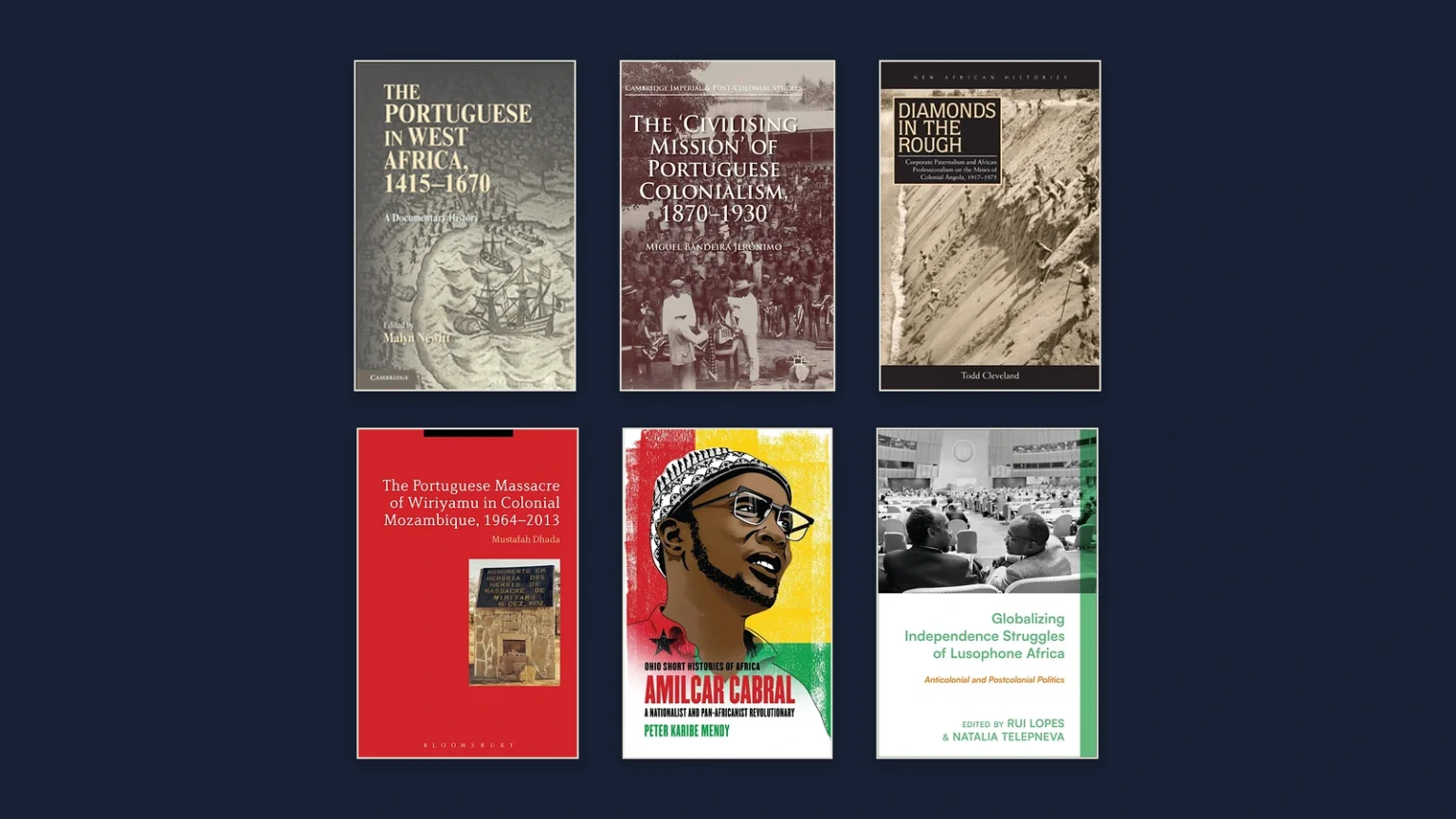
The strongest books on the Portuguese Empire in Africa do not narrate an uninterrupted national adventure. They expose a changing structure built through trade, slavery, coerced labor, concessionary capital, racial doctrine, war, and African political invention. These six volumes move from first encounters to the global destruction of colonial rule.
The Short Answer
For readers choosing books on the Portuguese Empire in Africa, begin with Miguel Bandeira Jerónimo, then read outward in both directions. His study explains how “civilization” became labor policy and colonial self-defense. Malyn Newitt supplies the earlier archive; Todd Cleveland and Mustafah Dhada reveal mature colonial machinery and violence; Peter Karibe Mendy restores anticolonial strategy; Rui Lopes and Natalia Telepneva place liberation within global networks.
These six books belong together because they replace the myth of a uniquely mild Portuguese presence with a history of negotiated encounters, coerced labor, corporate rule, military violence, African political thought, and transnational decolonization. The sequence is argumentative rather than strictly chronological, with Jerónimo as the clearest first entry.
Why books on the Portuguese Empire in Africa need more than a chronology
Portugal’s African empire lasted long enough to tempt a single continuous story, from fifteenth-century voyages to the independence settlements of 1974–75. That continuity is deceptive. Coastal exchange, Atlantic slavery, late territorial conquest, republican and authoritarian administration, concessionary companies, forced cultivation, settler expansion, and counterinsurgency did not operate through one unchanged design.
The useful question is not whether Portuguese rule was simply “better” or “worse” than other empires. It is how a relatively weak European state repeatedly converted limited resources into durable claims over African people and territory—and how African rulers, workers, intellectuals, soldiers, farmers, and liberation movements constrained, redirected, or destroyed those claims. A six-book route works because no single scale can hold the whole problem.
Read the empire as a changing technology of rule
The central thread is institutional improvisation. Portuguese authority was never simply projected from Lisbon onto passive territory. It depended on African intermediaries, international scrutiny, private companies, missionary systems, racial categories, labor recruitment, military coercion, and claims to cultural assimilation. Across five centuries, its instruments changed from coastal diplomacy and commerce to territorial bureaucracy, corporate paternalism, and counterinsurgency. The books become most illuminating when read for the gap between imperial language and governing practice—and for the African action that continually altered both.
Editor: Malyn Newitt
Recommended edition: Cambridge University Press paperback, 2010; ISBN 9780521159142
Best for: First encounters, trade, diplomacy, conversion, and slavery
Difficulty: Intermediate
Intellectual role: The archive before the retrospective imperial myth
BookInLight Rating: ★★★★★
Newitt’s sourcebook prevents the early empire from becoming a story told only by later national memory. Royal instructions, travel accounts, commercial records, and missionary reports show Portuguese ambitions meeting existing African states and trading systems. Diplomacy coexists with captivity; religious translation with commercial violence.
Read it early to see empire assembled through unstable relationships. Because the archive is largely mediated through European writing, its categories and silences require as much attention as its reported events.
Author: Miguel Bandeira Jerónimo
Recommended edition: Palgrave Macmillan hardback, 2015; ISBN 9781137355904
Best for: Understanding how moral language legitimized labor coercion
Difficulty: Advanced
Intellectual role: The conceptual center of the selection
BookInLight Rating: ★★★★★
Jerónimo dismantles the separation between humanitarian vocabulary and exploitation. “Civilization” did not merely decorate an economic system; it organized labor recruitment, missionary schooling, São Tomé cocoa production, and responses to international investigation.
This is the best starting point because it moves cleanly between doctrine, administration, and transnational pressure. It also corrects explanations based only on Portuguese weakness: colonial officials learned from wider imperial institutions while defending practices those institutions criticized.
Author: Todd Cleveland
Recommended edition: Ohio University Press paperback, 2015; ISBN 9780821421345
Best for: Labor history, corporate paternalism, and everyday life in colonial Angola
Difficulty: Intermediate
Intellectual role: The company town as an imperial institution
BookInLight Rating: ★★★★★
Cleveland follows African workers inside Diamang, the concessionary diamond company that became one of the empire’s strongest institutions. He rejects both workers-as-victims and corporate welfare as proof of humane rule. Skill, family life, and negotiated expectations helped stabilize an unequal system.
After Jerónimo, the book shows doctrine becoming housing, recreation, labor discipline, isolation, and profit. African agency does not cancel coercion; it explains how people made lives within structures they did not choose.
Author: Mustafah Dhada
Recommended edition: Bloomsbury Academic paperback, 2017; ISBN 9781350036802
Best for: Colonial warfare, oral history, atrocity investigation, and historical memory
Difficulty: Intermediate
Intellectual role: The forensic test of late-imperial claims
BookInLight Rating: ★★★★★
Dhada reconstructs the 1972 Wiriyamu massacre and the struggle over how it became knowable. Oral testimony, archives, missionary networks, military records, journalism, and local geography are made to test one another, showing how atrocity is concealed, disclosed, disputed, and remembered.
The study rejects accounts that treat late-colonial violence as an accidental excess, but it also refuses indictment without reconstruction. Who acted, what enabled them, and how evidence traveled remain central.
Author: Peter Karibe Mendy
Recommended edition: Ohio University Press paperback, 2019; ISBN 9780821423721
Best for: Guinea-Bissau, Cabo Verde, revolutionary organization, and anticolonial thought
Difficulty: General to Intermediate
Intellectual role: African strategy against the empire
BookInLight Rating: ★★★★★
Mendy restores a theater often overshadowed by Angola and Mozambique. Cabral appears as agronomist, organizer, diplomat, strategist, and theorist of culture. He joined local knowledge to international coalition-building while insisting that liberation had to transform social relations, not merely replace a flag.
The book’s accessibility makes it the best bridge from colonial institutions to anticolonial agency. Follow it with Cabral’s own writings, once Mendy has supplied the chronology and conflicts of unity, class, territory, and mobilization.
Editors: Rui Lopes and Natalia Telepneva
Recommended edition: Zed Books hardback, 2024; ISBN 9781350378308; open-access digital edition available
Best for: Comparative decolonization, diplomacy, solidarity networks, and the Cold War
Difficulty: Advanced
Intellectual role: The empire’s end as a connected global process
BookInLight Rating:
Difficulty: Advanced
★★★★★
This anthology refuses to treat Angola, Mozambique, Guinea-Bissau, Cabo Verde, and São Tomé and Príncipe as sealed cases. Liberation movements moved through the United Nations, Afro-Asian conferences, socialist states, Western activist networks, and competing Cold War alliances.
Its multi-author form requires more work than a continuous narrative, but the range is the point. Read after Mendy, it expands Cabral’s world without making him the sole model of liberation and follows independence into economic interests, cultural institutions, and postcolonial alignments.
How These Books Speak to One Another
Newitt and Jerónimo reveal different imperial formations: one maritime and diplomatically entangled with African polities; the other territorial, bureaucratic, racialized, and justified through development. Cleveland shows mature colonial power delegated to a company, while Dhada shows administration and counterinsurgency converging in organized killing.
Mendy and Lopes–Telepneva reverse the field of vision. Empire becomes the object acted upon by African organizers connecting villages, parties, military fronts, conferences, and states. Pair Jerónimo with Cleveland for doctrine beside workplace; Dhada with Mendy for repression beside liberation strategy. Together they make Portuguese exceptionalism untenable without flattening colonial differences.
The Reading Map
| Book | Difficulty | Rating | Why It Matters |
|---|---|---|---|
| Portuguese in West Africa | Intermediate | ★★★★★ | Early archive and encounter |
| Civilising Mission | Advanced | ★★★★★ | Doctrine becomes labor policy |
| Diamonds in the Rough | Intermediate | ★★★★★ | Company rule from below |
| Wiriyamu | Intermediate | ★★★★★ | Atrocity and historical proof |
| Amílcar Cabral | General to Intermediate | ★★★★★ | Liberation as organization |
| Globalizing Independence | Advanced | ★★★★★ | Decolonization beyond borders |
Where to Begin
- Entry point: Read Jerónimo over several focused sessions to acquire the vocabulary of labor, civilization, and imperial legitimacy.
- Historical depth: Move backward to Newitt and sample documents by region and problem rather than reading mechanically from page one.
- Institutional life: Read Cleveland next, then Dhada, shifting from the routine stability of company rule to the extremity of colonial war.
- Anticolonial agency: Read Mendy in a weekend, followed by selected speeches and essays by Cabral.
- Comparative finish: Use Lopes and Telepneva as the advanced synthesis; its chapters may be read in parallel by territory or network.
The Unfinished Archive
Among these books on the Portuguese Empire in Africa, Jerónimo offers the best balance of conceptual power and historical specificity, while Mendy is the most accessible first book for readers drawn primarily to decolonization. Newitt should come early, but not necessarily first: documentary abundance becomes more intelligible once the reader knows which imperial categories require suspicion.
The complete sequence reveals something no national chronicle can: Portuguese rule endured through adaptation, delegation, and international argument, yet its endurance depended on African work and political worlds it never fully controlled. The empire’s history is therefore neither a Portuguese possession nor a closed story of European action. It remains an African history of imposed structures, negotiated lives, organized resistance, and archives still being reopened.
Related BookInLight Reading Guides
Six Best Books on the Algerian War of Independence — a comparative route into another late colonial war, joining state violence, revolutionary theory, testimony, and memory.
Ten recent researchs on Frantz Fanon’s The Wretched of the Earth — scholarship on violence, subjectivity, class, trauma, and the unfinished politics of decolonization.
Seven Essential Books on Black Theology and Liberation — useful for readers pursuing the entanglement of Christianity, racial power, colonial history, and emancipatory thought.
Sources and Further Reading
Primary Texts and Editions
Malyn Newitt, ed., The Portuguese in West Africa, 1415–1670, Cambridge University Press, 2010 — documentary evidence for early encounters, commerce, diplomacy, religion, and slavery.
Miguel Bandeira Jerónimo, The ‘Civilising Mission’ of Portuguese Colonialism, 1870–1930, Palgrave Macmillan, 2015 — the principal source for ideology, labor policy, and international imperial comparison.
Todd Cleveland, Diamonds in the Rough, Ohio University Press, 2015 — company rule and African labor in colonial Angola.
Mustafah Dhada, The Portuguese Massacre of Wiriyamu in Colonial Mozambique, 1964–2013, Bloomsbury Academic, 2017 — massacre reconstruction, oral history, and evidentiary method.
Peter Karibe Mendy, Amílcar Cabral, Ohio University Press, 2019 — biography and political context for Guinea-Bissau and Cabo Verde.
Rui Lopes and Natalia Telepneva, eds., Globalizing Independence Struggles of Lusophone Africa, Zed Books, 2024 — comparative anticolonial networks and postcolonial politics.
Intellectual and Historical Context
John Thornton, Africa and Africans in the Making of the Atlantic World, 1400–1800, second edition, Cambridge University Press, 1998 — African institutions and agency in Atlantic formation.
Malyn Newitt, A History of Mozambique, Hurst, 1994 — long-duration political and commercial history of Mozambique.
Frederick Cooper, Africa since 1940, second edition, Cambridge University Press, 2019 — decolonization, citizenship, development, and postcolonial state formation.
Norrie MacQueen, The Decolonization of Portuguese Africa, Longman, 1997 — metropolitan revolution and the comparative dissolution of the African empire.
Patrick Chabal and David Birmingham, eds., A History of Postcolonial Lusophone Africa, Hurst, 2002 — national trajectories after formal independence.
Comparative Studies
Miguel Bandeira Jerónimo and António Costa Pinto, eds., The Ends of European Colonial Empires, Palgrave Macmillan, 2015 — comparative chronologies and forms of European decolonization.
Pamila Gupta, Portuguese Decolonization in the Indian Ocean World, Bloomsbury Academic, 2018 — ethnography, mobility, memory, and connected decolonization.
Witney W. Schneidman, Engaging Africa, University Press of America, 2004 — United States policy and the fall of Portugal’s colonial empire.
Bloomsbury Collections, open-access edition of Globalizing Independence Struggles of Lusophone Africa — full-text access for chapter-level comparative reading.
Image Credits
The Portuguese in West Africa, 1415–1670, Cambridge University Press paperback, 2010: cover asset supplied through Cambridge University Press; authoritative edition page. The same verified asset appears in the hero shelf and book module.
The ‘Civilising Mission’ of Portuguese Colonialism, 1870–1930, Palgrave Macmillan hardback, 2015: cover asset supplied through Springer Nature; authoritative edition page. The same verified asset appears in the hero shelf and book module.
Diamonds in the Rough, Ohio University Press paperback, 2015: cover asset supplied through Ohio University Press; authoritative edition page. The same verified asset appears in the hero shelf and book module.
The Portuguese Massacre of Wiriyamu in Colonial Mozambique, 1964–2013, Bloomsbury Academic paperback, 2017: cover asset supplied through Bloomsbury Atlas; authoritative edition page. The same verified asset appears in the hero shelf and book module.
Amílcar Cabral, Ohio University Press paperback, 2019: cover asset supplied through Ohio University Press; authoritative edition page. The same verified asset appears in the hero shelf and book module.
Globalizing Independence Struggles of Lusophone Africa, Zed Books hardback, 2024: cover asset supplied through Bloomsbury Atlas; authoritative edition page. The same verified asset appears in the hero shelf and book module.