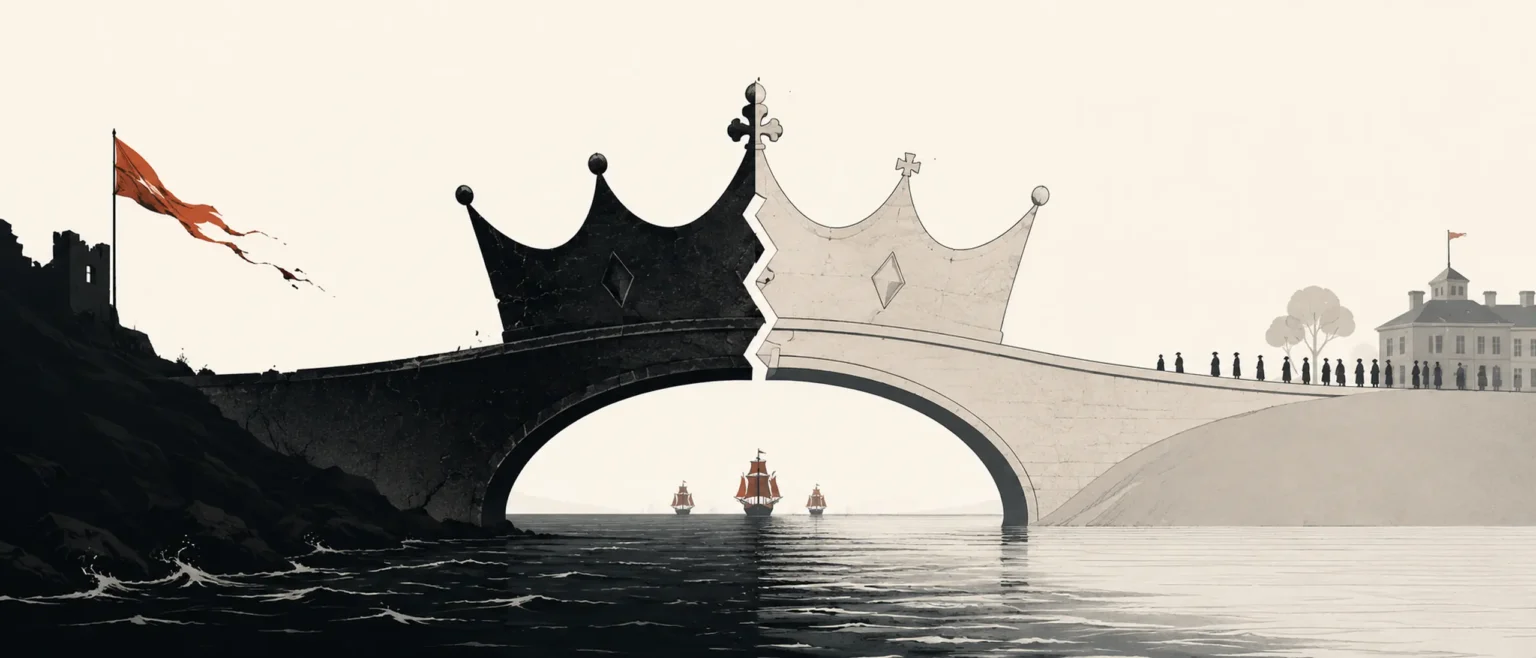
Illustration by Bookinlight Art Desk
The best books on the Glorious Revolution do more than retell the landing of William of Orange, the flight of James II, and the parliamentary settlement of 1689. They ask why a dynastic emergency became a constitutional turning point, why a supposedly “bloodless” revolution was experienced differently across England, Scotland, Ireland, the Dutch Republic, and the Atlantic world, and why later generations transformed a contested seizure of power into a story about liberty.
By Bookinlight
This reading packet treats 1688–89 as both event and argument. The books below move from revisionist synthesis to political narrative, popular reappraisal, transnational context, interdisciplinary historiography, and classic constitutional interpretation. Together they show that the Glorious Revolution was not one thing: it was a military intervention, a Protestant succession crisis, a legal settlement, a fiscal and imperial reorientation, and a memory-machine for later liberal constitutionalism.
The Reading Lens
The Best Books on the Glorious Revolution as a Problem of Power
Read in sequence, these works turn 1688 from a commemorative slogan into a field of disagreement. The central issue is not whether James II was defeated, but how political legitimacy was reconstructed after his defeat: through law, religion, invasion, elite negotiation, public opinion, war finance, and historical memory.
Central Question
When does deposition become constitutional settlement?
Historical Pressure
Religious fear, Dutch strategy, Stuart state-building, and war in the three kingdoms.
Why These Books
They replace a single Whig story with competing scales of interpretation.
The Reading Map
| Book | Difficulty | Rating | Why It Matters |
|---|---|---|---|
| 1688 | Advanced | ★★★★★ | Reframes 1688 as a modern revolution of state, economy, and ideology. |
| Revolution | Intermediate | ★★★★★ | Restores crisis, violence, and three-kingdom complexity to the story. |
| The Glorious Revolution | General to Intermediate | ★★★★½ | Makes revisionist history accessible without flattening the political drama. |
| The Anglo-Dutch Moment | Advanced | ★★★★½ | Places 1688 inside Dutch, European, imperial, and Atlantic settings. |
| The Revolution of 1688-89 | Advanced | ★★★★½ | Shows how law, gender, religion, literature, and political theory revise the field. |
| The Revolution of 1688 in England | Intermediate | ★★★★ | Clarifies political contingency before later revisionism expanded the frame. |
1
1688: The First Modern Revolution
Author: Steve Pincus
Best for: Readers who want the boldest modern reinterpretation of 1688.
Difficulty: Advanced
Intellectual role: Revisionist master-argument
Bookinlight Rating: ★★★★★
Steve Pincus’s 1688 is the indispensable revisionist challenge to the older image of the Glorious Revolution as a conservative, consensual, and narrowly constitutional adjustment. Its central claim is deliberately provocative: 1688 should be read as the first modern revolution, not because it produced a democratic republic, but because it involved competing programs of state formation, political economy, foreign policy, religion, and empire. Pincus sees James II not as a merely backward absolutist but as a monarch pursuing an aggressive Catholic, centralized, and imperial program; the revolutionaries, in turn, were not only restoring ancient liberties but promoting an alternative vision of political participation, commercial expansion, anti-French strategy, and fiscal-military transformation.
The book belongs here because it forces every reader to widen the category of revolution itself. Instead of asking whether 1688 was “really” revolutionary by French or Russian standards, Pincus asks what counts as revolutionary within early modern conditions. The answer is not barricades alone; it is the remaking of institutions, credit, sovereignty, public argument, and geopolitical alignment. This is a demanding work, full of archival density and historiographical pressure, but it rewards readers who want the central scholarly debate rather than a smooth narrative. It changes the reader’s understanding of 1688 by replacing the language of settlement with the language of ideological conflict and structural change.
Bookinlight Note: Read this first only if you enjoy large arguments; otherwise read it after one narrative history and return to it as the interpretive summit.
2
Revolution: The Great Crisis of the British Monarchy, 1685-1720
Author: Tim Harris
Best for: Readers who want a full political narrative across the three kingdoms.
Difficulty: Intermediate
Intellectual role: Narrative reconstruction of crisis
Bookinlight Rating: ★★★★★
Tim Harris’s Revolution is the most satisfying single-volume narrative for readers who need the event restored to its human, religious, and political volatility. Harris does not let 1688 become a clean morality play about parliamentary liberty defeating royal tyranny. He follows the crisis from the final years of James II through the contested aftermath, giving serious weight to England, Scotland, and Ireland. That three-kingdom emphasis is crucial: the Revolution did not have one meaning everywhere. In England it could be narrated as providential deliverance and constitutional repair; in Scotland it involved a sharper ecclesiastical and political restructuring; in Ireland it became inseparable from war, dispossession, and Jacobite defeat.
This book belongs in the article because it resists both triumphalist memory and overly abstract constitutional shorthand. Harris is especially strong on fear: fear of Catholic absolutism, fear of arbitrary power, fear of social disorder, fear of foreign domination, and fear that no stable legitimacy could survive the collapse of Stuart authority. Readers who benefit most are those who want the revolution to feel like an unfolding crisis rather than a finished doctrine. Harris changes one’s understanding of the theme by showing how the “settlement” of 1689 was less an ending than a pressured beginning. The Revolution had to be defended, explained, militarized, legislated, and remembered before it could become the supposedly stable foundation of British constitutional monarchy.
Bookinlight Note: This is the best narrative companion to Pincus: less programmatic, more atmospheric, and especially valuable for Scotland and Ireland.
3
The Glorious Revolution: 1688 – Britain’s Fight for Liberty
Author: Edward Vallance
Best for: General readers who want an accessible revisionist account.
Difficulty: General to Intermediate
Intellectual role: Public-facing revision of the bloodless myth
Bookinlight Rating: ★★★★½
Edward Vallance’s The Glorious Revolution is an excellent entry point because it keeps the political drama vivid while still pressing against the comforting national myth. The book’s central contribution is to show that 1688 was not simply a painless correction of monarchy by a unified political nation. It was an episode filled with anxiety over religion, loyalty, propaganda, armed force, popular mobilization, and the uncertain status of rights. Vallance is particularly useful for readers who have inherited the phrase “Glorious Revolution” as a schoolbook label and want to know why historians have become suspicious of its smoothness.
The book belongs here because it bridges two audiences: the general reader who needs narrative momentum and the serious humanities reader who wants the old triumphalist language unsettled. Vallance does not reduce the revolution to a Dutch invasion, nor does he leave it as a self-congratulatory English constitutional miracle. Instead, he tracks the pressures that made James II vulnerable and the post-revolutionary settlement morally complicated. Readers interested in political liberty will benefit from the book’s refusal to treat liberty as a simple inheritance. Liberty had to be defined against Catholic fear, royal prerogative, standing armies, religious dissent, and the unresolved status of those excluded from the new order. Vallance changes the reader’s understanding by making “glorious” sound less like a verdict and more like a question.
Bookinlight Note: This is the most approachable book in the sequence for readers who want seriousness without beginning in specialist historiography.
4
The Anglo-Dutch Moment: Essays on the Glorious Revolution and Its World Impact
Author: Jonathan I. Israel
Best for: Readers interested in Dutch power, Europe, empire, and Atlantic consequences.
Difficulty: Advanced
Intellectual role: Transnational and comparative expansion
Bookinlight Rating: ★★★★½
Edited by Jonathan I. Israel, The Anglo-Dutch Moment is essential because it breaks the habit of treating the Glorious Revolution as an enclosed English constitutional episode. Its major contribution is scale. The events of 1688–91 were Anglo-Dutch, British, European, colonial, confessional, commercial, and military. William of Orange was not merely a convenient Protestant substitute for James II; he was stadholder, military strategist, anti-French coalition-builder, and ruler whose intervention made sense within the Dutch Republic’s strategic struggle against Louis XIV. Once that wider frame is restored, the Revolution looks less like domestic correction and more like an international reordering.
This volume belongs in the list because it gives readers the context that English constitutional narratives often compress. It is especially valuable for those studying early modern Europe, Atlantic history, imperial politics, and the relationship between war and state formation. The essays illuminate how 1688 affected Scotland, Ireland, North America, the Netherlands, diplomacy, financial systems, religious politics, and the balance of power. The reader who benefits most is already comfortable with edited scholarly collections and wants multiple angles rather than one authorial line. The book changes the theme by making “Glorious Revolution” an inadequate national container. What happened in England cannot be separated from Dutch logistics, European war, Protestant alliances, colonial governance, and the emergence of Britain as a state shaped by transnational crisis.
Bookinlight Note: This is the corrective to island history: read it whenever 1688 begins to look too English, too neat, or too legalistic.
5
The Revolution of 1688-89: Changing Perspectives
Author: Lois G. Schwoerer
Best for: Readers who want historiographical plurality and disciplinary range.
Difficulty: Advanced
Intellectual role: Interdisciplinary historiographical revision
Bookinlight Rating: ★★★★½
Lois G. Schwoerer’s edited volume The Revolution of 1688-89 matters because it presents revision not as a single thesis but as a field of changing perspectives. The book gathers essays that examine the Revolution through political history, religious conflict, legal culture, literature, gender, colonial experience, and political thought. Its central contribution is methodological: 1688 cannot be understood only through crown and Parliament. It must also be studied through printed argument, symbolic performance, constitutional language, social expectation, and the different communities that interpreted the crisis through their own fears and ambitions.
The volume belongs here because it teaches readers how historiography works. Instead of offering one grand replacement for the Whig narrative, it shows why the older narrative became vulnerable. The Revolution appears less as a single constitutional moment and more as a contested field in which different political actors made claims about law, conscience, arms, succession, resistance, and obedience. This is especially useful for graduate students, teachers, and intellectually patient readers who want to see how a historical event can be reopened by new questions. It changes the reader’s understanding by making the Revolution porous: its meaning is not fixed in the Bill of Rights alone, nor in William’s landing, nor in James’s flight. Its meaning emerges from arguments about authority, representation, memory, and the boundaries of political community.
Bookinlight Note: This is the seminar-room volume: less seamless than a monograph, but excellent for seeing the intellectual architecture of the field.
6
The Revolution of 1688 in England
Author: J. R. Jones
Best for: Readers who want a compact political history before later revisionist expansion.
Difficulty: Intermediate
Intellectual role: Classic political interpretation
Bookinlight Rating: ★★★★
J. R. Jones’s The Revolution of 1688 in England remains valuable because it captures an important stage in the historiography before the full transnational and three-kingdom revisions became dominant. Jones emphasizes contingency, diplomacy, political maneuver, and the unresolved constitutional conflicts that survived the Restoration. The Revolution was not inevitable; James II’s policies, the opposition’s calculations, Dutch strategic interests, and the fragility of political trust all mattered. This makes the book a useful corrective to any reading that treats 1688 as the automatic victory of Parliament over monarchy.
The book belongs in this article because a serious reading list should include not only the newest revision but also the intellectual steps that made revision possible. Jones gives readers a disciplined account of political causation: who acted, what they feared, what they misjudged, and why the settlement took the shape it did. The reader who benefits most is one who wants a clear line through the English political crisis without losing sight of European diplomacy. Compared with later works, the book is narrower; that is part of its usefulness. It shows the machinery of political explanation before the interpretive field widened to include empire, print culture, gender, and Atlantic history. It changes the reader’s understanding by making the Revolution appear as a contingent political achievement rather than a constitutional destiny waiting to happen.
Bookinlight Note: Read Jones historically as well as factually: the book shows how scholars framed 1688 before later debates transformed the scale of the question.
How to Read These Books Together
Begin with Vallance if you want narrative access, Harris if you want the richest account of crisis, and Pincus if you want the central revisionist argument immediately. Then move outward: Israel gives the Dutch and international architecture; Schwoerer shows the interdisciplinary field; Jones lets you see an earlier political framework with greater clarity. The point is not to decide whether the Glorious Revolution was simply “liberal,” “conservative,” “foreign,” or “constitutional.” The point is to recognize that every label captures one pressure and conceals another.
FAQ
What is the best first book on the Glorious Revolution?
Edward Vallance is the most accessible starting point, while Tim Harris is the strongest narrative choice for readers ready for more detail.
Was the Glorious Revolution really bloodless?
Not in any serious three-kingdom view. England’s transition was comparatively restrained, but Scotland and Ireland reveal war, coercion, and lasting settlement by force.
Why do historians connect 1688 with modern constitutional monarchy?
Because the settlement reshaped sovereignty, succession, parliamentary authority, Protestant legitimacy, and the legal limits of royal power.
Which book gives the most revisionist interpretation?
Steve Pincus’s 1688 offers the boldest reinterpretation, arguing that the Revolution was modern, ideological, and structurally transformative.
What Reading Still Keeps Open
The best books on the Glorious Revolution leave the reader with a productive discomfort. 1688 can still be called a constitutional landmark, but only if the phrase is made large enough to include invasion, propaganda, confessional fear, war finance, Dutch strategy, Irish catastrophe, Scottish settlement, and the retrospective manufacture of national liberty. The Revolution’s power lies in that tension: it was both a settlement and a rupture, both a legal memory and a military event, both a British crisis and a European moment.