Illustration by Bookinlight Art Desk
Ethics & Moral Philosophy
Five Books on the Philosophy of Death
A serious reading path through mortality, immortality, the self, the evil of death, and the fragile hope that human meaning depends on others living after us.
By Bookinlight



Mortality as Philosophy’s Oldest Trial
The best books on philosophy of death do not simply console the reader. They discipline consolation. They ask whether death is an evil, whether immortality would rescue or deform us, whether the self survives bodily dissolution, whether a finite life can still be whole, and whether our values secretly depend on generations we will never meet. The five books gathered here form a compact intellectual history: Plato gives death a metaphysical drama; Heidegger makes mortality internal to existence; Nagel turns death into a problem of value and perspective; Kagan maps the analytic terrain with unusual clarity; Scheffler asks why the survival of humanity may matter more to our lives than our own survival.
Together they show that death is never only an event at the end of life. It is a pressure placed upon every account of the person, every theory of value, every hope for wisdom, and every ethical attachment to the future.
Why the Best Books on Philosophy of Death Refuse Easy Peace
A sentimental book about death tries to soften fear. A philosophical book about death asks what fear is about. Is death terrifying because it is annihilation, because it deprives us of goods, because it exposes the instability of the self, or because it makes all projects appear temporary? These books matter because they treat mortality as a test case for metaphysics and ethics alike. The philosophy of death asks what a human being is, what a life is worth, how time gives shape to meaning, and why our own disappearance does not necessarily exhaust what matters to us.
The Reading Lens
Death as the Limit That Gives Thought Its Shape
Read in sequence, these books move from the hope that philosophy prepares the soul for death to the harder modern claim that mortality structures existence itself. The central shift is not from religion to secularity, but from survival to significance. What matters is no longer only whether something persists after death, but whether finite beings can have values, projects, loves, and obligations that remain intelligible under the shadow of nonexistence.
Central Question
Can death be understood without reducing human life to either metaphysical consolation or biological termination?
Historical Pressure
The modern decline of shared afterlife certainty forces philosophy to ask how meaning survives without guaranteed personal survival.
Why These Books
Each book gives death a different philosophical grammar: soul, existence, value, argument, and collective futurity.
Five Essential Books on Death and Human Meaning
Phaedo
Plato
Best for: Readers who want the classical origin of philosophy as preparation for death.
Difficulty: General to Intermediate
Intellectual role: The founding drama of death, soul, argument, and philosophical courage.
Bookinlight Rating: ★★★★★
Phaedo remains indispensable because it presents death not as an abstract topic but as a scene: Socrates, condemned to drink hemlock, spends his last hours arguing about the soul’s immortality. The dialogue’s philosophical force lies in its tension between serenity and uncertainty. Plato gives us arguments, myths, objections, and dramatic gestures, but he never allows doctrine to erase the human difficulty of dying. For the philosophy of death, this is the primal text: death becomes the occasion on which philosophy proves whether it can govern fear, desire, and attachment without becoming cold.
Bookinlight Note: Read the dialogue twice: once for its doctrine of soul, and once for its staging of composure under public execution.
Being and Time
Martin Heidegger
Best for: Readers ready for a demanding account of finitude and existence.
Difficulty: Advanced
Intellectual role: The existential turn from death as event to death as structure.
Bookinlight Rating: ★★★★★
Heidegger’s importance for the philosophy of death lies in his refusal to treat death as merely a future incident. In Being and Time, death is bound to the way human existence understands itself as finite, projected, anxious, and never fully replaceable by public roles. The famous notion of being-toward-death is not a morbid slogan; it is an account of how mortality individualizes existence. Death discloses that no one else can die my death for me. For readers interested in ethics, politics, literature, or theology, Heidegger’s account remains powerful because it explains why finitude is not a fact added to life but a condition through which life becomes one’s own.
Bookinlight Note: Pair this with a short guide to existentialism, but return to the death sections slowly; their difficulty is part of their force.
Mortal Questions
Thomas Nagel
Best for: Readers who want analytic philosophy with existential urgency.
Difficulty: Intermediate
Intellectual role: The bridge between personal mortality and problems of value, identity, and perspective.
Bookinlight Rating: ★★★★★★
Nagel’s essays matter because they refuse to separate death from the wider architecture of human value. Mortal Questions is not only about mortality, but its death-centered essays clarify why the loss involved in death cannot be dismissed by saying that the dead no longer suffer. Nagel’s style is lucid, compressed, and philosophically exact. He takes ordinary intuitions seriously, then tests them until they reveal hidden commitments about time, consciousness, deprivation, and the standpoint from which a life can be judged. This is the best analytic entry point for readers who want rigor without losing contact with lived perplexity.
Bookinlight Note: Use Nagel after Heidegger if you want to see how mortality changes when the idiom shifts from existential phenomenology to analytic value theory.
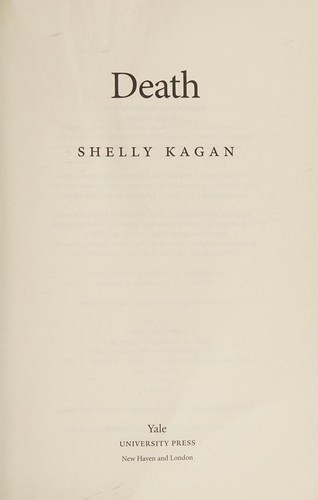
Death
Shelly Kagan
Best for: Readers seeking a full, teachable map of the main philosophical questions.
Difficulty: General to Intermediate
Intellectual role: The accessible analytic survey of death, soul, survival, fear, and immortality.
Bookinlight Rating: ★★★★★★
Kagan’s Death is unusually useful because it turns a university course into a sustained philosophical conversation. It asks whether we are material objects, whether the soul exists, whether personal survival makes sense, whether death is bad for the person who dies, whether immortality would be desirable, and whether fear of death is rational. Its great virtue is pedagogical clarity. Kagan often begins where many readers actually are, with ordinary beliefs about death, and then applies pressure until the beliefs either become arguments or collapse. This is the most practical book in the group for seminars, reading circles, and independent study.
Bookinlight Note: This is the best starting book for a public humanities course because it makes technical puzzles feel immediately human.
Death and the Afterlife
Samuel Scheffler
Best for: Readers interested in future generations, value, and the collective afterlife.
Difficulty: Intermediate
Intellectual role: The contemporary argument that meaning depends on humanity continuing after us.
Bookinlight Rating: ★★★★★★
Scheffler’s contribution is one of the most original recent turns in the philosophy of death. He does not defend personal immortality. Instead, he asks what would happen to our present values if we learned that humanity would end shortly after our own deaths. The result is startling: many of our deepest projects depend on a background confidence that others will continue after us. Cancer research, art, parenting, justice, education, and political reform all assume a human future. Scheffler therefore shifts the philosophy of death from individual survival to collective continuity, making mortality inseparable from ethics across generations.
Bookinlight Note: This is the book to bring into climate ethics, intergenerational justice, and debates about whether hope is private or civilizational.
How These Books Speak to One Another
Plato and Heidegger stand at opposite ends of a great philosophical reversal. Plato asks whether the soul can transcend death; Heidegger asks how death makes the self finite, singular, and answerable for its own existence. Nagel and Kagan then make the problem more precise: what exactly is lost when someone dies, and who is the subject of that loss? Scheffler completes the arc by showing that death is not only about the individual who disappears. It also reveals how much of personal meaning depends on an impersonal future. The sequence therefore moves from soul to self, from self to value, and from value to humanity’s continuation.
The Reading Map
| Book | Difficulty | Rating | Why It Matters |
|---|---|---|---|
| Phaedo | General to Intermediate | ★★★★★ | Death as soul, argument, and courage. |
| Being and Time | Advanced | ★★★★★ | Death as the structure of existence. |
| Mortal Questions | Intermediate | ★★★★★★ | Death as deprivation and value. |
| Death | General to Intermediate | ★★★★★★ | The clearest classroom map. |
| Death and the Afterlife | Intermediate | ★★★★★★ | Death as dependence on the future. |
Where to Begin
- Entry point: Begin with Death for a lucid map of the major questions.
- Historical background: Move to Phaedo to see how philosophy first dramatized dying as a test of wisdom.
- Conceptual foundation: Read Mortal Questions for the analytic problem of why death can be bad.
- Critical perspective: Use Being and Time to understand death as existential finitude rather than an isolated event.
- Contemporary relevance: Turn to Death and the Afterlife for future generations and collective meaning.
- Advanced reflection: Reread the sequence backward, from Scheffler to Plato, and ask whether immortality is really the answer mortality requires.
External Sources for Further Reading
Stanford Encyclopedia of Philosophy: Death
The Last Margin
The best books on philosophy of death leave us with a disciplined unease. They do not abolish fear, grief, or uncertainty. They make those experiences thinkable. Plato asks whether wisdom can make the soul ready; Heidegger asks whether mortality can make existence authentic; Nagel and Kagan ask what death takes from us; Scheffler asks why the future of others may sustain the value of our present lives. In the end, philosophy does not defeat death. It changes the question from how not to die into how a finite life can become answerable to truth, value, and those who will remain after us.