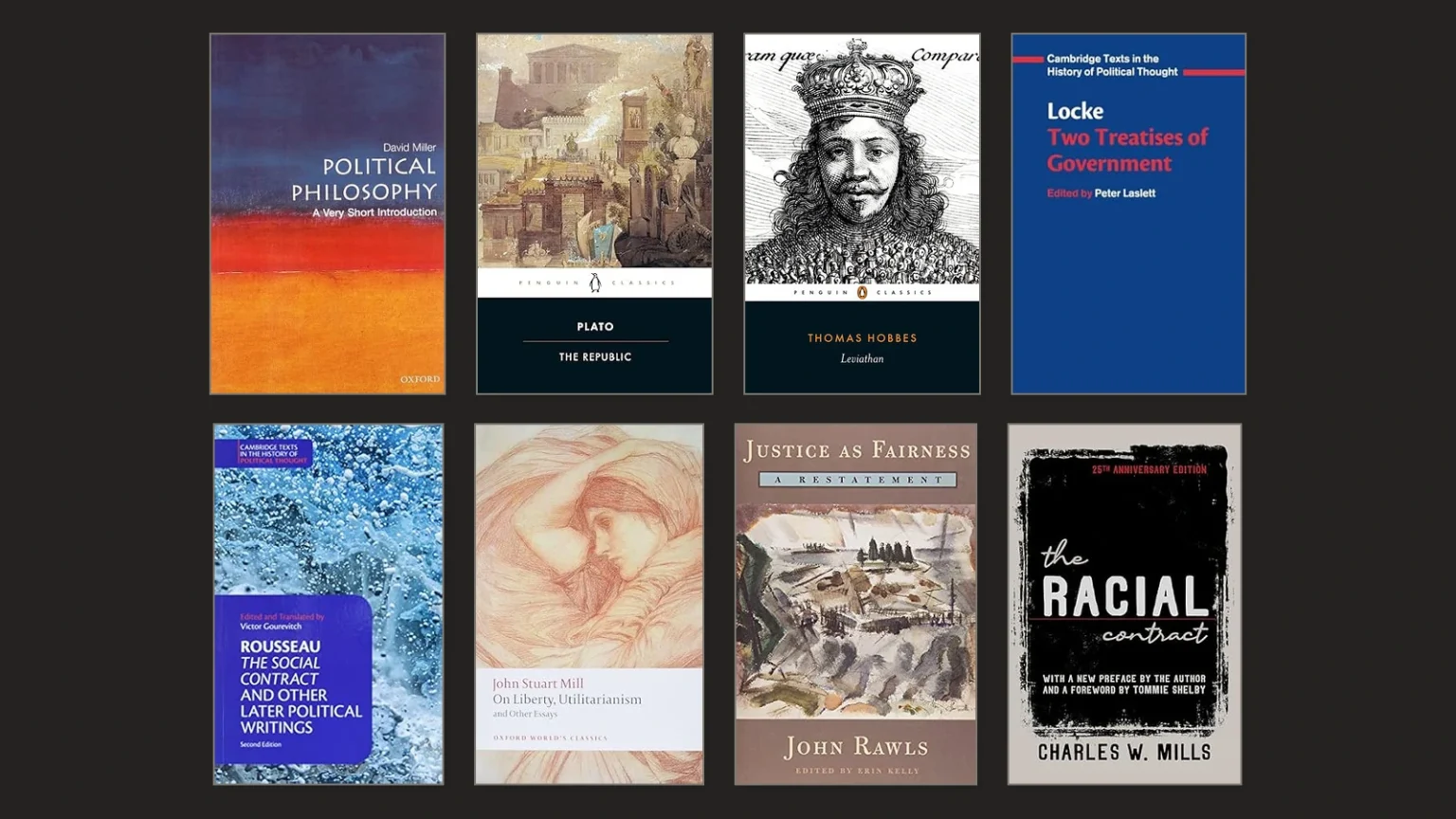
Political Philosophy for Beginners becomes manageable once orientation is separated from canon. Begin with David Miller’s compact map of authority, freedom, justice, democracy, and membership; then enter the primary texts in an order that tests who should rule, why states may coerce, what liberty demands, how property and class shape freedom, and whose exclusion ideal theory can miss.
Introduction
Political Philosophy for Beginners matters because ordinary political disagreement quickly reaches questions that facts alone cannot settle. We may agree that a law produces security yet disagree about whether it is legitimate; agree that an economy creates wealth yet dispute whether its distribution is just; agree that a decision was democratic yet question whether the majority had the right to make it. The discipline examines the principles by which institutions claim authority and people demand freedom, equality, recognition, security, or membership. The Internet Encyclopedia of Philosophy’s account of political-philosophical method is a useful reminder that the field moves between conceptual argument and judgments about political life.
Beginners often encounter the field in the least helpful form: a procession of famous names, each compressed into one slogan. Plato becomes rule by philosophers, Hobbes absolute sovereignty, Locke natural rights, Rousseau the general will, Mill the harm principle, Marx class struggle, and Rawls the veil of ignorance. Those formulas are not false, but they conceal the argumentative pressure that gives each idea meaning.
This guide therefore offers a reading path rather than a ranking. The sequence starts with a modern orientation, enters a foundational dialogue, develops competing accounts of authority and consent, tests popular rule against individuality, shifts from legal principle to class structure, reconstructs justice in contemporary terms, and ends with a nonideal critique of the contract tradition. Political Philosophy for Beginners should produce comparison, not reverence: each book is included because it changes the question inherited from the preceding one.
The shortest honest answer
Begin with David Miller’s Political Philosophy: A Very Short Introduction. Then read Plato, Hobbes, Locke, Rousseau, Mill, Marx and Engels, Rawls, and Mills. The order moves from orientation to justice, authority, rights, popular sovereignty, liberty, class, ideal theory, and racial domination. No large preparatory history is required.
Political Philosophy for Beginners is best learned by mastering the field’s vocabulary, then letting primary works disagree with one another. Miller supplies the map; Plato makes justice and political education inseparable; Hobbes and Locke construct rival accounts of legitimate authority; Rousseau and Mill test collective and individual freedom; Marx and Engels recast politics through class and capitalism; Rawls synthesizes modern liberal justice; Mills reveals what idealized contracts can conceal. The later books are not “more correct” than the earlier ones. They ask questions the earlier frameworks cannot adequately contain. Avoid postponing the primary texts until you have mastered an entire history of ideas: the sequence itself supplies the necessary background.
Before you start: how to approach Political Philosophy for Beginners
The main beginner problem is not lack of intelligence but a mismatch between kinds of books. Introductory surveys explain positions from outside; primary works build positions from within; histories reconstruct the controversies that made those positions urgent; contemporary criticism tests what their categories omit. Reading only surveys produces fluency without encounter. Beginning with the most difficult primary work can produce reverence, irritation, or dependence on summaries.
Chronology helps, but it should not rule the sequence. Plato comes early because later questions about authority, law, education, and the good life become clearer against his integration of ethics and politics. Hobbes precedes Locke because limited government is easier to understand after the case for undivided sovereignty has been made. Marx appears after Mill so that the language of individual liberty can be tested against class structure.
Learn only a small vocabulary before beginning: legitimacy is the justified right to rule, not merely effective control; authority claims a normative power to command; sovereignty concerns final political power; liberty may mean noninterference, nondomination, self-rule, or effective capacity; justice concerns fair terms among persons and institutions; consent may be actual, tacit, hypothetical, or reconstructed. Do not insist on final definitions. Each author reorganizes these terms.
Texts respond to wars, religious conflict, commercial expansion, revolution, industrialization, empire, democratization, and civil-rights struggles. Context explains why arguments take their form, but it does not reduce them to period documents. The reader’s task is double: reconstruct the question as the author faced it, then test whether the argument survives altered conditions.
The best first book on Political Philosophy for Beginners
Start with: Political Philosophy: A Very Short Introduction by David Miller
For Political Philosophy for Beginners, David Miller’s Political Philosophy: A Very Short Introduction is the best first book because it gives an educated beginner a usable grammar without pretending to settle the field. Its chapters organize political thought around problems—authority, democracy, freedom, justice, feminism, culture, and nationality—rather than around a parade of thinkers. That structure makes later comparison possible. When Hobbes defends sovereignty or Mill limits interference, the reader can ask which conception of authority or liberty is operating instead of treating each text as an isolated historical monument.
The book suits readers coming from literature, history, law, sociology, economics, or public debate as well as those with no disciplinary background. It is brief enough to finish before momentum disappears and serious enough to reveal why values conflict. Its greatest service is proportionality: justice is not the entire subject, democracy is not automatically legitimate, and freedom cannot be interpreted without asking about power, resources, and boundaries.
What Miller does not provide is the full experience of an argument unfolding in its original genre and historical pressure. Compression also makes some categories look cleaner than they are, while discussions of feminism, multiculturalism, and nationality reflect debates prominent around the book’s 2003 publication. Use the volume as scaffolding, not as an umpire. The recommended Oxford University Press paperback, ISBN 9780192803955, is the exact edition shown below. Read it completely, then go immediately to Plato’s Republic. The point of the first book is to make primary reading possible, not to delay it.
The core reading sequence

Book 1
Political Philosophy: A Very Short Introduction by David Miller
Edition shown: Oxford University Press / 2003 / paperback / ISBN 9780192803955
Place in the sequence: Orientation: the field’s recurring questions and vocabulary
Miller earns the first position because he teaches the reader what kind of activity political philosophy is before asking for allegiance to any doctrine. The book moves through political authority, democracy, freedom, justice, feminism, multiculturalism, and nationality, but its real achievement is architectural. It shows that political arguments usually turn on several questions at once: what human beings owe one another, which institutions may coerce them, how goods and opportunities should be distributed, and who belongs to the political community. That map prevents a beginner from mistaking a famous answer for the whole field.
Read this short volume slowly rather than treating it as a preliminary hurdle. Its examples reveal how abstract principles become institutional choices. Freedom is not merely a feeling of being unrestrained; justice is not simply kindness; democracy is not exhausted by voting. Miller repeatedly asks what a value means when laws, offices, borders, markets, and public resources must embody it. Keep a page of paired terms—liberty and authority, equality and desert, citizenship and exclusion—and revise it as later writers redefine them. The habit will matter more than memorizing Miller’s own conclusions.
The book’s limitation is also the reason to place it first rather than last. Compression smooths over disputes that become sharp in the primary texts, and the political examples reflect the period in which it was written. It cannot supply the historical texture of Hobbes’s civil war, Rousseau’s republic, Marx’s industrial capitalism, or Mills’s account of racial domination. Nor should its accessible classifications be treated as neutral. They are provisional coordinates. The sequence that follows repeatedly unsettles them, especially by asking whose experience is hidden when political philosophy begins from an idealized citizen.
The 2003 Oxford paperback shown here is concise, inexpensive, and bibliographically straightforward. Read it in full, including the final discussion of nationality, because boundaries and membership are not peripheral to political justice. Then move directly to Plato. Miller tells you what the questions are; The Republic shows what happens when those questions are dramatized through argument, character, education, and institutional design. That transition—from a modern map to an ancient primary work—keeps orientation from hardening into second-hand knowledge.
Difficulty: Beginner
“Political Philosophy: A Very Short Introduction introduces the concepts of political philosophy — authority, democracy, freedom and its limits, justice, feminism, multiculturalism, and nationality.”
— Oxford University Press • Oxford Academic

Book 2
The Republic by Plato
Edition shown: Penguin Classics / translated by Desmond Lee / introduction by Melissa Lane / 2007 / paperback / ISBN 9780140455113
Place in the sequence: Foundational encounter: justice, rule, education, and the political soul
Plato comes second because political philosophy becomes vivid when its questions are staged as conflicts among recognizable positions. In Book I, justice is successively associated with honesty, helping friends, harming enemies, and the advantage of the stronger. Socrates does not merely replace these definitions with a slogan. The dialogue forces the reader to notice how political claims depend on assumptions about expertise, power, character, and the good life. That argumentative theatre is a better first primary encounter than beginning with a treatise whose vocabulary already presumes a developed theory of sovereignty or rights.
The central analogy between city and soul can seem alien, yet it establishes a problem that never disappears from the tradition: can institutions be just when citizens’ desires and education are disordered? Watch how Plato links political rule to knowledge, divides social functions, regulates poetry, and makes education the hinge between psychology and constitution. The philosopher-ruler is not simply an eccentric proposal about experts. It raises the enduring question of whether political legitimacy rests on consent, competence, virtue, or some combination of them. Later books in this sequence answer by rejecting, revising, or secularizing those possibilities.
Do not read The Republic as a blueprint to endorse or dismiss. Its communal arrangements, censorship, hierarchy, treatment of family, and sharp distrust of democracy demand criticism. The productive beginner’s question is not “Was Plato a democrat?” but “What conception of justice makes these institutions appear defensible?” That question distinguishes internal reconstruction from approval. It also prepares the reader to compare Plato’s order-oriented politics with Hobbes’s security, Locke’s rights, Rousseau’s collective self-rule, and Mill’s individuality. The famous cave, meanwhile, belongs within a political argument about education and authority, not as an isolated inspirational allegory.
The Penguin Classics edition uses Desmond Lee’s readable translation and adds Melissa Lane’s introduction, which helps situate the dialogue without turning it into a specialist exercise. Read the work complete, but in stages: Books I–IV for the definition of justice and construction of the city; Books V–VII for philosophers, education, and the forms; Books VIII–IX for constitutional decline and tyranny; Book X for poetry and the final myth. Brief pauses between these units will preserve the argument’s shape. The next step is Hobbes, where the question shifts from who is fit to rule toward why any common coercive authority is necessary.
Difficulty: Moderate
“The center of Plato’s Republic is a contribution to ethics: a discussion of what the virtue justice is and why a person should be just.”
— Eric Brown • Stanford Encyclopedia of Philosophy
Book 3
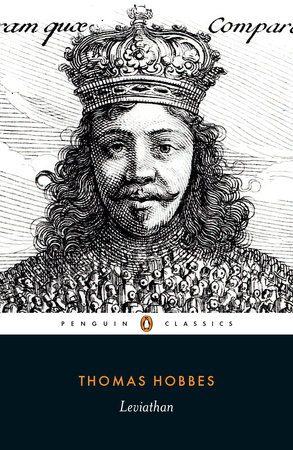
Leviathan by Thomas Hobbes
Edition shown: Penguin Classics / introduction and notes by Christopher Brooke / 2017 / paperback / ISBN 9780141395098
Place in the sequence: Authority: fear, representation, sovereignty, and civil peace
Hobbes should be encountered after Plato because he dismantles the expectation that political order must rest on a shared account of human excellence. His starting point is conflict among agents who are vulnerable, roughly equal in their capacity to kill, divided by judgment, and driven by competing desires. The state of nature is not merely a prehistoric episode. It is a thought experiment that asks what relations remain when no public authority can settle disputes. By making security prior to cultivated virtue, Hobbes gives the beginner a stark model of why political obligation might arise at all.
Follow four connected ideas. First, natural equality creates insecurity rather than harmony. Second, rational “laws of nature” recommend peace but cannot reliably secure it without enforcement. Third, covenant authorizes a sovereign representative whose acts count as those of the multitude. Fourth, sovereignty must be sufficiently undivided to prevent a return to civil war. This is not the crude claim that might makes right. Hobbes’s argument depends on authorization, representation, and the conditions under which promises become dependable. The problem of political obligation becomes concrete here: why should a person treat the state’s commands as binding rather than merely threatening?
The difficulty lies partly in the book’s scale. Leviathan begins with sensation, language, and reasoning; develops a political anthropology; constructs commonwealth and sovereignty; and then devotes extensive attention to religion and scriptural authority. Those theological books are not disposable, because Hobbes understood rival religious jurisdiction as a cause of political disorder. Still, a first reading may proceed strategically. Read Chapters 13–21 carefully, then Chapters 26, 29–30, and 42, using Brooke’s introduction to recover the civil-war context. Return later to the opening account of mind and language, which explains why disagreement is so persistent.
The 2017 Penguin Classics edition combines a clean modern presentation with Christopher Brooke’s historically alert introduction and notes. It is the edition shown because it neither abridges the work nor overwhelms a first reader with a full scholarly apparatus. Hobbes’s greatest limitation as a stage in the sequence is his tendency to treat concentrated public power as the decisive remedy for conflict. Locke comes next to ask whether authority can protect people while remaining limited by rights, trust, and a right of resistance. Read Hobbes generously first; otherwise Locke’s objections will seem obvious before their target has been understood.
Difficulty: Demanding
“Thomas Hobbes is rightly regarded as a monumental figure in the history of philosophy, especially for his masterpiece Leviathan.”
— Marcus P. Adams • Stanford Encyclopedia of Philosophy

Book 4
Two Treatises of Government by John Locke
Edition shown: Cambridge Texts in the History of Political Thought / edited by Peter Laslett / 1988 / paperback / ISBN 9780521357302
Place in the sequence: Limited government: natural rights, property, consent, and resistance
Locke follows Hobbes because the comparison isolates a central modern dispute. Both begin from individuals outside established political authority and both use consent-like reasoning, yet Locke denies that self-preservation requires surrender to an absolute sovereign. Persons possess natural rights, government is a fiduciary trust, legislative power is limited by the ends for which society was formed, and resistance becomes legitimate when rulers systematically betray that trust. Reading the two writers back to back turns “social contract” from a single doctrine into a family of rival arguments about authorization, limits, and institutional design.
The Second Treatise supplies the familiar route through the text: the state of nature, the state of war, property, political society, legislative supremacy, prerogative, conquest, usurpation, tyranny, and dissolution. Pay particular attention to the transition from natural freedom to majority rule. Individual consent cannot operate a commonwealth unless collective decisions can bind dissenters, yet that mechanism creates its own problem: what exactly has each person authorized? Locke’s answer relies on public good, standing law, and accountable power. His account helps explain why constitutional limitation is not simply hostility to government but a theory of legitimate government.
Property is the most contested chapter and should not be reduced to “mixing labor makes ownership.” Locke introduces common possession, labor, spoilage, sufficiency, money, and inequality in a compressed chain. Later readers have drawn liberal, capitalist, egalitarian, colonial, and theological implications from it. The historical relation between Locke’s philosophy and colonial practices remains an area of substantial disagreement, but a beginner should not quarantine the issue from the theory. Ask who counts as an appropriator, which lands appear “unused,” and how money alters the original moral limits. Such questions prepare the move from rights-based argument to Rousseau’s critique of dependence and inequality.
Peter Laslett’s Cambridge edition is the recommended text because its introduction, chronology, textual work, and notes establish the Treatises as historically situated interventions rather than timeless constitutional maxims. On a first pass, read Laslett selectively, then the Second Treatise in full. Read the First Treatise’s opening and representative sections to understand Locke’s attack on patriarchal divine-right theory; return for a complete reading when studying seventeenth-century controversy. The edition is demanding because editorial context is substantial, not because the prose is uniformly obscure. Rousseau should follow immediately: he radicalizes freedom by asking whether obedience to law can become collective self-rule rather than merely protected private independence.
Difficulty: Demanding
“In the Two Treatises of Government, he defended the claim that men are by nature free and equal.”
— Alex Tuckness • Stanford Encyclopedia of Philosophy

Book 5
The Social Contract and Other Later Political Writings by Jean-Jacques Rousseau
Edition shown: Cambridge Texts in the History of Political Thought / second edition / edited and translated by Victor Gourevitch / 2018 / paperback / ISBN 9781316605448
Place in the sequence: Popular sovereignty: the general will, civic freedom, and political membership
Rousseau belongs at the midpoint because he transforms the vocabulary inherited from Hobbes and Locke. The problem is no longer only how individuals escape insecurity or preserve pre-political rights. It is how association can produce a form of obedience consistent with freedom. The general will names the common standpoint citizens must adopt when legislating for themselves; sovereignty belongs to the people and cannot be represented away. This makes Rousseau indispensable to democratic and republican thought, but it also creates interpretive danger. Collective self-rule can sound emancipatory or coercive depending on how unity, dissent, and citizenship are understood.
Distinguish the sovereign from the government. The sovereign is the citizen body acting legislatively through the general will; government is the subordinate executive charged with applying law. Much confusion disappears once this distinction is secure. Rousseau does not say that every majority preference is just, nor that a ruler may simply claim to embody the people. A general will must concern a genuinely common matter and arise under political conditions that prevent factions and extreme dependence from corrupting judgment. The argument therefore connects constitutional form to social equality, civic education, scale, and mores rather than treating voting procedure as self-sufficient.
The text’s hardest sentences concern being “forced to be free,” civil religion, the legislator, and the apparent demand for civic unity. Do not neutralize them, but do not isolate them either. Read each within Rousseau’s attempt to explain how law can be one’s own without collapsing into private choice. The result is a severe politics of membership: citizens gain moral and civil freedom, yet the political community places demanding conditions on participation. Readers should also notice exclusions and silences, including gendered citizenship and the limited scale Rousseau associates with republican government. These tensions make the work a bridge to later democratic theory rather than its final answer.
Victor Gourevitch’s second-edition Cambridge volume is especially useful because the translation preserves Rousseau’s technical distinctions and places The Social Contract beside later writings that reveal how abstract principles meet particular political circumstances. Read The Social Contract completely, then select the “Discourse on Political Economy” and portions of the writings on Poland and Corsica. The additional texts correct the impression that Rousseau wrote only an ethereal theory of legitimacy. Mill comes next because his defense of individuality and dissent tests the risks of collective authority from another direction: even formally popular power can become socially oppressive.
Difficulty: Moderate
“In The Social Contract, Rousseau sets out to answer what he takes to be the fundamental question of politics.”
— Christopher Bertram • Stanford Encyclopedia of Philosophy

Book 6
On Liberty, Utilitarianism and Other Essays by John Stuart Mill
Edition shown: Oxford World’s Classics / second edition / edited by Mark Philp and Frederick Rosen / 2015 / paperback / ISBN 9780199670802
Place in the sequence: Individual freedom: coercion, social tyranny, utility, and experiments in living
Mill follows Rousseau to expose a problem that popular sovereignty cannot solve by itself. A society may govern through representative institutions and still suppress individuality through opinion, custom, moralism, and informal sanctions. On Liberty therefore asks when coercion is justified and why unconventional lives matter. The harm principle is the famous answer, but the book’s deeper structure joins liberty of thought, liberty of action, and human development. Mill wants institutions and social norms that permit “experiments in living,” because fallible people learn not only through argument but through diverse ways of life.
Read Chapter 2 with particular care. Mill’s defense of discussion does not rest only on the possibility that authorities are wrong. Even a largely true doctrine becomes inert when it is held without encountering opposition; partial truths may need conflict before their missing elements become visible. This epistemic argument links political liberty to collective intelligence. Chapter 3 then explains individuality as a component of well-being, while Chapters 4 and 5 test where self-regarding conduct ends and harm to others begins. The boundary is less mechanical than summaries suggest, because social actions create indirect effects and relations of dependency.
The companion essay Utilitarianism complicates the picture. Liberty is not an absolute natural right in Mill’s framework; it is defended through a broad conception of utility grounded in the permanent interests of progressive beings. That foundation invites questions about paternalism, competence, empire, and Mill’s notorious exception for societies he deemed “barbarous.” A responsible reading must keep the universal rhetoric of liberty beside these exclusions. Mill’s feminism, represented elsewhere most directly in The Subjection of Women, also reveals how customs that appear voluntary can rest on entrenched power. The liberal tradition is best approached as an internal argument about freedom, not a settled creed.
The second-edition Oxford World’s Classics volume provides On Liberty, Utilitarianism, and related essays in a compact scholarly package, with editorial material that clarifies intellectual context and textual relations. Read On Liberty in full, then Utilitarianism; use the other essays to pursue representative government or social reform. Mill’s limitation in this sequence is his tendency to frame the political subject as an individual whose social location can sometimes remain abstract. Marx and Engels come next to shift attention from justified interference to class power, production, ownership, and the historical transformation of society.
Difficulty: Moderate
“His most important works include System of Logic (1843), On Liberty (1859), Utilitarianism (1861)”
— Christopher Macleod • Stanford Encyclopedia of Philosophy
Book 7
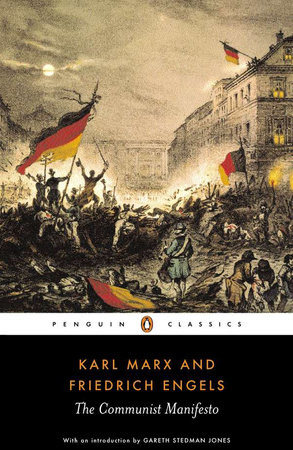
The Communist Manifesto by Karl Marx and Friedrich Engels
Edition shown: Penguin Classics / translated by Samuel Moore / introduction and notes by Gareth Stedman Jones / 2004 / paperback / ISBN 9780140447576
Place in the sequence: Historical structure: class conflict, capitalism, revolution, and ideology
The Manifesto enters only after the major contract and liberty texts because it changes the unit of political explanation. Instead of beginning with individuals choosing principles or limits on coercion, Marx and Engels foreground modes of production, class relations, technological change, and conflict over social power. The bourgeoisie appears not simply as a group with mistaken beliefs but as a historically revolutionary class that transforms markets, law, family life, work, and the state. Political institutions are read in relation to material organization. That shift is essential even for readers who reject the authors’ revolutionary conclusions.
Read the opening section for its account of capitalism’s dynamism as well as its exploitation. The prose is memorable partly because it refuses a simple picture of stagnating oppression: capitalist development dissolves inherited hierarchies, expands global interdependence, revolutionizes production, and creates new forms of insecurity. The second section distinguishes communist aims from caricatures and discusses property, labor, family, nation, and political power. The later survey of socialist tendencies is more historically specific, but it teaches a valuable methodological lesson—political labels gather rival projects whose social bases and strategic functions must be distinguished.
This pamphlet is not a substitute for Marx’s mature critique of political economy, and it should not be treated as a predictive checklist. Its compressed account of polarization, revolution, and the political role of the proletariat belongs to 1848 and to the Communist League’s purposes. Some claims illuminate later capitalism; others require revision or rejection. The beginner should also resist turning “class” into the only axis of domination. Gender, race, empire, citizenship, and ecology interact with production without becoming mere decorative additions. The value of this stage is learning to ask how ostensibly neutral rights operate within unequal social structures, not acquiring one universal explanatory key.
The Penguin Classics edition combines Samuel Moore’s historical English translation with Gareth Stedman Jones’s extensive introduction and notes. Its scholarly apparatus is longer than the primary text, which is an advantage if used in the right order. Read the Manifesto itself first, completely and in one or two sittings; then read the historical introduction and return to the text. This preserves its rhetorical force while preventing decontextualized quotation. Rawls follows because he reconstructs modern justice at a high level of normative abstraction, asking which principles free and equal citizens could reasonably accept for the basic structure of society. The contrast between structural critique and ideal justification is deliberate.
Difficulty: Moderate
“This small pamphlet is by far the most influential single piece of political writing since the French Revolutionary Declaration…”
— Eric Hobsbawm • Verso Books

Book 8
Justice as Fairness: A Restatement by John Rawls
Edition shown: Belknap Press of Harvard University Press / edited by Erin Kelly / 2001 / paperback / ISBN 9780674005112
Place in the sequence: Contemporary synthesis: fair cooperation, basic liberties, and distributive justice
Rawls belongs near the end because his theory gathers questions raised throughout the sequence into a systematic modern framework. Society is conceived as a fair system of cooperation among free and equal citizens across time. The primary subject of justice is the “basic structure”: major political, legal, and economic institutions whose combined effects shape life prospects. The original position and veil of ignorance model fair terms for choosing principles without allowing arbitrary social advantages to dictate them. These devices become clearer after Plato, contract theory, Mill, and Marx have supplied competing pictures of persons, institutions, and inequality.
Concentrate on the two principles and their priority. Equal basic liberties come first; fair equality of opportunity and the difference principle govern social and economic inequalities. The difference principle does not require numerical equality, nor does it simply celebrate any inequality that produces growth. Institutional arrangements must improve the expectations of the least advantaged under fair background conditions. Rawls also distinguishes a property-owning democracy from welfare-state capitalism, a point often missed in abbreviated presentations. The debates over distributive justice become more intelligible once this institutional focus is understood.
Use the “restatement” rather than A Theory of Justice as the beginner’s first Rawls. It is shorter, incorporates decades of clarification, and presents the mature formulation with less historical detour. It is not easy: terms such as public reason, primary goods, reasonable pluralism, and stability belong to a connected system. Make a diagram of the argument rather than underlining isolated conclusions. Begin with society as cooperation, move through the original position and principles, then trace how the principles apply to institutions. Read slowly enough to distinguish a device of representation from a hypothetical historical contract.
Rawls’s limitation is methodological as much as substantive. Ideal theory can illuminate standards of justification while underdescribing how conquest, racial hierarchy, patriarchy, and accumulated dispossession shape the actual basic structure. That criticism does not make Rawls useless; it changes what must follow him. The Belknap edition, edited by Erin Kelly, should be read substantially in full, though a beginner may postpone the densest discussions of stability until the core principles are secure. Mills comes next not as an optional identity-themed supplement but as a direct challenge to the contract tradition’s tendency to imagine equal parties while leaving domination outside the model.
Difficulty: Demanding
“The move to agreement among citizens is what places Rawls’s justice as fairness within the social contract tradition of Locke, Rousseau, and Kant.”
— Leif Wenar • Stanford Encyclopedia of Philosophy

Book 9
The Racial Contract by Charles W. Mills
Edition shown: Cornell University Press / 25th Anniversary Edition / new preface by the author / foreword by Tommie Shelby / 2022 / paperback / ISBN 9781501764288
Place in the sequence: Nonideal critique: racial domination, epistemology, and the exclusions of the contract
Mills closes the sequence by turning the social contract inside out. Canonical contract theory describes political legitimacy as if free and equal persons were establishing fair terms, but the modern world was also organized through conquest, slavery, settler colonialism, segregation, and differential personhood. The “racial contract” names the political, moral, and epistemological arrangements that made white supremacy systemic rather than accidental. It is an intentionally revisionary model: the actual historical contract has often allocated rights and recognition unequally while political philosophy narrated universal consent. This critique reaches backward across Locke, liberalism, and Rawls.
The book has three closely related dimensions. Politically, it describes a global structure of racial rule. Morally, it shows how categories of full and lesser personhood distribute obligation and vulnerability. Epistemologically, it analyzes structured misperception—ways dominant groups learn not to know the world they have made. That third claim is especially important for beginners. Injustice is not sustained only by bad principles; it can shape what counts as evidence, whose testimony is credible, and which histories appear peripheral. The philosophy of race therefore alters methods of political inquiry as well as its subject matter.
Read Mills beside, not instead of, Rawls. Rawls asks which principles would be fair under appropriately modeled conditions; Mills asks what philosophical abstraction conceals when societies are already structured by domination. The resulting tension between ideal and nonideal theory remains productive. A beginner should also ask where Mills’s global racial model needs differentiation across empires, nations, Indigenous peoples, migration regimes, and intersections with gender and class. Feminist political philosophy has similarly shown that the public/private distinction can hide power within family and care relations; the broader field is mapped in the Stanford Encyclopedia’s feminist political philosophy overview.
The 25th Anniversary Edition is the correct edition for this path because it preserves the original argument while adding Mills’s new preface and Tommie Shelby’s foreword, allowing readers to see both the work’s intervention and its continuing debate. Read the book in full; its compact structure is cumulative, and extracting only the headline thesis misses its account of cognition and moral psychology. Ending here leaves political philosophy open rather than complete. The next serious reading should branch outward—to feminist contract criticism, colonial and postcolonial theory, disability justice, global justice, and democratic theory—while retaining the comparative discipline learned from the nine-book sequence.
Difficulty: Moderate
“Charles Mills’s treatment of the biases in western philosophy in The Racial Contract is a tour de force.”
— Gustavus Myers Center for the Study of Bigotry and Human Rights • Cornell University Press
How these books fit together
The sequence has three movements. Books 1–3 move from orientation to the ancient question of just rule and then to the modern problem of political order. Plato connects the city to character and knowledge; Hobbes strips politics down to vulnerability, conflict, authorization, and peace.
Books 4–7 develop the modern argument over freedom. Locke limits political power through rights and trust. Rousseau asks how law can express collective self-rule. Mill defends individuality against both legal coercion and social conformity. Marx and Engels then challenge the assumption that legal freedom reveals the whole social order. Together these books show why contractarian arguments can authorize power, restrict it, democratize it, or conceal background inequality.
Books 8–9 bring the path into contemporary methodological conflict. Rawls reconstructs a fair basic structure through idealized choice among free and equal citizens. Mills asks how philosophy changes when racial domination is treated as constitutive of modern political society rather than an external defect. The point is not to stage a simple defeat of Rawls. It is to make the reader capable of seeing what ideal theory clarifies and what nonideal theory insists must enter the model. Political Philosophy for Beginners should end with a sharpened method: identify the normative principle, the institution that embodies it, the history that formed the institution, and the people whom the theory renders visible or invisible.
Common beginner mistakes
1. Beginning with the longest famous book. Political Philosophy for Beginners does not become more serious merely because the opening book is long. Starting with A Theory of Justice, all of Capital, or an unannotated Leviathan confuses ambition with sequence. Difficulty is productive after the reader knows what problem the text is solving. Use Miller for orientation and the shorter Rawls restatement before larger works.
2. Reading slogans instead of arguments. “The general will,” “the harm principle,” and “the veil of ignorance” are not detachable doctrines. Record the problem, assumptions, inference, institutional consequence, and strongest objection for each major claim. A slogan becomes knowledge only when you can explain why its author needed it.
3. Treating chronology as endorsement. Earlier books are not primitive stages surpassed by later enlightenment. Plato can expose problems Rawls brackets; Hobbes can clarify emergencies liberal constitutionalism underestimates; Mills can reveal histories the canonical sequence normalized. Read forward for development and backward for criticism.
4. Assuming a translation or edition is neutral. Introductions frame interpretation, notes identify controversies, and translations decide how technical terms recur. Use the editions specified here, but read editorial apparatus after a first encounter when a long introduction threatens to predetermine the argument. Never substitute an abridgment without checking what has been removed.
5. Trying to master the whole tradition before forming judgments. Political philosophy is learned by comparing arguments, not by waiting for complete background. Write provisional objections and revise them. The danger is not early disagreement; it is criticism that never reconstructs the view it rejects.
Optional paths depending on your interest
If you are interested in authority and political obligation, prioritize Leviathan and Two Treatises of Government. Read them consecutively and compare authorization, consent, sovereignty, law, resistance, and the conditions under which government dissolves.
If you are interested in democracy and republican freedom, prioritize The Social Contract and The Republic. The reversal is useful: Rousseau clarifies popular sovereignty, then Plato tests whether democratic choice can be separated from education and character.
If you are interested in liberty, capitalism, and class, prioritize On Liberty and The Communist Manifesto. Ask whether formal noninterference is adequate when work, property, social dependence, and economic power structure available choices.
For a more advanced path, continue with Justice as Fairness and The Racial Contract. Then add Carole Pateman on the sexual contract, Amartya Sen on capabilities and comparative justice, and postcolonial work that relocates the canon within empire.
FAQ
How much historical background do I need before starting?
Very little in advance. Learn context locally: the Peloponnesian-war aftermath for Plato, the English Civil Wars for Hobbes, exclusion and religious conflict for Locke, eighteenth-century republican debate for Rousseau, industrial capitalism for Marx, and twentieth-century civil-rights struggles for Mills. A good edition’s introduction and chronology are usually sufficient for a first reading.
Which editions and translations matter most in this sequence?
Use complete, annotated editions with identifiable translators or editors. Lee’s accessible Plato, Brooke’s Hobbes, Laslett’s Locke, Gourevitch’s Rousseau, the Oxford Mill, Stedman Jones’s Penguin Manifesto, Kelly’s Rawls restatement, and the anniversary Mills edition all clarify textual or historical problems without replacing the primary work. Edition details appear on each card.
May I skip parts of Leviathan or the Two Treatises on a first reading?
Yes, selectively and transparently. For Hobbes, begin with Chapters 13–21, 26, 29–30, and 42, then return to the rest. For Locke, read the Second Treatise fully and representative parts of the First Treatise before completing it later. Skipping is a reading strategy, not permission to claim mastery of unread sections.
How does Political Philosophy for Beginners differ from a university syllabus?
A syllabus must represent periods, methods, assessment goals, and institutional constraints. This path makes a narrower editorial promise: nine books arranged to make each next argument legible. It omits major traditions and regions, so completion should open further study rather than certify comprehensiveness.
Related BookInLight Reading Guides
Learning to Think Politically: Twenty Books from First Questions to Hard Arguments — A broader map that extends this compact route into democracy, ideology, identity, global justice, and contemporary disputes.
Five Books on Leo Strauss and Classical Political Philosophy — A focused route into the relation between ancient political philosophy, modernity, and the practice of close textual reading.
Seven Essential Books on Gramsci and Cultural Hegemony — A useful continuation for readers who want to deepen the Marxian path through culture, consent, civil society, and political strategy.
This article was researched and written by the BookInLight Department of Political Thought and Intellectual History. It underwent bibliographical review, source verification, quotation verification, link verification, and editorial fact-checking. We welcome factual corrections, overlooked sources, edition suggestions, interpretive observations, and constructive ideas that would strengthen the guide.
The BookInLight Art Department is credited for editorial art direction, visual composition, cover selection, and image presentation. Rights in third-party book covers remain with their publishers, artists, designers, and other rights holders. Complete republication, reproduction, translation, or reuse of this article requires prior written authorization from BookInLight.
Sources and Further Reading
Primary Texts and Editions
David Miller. Political Philosophy: A Very Short Introduction. Oxford University Press, 2003. Authoritative edition page. Edition record and chapter architecture.
Plato. The Republic, translated by Desmond Lee, introduction by Melissa Lane. Penguin Classics, 2007. Authoritative edition page. Translation, edition details, and reading sequence.
Thomas Hobbes. Leviathan, introduction and notes by Christopher Brooke. Penguin Classics, 2017. Authoritative edition page. Edition details and unabridged text.
John Locke. Two Treatises of Government, edited by Peter Laslett. Cambridge University Press, 1988. Authoritative edition page. Textual history, chronology, and edition.
Jean-Jacques Rousseau. The Social Contract and Other Later Political Writings, edited and translated by Victor Gourevitch. Cambridge University Press, second edition, 2018. Authoritative edition page. Translation and companion political writings.
John Stuart Mill. On Liberty, Utilitarianism and Other Essays, edited by Mark Philp and Frederick Rosen. Oxford University Press, second edition, 2015. Authoritative edition page. Contents and editorial context.
Karl Marx and Friedrich Engels. The Communist Manifesto, translated by Samuel Moore, introduction by Gareth Stedman Jones. Penguin Classics, 2004. Authoritative edition page. Text, apparatus, and edition history.
John Rawls. Justice as Fairness: A Restatement, edited by Erin Kelly. Belknap Press, 2001. Authoritative edition page. Mature formulation and exact edition.
Charles W. Mills. The Racial Contract, 25th Anniversary Edition. Cornell University Press, 2022. Authoritative edition page. New preface, foreword, and exact edition.
Reference Works and Critical Context
Internet Encyclopedia of Philosophy. “Political Philosophy: Methodology.” Source. Scope and methodological framing.
A. John Simmons. “Political Obligation.” Source. Authority, obligation, and consent problems.
Eric Brown. “Plato’s Ethics and Politics in The Republic.” Source. Structure of Plato’s argument and quotation verification.
Marcus P. Adams. “Hobbes’s Philosophy of Science.” Source. Hobbes’s systematic method and quotation verification.
Alex Tuckness. “Locke’s Political Philosophy.” Source. Rights, property, consent, resistance, and quotation verification.
Christopher Bertram. “Jean Jacques Rousseau.” Source. General will, sovereignty, freedom, and quotation verification.
Christopher Macleod. “John Stuart Mill.” Source. Mill’s works, liberty, utility, and quotation verification.
Leif Wenar. “John Rawls.” Source. Justice as fairness, institutions, and quotation verification.
Eric Hobsbawm. “Introduction to Marx & Engels’ The Communist Manifesto.” Source. Historical influence and quotation verification.
Image Credits
Political Philosophy: A Very Short Introduction — Oxford University Press / 2003 / paperback / ISBN 9780192803955. Cover image supplied through Amazon Media exact-ISBN image, checked against the authoritative edition page; edition correspondence verified against the publisher edition page.
The Republic — Penguin Classics / translated by Desmond Lee / introduction by Melissa Lane / 2007 / paperback / ISBN 9780140455113. Cover image supplied through Amazon Media exact-ISBN image, checked against the authoritative edition page; edition correspondence verified against the publisher edition page.
Leviathan — Penguin Classics / introduction and notes by Christopher Brooke / 2017 / paperback / ISBN 9780141395098. Cover image supplied through Penguin Random House official cover server; edition correspondence verified against the publisher edition page.
Two Treatises of Government — Cambridge Texts in the History of Political Thought / edited by Peter Laslett / 1988 / paperback / ISBN 9780521357302. Cover image supplied through Amazon Media exact-ISBN image, checked against the authoritative edition page; edition correspondence verified against the university press edition page.
The Social Contract and Other Later Political Writings — Cambridge Texts in the History of Political Thought / second edition / edited and translated by Victor Gourevitch / 2018 / paperback / ISBN 9781316605448. Cover image supplied through Amazon Media exact-ISBN image, checked against the authoritative edition page; edition correspondence verified against the university press edition page.
On Liberty, Utilitarianism and Other Essays — Oxford World’s Classics / second edition / edited by Mark Philp and Frederick Rosen / 2015 / paperback / ISBN 9780199670802. Cover image supplied through Amazon Media exact-ISBN image, checked against the authoritative edition page; edition correspondence verified against the publisher edition page.
The Communist Manifesto — Penguin Classics / translated by Samuel Moore / introduction and notes by Gareth Stedman Jones / 2004 / paperback / ISBN 9780140447576. Cover image supplied through Penguin Random House official cover server; edition correspondence verified against the publisher edition page.
Justice as Fairness: A Restatement — Belknap Press of Harvard University Press / edited by Erin Kelly / 2001 / paperback / ISBN 9780674005112. Cover image supplied through Amazon Media exact-ISBN image, checked against the authoritative edition page; edition correspondence verified against the university press edition page.
The Racial Contract — Cornell University Press / 25th Anniversary Edition / new preface by the author / foreword by Tommie Shelby / 2022 / paperback / ISBN 9781501764288. Cover image supplied through Amazon Media exact-ISBN image, checked against the authoritative edition page; edition correspondence verified against the university press edition page.