The modern Penguin English Library is a design-led classics shelf with a more complicated editorial ancestry than its uniform orange spines suggest. This Penguin English Library guide argues that the revived collection excels at making English-language fiction inviting, affordable, and collectable, but should not be mistaken for the editor-led critical project that used the name in the 1960s. It is strongest for serious general reading; students and researchers often need a more annotated rival.
The Short Answer
The Penguin English Library is best understood as a collectable general-reader series, not a consistently scholarly edition programme. Its great achievement is to make a substantial canon of fiction in English feel approachable as physical books. Its principal weakness is thin and uneven scholarly apparatus: a familiar spine does not guarantee a uniform copy-text policy, critical introduction, explanatory notes, or research-level bibliography.
That distinction matters because the name carries historical prestige, and any Penguin English Library guide has to separate reputation from edition-level practice. Penguin’s current official series page now lists 112 books and describes them as collectable editions of fiction in English. The visual system encourages readers to see the shelf as a coherent library. Editorially, though, the coherence is looser. The 2012 revival deliberately stripped back many of the “added extras” associated with academic classics, foregrounding the text and the designed object. It therefore solves a different problem from Oxford World’s Classics or a heavily annotated Penguin Classics volume.
For a reader building a home library, reading major novels independently, or wanting attractive inexpensive paperbacks that feel related without becoming deluxe objects, the series remains unusually persuasive. For a student writing about textual variants, historical vocabulary, publication context, or editorial history, the cover should be treated as the beginning of edition choice, not the end of it. The central paradox of the collection is productive: its strongest editorial decision is often to get out of the reader’s way, and that same decision sets the limit of its academic authority.
The Editorial Problem the Penguin English Library Set Out to Solve
The first Penguin English Library belonged to a moment when inexpensive paperbacks were changing who could own a serious literary library. Penguin Classics had established a mass-market route into translated literature; English-language classics needed a comparable structure. Penguin’s own history of Penguin Classics records that Tony Godwin introduced the English Library in September 1965 as a sister series, with the literary scholar David Daiches as general editor and Wuthering Heights as its first title.
The archival story is slightly earlier and more revealing. The Penguin archive at the University of Bristol preserves a general file beginning in 1962, including Daiches’s appointment and resignation in 1962–63, notes for contributors dated January 1963, market reports, proposed titles, and Godwin’s cover grid. Penguin and later commentators sometimes call 1963 the year the series was “created”; the books themselves reached readers in 1965. The distinction is worth keeping because it separates institutional formation from publication.
The original problem was not merely cheapness. Penguin wanted reliable English classics for intelligent non-specialists without turning every volume into a school text or an expensive scholarly edition. Daiches placed editors between historical works and readers returning to literature after school. The old Library could therefore accommodate drama, essays, and nonfiction as well as novels; “English” named a literary tradition broad enough to require editing and context.
How the Project Took Shape
The historical Library was eventually absorbed into Penguin Classics. Penguin’s account places the decisive amalgamation after the death of Penguin Classics editor Betty Radice, with English-language titles entering the wider Classics list in 1985. That institutional merger effectively removed the need for a separate orange-spined English canon. The name survived in memory, second-hand bookshops, and collectors’ shelves rather than as an independent editorial necessity.
In a 2012 Independent feature, Penguin publishing director Simon Winder traced the revival to seeing young visitors drawing in Tate Britain. His problem was not how to add more notes but how to make encountering Wuthering Heights attractive again. The report also made the break explicit: long introductions and footnotes moved out of the reader’s way, with short essays placed at the back.
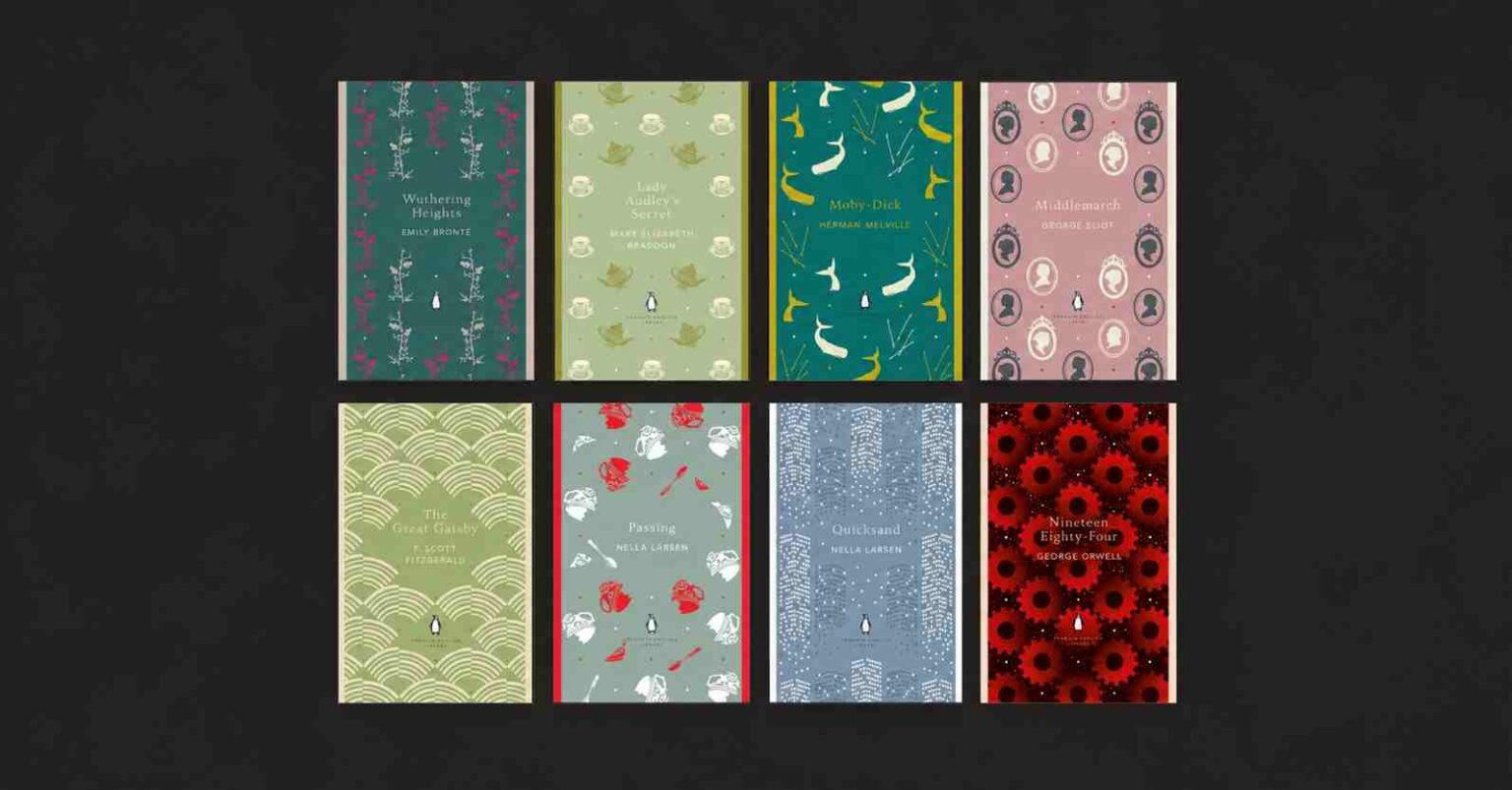
Design therefore became constitutive, not decorative. Coralie Bickford-Smith’s account of the redesign says she was given just under a year to devise 100 covers, using illustrated icons within a repeatable grid and retaining Penguin Orange on the spines. Art director Jim Stoddart and a team of illustrators made the extraordinary production schedule possible. Bickford-Smith’s portfolio record identifies the format as a 198 × 129 mm B-format paperback and credits the wider illustration and artwork team.
The first revived list was also a new canon. Stuart Kelly’s 2012 comparison in the Guardian observed that the relaunch was much more hospitable to Gothic and genre fiction and, unlike the old series, initially concentrated on novels rather than nonfiction. The 2012 marketing frame ran from the eighteenth-century rise of the novel to the First World War. Later additions quietly loosened that boundary: interwar modernists, Harlem Renaissance fiction, and Orwell entered the orange-spined system.
The Volumes That Best Explain the Project
These eight volumes were chosen from a larger pool because, together, they reveal more than a row of famous titles. They show the bridge to the historical series, the 2012 embrace of genre, the transatlantic meaning of “English,” the physical strengths and stresses of the format, the extension beyond the original chronological cutoff, recent canon expansion, and one conspicuous contradiction between current marketing and catalogue practice. Each card refers to the exact paperback edition and cover shown.

Foundational Volume
Wuthering Heights: The title that connects two different English Libraries
Author: Emily Brontë
Edition: Penguin English Library / Penguin Classics paperback, 6 December 2012; ISBN 9780141199085; 384 pages; 197 × 130 mm; UK list price £9.99.
Why it matters: Wuthering Heights was the first book issued when the historical Penguin English Library reached print in September 1965. Its return in 2012 made the novel a bridge between the old critical programme and the modern collectable one. The continuity is branding, not identity of edition: this ISBN is the 2012 paperback, not David Daiches’s original EL1.
Main limitation: The modern volume does not recreate the 1965 project’s editor-led scholarly identity. Readers who need a documented copy-text, extensive textual notes, or Daiches’s historical apparatus should verify a specialist edition rather than infer those features from the orange spine.
Best suited to: General readers, collectors, and anyone studying how Penguin converted an older scholarly brand into a modern reading series.
Canon-Expanding Volume
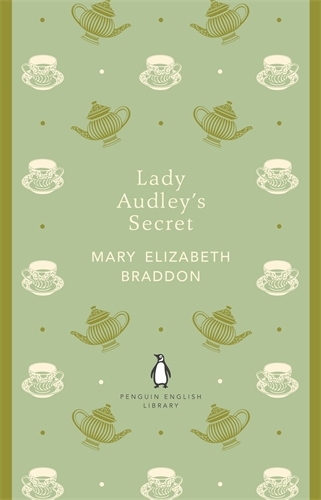
Lady Audley’s Secret: Sensation fiction moves from the margins to the shelf
Author: Mary Elizabeth Braddon
Edition: Penguin English Library / Penguin Classics paperback, 26 April 2012; ISBN 9780141198842; 512 pages; 197 × 129 mm; UK list price £9.99.
Why it matters: Braddon’s 1862 sensation novel explains the 2012 relaunch better than another Austen or Dickens title. The new list gave conspicuous space to Gothic, detective, adventure, and sensation fiction. Giving Lady Audley’s Secret the same visual status as the prestige Victorian novel makes a canon-forming argument: popular genre belongs inside literary history.
Main limitation: Its presence is more radical than its apparatus. The edition removes barriers to reading but does not supply the archival context, periodical history, or sustained annotation a research project on sensation fiction may require.
Best suited to: Readers exploring the Victorian novel beyond the traditional syllabus, and teachers who can supply contextual material separately.

Reputation-Defining Volume
Moby-Dick: A transatlantic classic tests the meaning of “English”
Author: Herman Melville
Edition: Penguin English Library / Penguin Classics paperback, 26 April 2012; ISBN 9780141198958; 720 pages; 197 × 130 mm; UK list price £10.99.
Why it matters: Melville makes clear that “English” in the revived Library means the language of the work, not English nationality. The series can therefore place American literature beside Austen, Eliot, Hardy, and the Brontës. Moby-Dick also tests the philosophy of presenting a difficult, encyclopedic novel first as a book to read rather than an academic object fenced by explanation.
Main limitation: That invitation can become a weakness in a text dense with biblical, maritime, Shakespearean, scientific, and historical reference. Close study benefits from fuller notes and a more explicit textual rationale.
Best suited to: Confident general readers who want an uncluttered reading text and collectors building a visually coherent classics shelf.

Material-Design Benchmark
Middlemarch: The elegant B-format meets a 944-page novel
Author: George Eliot
Edition: Penguin English Library / Penguin Classics paperback, 27 September 2012; ISBN 9780141199795; 944 pages; 198 × 129 mm; 41 mm spine; 636 g; UK list price £10.99.
Why it matters: Middlemarch is the revival’s hardest material case. The repeated cameo motif and orange-spine system make the book instantly part of the set, while B-format preserves shelf coherence. Yet 944 pages and a 41 mm spine reveal the cost of forcing radically different novel lengths into one compact trade format.
Main limitation: At this length the format becomes dense. The series identity also does not explain the textual decisions behind the reading text. For heavy annotation, seminar use, or textual comparison, a roomier critical edition can be a better working copy.
Best suited to: Readers who value continuity of design and want Eliot in the set; less ideal as the sole copy for heavily annotated academic study.

Scope-Expansion Volume
The Great Gatsby: The 1914 boundary gives way to interwar modernity
Author: F. Scott Fitzgerald
Edition: Penguin English Library / Penguin Classics paperback, 7 June 2018; ISBN 9780241341469; 160 pages; 197 × 129 mm; UK list price £8.99.
Why it matters: The 2012 relaunch was advertised as a hundred books running to the First World War. Fitzgerald’s 1925 novel, added in 2018, shows that rule giving way to a more useful canon. An English-language classics shelf that excluded modernism and interwar American fiction would quickly look artificially sealed.
Main limitation: Expansion improves the list while making its boundary less exact. Readers cannot infer period coverage from the brand alone, and annotated editions may better serve coursework on the novel’s racial, class, and 1920s contexts.
Best suited to: First-time readers and collectors who want a compact, visually integrated edition of a major American modernist novel.

Canon-Expanding Volume
Passing: The shelf widens into the Harlem Renaissance
Author: Nella Larsen
Edition: Penguin English Library / Penguin Classics paperback, 1 October 2020; ISBN 9780241472712; 128 pages; 197 × 128 mm; UK list price £8.99.
Why it matters: Passing brings an African American woman writer and the Harlem Renaissance into a series whose 2012 identity remained anchored in British and white American classics. The uniform orange spine now normalizes a work older popular-classics shelves often treated as specialist or supplementary.
Main limitation: Inclusion is not contextual depth. Larsen’s novel benefits from historical knowledge about racial classification, migration, modernist networks, and passing; the Library’s light-touch model leaves much of that work to readers and teachers.
Best suited to: General readers entering Larsen for the first time, and courses where contextual scholarship is supplied through separate readings.

Current-Direction Volume
Quicksand: A 2024 addition turns recovery into catalogue depth
Author: Nella Larsen
Edition: Penguin English Library / Penguin Classics paperback, 4 April 2024; ISBN 9780241652657; 160 pages; 198 × 129 mm; UK list price £7.99.
Why it matters: Adding Quicksand four years after Passing matters because it resists tokenism at author level. Larsen is not represented by one currently fashionable title and left at the edge. The 2024 volume shows a catalogue capable of revising its internal map of what general readers ought to encounter.
Main limitation: The series rarely publishes a formal rationale for why one recovery becomes a sustained author presence while another does not. Its canon is flexible but the institutional logic often has to be inferred from catalogue practice.
Best suited to: Readers interested in Harlem Renaissance fiction, comparative study with Passing, and the changing shape of Penguin’s general-reader canon.

Revealing Limitation
Nineteen Eighty-Four: A great cover exposes a fuzzy chronological promise
Author: George Orwell
Edition: Penguin English Library / Penguin Classics paperback, 7 June 2018; ISBN 9780241341650; 320 pages; 198 × 129 mm; UK list price £8.99.
Why it matters: Orwell’s novel demonstrates the revival’s visual intelligence: the red-and-black gear pattern turns political machinery into a repeatable surface without illustrating a scene. It also exposes a contradiction. Penguin’s current series description ends at the Second World War, while Nineteen Eighty-Four was first published in 1949 and is listed as a series title.
Main limitation: The mismatch warns readers not to treat the marketing chronology as a bibliographical rule. The Library’s boundaries are curatorial rather than strictly historical. For political, textual, or reception scholarship on Orwell, a more fully documented critical edition is preferable.
Best suited to: General readers and design-conscious collectors; also a useful case study in the gap between series branding and catalogue practice.
The Series at a Glance
What the Penguin English Library Calls a Classic
The catalogue’s most revealing word is not “English” but “fiction.” The old series conceived English literature more broadly; the revived project was built around novels, and its current official language still presents it as a collection of fiction in English. That produces a clearer commercial identity but a narrower theory of literature. Essays, political prose, sermons, scientific writing, memoir, and much drama no longer have the structural place they once could occupy in the English Library idea.
Within fiction, the range has moved. The 2012 relaunch retained a nineteenth-century centre of gravity while elevating sensation, Gothic, adventure, detective fiction, and American works. A series creates canon through repetition: when Lady Audley’s Secret receives the same trim size, Penguin mark, orange spine, and shelf status as Middlemarch, design performs institutional equalization before criticism begins.
The later list complicates the inheritance further. The Great Gatsby, Passing, and Quicksand widen the temporal and cultural field, while the current official series page’s 112-title count shows that the project has outgrown the neat “100 books” architecture of the launch. The Larsen volumes are especially significant because they deepen representation at author level. A single recovery can be fashion; a second title begins to look like revision of the shelf’s internal hierarchy.
Still, breadth should not be mistaken for comprehensiveness. The collection remains structurally Anglophone and overwhelmingly organized around the British and American novel. “English” is usefully linguistic rather than national—Melville fits without strain—but that linguistic rule excludes translated literatures by design. Nor does the inclusion of several Black or women writers erase the much larger historical weight of a canon built around familiar British and white American authors. The modern Library expands the canon from inside a recognizable trade-classics market; it does not attempt to replace the category of world literature.
Penguin English Library Guide to Translation and Textual Policy
A translation policy is almost absent because translation is outside the modern series’ central remit. That absence is editorially meaningful. The Library collects works written in English; readers looking for Homer, Dante, Tolstoy, Kafka, Flaubert, or other translated classics should move into Penguin Classics or another world-classics series. This division echoes the historical relationship between the two Penguin programmes, even though Penguin Classics itself has long since expanded to include English-language works.
Textual policy is a more difficult question. The revived Library is not advertised as a uniform critical-edition system with a single published method for copy-texts, variants, modernization, and emendation. In practice, Penguin has frequently moved established texts among formats and imprints. A particularly clear documentary example appears in the 2025 Penguin Classics sample of Sense and Sensibility: its publication history records a Penguin Classics edition edited by Ros Ballaster in 1995, the same edition entering the Penguin English Library in 2012, and publication back in Penguin Classics in 2025. The design series can therefore function as a container for an existing edited text rather than evidence of a newly established one.
For ordinary quotation in an essay where a teacher has assigned the same ISBN, pagination and stability may be perfectly adequate. For textual scholarship—questions of variants, manuscript states, censored passages, authorial revisions, or the rationale for emendation—the Library should not be treated as automatically authoritative. The responsible rule is simple: cite the exact edition you are using, and choose a critical or scholarly edition when the argument depends on the constitution of the text.
Introductions, Notes, and Scholarly Apparatus
The modern Library’s most principled inconsistency with conventional classics publishing is its suspicion of mediation at the point of entry. At launch, Penguin deliberately minimized lengthy introductions and footnotes, relocating short essays to the back in many volumes. This is a readerly choice with real advantages. It reduces spoiler risk, keeps a first encounter from being pre-interpreted by an academic voice, and lets a novel occupy the visual and intellectual foreground.
For independent readers, that lightness can be liberating. A person intimidated by a forty-page introduction, a chronology, three maps, and dense explanatory notes may actually finish the novel in the Penguin English Library. The series understands a neglected fact about classics: apparatus can enable reading, but it can also signal that a book requires permission from specialists before it can be enjoyed.
The cost is uneven usefulness in teaching. A student reading Braddon may need the vocabulary of sensation fiction and Victorian legal context; a reader of Larsen may need historical orientation on racial classification and Harlem modernism; a reader of Melville may want help with maritime terminology and allusion. The Library does not promise those aids consistently. Nor should a short afterword be confused with a documentary bibliography or a set of explanatory notes keyed to the text.
Teachers can compensate by pairing these editions with articles, lecture material, or online primary sources. In that environment, the uncluttered text can become an advantage because the course supplies the apparatus externally. For self-directed research, however, Oxford World’s Classics, Norton Critical Editions, or specific Penguin Classics volumes often save time by integrating context with the reading text. The revived Library’s apparatus is not “bad scholarship”; it is a different allocation of editorial attention.
Design, Format, and the Material Idea of the Book
The 2012 redesign is the project’s most consistent intellectual argument. Bickford-Smith’s grid converts a novel into a field of recurring signs: whales and harpoons for Moby-Dick, cameos for Middlemarch, domestic fragments for Passing, gears for Nineteen Eighty-Four. The covers avoid the familiar trade-classics habit of attaching a single period painting to a text and calling the association historical. Instead, pattern creates atmosphere while leaving character faces and narrative scenes largely to the reader.
The B-format documented by the designer is portable and familiar in the hand. It works especially well for books such as Passing or The Great Gatsby, where the narrow spine and modest page count preserve the lightness of a trade paperback. Middlemarch shows the opposite case. At 944 pages and a 41 mm spine, the same format becomes a compact block. Series consistency then competes with ease of annotation and physical flexibility.
There is also a limit to what can be inferred from appearance. A beautiful patterned cover does not tell us about paper longevity, binding life over repeated seminar use, or typographic comfort across every printing. Those production details can change. The defensible claim is narrower: as a visual system, the modern Penguin English Library is exceptionally coherent; as a physical format, it is a trade paperback optimized for affordability and shelf identity, not a deluxe binding or archival object. Its success lies in making the ordinary paperback feel intentional.
Price, Availability, and Academic Use
On the UK edition pages checked for this article, the eight defining volumes carry list prices from £7.99 to £10.99. Penguin’s current shop collection also advertises a five-for-£25 promotion, while individual promotional prices and stock status vary. That distinction matters: a multibuy deal is evidence of aggressive accessibility, not a stable list price for every territory or every date.
At those UK list prices, the editorial value proposition is strong for readers who want physical books. The buyer receives a coherent design object, a stable reading text, and access to a large catalogue without paying the premium attached to hardback collectors’ series. Replacement cost is also relatively modest. The system invites use rather than reverence: these are books designed to travel in bags, gather annotations, and share shelves with one another.
Academic value depends on the task. For a survey course focused on reading whole novels, especially where the instructor supplies secondary material, the editions can work very well. Their uniform dimensions simplify ordering and the prices remain comparatively student-friendly. For an upper-level seminar organized around textual history or criticism, the lack of a uniform notes-and-bibliography standard becomes harder to defend. A cheap copy that sends every student elsewhere for basic annotation may not be the cheapest pedagogical solution.
Penguin English Library Guide: How It Compares with Its Closest Rivals
The closest competitors do not solve precisely the same problem. Penguin Classics is now a much broader institutional library: translated literature, English-language classics, ancient texts, modern works, and editions with named translators or editors coexist under the black-spine identity. It is the better first place to look when translation quality, a scholarly introduction, explanatory notes, or a documented editorial lineage matters more than visual uniformity. The English Library is the more focused and more immediately collectable reading shelf.
Oxford World’s Classics is the sharper competitor for teaching. Oxford explicitly foregrounds critical introductions, comprehensive notes, chronologies, bibliographies, and expert translations. That makes OWC less minimal but more predictable as an academic tool. For a first reading of a difficult nineteenth-century novel, some readers will prefer Penguin’s cleaner page; for a course requiring contextual explanation at hand, Oxford’s apparatus usually earns its extra visual density.
Vintage Classics competes more directly at the level of trade curation and design. Its red-spine identity, launched in 2007, also turns a backlist into a recognizable shelf, while its conception of the classic extends comfortably into twentieth-century and rediscovered literature. Vintage is often the stronger home for modern and postwar fiction; the Penguin English Library retains a clearer historical aura and a more tightly patterned visual language.
For readers choosing between them, the useful hierarchy is functional rather than prestigious. Choose the English Library when you want an uncluttered, attractive reading copy of fiction in English. Choose Penguin Classics when the exact editor, translator, or scholarly frame matters. Choose Oxford when explanatory apparatus and teaching support are priorities. Choose Vintage when the desired work belongs more naturally to a modern, rediscovered, or postwar trade-classics list. A collection can sensibly contain all four without contradiction.
Limitations and Contradictions
The first limitation is historical branding. The modern series borrows authority from a 1960s project whose editorial purpose was materially different. The name and orange spine suggest continuity, but the revival moved from editor-led mediation toward design-led access. Readers who know the old books can therefore overestimate the scholarly uniformity of the new ones; readers who know only the new covers can miss how ambitious the earlier English Library was as an editorial institution.
The second is the elasticity of scope. The 2012 launch advertised a line ending around the First World War. The current description stretches to the end of the Second World War. Nineteen Eighty-Four, published in 1949, exceeds even that later formulation. The obvious conclusion is not that Orwell should be removed. It is that the chronological boundary is marketing shorthand, subordinate to curatorial opportunity. The catalogue is more interesting because it can change, but less exact as a stated system.
Finally, visual consistency can conceal textual inconsistency. The reader sees one design system and may assume one editorial system. In reality, editions can inherit different text histories and amounts of apparatus. This is the collection’s most consequential practical weakness because it touches citation and teaching. The remedy is not suspicion of Penguin but bibliographical discipline: inspect the exact ISBN, copyright page, named editor or essayist, and contents before deciding what the book can support.
Editorial research and authorship: This article was researched and written by the BookInLight Department of Publishing History and Book Studies, with bibliographical review, edition checking, source verification, and editorial fact-checking by the BookInLight research team. Readers who identify a factual correction, an overlooked source, a missing volume, an interpretive suggestion, or another constructive possibility are warmly invited to share their comments and recommendations.
Art direction and rights: The editorial art direction, visual composition, cover selection, and presentation of images were developed by the BookInLight Art Department. Individual book covers remain the property of their respective publishers, designers, artists, and rights holders and are credited below. Complete republication, reproduction, translation, or reuse of this article, whether in print or digital form, is permitted only with prior written authorization from BookInLight.
Sources and Further Reading
Series History and Editorial Mission
1. Penguin Books, The Penguin English Library — current official series identity, catalogue count, and present scope statement.
2. Penguin Books, Penguin Classics at 75: five landmark books that shaped the iconic series — September 1965 launch, David Daiches, first title, and later amalgamation into Penguin Classics.
3. University of Bristol Special Collections, Penguin English Library General File (EL/043) — archival evidence for 1962–70 planning, Daiches’s appointment, contributor notes, market research, and commissioned titles.
4. University of Bristol Special Collections, Penguin English Library editorial files — early volume sequence and publication records, including the 1965 first group.
5. Arifa Akbar, A whole new chapter for the Penguin English Library, The Independent, 4 June 2012 — Simon Winder’s revival rationale, launch pricing, and deliberate reduction of front-loaded apparatus.
6. Stuart Kelly, The new Penguin English Library is a far cry from its 1963 version, The Guardian, 24 May 2012 — contemporary comparison of the old and new canons, especially genre fiction and the disappearance of nonfiction.
Design, Format, and Editorial Practice
7. Coralie Bickford-Smith, Coralie Bickford-Smith on designing the Penguin English Library series, Penguin Books, 1 June 2018 — the 100-cover brief, icon system, orange spines, art direction, and later additions.
8. Coralie Bickford-Smith, Penguin English Library project portfolio — B-format dimensions, design period, collaborators, and production credits.
9. Penguin Shop, Penguin English Library collection — current UK promotional pricing, selected stock status, and consumer-facing series description.
10. Penguin Classics, Sense and Sensibility sample, 2025 edition — copyright-page evidence that an established Penguin Classics edition entered the Penguin English Library in 2012 and later returned to Penguin Classics.
Defining Volumes
11. Penguin Books, Wuthering Heights, ISBN 9780141199085 — exact 2012 paperback metadata and series membership.
12. Penguin Books, Lady Audley’s Secret, ISBN 9780141198842 — exact 2012 paperback metadata and series membership.
13. Penguin Books, Moby-Dick, ISBN 9780141198958 — exact 2012 paperback metadata and series membership.
14. Penguin Books, Middlemarch, ISBN 9780141199795 — exact 2012 paperback pagination, dimensions, weight, and series membership.
15. Penguin Books, The Great Gatsby, ISBN 9780241341469 — exact 2018 paperback metadata and series membership.
16. Penguin Books, Passing, ISBN 9780241472712 — exact 2020 paperback metadata, price, and series membership.
17. Penguin Books, Quicksand, ISBN 9780241652657 — exact 2024 paperback metadata and evidence of the current catalogue’s direction.
18. Penguin Books, Nineteen Eighty-Four, ISBN 9780241341650 — exact 2018 paperback metadata and series membership.
Competitor Series
19. Oxford University Press, Oxford World’s Classics — official statement of critical introductions, comprehensive notes, expert translations, chronologies, bibliographies, and catalogue scale.
20. Penguin Books, Vintage Classics — official history and current identity of the red-spine trade-classics competitor.
Image Credits
1. Wuthering Heights, Penguin English Library / Penguin Classics paperback, 2012. Cover image supplied through Penguin Books’ official public image endpoint; exact edition and series membership verified on the Penguin Books edition page.
2. Lady Audley’s Secret, Penguin English Library / Penguin Classics paperback, 2012. Cover image supplied through Penguin Books’ official public image endpoint; exact edition and series membership verified on the Penguin Books edition page.
3. Moby-Dick, Penguin English Library / Penguin Classics paperback, 2012. Cover image supplied through Penguin Books’ official public image endpoint; exact edition and series membership verified on the Penguin Books edition page.
4. Middlemarch, Penguin English Library / Penguin Classics paperback, 2012. Cover image supplied through Penguin Books’ official public image endpoint; exact edition and series membership verified on the Penguin Books edition page.
5. The Great Gatsby, Penguin English Library / Penguin Classics paperback, 2018. Cover image supplied through Penguin Books’ official public image endpoint; exact edition and series membership verified on the Penguin Books edition page.
6. Passing, Penguin English Library / Penguin Classics paperback, 2020. Cover image supplied through Penguin Books’ official public image endpoint; exact edition and series membership verified on the Penguin Books edition page.
7. Quicksand, Penguin English Library / Penguin Classics paperback, 2024. Cover image supplied through Penguin Books’ official public image endpoint; exact edition and series membership verified on the Penguin Books edition page.
8. Nineteen Eighty-Four, Penguin English Library / Penguin Classics paperback, 2018. Cover image supplied through Penguin Books’ official public image endpoint; exact edition and series membership verified on the Penguin Books edition page.