The Best Format for Reading The Death of Ivan Ilyich is a modern annotated print edition, preferably Oxford World’s Classics, because Tolstoy’s short novella rewards slow rereading, visible paragraph structure, marginal notes, and the ability to return instantly to earlier turns in Ivan’s thinking. A publisher-identified ebook is the strongest companion. Audio can be powerful, but translation transparency matters, and several recordings document their textual basis unevenly. Free versions are legitimate, though they usually give you an older English translation.
Best Overall Format
Tolstoy published Смерть Ивана Ильича in 1886, after the spiritual and intellectual crisis that transformed his writing after Anna Karenina. The novella is short enough to finish in a few sittings, but that brevity is precisely why format matters. There is little narrative excess. Repeated phrases, social evasions, changes in tone, the gradual alteration of Ivan’s inner language, and the relation between early satire and the final chapters carry disproportionate weight.
The Best Format for Reading The Death of Ivan Ilyich is therefore print—not because paper is intrinsically superior, but because this particular work rewards stopping. A physical page makes it effortless to turn back three chapters, compare Ivan’s earlier assumptions with his later perceptions, mark an image, or leave the book open beside secondary criticism. Its modest length also removes the principal disadvantage of print: there is no unwieldy thousand-page volume to carry.
Ebook is a very close second. For readers with low vision, commuters, travellers, or anyone who prefers adjustable typography, a correctly identified modern ebook can easily become the main format. The decisive distinction is not paper versus screen; it is documented edition versus anonymous text. Tolstoy’s novella circulates in many English translations, and a cheap digital file that omits the translator can quietly substitute a century-old version for the modern one pictured on its storefront.
| Format | Best for | Trade-off | Verdict |
|---|---|---|---|
| First reading, notes, study | Less adjustable for accessibility | Best overall | |
| Ebook | Portability, search, larger type | Edition identity is easy to overlook | Best alternative |
| Audiobook | Continuity and accessibility | Harder to compare passages | Strong companion |
| Free text | Budget reading and reference | Usually an older translation | Useful, not default |
Format verdict: Print is the strongest main format because the novella is compact enough to remain physically convenient while still rewarding annotation, rereading, and comparison of closely spaced but thematically transformed passages.


Penguin Little Black Classics — Anthony Briggs, 2016. Penguin identifies Briggs as translator, ISBN 9780241251768, and the paperback as a 128-page Little Black Classics volume. It is physically small and uncluttered.
Best for: a first-time reader who wants Tolstoy’s novella alone rather than a large story collection.
Why choose it: Briggs gives you a named modern translator in an inexpensive, portable edition. Main trade-off: this is primarily a reading copy, not the strongest study apparatus.
Penguin Classics — The Death of Ivan Ilyich and Other Stories, 2008. The publisher lists Anthony Briggs, David McDuff, and Ronald Wilks as translators and Briggs as introducer; ISBN 9780140449617. The title novella is placed beside Tolstoy’s other treatments of mortality and moral crisis.
Best for: readers who expect to continue beyond Ivan Ilyich. Why choose it: the surrounding stories turn a single encounter into a view of Tolstoy’s late-fiction preoccupations.
Main trade-off: the larger collection is unnecessary if your only aim is this novella, and it is not as tightly oriented toward explanatory apparatus as Oxford’s 2015 volume.
Oxford World’s Classics — Nicolas Pasternak Slater, edited by Andrew Kahn, 2015. The bibliographic record identifies ISBN 9780199669882 and a volume containing six late stories, an introduction, note on text and translation, chronology, select bibliography, and explanatory notes.
Why it beats the simpler alternatives: it combines a contemporary translation with enough apparatus to answer ordinary questions about Russian context, language, and Tolstoy’s later moral thought without turning the book into a documentary archive. For a serious first encounter, that balance is unusually good.
Vintage Classics — Richard Pevear and Larissa Volokhonsky, 2012. The stand-alone paperback, ISBN 9780307951335, reproduces the translators’ version first published in their 2009 collection. Penguin Random House lists the edition at 64 pages.
Best for: translation-conscious readers who already favour Pevear and Volokhonsky or want an exceptionally compact modern reading copy. Main trade-off: its advantage is the translation and clean presentation, not substantial explanatory notes.
Best inside this format: Oxford World’s Classics, because Nicolas Pasternak Slater’s modern translation and Andrew Kahn’s editorial apparatus make it useful for a first reading, university discussion, and later rereading without forcing the reader into a heavyweight critical edition.
Kindle and Ebook
Format verdict: Ebook is the strongest alternative to print because The Death of Ivan Ilyich is short, structurally simple, and highly compatible with adjustable type, search, highlighting, and screen-reader technology. Its weakness is bibliographic opacity: dozens of files can share the same title while containing different English translations.
Penguin Little Black Classics ebook — Anthony Briggs. Penguin identifies the ebook separately as ISBN 9780241251775 and names Briggs as translator. That disclosure is the central reason to prefer it to a generic Kindle listing: you know which English text you are receiving.
Best for: first-time digital readers and accessibility-focused readers. The file’s practical advantages—font scaling, search, bookmarks—matter more here than elaborate multimedia features.
Penguin Classics collection ebook — 2008. ISBN 9780141912455 gives a larger Tolstoy collection in digital form. It is better for readers who intend to compare Ivan’s death with Tolstoy’s other moral narratives, but less efficient for someone who wants only the novella.
Ian Dreiblatt’s Melville House translation. Penguin Random House’s listing identifies Dreiblatt as translator of the 2011 Art of the Novella edition. It is a legitimate modern alternative and a useful reminder that “free Tolstoy” and “modern Tolstoy translation” are not interchangeable categories.
Best inside this format: Penguin’s Anthony Briggs ebook, because the publisher explicitly identifies both translator and ebook ISBN, providing a modern text with the search and accessibility advantages that make digital reading worthwhile.
Audiobook
Format verdict: Audio can carry Tolstoy’s irony and the growing pressure of Ivan’s consciousness with unusual continuity, but it weakens rapid comparison between passages. For study, audio is better as a companion. For readers who cannot comfortably use print, it can absolutely become the main format.
Oliver Ford Davies — Blackstone listing. This is the safest bibliographic recommendation because the catalogue identifies the recording as unabridged, names Davies as narrator, identifies Louise and Aylmer Maude as translators, and reports a runtime of 2.85 hours.
The advantage is not that metadata can prove Davies is your preferred narrator—it cannot. The advantage is that you know which text is being performed. The Maude translation is older English, so readers pairing audio with Oxford, Briggs, or Pevear–Volokhonsky in print will encounter wording differences.
Simon Prebble — Blackstone. Blackstone identifies this as an unabridged production and gives a runtime of approximately 2.6 hours. Prebble is therefore a credible commercial alternative. The public catalogue page consulted, however, does not identify the translation basis as clearly as the Oliver Ford Davies listing.
George Guidall — Recorded Books. The library catalogue identifies Guidall, Recorded Books, unabridged status, and a runtime of 2.63 hours. Again, the missing translation disclosure limits how confidently it can be paired with a specific print edition.
LibriVox — Laurie Anne Walden. The free recording runs 2:32:14 and explicitly uses Constance Garnett’s translation. It is an excellent no-cost accessibility route, but Garnett’s historically important English should not be mistaken for a recent translation.
The safest final step with any paid audiobook is to compare the official sample before purchasing, because narrator preference cannot be inferred from runtime, publisher reputation, or abridgement metadata alone.
Best inside this format: Oliver Ford Davies’s unabridged recording of the Maude translation, because the available catalogue metadata identifies narrator, translators, completeness, audio publisher, and runtime rather than leaving the underlying English text ambiguous.
Free, Public-Domain, and Library Sources
Format verdict: Free access is entirely viable for this novella, but the strongest free route and the strongest first-reading edition are not the same thing. Public-domain English versions are useful for reading, quotation search, comparison, and accessibility; a borrowed modern edition is preferable when translation choice matters.
Christian Classics Ethereal Library. Despite the repository’s theological identity, its Tolstoy page is unusually useful because it explicitly names Louise and Aylmer Maude as translators and offers a clean HTML text plus PDF. The bibliographic transparency is better than many anonymous public-domain sites.
Best for: free reading, searchable quotation reference, and comparison with a modern translation. Main trade-off: the Maudes belong to an earlier phase of Tolstoy translation and the presentation lacks modern explanatory notes.
WorldCat and local libraries. For readers who want the recommended Oxford translation without buying it, library discovery is the more valuable “free” strategy. WorldCat’s record identifies Nicolas Pasternak Slater as translator and Andrew Kahn as editor, making it possible to search for the right edition instead of merely any copy called The Death of Ivan Ilyich.
Best library route: request ISBN 9780199669882 through your local public or university library, because edition-level identification preserves the modern translation and scholarly apparatus that justified the recommendation in the first place.
Copyright status varies by jurisdiction. Tolstoy’s Russian text and early English translations are public domain in many countries, but readers should apply the law governing their own location rather than assuming that every modern translation is free to reproduce.
Best inside this format: CCEL’s Maude text for direct free reading, because the translation is explicitly identified and the text is accessible in straightforward HTML. For a modern translation at no retail cost, borrowing Oxford through a library is the better choice.
Critical, Student, and Collector Options
Format verdict: The novella does not require an enormous critical apparatus to be understood, so a balanced scholarly paperback is more useful than an overbuilt classroom volume for most readers. Material luxury adds less here than translation and notes.
Student and serious-study choice: Oxford World’s Classics. Andrew Kahn’s editorial framework supplies the practical academic components most readers actually use—introduction, chronology, bibliography, textual note, and explanatory notes—while Pasternak Slater provides a modern translation.
Translation-comparison choice: Vintage / Pevear and Volokhonsky. Put the 2012 stand-alone Vintage text beside Oxford or Briggs. Because the novella is so short, comparing two translations is not a specialist extravagance; it is a realistic way to see how diction and syntax alter the experience of Tolstoy’s moral pressure.
Collector choice: there is no currently verified premium edition of this novella that adds enough textual value to displace Oxford as the reading recommendation. A handsome private-press or out-of-print edition may be collectible, but scarcity, binding, or illustration should not be confused with a superior English text.
For a shelf copy that will actually be read, the compact Vintage Pevear–Volokhonsky edition is the more rational permanent object. Collectors interested principally in Tolstoy as material book culture should investigate specific fine-press editions individually rather than buying an unidentified “deluxe classic.”
Best inside this format: Oxford World’s Classics for students and serious readers, because its apparatus materially improves interpretation while remaining proportionate to a novella of this length. There is no reason to pay collector-edition prices simply to obtain the strongest reading text.
Final Recommendation
The Best Format for Reading The Death of Ivan Ilyich remains a modern print edition, but the best decision changes slightly with the reader. The important thing is to choose deliberately: format should solve a reading problem rather than conceal the edition underneath it.
First-time reader: Oxford World’s Classics in print, because Pasternak Slater’s modern translation and Kahn’s notes provide context without overwhelming Tolstoy.
Student: Oxford in print, because page references, chronology, bibliography, and explanatory notes make seminar and essay work easier.
Serious rereader: Oxford plus the Vintage Pevear–Volokhonsky edition, because this novella is short enough for meaningful translation comparison.
Casual reader: Penguin Little Black Classics, because Briggs’s translation is modern, named, portable, and contained in a small stand-alone volume.
Commuter or listener: Oliver Ford Davies’s unabridged Maude recording, because its textual basis is explicitly documented; compare the sample before committing.
Budget reader: CCEL’s Maude text, because it is free and translator-identified rather than anonymous.
Collector: choose a well-made modern reading edition unless a specific fine-press production has independent bibliographic merit; luxury alone adds little textual value.
Accessibility-focused reader: the official Penguin ebook or a documented audiobook, because scalable text or spoken delivery can remove barriers without sacrificing edition identity.
The most productive two-format strategy is Oxford print plus a searchable ebook. Print remains the interpretive anchor; digital search becomes the reference tool. Audio can replace either when accessibility requires it, but for readers doing close textual work it is better treated as an additional performance of the novella than as the sole copy.
FAQ
Is print or Kindle better for The Death of Ivan Ilyich?
Print is better for most serious first-time readers because the novella invites rereading and marginal annotation. Kindle or another ebook format is better when adjustable type, portability, search, or screen-reader access is more important. The real requirement is to choose a digital edition that names its translator.
Which translation should a beginner choose?
Nicolas Pasternak Slater’s Oxford translation is the safest all-purpose choice because it is modern and embedded in a strong scholarly edition. Anthony Briggs is an excellent compact alternative. Pevear and Volokhonsky are especially useful for readers interested in comparing modern translation approaches.
What is the Best Format for Reading The Death of Ivan Ilyich if I want only one copy?
Choose the Oxford World’s Classics paperback, because its combination of modern translation, introduction, explanatory notes, chronology, and bibliography serves both ordinary reading and later study.
Is the audiobook suitable as the main format?
Yes, particularly for accessibility or readers who absorb prose better through speech. For close study, it is less efficient because retrieving and comparing specific passages takes longer. A text-plus-audio combination is stronger when annotation matters.
Is the free public-domain version complete?
The CCEL text consulted presents the complete Maude translation and identifies Louise and Aylmer Maude by name. The caution is not completeness but age: a public-domain translation represents an earlier English style and should not be confused with a modern Oxford, Briggs, Dreiblatt, or Pevear–Volokhonsky version.
Which edition has the best notes?
Among the editions compared here, Oxford World’s Classics offers the strongest balance of explanatory notes and contextual apparatus. It is substantially more useful for independent study than the stripped-down Penguin Little Black Classics or stand-alone Vintage edition.
Can I combine print and audio?
Yes, but verify translation compatibility if you want to follow word-for-word. The Oliver Ford Davies recording explicitly uses the Maude translation, so it will not track a Pasternak Slater, Briggs, or Pevear–Volokhonsky print copy exactly.
What should I verify before buying an unfamiliar edition?
Check the translator first, then publisher, publication year, completeness, presence of notes, and—if it is audio—abridgement status and narrator. A famous title printed on the cover is not enough bibliographic information.
Related BookInLight Reading Guides
Best Format for Reading Anna Karenina — The closest companion guide, comparing print, ebook, audiobook, free texts, and translation choices for Tolstoy’s major novel.
Oxford World’s Classics: A Complete Guide to the Series — Useful for understanding why Oxford’s combination of translation, introduction, chronology, notes, and bibliography works particularly well for Tolstoy.
The Red Spine and the Moving Canon: What Vintage Classics Is For — Provides context for judging the Pevear–Volokhonsky Vintage edition as a trade reading copy rather than assuming a series brand guarantees one editorial method.
Barnes & Noble Classics and the Limits of the Bargain Edition — Explains why an inexpensive public-domain Tolstoy translation can be useful while still requiring scrutiny of translator and scholarly apparatus.
Professional editorial note. This article was researched and prepared by the BookInLight Department of Publishing History, Translation, and Textual Scholarship. Bibliographic review, source verification, translation and edition comparison, audiobook metadata checking, public-domain source evaluation, and editorial fact-checking were conducted against publisher records, library catalogues, repository records, and the exact source pages listed below.
Readers who identify a factual correction, overlooked edition or recording, updated regional availability, interpretive suggestion, or other constructive improvement are invited to send feedback to BookInLight. The BookInLight Art Department is credited for editorial art direction, visual composition, source-strip design, cover selection, and image presentation. Individual book covers and provider identities remain the property of their respective publishers, designers, artists, platforms, companies, and rights holders. Complete republication, reproduction, translation, or reuse of this article requires prior written authorization from BookInLight.
Sources and Further Reading
Publication History and Tolstoy Context
Liza Knapp, “Death,” in Leo Tolstoy: A Very Short Introduction, Oxford Academic — Tolstoy’s treatment of mortality and the place of The Death of Ivan Ilyich within that larger concern.
Oxford University Press Blog, “The two faces of Leo Tolstoy” — Context for Tolstoy’s later fiction and the Oxford translation project.
Print Editions and Translations
Penguin, The Death of Ivan Ilyich, ISBN 9780241251768 — Anthony Briggs translator credit, 2016 paperback metadata, dimensions, extent, and Little Black Classics identification.
Penguin Classics, The Death of Ivan Ilyich and Other Stories, ISBN 9780140449617 — translators, introducer, date, and collection metadata.
WorldCat, Oxford World’s Classics, 2015 — Nicolas Pasternak Slater translator credit, Andrew Kahn editor credit, ISBN 9780199669882, and library holdings.
Google Books record for the Oxford World’s Classics edition — contents, explanatory notes, bibliographic details, and edition structure.
Penguin Random House, Vintage edition, ISBN 9780307951335 — Richard Pevear and Larissa Volokhonsky translation, 2012 stand-alone paperback, pagination, and publication data.
Vintage, The Death of Ivan Ilyich and Other Stories — publication history of the Pevear–Volokhonsky collection.
Melville House / Penguin Random House record — Ian Dreiblatt translator identification and 2011 ebook metadata.
Ebook and Free-Text Sources
Penguin ebook, ISBN 9780241251775 — Anthony Briggs translator identification and official digital-edition record.
Penguin Classics ebook, ISBN 9780141912455 — official collection-level digital metadata.
Christian Classics Ethereal Library, The Death of Ivan Ilych — free HTML text explicitly identifying Louise and Aylmer Maude as translators.
University of Pennsylvania, Online Books Page: Leo Tolstoy — bibliographic discovery of public-domain and scanned historical editions.
Audiobook Recordings
Blackstone Library, Oliver Ford Davies recording — Maude translation identification, unabridged status, narrator, formats, and 2.85-hour runtime.
Blackstone Library, Simon Prebble recording — narrator, unabridged status, audio publisher, formats, and runtime.
Recorded Books / Blackstone catalogue, George Guidall recording — narrator, unabridged status, publisher, and runtime.
LibriVox, Laurie Anne Walden recording — Constance Garnett translation, 2:32:14 runtime, and free-download production metadata.
Library and Edition Discovery
WorldCat, Pevear–Volokhonsky collection record — bibliographic confirmation of translators and 2009 Knopf publication.
WorldCat, Penguin 2008 print record — library-level identification of the Briggs/McDuff/Wilks collection.
Image Credits
Cover, opening print comparison: Leo Tolstoy, The Death of Ivan Ilyich, Penguin Little Black Classics paperback, translated by Anthony Briggs, 2016, ISBN 9780241251768. Cover asset supplied by Penguin Books. Authoritative edition page.
Cover, opening print comparison: Leo Tolstoy, The Death of Ivan Ilyich and Other Stories, Penguin Classics paperback, 2008, ISBN 9780140449617. Cover asset supplied by Penguin Books. Authoritative edition page.
Cover, detailed print profile: Leo Tolstoy, The Death of Ivan Ilyich, Penguin Little Black Classics paperback, translated by Anthony Briggs, 2016, ISBN 9780241251768. Repeated use of the same verified Penguin cover asset. Authoritative edition page.
Cover, detailed print profile: Leo Tolstoy, The Death of Ivan Ilyich and Other Stories, Penguin Classics paperback, 2008, ISBN 9780140449617. Repeated use of the same verified Penguin cover asset. Authoritative edition page.
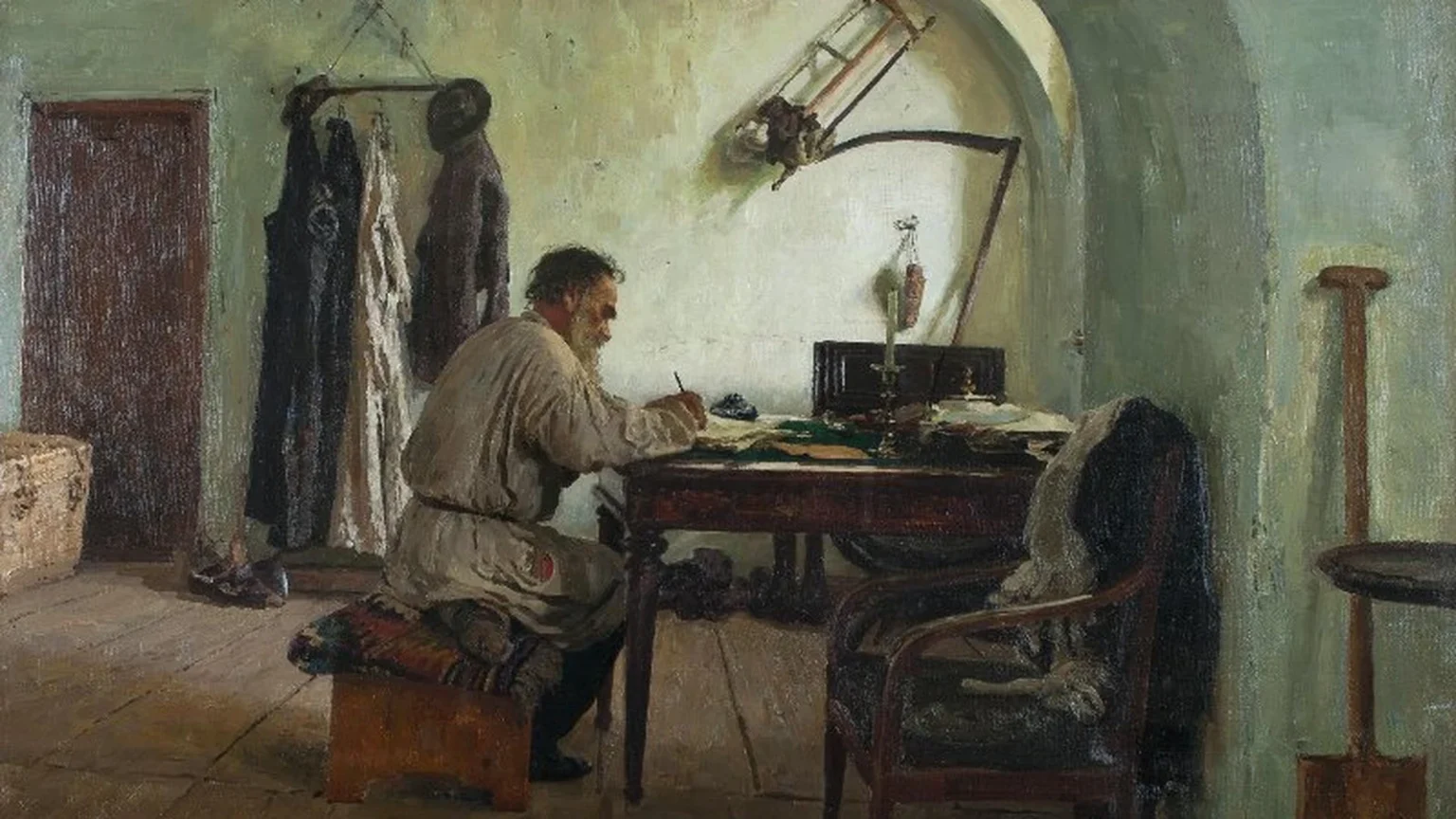
Image credit: Ilya Repin — Source: Wikimedia Commons / Pushkin House — License: Public Domain