By the BookInLight Culture, Literature & Political Thought Desk
Russian literature books for beginners are easiest to choose when you treat the tradition as a progression of forms rather than a shelf of monuments. Start with Pushkin’s short prose, learn Gogol’s grotesque comedy and Chekhov’s ambiguity, then move into Dostoevsky and Tolstoy before ending with Bulgakov’s twentieth-century reinvention of the classic tradition.
Finding Your Way into Russian Literature
Russian literature looks intimidating when its largest novels stand in for the whole tradition. A better entry uses short prose, social comedy, compact ideological fiction, and only then the long novels.
This is therefore a reading curriculum, not a “greatest books” ranking. Catriona Kelly’s Oxford introduction to Russian literature uses Pushkin to illuminate the wider tradition, while the Oxford Handbook of the Russian Novel situates Pushkin, Gogol, Turgenev, Dostoevsky, and Tolstoy inside a canon that extends far beyond them.
The Reading Order in Brief
If you want one answer: begin with Pushkin, but read the collection selectively. Then move through Gogol, Turgenev, and Chekhov before attempting the long novels. This order deliberately places Chekhov before Dostoevsky even though Crime and Punishment is earlier: Chekhov gives you a short-form lesson in ambiguity before the sequence becomes much heavier.
| Step | Read | What it teaches | Difficulty |
|---|---|---|---|
| 1 | Pushkin, selected prose | Narrative economy, irony, historical storytelling | Beginner |
| 2 | Gogol, selected stories | Grotesque bureaucracy, unstable reality, black comedy | Beginner |
| 3 | Fathers and Sons | Ideology inside a compact realist novel | Beginner |
| 4 | Chekhov, selected stories | Ambiguity, understatement, open endings | Beginner |
| 5 | Crime and Punishment | Psychological pressure, argument, conflicting voices | Moderate |
| 6 | Anna Karenina | Social scale, parallel plots, moral observation | Demanding |
| 7 | The Master and Margarita | Modernist satire and the afterlife of Pushkin and Gogol | Moderate |
What to Know Before You Begin
Three habits remove much of the friction. Keep a simple character list for long novels; first names, patronymics, surnames, and diminutives carry social meaning. Identify the translator before buying: BookInLight’s guides to Penguin Classics and Oxford World’s Classics show why series branding never replaces translator and edition data.
Finally, do not confuse chronology with pedagogy. An Oxford visiting-student syllabus similarly moves from Pushkin, Gogol, Turgenev, and Chekhov toward Dostoevsky, Tolstoy, and then Bulgakov.
Start with Pushkin, but Read Selectively
Pushkin is the best first author because later writers repeatedly return to possibilities he helped establish, while his prose can be sampled without a major-novel commitment. Begin with “The Queen of Spades,” continue to “The Captain’s Daughter,” then try several Belkin tales.
For a prose-first beginner this is more useful than starting with the verse novel Eugene Onegin, and less burdensome than War and Peace or The Brothers Karamazov. You learn tonal range before length and philosophical density become competing difficulties.
The Seven-Book Reading Path

Novels, Tales, Journeys by Alexander Pushkin
Trans. Richard Pevear & Larissa Volokhonsky · Penguin Classics · 2017 · 512 pp. · ISBN 9780241290378
Do not treat “complete prose” as an instruction to read from page one to page 512. For a beginner, this edition is a library from which to build a first week. Read “The Queen of Spades” for Pushkin’s control of pace, obsession, and supernatural suggestion; “The Captain’s Daughter” for his ability to compress private loyalty and public history; then a few Belkin tales for the games he plays with narrators and literary convention. What matters is the apparent ease. Pushkin can make highly designed prose look transparent, and recognizing that economy helps you see why later Russian writers could imitate, parody, or rebel against him. Pevear and Volokhonsky’s volume is useful because the same translators carry you across the prose corpus, while the notes prevent historical references from becoming obstacles. Save the travel material and less immediately compelling fragments for later. The aim of this first stage is not completion but calibration: after Pushkin, you should know that “Russian classic” does not automatically mean sprawling, solemn, or slow. Notice especially how quickly a narrator can establish social rank, irony, and danger without explanatory scaffolding; that economy becomes a useful baseline for everything that follows.
Difficulty: Beginner
“A superb gathering of writings by the short-lived Alexander Pushkin.”
— Kirkus Reviews · Penguin Classics

Diary of a Madman, The Government Inspector, & Selected Stories by Nikolay Gogol
Trans. Ronald Wilks; intro. Robert Maguire · Penguin Classics · 2005 · 368 pp. · ISBN 9780140449075
Pushkin teaches control; Gogol teaches what happens when reality begins to warp. Start with “The Overcoat” and “Diary of a Madman,” then add “Nevsky Prospect.” Low-ranking clerks, status anxiety, urban spectacle, bureaucratic absurdity, and sudden tonal lurches become a vocabulary you will recognize later in Dostoevsky and Bulgakov. The important beginner mistake is to read Gogol merely as a social satirist who exposes corrupt officials. His comedy keeps destabilizing the world it appears to explain: objects acquire strange force, narrators become unreliable, and pathos can turn ridiculous without warning. Ronald Wilks gives you several major stories plus The Government Inspector, but the play need not come immediately. Read it after two or three stories, when Gogol’s logic of mistaken identity and institutional panic already feels familiar. This stage is short enough to remain playful, yet it introduces one of the tradition’s most durable techniques: using absurdity not as escape from reality but as a sharper way of making reality look estranged. Watch how official language, clothing, rank, and physical objects begin to control characters; those details make Gogol’s influence easier to recognize later.
Difficulty: Beginner
“The stories gathered here … range from comic to tragic.”
— Penguin Classics · Edition description

Fathers and Sons by Ivan Turgenev
Trans. Peter Carson; intro. Rosamund Bartlett; afterword Tatyana Tolstaya · Penguin Classics · 2009 · 240 pp. · ISBN 9780141441337
This is the bridge from short prose to the Russian novel of ideas. Published in 1862, Fathers and Sons makes generational conflict concrete in Bazarov, whose “nihilism” is not a detachable philosophical lecture but a way of speaking, judging, loving, and misreading other people. Read for the pressure between ideology and characterization. Turgenev is especially useful before Dostoevsky because he lets positions remain legible without making every conversation feel like a spiritual emergency. The novel also gives you a manageable introduction to the social transformations surrounding the emancipation era without demanding a history textbook beside you. Peter Carson’s translation is the reason for choosing this particular edition: the Penguin page preserves Donald Rayfield’s strong judgment in favor of Carson’s English, while Rosamund Bartlett’s introduction supplies context. If you dislike spoilers, read the novel before the introduction and use the notes only as needed. By the end, you should be alert to a central Russian-literary habit: ideas matter most when characters cannot live them as cleanly as they can state them. Track Bazarov’s language when he moves from argument to embarrassment, desire, or grief; the changes reveal more than a glossary definition of nihilism ever could.
Difficulty: Beginner
“If you want to get as close as an English reader can to enjoying Turgenev, Carson is probably the best.”
— Donald Rayfield · Times Literary Supplement via Penguin Classics

Ward No. 6 and Other Stories, 1892–1895 by Anton Chekhov
Trans. Ronald Wilks · Penguin Classics · 2004 · 368 pp. · ISBN 9780140447866
Chekhov is the sequence’s deliberate pause before the large novels. Begin with “The Student,” then “The Black Monk,” and finally “Ward No. 6.” The first teaches how much significance Chekhov can place inside a very short arc; the second unsettles any easy border between insight and delusion; the title story expands moral indifference into institutional catastrophe. What you are learning here is not “what Chekhov means” but how to resist premature closure. His stories often refuse the satisfying verdict a beginner expects from moral fiction. That makes him ideal preparation for Dostoevsky and Tolstoy, whose novels contain arguments that should not be mistaken for the author’s final word. Ronald Wilks’s translation is clear without turning the stories into contemporary minimalism, and the 1892–95 concentration gives the collection coherence. Do not feel obliged to finish every story before moving on. Three or four carefully read pieces are enough to train the habit you need: notice changes in tone, point of view, and moral distance before asking for a thesis. Read one story per sitting and resist explaining the ending immediately; Chekhov often makes delayed uncertainty part of the experience.
Difficulty: Beginner
“These stories … show him exploring complex, ambiguous and often extreme emotions.”
— Penguin Classics · Edition description

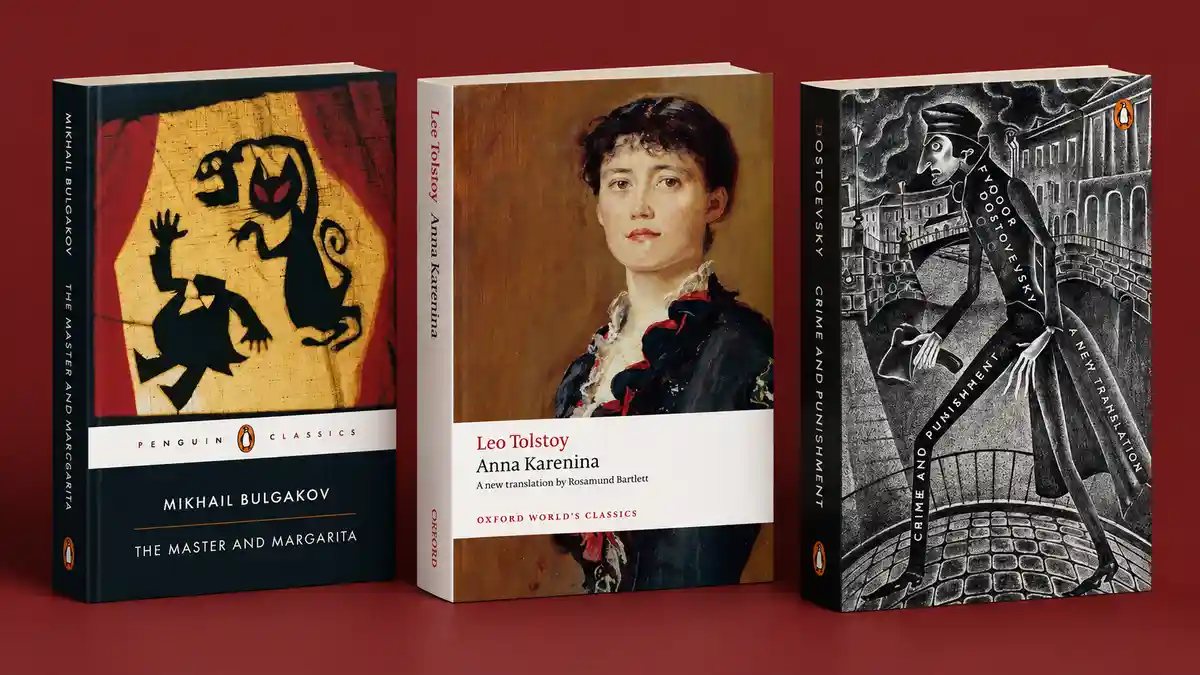
Crime and Punishment by Fyodor Dostoyevsky
Trans. Oliver Ready · Penguin Classics · 2014 · 752 pp. · ISBN 9780141192802
For a first full Dostoevsky novel, choose Crime and Punishment over The Brothers Karamazov. It has one dominant line of pressure, a recognizable crime narrative, and enough philosophical conflict to teach Dostoevsky’s method without requiring you to master an entire family theology. Oliver Ready’s translation is especially helpful because it preserves speed, verbal abrasion, and comic volatility; Penguin’s supporting page repeatedly emphasizes the version’s urgency and humor. Read quickly enough to feel Raskolnikov’s feverish momentum, but mark scenes in which another character seems to “answer” an idea he has not formally stated. Dostoevsky builds argument through competing voices, not through a lecturer standing above the novel. If you want a shorter test before committing, Notes from Underground is possible, but it is more concentrated and rhetorically hostile than its length suggests; BookInLight’s Notes from Underground format guide explains why close rereading matters there. Here, let plot pull you through the argument. Keep a small name list, but do not stop for every allusion. Mark the interrogation scenes, overheard conversations, and sudden tonal changes: they show how Dostoevsky converts abstract positions into dramatic pressure.
Difficulty: Moderate
“At last we have a translation that brings out the wild humour and vitality of the original.”
— Robert Chandler · Penguin Classics

Anna Karenina by Leo Tolstoy
Trans. & ed. Rosamund Bartlett · Oxford World’s Classics · 2016 · 896 pp. · ISBN 9780198748847
Tolstoy comes after Dostoevsky here not because he is “harder,” but because Anna Karenina asks you to hold a much wider social field in mind. Its force comes from parallel lives, shifts between city and country, changes of social register, apparently ordinary conversations, and the way moral judgment migrates from one consciousness to another. Do not reduce the novel to Anna’s plot. Levin’s agricultural arguments, family life, and spiritual searching are structural counterweights, not digressions to be skipped. Rosamund Bartlett’s Oxford World’s Classics translation is a strong first-reading edition because it combines modern English with substantial notes and a translator-editor who is also a Tolstoy specialist. To avoid having the introduction pre-frame the novel, read it afterward and use the explanatory notes during the text. BookInLight’s Anna Karenina format guide reaches the same practical conclusion: an annotated print edition is especially useful for names, parallel plots, and backtracking. Length is the main difficulty; the prose itself is not a locked door. Read by parts rather than page targets, and note where Anna’s and Levin’s stories echo without becoming simple moral opposites. That structural attention makes the novel feel designed rather than merely enormous.
Difficulty: Demanding
“This is a fine new translation.”
— Catherine Brown · The Independent via Oxford University Press

The Master and Margarita by Mikhail Bulgakov
Trans. Richard Pevear & Larissa Volokhonsky · Penguin Classics · 2007 · 432 pp. · ISBN 9780140455465
End the starter path by watching the nineteenth-century tradition become something recognizably modern and Soviet. Bulgakov mixes demonic farce, literary satire, a love story, and a Jerusalem narrative without asking you to choose one stable genre. Read it after Gogol and Pushkin and the apparent chaos becomes more legible: grotesque visitors, unstable narrators, satire under censorship, and literary self-consciousness now belong to a much harsher political environment. The Oxford Handbook specifically notes the novel’s modernist techniques and its demonstrable connection to Pushkin and Gogol, which is why it functions better here as a culmination than as book one. Penguin records that Bulgakov completed the novel in 1938; it appeared only posthumously, first incompletely in 1966–67 and then in full in 1973. Do not try to decode every symbol on a first pass. Follow the recurring questions of artistic freedom, cowardice, punishment, and the survival of texts. Pevear and Volokhonsky provide a widely available complete translation with useful contextual apparatus, making this an accessible doorway into twentieth-century Russian literature rather than merely an eccentric finale. Keep the Moscow and Jerusalem strands distinct at first; their relationship becomes more productive when you let the parallels accumulate instead of solving them immediately.
Difficulty: Moderate
“Bulgakov’s novel … is now considered one of the best Russian novels of the twentieth century.”
Why This Reading Order Works
The sequence is formal before it is chronological: Pushkin teaches economy; Gogol estrangement; Turgenev ideological conflict; Chekhov ambiguity; Dostoevsky psychological pressure; Tolstoy social scale; Bulgakov modernist reinvention.
That is more useful than treating difficulty as “big ideas plus long names.” The Oxford Handbook emphasizes formal eccentricity alongside philosophical, political, and moral questions. Moving through several forms lets you see how ideas are created by narrative technique rather than extracting a vague doctrine of “the Russian soul.”
Five Mistakes That Make Russian Classics Harder
Starting with the biggest monument. War and Peace and The Brothers Karamazov are not initiation rituals. Postponing them is sequencing, not avoidance.
Buying by title instead of translator. English versions can differ in rhythm, register, annotation, completeness, and even the way names are presented. Verify the translator and ISBN before buying.
Reading every introduction first. Scholarly introductions are valuable but often discuss endings, structural parallels, and interpretive problems. For a first encounter with fiction, notes during reading and the introduction afterward are often the better order.
Treating patronymics as pointless clutter. Make a one-page name list. Within a few chapters, shifts from formal name to diminutive begin to reveal intimacy, status, and tension.
Turning a canon into a national essence. These seven writers are a practical route through a famous line of Russian prose, not proof that one temperament defines Russian culture. The scholarly canon itself is being widened by work on women writers, imperial and postcolonial contexts, émigré writing, and Russophone literature beyond Russia.
Choose a Different Route If…
Shortest route: Pushkin’s “The Queen of Spades,” Gogol’s “The Overcoat,” and three Chekhov stories before deciding whether you want a long novel.
Psychology first: move from Chekhov to Crime and Punishment, then Anna Karenina.
Politics and social change: emphasize Fathers and Sons, Tolstoy’s institutions, and Bulgakov’s literary bureaucracy without reducing fiction to political documents.
Twentieth-century continuation: use Bulgakov as a hinge toward Nabokov, Platonov, Pasternak, Grossman, Solzhenitsyn, Teffi, and later Soviet and post-Soviet writers.
Russian Literature for Beginners: FAQ
What order should a beginner read Russian literature?
For this route: Pushkin, Gogol, Turgenev, Chekhov, Dostoevsky, Tolstoy, Bulgakov. The order is pedagogical rather than strictly chronological: short prose trains attention before the large novels demand stamina.
Which Dostoevsky book should I read first?
Crime and Punishment is the best all-purpose first Dostoevsky because plot supplies momentum while the novel still exposes his psychological and philosophical method. Notes from Underground is shorter but denser; save The Brothers Karamazov for later.
Should I start with War and Peace?
Only if epic historical fiction is exactly what attracts you. Its scale creates unnecessary friction if you are still testing Tolstoy. Anna Karenina is the better first large Tolstoy in this sequence.
Is there one best translation of Russian classics?
No. Translation is work-specific. This guide favors Oliver Ready for Crime and Punishment and Rosamund Bartlett for Anna Karenina. Compare samples when possible and choose editions that clearly identify translator, text, notes, and revision status.
What This Starter Path Leaves Out
This seven-book path privileges a famous prose line from the nineteenth century into Soviet modernism. It leaves out poetry, much drama, recovered women’s writing, and writers shaped by imperial, Ukrainian, Polish, Jewish, émigré, and other Russophone contexts.
The Oxford Handbook explicitly widens the field through empire, translation, émigré writing, postcolonial approaches, and contemporary Russophone fiction. The New Cambridge History of Russian Literature likewise rejects a single integral narrative in favor of parallel histories of movements, mechanisms, forms, and literary heroes. Treat this sequence as an entrance, not a complete map.
Related BookInLight Reading Guides
Best Format for Reading Anna Karenina — a deeper comparison of translations, print, ebook, audio, and the Bartlett Oxford edition recommended here.
The Underground Voice: Read Dostoevsky First, Then Listen — useful if you want a shorter Dostoevsky entry before committing to Crime and Punishment.
The Karamazov Choice: Why Print Should Lead and Audio Should Follow — the logical next Dostoevsky step after the present sequence.
Penguin Classics: A Complete Guide to the Series — how to judge translation, editorial apparatus, and edition identity across a major classics list.
Sources and Further Reading
The Oxford Handbook of the Russian Novel — current scholarly overview of form, canon, empire, translation, and Russophone contexts.
Introduction to The Oxford Handbook of the Russian Novel — canon formation, genre history, and Bulgakov’s relation to Pushkin and Gogol.
Catriona Kelly, Russian Literature: A Very Short Introduction — concise orientation using Pushkin as a central organizing figure.
St Edmund Hall, University of Oxford: Comparative Literature — syllabus evidence for a staged path through the same core writers.
Library of Congress: Russian Literature by Peter Kropotkin — digitized historical survey, useful chiefly as a reception document.
Penguin Classics: Novels, Tales, Journeys — exact Pushkin edition, translators, ISBN, pagination, contents, and review quotation.
Penguin Classics: Diary of a Madman, The Government Inspector, & Selected Stories — exact Gogol edition and contents.
Penguin Classics: Fathers and Sons — exact Carson translation, edition data, and critical endorsements.
Penguin Classics: Ward No. 6 and Other Stories, 1892–1895 — exact Chekhov edition, translator, ISBN, contents, and pagination.
Penguin Classics: Crime and Punishment — Ready translation, edition details, and critical responses.
Oxford University Press: Anna Karenina — exact Bartlett paperback, ISBN, pagination, and review excerpts.
Google Books: Anna Karenina, Oxford World’s Classics — independent cross-check for translator, publisher, year, ISBN, and length.
Penguin Classics: The Master and Margarita — exact edition, translators, publication history, ISBN, and length.
The New Cambridge History of Russian Literature — a recent multi-perspectival literary history that treats the tradition through parallel histories rather than a single canonical narrative.
Library of Congress: Before They Were Titans — specialist essays on early Dostoevsky and Tolstoy.
Image Credits
Novels, Tales, Journeys, Alexander Pushkin, Penguin Classics, 2017 — cover image: Penguin Books.
Diary of a Madman, The Government Inspector, & Selected Stories, Nikolay Gogol, Penguin Classics, 2005 — cover image: Penguin Books.
Fathers and Sons, Ivan Turgenev, Penguin Classics, 2009 — cover image: Penguin Books.
Ward No. 6 and Other Stories, 1892–1895, Anton Chekhov, Penguin Classics, 2004 — cover image: Penguin Books.
Crime and Punishment, Fyodor Dostoyevsky, trans. Oliver Ready, Penguin Classics, 2014 — cover image: Penguin Books.
Anna Karenina, Leo Tolstoy, trans. Rosamund Bartlett, Oxford World’s Classics, 2016 — cover image: Oxford University Press.
The Master and Margarita, Mikhail Bulgakov, trans. Richard Pevear & Larissa Volokhonsky, Penguin Classics, 2007 — cover image: Penguin Books.