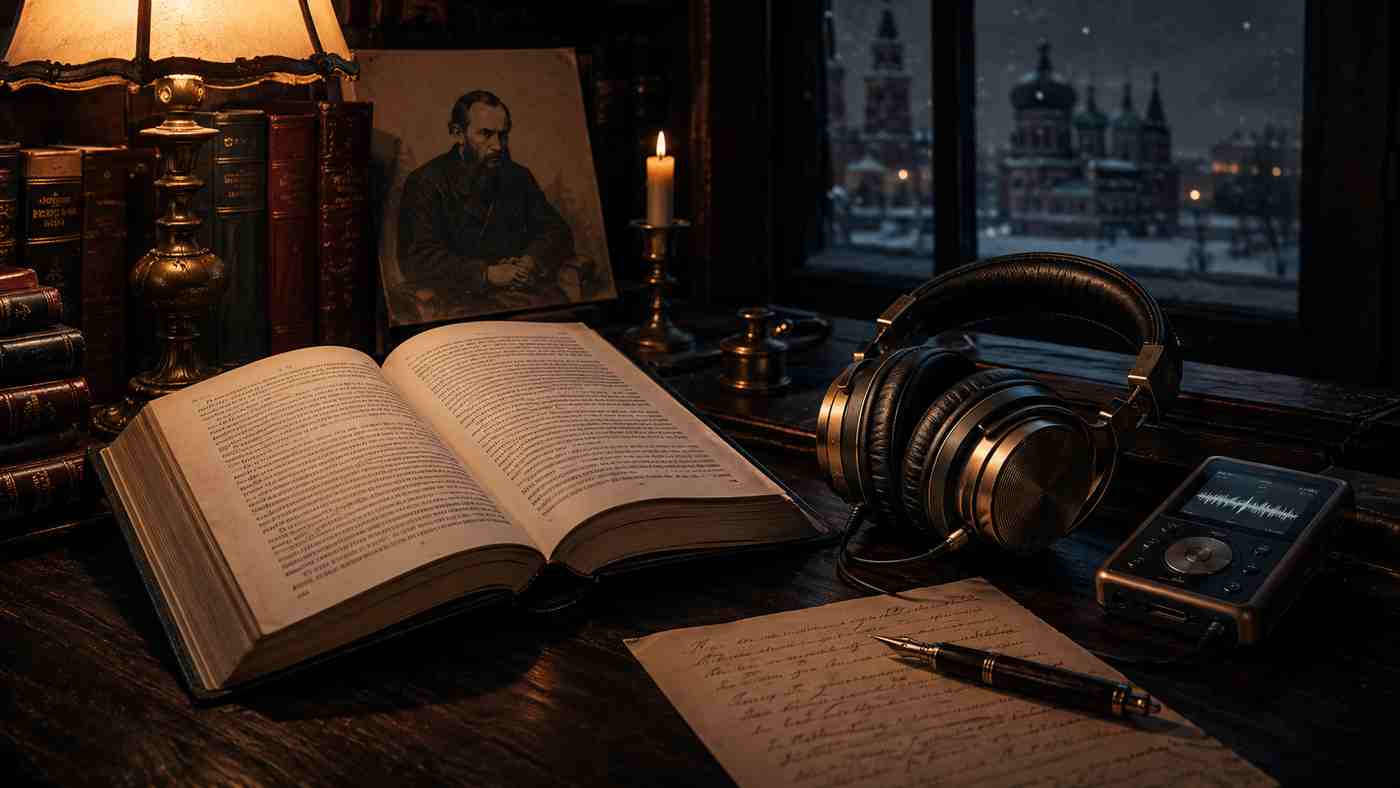
For a first serious encounter, print is the stronger main format. The Brothers Karamazov Print vs Audiobook decision turns on navigation: Dostoevsky’s shifting names, long arguments, recurring testimony, and translation-dependent phrasing reward a stable page. The best alternative is an unabridged audiobook used alongside the book, especially for momentum and vocal continuity. The main caution is textual provenance: a famous narrator or cheap ebook does not tell you which English translation you are receiving.
Quick verdict
Best overall format
Annotated print, because the novel repeatedly asks readers to return to names, speeches, clues, and earlier moral claims.
Best source inside that format
Michael R. Katz’s Liveright/Norton translation, because its contemporary English preserves dramatic speed without making a beginner fight the prose before reaching the argument.
Best companion format
Luke Thompson’s unabridged Penguin Audio recording, because the publisher identifies the narrator, David McDuff translation, introduction, runtime, and edition status.
Use caution with
Unidentified bargain ebooks and generic audio listings, because the title alone does not establish the translator, completeness, notes, narrator, or textual basis.
Best Overall Format: The Brothers Karamazov Print vs Audiobook
The Brothers Karamazov is a long novel, but length alone does not make print preferable. Its deeper difficulty is relational. Russian given names, patronymics, surnames, diminutives, and nicknames coexist; testimony changes meaning when compared with earlier scenes; and the philosophical set pieces are embedded in emotional situations that matter as much as their abstract claims. A printed page lets the reader pause, mark a name, compare a phrase, and return to a speech without losing the larger position in the book.
Audio strengthens a different set of qualities. Dostoevsky’s arguments often arrive as provocation, interruption, confession, or accusation, and a skilled narrator can restore their pressure as spoken encounters. Audio also keeps a forty-plus-hour book moving through walks, commutes, and household routines. Yet those advantages become weaknesses when the reader needs to verify who is speaking, inspect a translator’s wording, or compare a courtroom claim with an earlier event. For most readers, audio is better at sustaining contact with the novel than at governing the whole reading experience.
The best answer to The Brothers Karamazov Print vs Audiobook is therefore not a ceremonial defence of paper. It is a two-format strategy: use print as the authoritative base and audio as an optional continuity tool. Readers who cannot comfortably use print may reverse that hierarchy, but they should keep a searchable ebook or character list close at hand. One format can replace the other only when accessibility or circumstance requires it; for study, translation comparison, and rereading, they are not fully interchangeable.
Use caution: do not assume that two files called The Brothers Karamazov contain equivalent English texts. Constance Garnett, Richard Pevear and Larissa Volokhonsky, David McDuff, Ignat Avsey, Susan McReynolds, and Michael R. Katz offer materially different verbal experiences.
Format verdict: In The Brothers Karamazov Print vs Audiobook, print is the strongest main format because the novel rewards stable navigation, annotation, visible paragraph structure, and quick return to earlier names and arguments. Its real drawback is physical: most complete one-volume editions are substantial, and the most scholarly options are not comfortable commuter books.
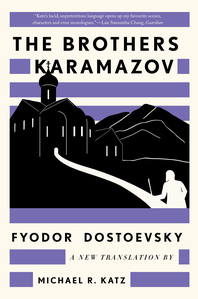
W. W. Norton / Liveright — Michael R. Katz
Translator or editor: Michael R. Katz.
Edition: UK paperback published 16 July 2024, ISBN 9781324095101; the translation first appeared from Liveright in 2023.
Best for: First-time readers, book clubs, and readers who want contemporary English with strong dramatic momentum.
Why this over alternatives: Katz treats the novel as speech as well as philosophy. The result is easier to follow through quarrels, confessions, comic eruptions, and courtroom rhetoric without sanding the book into generic modern prose.
Main trade-off: It is a reading edition rather than a full critical apparatus. Students requiring extensive contexts and criticism should add the Norton Critical Edition or a separate companion.
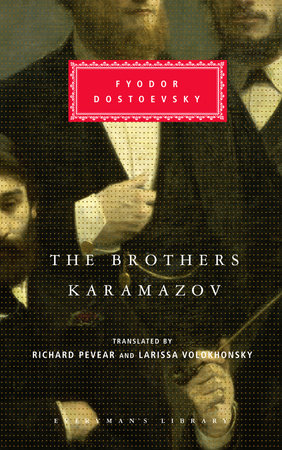
Everyman’s Library — Pevear and Volokhonsky
Translator or editor: Richard Pevear and Larissa Volokhonsky; introduction by Malcolm Jones.
Edition: Hardcover published 28 April 1992, ISBN 9780679410034, 840 pages.
Best for: Serious rereaders, readers comparing translation strategies, and anyone wanting a durable one-volume library copy.
Why this over alternatives: The Pevear–Volokhonsky translation deliberately preserves more of Dostoevsky’s verbal roughness and shifting registers, while Everyman’s Library adds sewn-looking traditional presentation, acid-free paper, chronology, bibliography, and ribbon marker.
Main trade-off: Source-oriented syntax can feel less immediately fluent than Katz or Avsey, and the premium binding adds ownership value more than beginner guidance.
Oxford World’s Classics — Ignat Avsey
Best for: First-time readers who want a fluent translation plus an introduction and explanatory notes in one practical paperback.
Why this over alternatives: Avsey’s version, published under the title The Karamazov Brothers, tends toward natural English while the Oxford apparatus supplies orientation without becoming a research anthology.
Main drawback: Readers who want the newest English version may prefer Katz; readers who want a large body of criticism should prefer the Norton Critical Edition.
Norton Critical Edition — Susan McReynolds
Best for: University courses, research-led rereading, and readers who need contexts, annotations, criticism, chronology, and bibliography in the same volume.
Why this over alternatives: The second edition uses Susan McReynolds’s substantially revised translation and surrounds it with a pronunciation key, documentary contexts, and a broad critical dossier.
Main drawback: The apparatus is a genuine asset for study but can make a first recreational reading feel overdetermined and physically cumbersome.
Best inside this format: the Michael R. Katz translation from Liveright/Norton, because it gives a first-time reader the strongest balance of contemporary clarity, dramatic speed, humour, and seriousness. Choose Oxford Avsey when notes are essential, Norton Critical for formal study, and Everyman’s Library for a durable Pevear–Volokhonsky copy.
Kindle and Ebook
Kindle / Ebook
Format verdict: Ebook is the best portable and searchable reading format. Adjustable type, dictionary access, highlights, and instant name-searching solve real problems in this novel. It weakens spatial memory, however: a location number or reflowed screen is less useful than a marked page when comparing distant speeches or following the shape of an argument.
Norton / Liveright — Michael R. Katz Ebook
Best for: Readers who want the recommended modern translation on a phone, tablet, or ereader.
Why this over alternatives: The publisher page identifies Katz, the print ISBN, and the companion ebook ISBN 9781631498206. That provenance is much safer than a low-cost store listing whose translator is absent or buried.
Main drawback: Digital notes and back-and-forth comparison depend on the reading app. Even a well-produced file cannot reproduce the stable visual geography of a marked print volume.
Penguin Ebook — David McDuff
Best for: Readers who want a searchable copy matching Penguin’s Luke Thompson audiobook.
Why this over alternatives: The exact Penguin record names McDuff as translator, introducer, and annotator and identifies the 2003 ebook. Matching text and audio makes it easier to switch formats without encountering changed names or sentence rhythms.
Main drawback: McDuff’s translation is reliable and well established, but readers seeking the most recent English idiom may find Katz more immediate.
Standard Ebooks — Constance Garnett
Best for: Budget readers who want a clean, device-friendly public-domain edition.
Why this over alternatives: Standard Ebooks takes the Garnett text and gives it modern typography, metadata, chapter navigation, and carefully prepared EPUB files. For ordinary free reading, its production is materially better than a plain transcription.
Main drawback: The underlying English translation dates from 1912. Its historical importance does not make it the best first choice for every contemporary reader.
Project Gutenberg — Constance Garnett
Best for: Plain-text search, broad download compatibility, and a no-account backup copy.
Why this over alternatives: Ebook number 28054 clearly names Garnett and offers EPUB, Kindle, HTML, and plain-text formats. It is transparent about public-domain status in the United States.
Main drawback: The reading experience is more utilitarian than Standard Ebooks, and legal status outside the United States depends on local copyright law.
Best inside this format: the official Norton/Liveright Michael R. Katz ebook, because it combines a clearly identified modern translation with search, adjustable type, and portability. Standard Ebooks is the best free file, while the Penguin McDuff ebook is the best digital partner for the Luke Thompson recording.
Audiobook
Audiobook
Format verdict: For The Brothers Karamazov Print vs Audiobook, audio is an excellent companion and a defensible main format for accessibility-focused listeners. It strengthens pace, pronunciation, dialogue, and the novel’s theatrical energy. It weakens note-taking, name recognition, quotation recovery, and rapid comparison between distant passages, so listeners should prefer an unabridged recording whose translation is explicitly named.
Penguin Audio — Luke Thompson, David McDuff translation
Best for: Listeners who want the most completely documented modern commercial recording and readers pairing audio with Penguin’s McDuff ebook or paperback.
Why this over alternatives: Penguin identifies Thompson, McDuff, the included introduction, the 2021 publication, ISBN 9780241533222, and a runtime of 2,586 minutes. OverDrive independently labels the edition unabridged. That metadata makes this the safest recommendation before subjective narrator preference is considered.
Main drawback: Forty-three hours of listening magnifies any mismatch between reader and narrator. Compare the official sample, because metadata cannot decide whether Thompson’s vocal choices suit you.
Macmillan Audio — Ben Miles, Pevear and Volokhonsky translation
Best for: Readers who specifically want the Pevear–Volokhonsky text in audio or who already own the Vintage or Everyman edition.
Why this over alternatives: Macmillan’s 2024 production names Ben Miles, the translators, the audio imprint, ISBN 9781250351036, and provides an official excerpt. It therefore offers a clearly traceable modern alternative rather than an anonymous re-recording of a public-domain text.
Main drawback: A translation that preserves more verbal strangeness may require closer listening. Sample both this and Thompson before choosing; narrator preference remains subjective.
LibriVox Version 3 — Bruce Pirie, Constance Garnett translation
Best for: A no-cost, continuous solo reading and listeners who accept the historical Garnett translation.
Why this over alternatives: Version 3 is read by one named volunteer across ninety-six listed sections, avoiding the changing voices of a collaborative recording. The chapter-level page also makes completeness easier to inspect.
Main drawback: Volunteer production and public-domain text are not equivalent to a current commercial recording. Audio levels, performance preferences, and pronunciation should be tested before committing.
Best inside this format: Luke Thompson’s Penguin Audio recording, because the narrator, unabridged status, David McDuff translation, introduction, publication date, ISBN, and forty-three-hour runtime are all documented across publisher and library records. Compare the official sample with Ben Miles before purchase, because no metadata can settle voice preference.
Podcast and Companion Audio
Podcast / Companion Audio
Format verdict: Companion audio is useful when it clarifies translation or intellectual context at the right stage. It should not become a substitute interpretation that tells the reader what every scene means. Translation interviews work well before or during reading; full-book seminars are safer afterward because they usually disclose plot structure and interpretive conclusions.
“The Passage” — Michael R. Katz on Translation
Best for: Readers deciding whether Katz’s translation suits them and anyone interested in what translation gains, loses, and recreates.
Why this over alternatives: Katz reads from his own version and discusses concrete limits and choices in translating Dostoevsky. That direct connection to the recommended text is more useful than a general podcast that treats the novel only as a bundle of themes.
Main drawback: It is an interview about translation, not a chapter guide. It helps readers choose and hear the English voice but does not solve navigation through the novel.
North Carolina Study Center — Thomas Pfau
Best for: Readers who have finished the novel and want a university-level discussion of its philosophical and theological architecture.
Why this over alternatives: Pfau is identified with Duke, and the recorded seminar is devoted to Dostoevsky and this book rather than to a broad “great novels” conversation.
Main drawback: A whole-book discussion can pre-frame characters and reveal developments. It belongs after the first reading, or at least after the reader accepts substantial spoilers.
Best inside this format: the Michael R. Katz interview, because it addresses the exact translation decision without trying to replace the novel’s interpretive work. Use the Thomas Pfau seminar after reading, when spoilers become analysis rather than interference.
Free, Public-Domain, and Library Sources
Free / Public Domain / Library
Format verdict: Free sources are excellent for sampling, search, backup access, and readers with limited budgets. Their usual compromise is not completeness but translation age and editorial apparatus. Library borrowing is the better low-cost route when the reader wants Katz, McDuff, Avsey, or a modern commercial audiobook.
Standard Ebooks
Best for: The cleanest free ordinary-reading experience.
Why this over alternatives: Its Garnett-based edition has purposeful typography, a working contents structure, modern ebook semantics, and downloads for common devices.
Main drawback: Production quality cannot modernize the 1912 translation itself.
Project Gutenberg
Best for: Plain text, quick quotation search, and the widest choice of open download formats.
Why this over alternatives: The record identifies the translator, ebook number, release and update dates, language, formats, and United States public-domain status.
Main drawback: Its presentation is functional rather than editorially refined; use Standard Ebooks when sustained screen reading is the priority.
Internet Archive Historical Scan
Best for: Inspecting a paginated historical copy, checking material layout, or comparing a scan against a transcription.
Why this over alternatives: A page image preserves pagination and the physical sequence that reflowable files discard.
Main drawback: Scans are slower on phones, OCR can be unreliable, and item metadata should be checked against the scanned title page rather than accepted automatically.
OverDrive / Libby — Michael R. Katz Ebook
Best for: Borrowing the recommended modern translation through a participating public or university library.
Why this over alternatives: The exact OverDrive record identifies the Katz translation and Liveright. It lets readers search for libraries carrying that edition rather than settling for any record with the same title.
Main drawback: Holdings, wait lists, formats, and territorial access vary. The record proves the library edition exists, not that every reader’s library owns it.
Best inside this format: Standard Ebooks, because it offers the least-friction public-domain reading file. For a modern translation, the stronger route is OverDrive/Libby or a local catalogue carrying Katz, McDuff, or Avsey. Always apply the copyright law of the country where the download occurs.
Critical, Student, and Collector Options
Critical / Student / Collector
Format verdict: Specialized editions should be chosen by task. Critical apparatus adds documents and scholarship; a student edition adds orientation; a collector binding adds durability and material pleasure. None of these benefits automatically makes the translation easiest or the volume most portable.
Norton Critical Edition, Second Edition
Best for: Students, teachers, and serious rereaders who need a text surrounded by primary contexts and scholarship.
Why this over alternatives: McReynolds’s revised translation is joined by a pronunciation key, expanded annotations, Dostoevsky materials, criticism, chronology, and bibliography. No other practical one-volume option in this comparison supplies the same research package.
Main drawback: The edition encourages consultation and cross-reference rather than uninterrupted immersion. It is the best study tool, not the lightest first-read object.
Oxford World’s Classics — Ignat Avsey
Best for: Students and book groups who want guidance without a full critical anthology.
Why this over alternatives: Translation, introduction, and notes operate as a coherent entry package. It is easier to teach from than a bare reading edition and less interruptive than the Norton Critical Edition.
Main drawback: Its apparatus is selective, not comprehensive; advanced research still requires criticism beyond the volume.
Everyman’s Library Hardcover
Best for: Collectors, gifts, and readers building a durable library of Russian classics.
Why this over alternatives: The official specifications identify acid-free cream paper, full-cloth case, foil stamping, decorative endpapers, ribbon marker, chronology, and bibliography. Those are real material benefits, not merely a decorative cover change.
Main drawback: Premium construction does not settle the translation debate. Buy it because you want Pevear and Volokhonsky in a durable format, not because a collector binding is inherently more authoritative.
Best inside this format: the Norton Critical Edition for serious study, because its documentary and critical apparatus is unmatched here; Oxford Avsey for a guided first reading, because it offers support with less interruption; and Everyman’s Library for collecting, because its material specifications are documented and its translation is clearly identified.
Final Recommendation
The practical answer to The Brothers Karamazov Print vs Audiobook is not that audio fails, but that print should establish the text. Dostoevsky’s shifts between narration, confession, argument, courtroom rhetoric, and theological debate are easier to distinguish when the page remains available for return. Audio then becomes unusually effective: it restores pace, keeps the Russian names audible, and can carry a reader through stretches that might otherwise be postponed.
For readers still deciding among translations, Jennifer Wilson’s review of the Michael R. Katz translation is a useful independent companion because it places the new version within the long English history of the novel rather than treating translation as a matter of isolated sample sentences.
First-time reader
Choose: the Michael R. Katz print edition from Liveright/Norton, with the Luke Thompson audiobook as an optional companion. This pairing is strongest because the modern prose remains navigable on the page while audio supplies continuity without forcing you to surrender annotation.
Student
Choose: the Norton Critical Edition. Its revised translation, notes, contexts, criticism, chronology, and bibliography make it the most efficient single-volume research base because assignments usually require evidence beyond the narrative itself.
Serious rereader
Choose: a second translation in print—Avsey, Katz, or Pevear and Volokhonsky—rather than another format of the same wording. A rereader gains more from noticing translational decisions than from merely repeating an identical text through a new device.
Casual reader
Choose: the official Katz or McDuff ebook when portability is what will keep the project alive. Search, bookmarks, and instant definitions compensate for the loss of physical orientation, provided the file clearly identifies its translator.
Commuter or listener
Choose: Luke Thompson’s unabridged Penguin recording of the McDuff translation. It is the safest evidence-based recommendation because the narrator, textual basis, length, publisher, and unabridged status are all documented; compare its official sample with Ben Miles before purchase.
Budget reader
Choose: Standard Ebooks for the cleanest free Garnett file, or borrow Katz through OverDrive/Libby when available. This is the best-value route because it separates cost from textual quality instead of assuming that every free transcription is equally usable.
Collector
Choose: the Everyman’s Library hardcover only when you actively want the Pevear and Volokhonsky translation. Its documented cloth binding, acid-free paper, ribbon marker, chronology, and bibliography justify it as an object, but material finish does not make its English universally preferable.
Accessibility-focused reader
Choose: an unabridged audiobook as the main format, accompanied by a searchable ebook. The audio removes print barriers, while the ebook restores spelling, navigation, quotation search, and visual access to names and chapter boundaries.
The strongest all-purpose plan is therefore print first, audio second, and ebook as reference. That hierarchy answers The Brothers Karamazov Print vs Audiobook without pretending that every reader has the same access needs: the page is the best intellectual workspace, the recording is the best engine of continuity, and the searchable file is the best auxiliary tool.
FAQ
Is The Brothers Karamazov better in print or audiobook?
Print is better as the main format because the novel repeatedly asks the reader to compare claims, return to speeches, track names, and annotate difficult passages. Audiobook is the stronger companion because performance and continuity can reduce fatigue. For most readers, the best answer to The Brothers Karamazov Print vs Audiobook is a coordinated two-format reading rather than a winner-takes-all choice.
Which translation should a beginner choose?
Michael R. Katz is the clearest default for a first-time English reader because it is recent, direct, and available in matching print and ebook forms. Ignat Avsey is a strong guided alternative because the Oxford volume joins translation, introduction, and notes. Readers should still compare samples: ease, foreignness, rhythm, and lexical closeness are legitimate competing priorities.
Can the audiobook replace the printed book?
It can for a reader who cannot comfortably use print, and it can for a listener whose main aim is narrative completion. It is less satisfactory for study because audio makes backward comparison, quotation capture, footnote consultation, and visual differentiation of names slower. A searchable ebook is the most useful companion when audio is the primary format.
What is the safest audiobook recommendation?
Luke Thompson’s Penguin recording of David McDuff’s translation is the safest recommendation because Penguin identifies the narrator and translation, while OverDrive identifies the recording as unabridged. Ben Miles’s Macmillan recording of Pevear and Volokhonsky is a credible alternative with an official sample. Metadata cannot determine which voice you will prefer, so sample both when regional access permits.
Is the free public-domain edition complete?
The Standard Ebooks and Project Gutenberg versions use Constance Garnett’s complete public-domain translation rather than an abridgement. The caution concerns language and production, not completeness: Garnett’s English dates from 1912, and raw transcriptions are less pleasant than a carefully produced ebook. Copyright status also varies by jurisdiction, so readers outside the United States should check local law.
Which edition has the best notes for study?
The second Norton Critical Edition is the strongest compact study edition because it combines Susan McReynolds’s revised translation with annotations, contextual writings, criticism, chronology, and bibliography. Oxford’s Avsey edition is preferable for a first course or book group when a full critical anthology would interfere with reading momentum.
What should I verify before buying?
Verify the translator, narrator, abridgement status, audio publisher, ebook publisher, and whether notes survive in the digital file. Do not assume that two covers with the same title contain the same English text, or that every storefront listing identifies its textual basis. In any The Brothers Karamazov Print vs Audiobook decision, translation and completeness matter more than platform familiarity.
Related BookInLight Reading Guides
Editorial research and authorship: This guide was researched and written by the BookInLight Department of Russian Literature and Translation Studies, with bibliographical review, edition comparison, source verification, and editorial fact-checking by the BookInLight research team. Readers who identify a factual correction, an overlooked edition or recording, changed availability information, an interpretive suggestion, or other constructive feedback are warmly invited to share it.
Art direction and rights: The editorial art direction, visual composition, source-strip design, cover selection, and presentation of images were developed by the BookInLight Art Department. Individual book covers and provider logos remain the property of their respective publishers, designers, artists, companies, platforms, and rights holders and are credited below. Complete republication, reproduction, translation, or reuse of this article, whether in print or digital form, requires prior written authorization from BookInLight.
Sources and Further Reading
Print Editions and Translations
W. W. Norton / Liveright, Michael R. Katz paperback — supports translator, publication date, ISBN, page count, dimensions, and ebook relationship.
Oxford University Press, Ignat Avsey edition — supports the Oxford World’s Classics translation, introduction, notes, date, and ISBN.
Everyman’s Library, Pevear and Volokhonsky hardcover — supports translator, introduction, ISBN, and documented material specifications.
W. W. Norton, Norton Critical Edition, second edition — supports Susan McReynolds’s revised translation and the volume’s contextual and critical apparatus.
Ebook and Public-Domain Sources
Penguin Classics ebook, David McDuff translation — supports the official digital edition, translator, introduction, notes, date, and ISBN.
Standard Ebooks, Constance Garnett edition — supports the public-domain text basis and available carefully produced ebook formats.
Project Gutenberg ebook no. 28054 — supports translator attribution, release and update data, formats, and United States public-domain notice.
Internet Archive historical scan — supports access to a page-image copy for pagination and material comparison.
OverDrive record for the Katz ebook — supports the existence of the exact modern translation in participating library systems.
Audiobook Recordings
Penguin audiobook narrated by Luke Thompson — supports narrator, McDuff translation, publication data, ISBN, and stated duration.
OverDrive record for the Luke Thompson audiobook — supports the recording’s unabridged status and library-distribution metadata.
Macmillan Audio edition narrated by Ben Miles — supports narrator, Pevear and Volokhonsky textual basis, publication data, ISBN, and official sample.
LibriVox, Bruce Pirie solo recording — supports the Garnett basis, reader, section count, and public-domain recording status.
Companion Audio and Translation Context
Michael R. Katz podcast conversation and reading — supports translator-led discussion of choices and provides an audio sample of the English prose.
Thomas Pfau webinar on The Brothers Karamazov — supports the recommendation of an academically grounded post-reading lecture.
Jennifer Wilson, “The Cacophonous Miracle of ‘The Brothers Karamazov’” — supports evaluation of the Katz translation within the English translation history.
David Remnick, “The Translation Wars” — supports the broader debate around Garnett and Pevear–Volokhonsky.
“The Light of ‘The Brothers Karamazov’” — supports publication context and the continuing critical significance of the novel’s religious and ethical arguments.
Image Credits
Cover: The Brothers Karamazov, Michael R. Katz translation, Liveright/W. W. Norton paperback, 2024 UK edition; compact Print comparison-row appearance. Cover image supplied through the authoritative W. W. Norton edition page.
Cover: The Brothers Karamazov, Richard Pevear and Larissa Volokhonsky translation, Everyman’s Library hardcover; compact Print comparison-row appearance. Cover image supplied through the authoritative Penguin Random House edition page.
Cover: The Brothers Karamazov, Michael R. Katz translation, Liveright/W. W. Norton paperback, 2024 UK edition; detailed Print profile appearance. Cover image supplied through the authoritative W. W. Norton edition page.
Cover: The Brothers Karamazov, Richard Pevear and Larissa Volokhonsky translation, Everyman’s Library hardcover; detailed Print profile appearance. Cover image supplied through the authoritative Penguin Random House edition page.