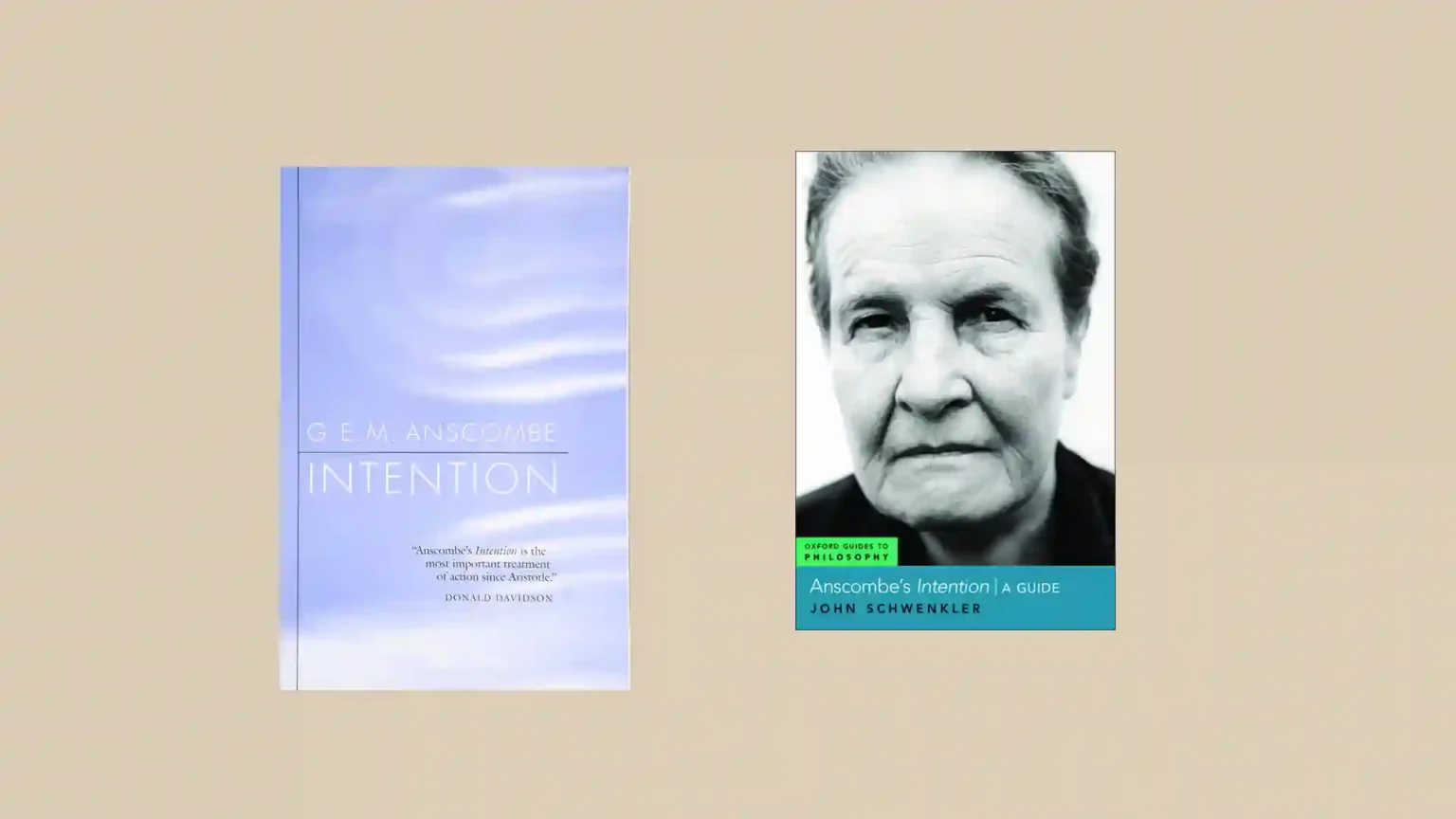
Before Anscombe’s Intention, clarify action, reasons, practical knowledge, and the questions that give her text its architecture.
Two actions can look identical from outside while belonging to different descriptions: a hand moves because it slipped on a wet rail; a hand moves because its owner is signalling a driver. Two sentences can look similar while doing different work: “I am going to London tomorrow” can report a prediction, or express a plan. Anscombe’s Intention begins from distinctions of this kind and then refuses to let them stay isolated. The preparation that matters is not a long syllabus in Aristotle, Wittgenstein, or action theory. It is the ability to keep several uses of “intention” apart long enough to see why Anscombe thinks they belong to one subject.
Start with the three headings
The most economical orientation comes from the Stanford Encyclopedia of Philosophy entry on intention, read beside the SEP entry on Elizabeth Anscombe. Anscombe distinguishes three headings under which talk of intention appears: expressions of intention for the future, intentional actions, and the intention with which an action is done. A preparation that treats only future plans misses the book’s center. A preparation that treats only bodily action misses the connection to reasons and practical thought.
Do not begin with a theory of inner mental states
The tempting model says that an intention is an internal item that first exists in the mind and then causes behavior. Intention repeatedly resists that picture. The book asks how intentional action is identified and described, what kind of knowledge an agent has of what is being done, and why the same physical movement can fall under several descriptions, only some of them intentional. John Schwenkler’s guide to Intention is helpful precisely because it reconstructs the book’s project rather than replacing it with the vocabulary of later action theory; its introductory chapter clarifies why the text’s sequence matters.
Learn the special ‘Why?’ question
The practical hinge is Anscombe’s special use of “Why?” An action is intentional under a description when a certain request for reasons has application; answers can cite an end, a further action, or a practical reason. This is not ordinary causal explanation. “Why did the cup fall?” may invite a physical cause. “Why are the boards being cut?” can invite an answer that locates the cutting inside a larger practical order. Schwenkler’s discussion of the book’s preliminaries is useful here because it prevents the “Why?” test from being turned into a mechanical rule detached from the descriptions under which action is known.
Keep reasons and causes distinct without pretending they never interact
A reader arriving from contemporary philosophy can be misled by a false choice: either reasons are causes in exactly the same sense as physical events, or reasons are not explanatory at all. Anscombe’s question is more local. What makes an explanation an explanation of action as intentional? The vocabulary of reasons, ends, and descriptions is doing logical work before any general metaphysics of causation is settled. This is one place where the broader BookInLight guide to philosophy of language can help indirectly: Anscombe’s philosophical method repeatedly depends on noticing what a question is asking and what a description makes available, not merely on adding hidden entities behind ordinary speech.
Understand practical reasoning before reading the practical syllogism passages
The practical syllogism is not best approached as a defective cousin of deductive logic. It displays how an end and a characterization of circumstances can organize action. Aristotle is part of the background, but reading the whole Nicomachean Ethics is unnecessary preparation. The minimum is conceptual: practical reasoning culminates in doing, not merely in a proposition believed. That makes Intention a book about the form of practical thought as much as a book about a mental attitude. Roger Teichmann’s The Philosophy of Elizabeth Anscombe supplies wider context when this Aristotelian dimension becomes difficult.
Practical knowledge is the hard turn
The book becomes stranger when Anscombe claims that an agent can know an intentional action without observing it in the way a spectator would. This is often paraphrased too quickly as infallible self-knowledge. The safer entry is that practical knowledge is constitutively connected with the action’s intentional description: knowing what is being done is part of the practical organization of doing it. Later scholarship disagrees sharply about how strong this claim is. The Oxford Handbook of Elizabeth Anscombe and its chapter on “Intention in Action” are better follow-ups than prerequisites.
Choose the text before choosing the commentary
For the primary text, the second edition is the standard point of reference; a widely used Harvard University Press reprint appeared in 2000, and WorldCat’s record helps identify it in library catalogues. The edition history matters because the book’s numbered sections are the stable navigation system. A commentary should follow those sections rather than substitute a new chapter architecture. Schwenkler’s guide works well for that purpose, especially its discussion of the unity of action.
A minimal pre-reading checklist
Three headings: future expression, intentional action, intention-with-which. If these still look like three unrelated topics, orientation is not finished.
Description: one bodily event can be intentional under one description and non-intentional under another.
The special ‘Why?’ question: reasons for action are not interchangeable with any causal explanation.
Practical reasoning: its conclusion is tied to action, not only to theoretical assent.
Practical knowledge: be ready for the claim that an agent’s knowledge of intentional action is not ordinary observational knowledge.
What is not required is just as important. A complete course in Aristotle, a full reading of Wittgenstein, and a survey of contemporary action theory can all enrich Intention, but making them compulsory front-loads the very conceptual schemes the book is meant to unsettle. The better preparation is narrower: acquire the distinctions above, then let the numbered sections change what “intention” seems to name.
What not to front-load
Three preparatory detours are especially easy to overvalue. A complete history of Aristotelian practical philosophy can make Anscombe look like a commentator before her own questions are visible. A large dose of later Davidsonian action theory can make the text seem valuable only as a precursor to debates framed in a different vocabulary. And reading every Wittgensteinian influence in advance can turn methodological echoes into a hunt for hidden sources. Each background can become useful after a first pass. None is needed to understand why the book asks about intentional descriptions, answers to ‘Why?’, practical reasoning, and knowledge of action. The efficient order is primary text first, targeted commentary second, wider genealogy only when a specific difficulty demands it.
The next question
Once those distinctions are in place, the unavoidable problem is no longer “What mental state causes intentional action?” It is: how can practical knowledge, reasons, and the descriptions under which an action is intentional belong to one unified account of agency? That is the question Intention makes difficult enough to be worth reading.
Cover artwork: credits and source records
- Intention — Harvard University Press (source record)
- Anscombe’s Intention: A Guide — Oxford University Press (source record)