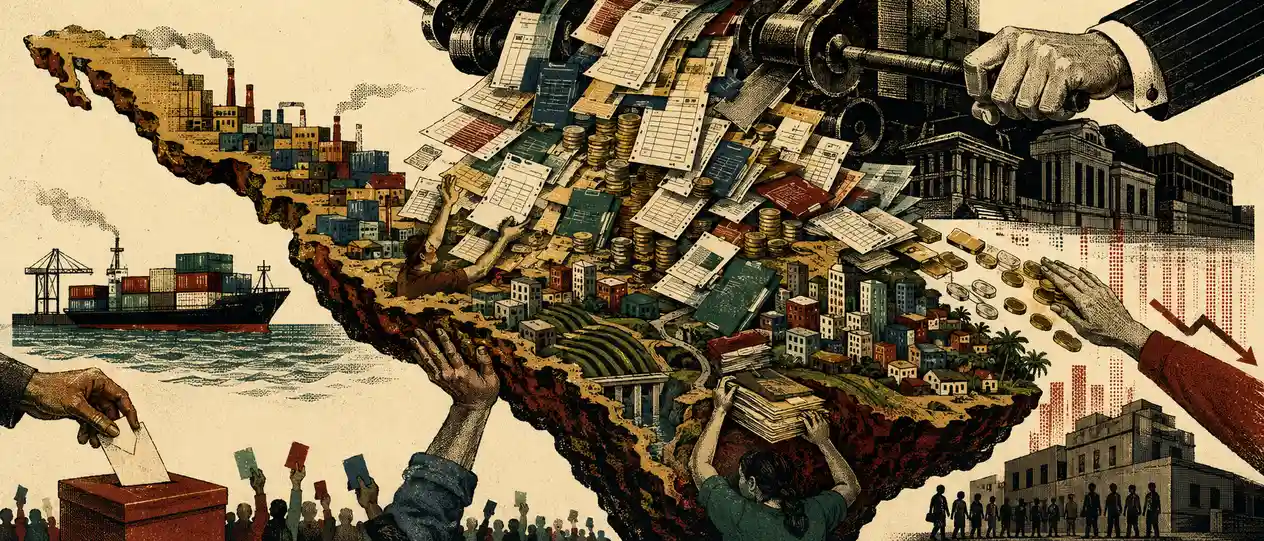
Illustration by Bookinlight Art Desk
The best books on Latin American debt crisis do more than explain why Mexico’s 1982 default threat became a continental rupture. They show how debt remade sovereignty, democracy, development strategy, and the moral language of international finance.
This reading packet treats the Latin American debt crisis as a problem in political economy rather than as a narrow banking event. The crisis was born from petrodollar recycling, expanding commercial-bank lending, import-substitution exhaustion, oil shocks, rising United States interest rates, and weak domestic fiscal structures. Yet its deepest meaning lies in how those forces entered parliaments, ministries, unions, central banks, households, and creditor negotiations.
By Bookinlight
The Reading Lens
How the Best Books on Latin American Debt Crisis Reframe the Lost Decade
The strongest books on this subject refuse a single villain. They move between creditor banks, debtor states, development ideology, democratic fragility, and reform politics. Together, they reveal the crisis as a transfer of risk from private finance to public society, and as a turning point from state-led development toward market reform. Read in sequence, they make the “lost decade” less a pause in progress than a laboratory of global financial power.
Central Question
Who paid when sovereign debt became systemic risk?
Historical Pressure
The collision of global credit expansion, recession, austerity, and democratization.
Why These Books
They connect finance, dependency, policy choice, and social consequence.
The Reading Map
| Book | Difficulty | Rating | Why It Matters |
|---|---|---|---|
| Debt and Development Crises in Latin America: The End of an Illusion | Advanced | ★★★★★ | Frames debt as a development crisis, not only a payments failure. |
| Debt and Crisis in Latin America: The Supply Side of the Story | Advanced | ★★★★★ | Restores creditor banks to the center of the story. |
| Latin American Political Economy: Financial Crisis And Political Change | Intermediate | ★★★★½ | Links financial shock to party systems, regimes, and policy conflict. |
| Debt And Democracy In Latin America | Intermediate | ★★★★½ | Shows austerity as a democratic test. |
| Crisis and Reform in Latin America: From Despair to Hope | General to Intermediate | ★★★★½ | Explains the reform era that followed the crisis. |
1
Debt and Development Crises in Latin America: The End of an Illusion
Stephany Griffith-Jones and Osvaldo Sunkel
Best for: readers who want the structural origins of the crisis.
Difficulty: Advanced
Intellectual role: The dependency-and-development frame.
★★★★★
This is the book to read first because it refuses to treat the Latin American debt crisis as a technical accident in balance-of-payments management. Griffith-Jones and Sunkel place the crisis inside a longer arc of development strategy, external vulnerability, and unequal financial integration. Their title’s “illusion” is not merely the belief that debt could fund endless growth; it is the broader developmental hope that peripheral economies could borrow from a global financial system without inheriting its asymmetries. The result is a book that reads the crisis as a collapse of a historical model. It clarifies why sovereign borrowing, industrial policy, commodity dependence, and international banking cannot be separated. For readers trained on later narratives of “bad governance” or “market discipline,” this volume is especially valuable because it restores the international system to the center of analysis. It does not absolve debtor states, but it insists that domestic policy mistakes operated within a hierarchy of credit, currency, and negotiating power. The book will benefit readers interested in dependency theory, development economics, and the political ethics of debt. It changes one’s understanding of the crisis by shifting the question from “Why did Latin America borrow too much?” to “What kind of world economy made borrowing appear like development, then made repayment look like discipline?”
Bookinlight Note
Read this as the conceptual foundation: it gives the crisis its historical depth and its moral grammar.
2
Debt and Crisis in Latin America: The Supply Side of the Story
Robert Devlin
Best for: readers who want to understand creditor responsibility.
Difficulty: Advanced
Intellectual role: The banking-system corrective.
★★★★★
Devlin’s book is indispensable because it reverses the usual angle of vision. Instead of beginning with debtor governments, fiscal indiscipline, or populist macroeconomics, it asks how international banks helped produce the instability they later described as a debtor problem. This “supply side” emphasis matters enormously. It shows that the crisis cannot be understood only through Latin American state behavior; it must also be read through the incentives of transnational banks, the transformation of international lending, and the mechanisms by which private risk became public obligation. Devlin is especially strong on the relationship between financial innovation and political silence. In the euphoric lending environment of the 1970s, credit appeared abundant, rational, and mutually beneficial. After 1982, the same flows were redescribed as excessive borrowing and irresponsible domestic management. The book’s value lies in exposing that narrative shift. Readers interested in international political economy, banking history, and sovereign-debt restructuring will find it demanding but clarifying. It changes the reader’s understanding by making creditor agency visible. The Latin American debt crisis becomes not simply a story of states that failed to manage debt, but of a financial order that expanded claims faster than it expanded responsibility. That point remains crucial for interpreting later emerging-market crises.
Critical Reception
“Possibly the most original and polemical analysis published to date.”
Bookinlight Note
Pair Devlin with Griffith-Jones and Sunkel: one gives the development crisis, the other the banking architecture.
3
Latin American Political Economy: Financial Crisis And Political Change
Jonathan Hartlyn and Samuel A. Morley
Best for: readers who want political context around financial crisis.
Difficulty: Intermediate
Intellectual role: The regime-and-institution bridge.
★★★★½
Hartlyn and Morley’s volume is valuable because it catches the debt crisis in the moment when finance became politics in its most immediate form. The book belongs here because it connects macroeconomic breakdown to the institutional terrain of Latin American states: parties, regimes, technocrats, military legacies, business groups, labor organizations, and international actors. It is not only interested in why the crisis happened; it asks how different societies absorbed the shock and translated it into political conflict. That emphasis is essential. Debt service was not an abstract line item. It required import compression, wage restraint, fiscal cuts, exchange-rate adjustment, and negotiations whose effects were distributed unevenly across classes and regions. The book is especially useful for readers who already know the financial outline but want to understand why adjustment took different forms in different countries. It illuminates the connection between economic emergency and political change without reducing politics to an aftereffect of economics. For students of comparative politics, it provides an excellent bridge between balance-sheet crisis and regime analysis. It changes the reader’s understanding by showing that the “Latin American” debt crisis was also a series of national political crises. Each country entered the storm with different institutions, coalitions, memories of development, and capacities for social bargaining.
Bookinlight Note
Use this volume to prevent a purely financial reading of the crisis; it keeps institutions and political conflict in view.
4
Debt And Democracy In Latin America
Barbara Stallings and Robert R. Kaufman
Best for: readers focused on democratization and austerity.
Difficulty: Intermediate
Intellectual role: The democratic-governability test.
★★★★½
This book belongs at the center of any serious reading list because the Latin American debt crisis unfolded alongside democratic transition. The timing was cruel: newly restored or fragile democracies inherited external obligations, inflationary pressure, and creditor demands that narrowed the space for ordinary electoral promise. Stallings and Kaufman frame debt not merely as an economic burden but as a democratic dilemma. Could governments negotiate with foreign creditors while remaining accountable to domestic citizens? Could parties accept austerity without destroying their social bases? Could technocratic stabilization coexist with democratic legitimacy? These questions make the book a crucial contribution to the humanities of political economy. It is useful for readers interested in how economic necessity becomes a political language, and how that language can both discipline and delegitimize popular sovereignty. The book also complicates easy contrasts between authoritarian efficiency and democratic responsiveness. Regime type mattered, but not mechanically; institutions, coalitions, creditor relations, and policy sequencing mattered too. The reader comes away with a sharper sense that debt was not simply paid with money. It was paid through political trust, social patience, and the credibility of new democratic orders. For anyone studying the “lost decade,” this volume shows why the crisis cannot be separated from the remaking of Latin American democracy.
Bookinlight Note
The key word here is legitimacy: the book asks what austerity does to democratic consent.
5
Crisis and Reform in Latin America: From Despair to Hope
Sebastian Edwards
Best for: readers who want the reform-era aftermath.
Difficulty: General to Intermediate
Intellectual role: The post-crisis reform narrative.
★★★★½
Edwards offers the clearest entry into the policy world that followed the debt crisis. The book surveys the movement from the emergency of 1982 through stabilization, liberalization, privatization, trade opening, and the uneven social consequences of reform. Its importance lies not in being neutral about every controversy, but in documenting the reformist interpretation that became central to governments, international institutions, and many economists in the 1990s. For that reason, it should be read after the more structural and political volumes above. Edwards helps readers understand why the debt crisis became an argument for changing the development model itself. Import substitution, state intervention, protectionism, and inflationary finance were recoded as symptoms of a failed order; market orientation and openness were presented as the route out of despair. The book is accessible enough for general readers but detailed enough for students of policy history. It changes the reader’s understanding by showing how crisis becomes reform vocabulary. The shock of debt did not automatically produce neoliberal restructuring, but it created the conditions in which reform packages could appear necessary, modernizing, and internationally credible. Reading Edwards critically alongside Devlin, Griffith-Jones, Sunkel, Stallings, Kaufman, Hartlyn, and Morley gives the fullest view: the crisis was both a financial breakdown and a battle over the future grammar of development.
Bookinlight Note
Read this last: it shows how an emergency became a reform program and then a historical narrative.
Questions Readers Usually Bring to This Subject
What caused the Latin American debt crisis?
The crisis emerged from heavy external borrowing, global bank lending, oil shocks, rising interest rates, recession, commodity vulnerability, and domestic policy weaknesses. Mexico’s 1982 announcement made the problem systemic.
Why is the 1980s called Latin America’s lost decade?
Growth slowed sharply, real wages and investment suffered, inflation and austerity intensified, and many states spent the decade negotiating debt rather than expanding development.
Which book should beginners read first?
Sebastian Edwards is the most accessible entry point. Readers who want deeper structural analysis should then move to Griffith-Jones, Sunkel, and Devlin.
Are these books only for economists?
No. The strongest works treat debt as a political, historical, and institutional problem, making them useful for readers in history, political theory, development studies, and international relations.
The Last Margin
The best books on Latin American debt crisis show that debt is never only a contract between borrower and lender. It is a structure of time, authority, discipline, and memory. These five books belong together because they restore the crisis to its full scale: development dream, banking expansion, sovereign constraint, democratic strain, and reform settlement. Their shared lesson is severe but clarifying: when finance fails, societies do not merely repay loans; they renegotiate the meaning of political possibility.