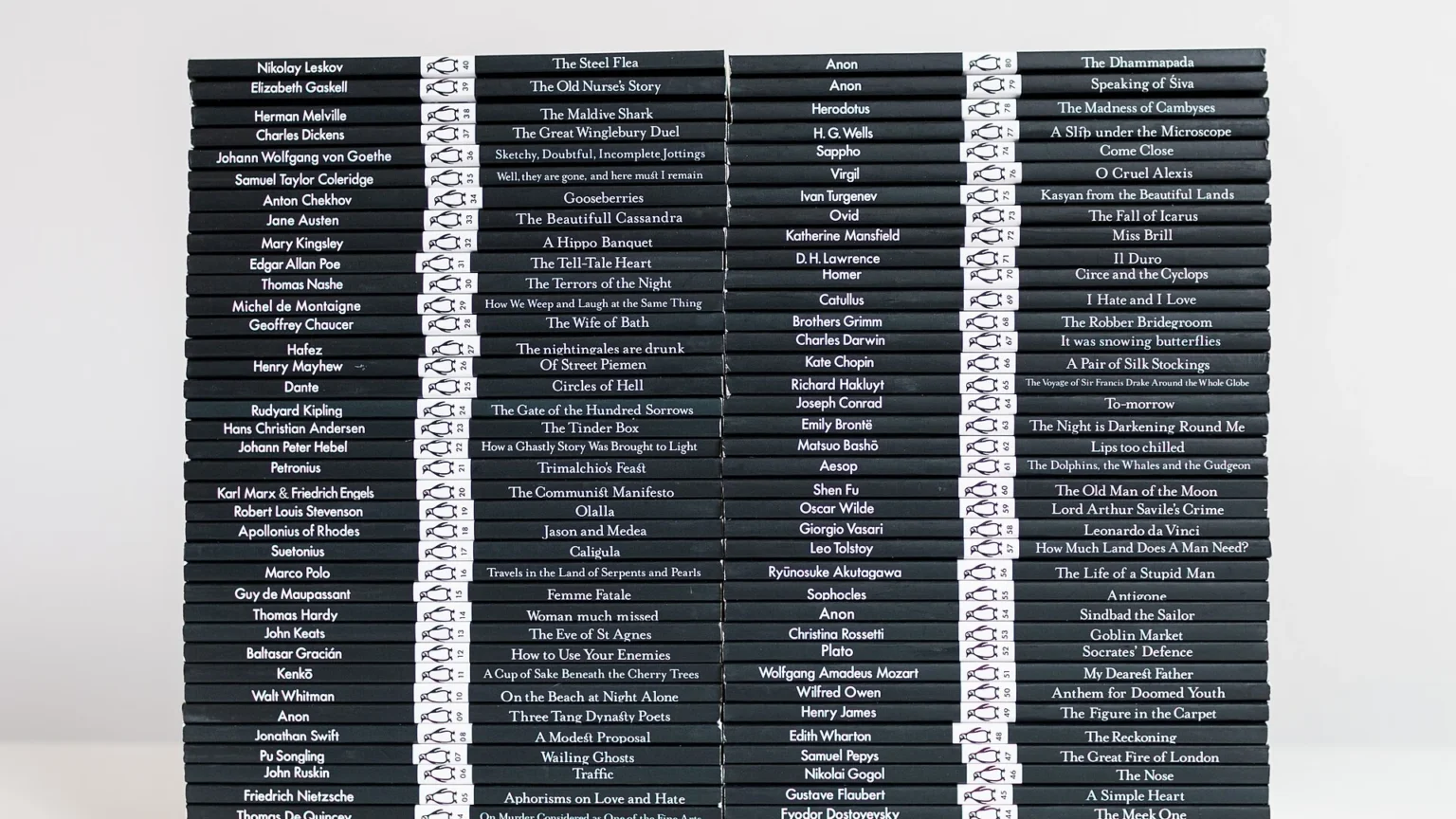
Penguin Little Black Classics look like a miniature canon, but their real achievement is sharper: they turn the Penguin Classics backlist into a shelf of one-sitting encounters. For readers asking where to start, the strongest volumes are complete short works or selections that survive the loss of notes and introductions. The series is brilliant at invitation, uneven as scholarship, and most useful as a route into larger editions rather than a substitute for them.
The Short Answer: Penguin Little Black Classics Where to Start
Start with A Modest Proposal, The Yellow Wall-Paper, The Life of a Stupid Man, Come Close, and How to Use Your Enemies. Together they show what the project does best: complete short works, strong inherited translations, surprising canonical side roads, and genuine one-sitting portability. Treat most volumes as gateways, not definitive scholarly editions; for citation, notes, or complete texts, move to the parent Penguin Classic or a fuller rival edition.
That distinction matters because the current Penguin series page presents 129 products, while Penguin’s own reader guide describes 128 books. The apparent mismatch is mostly cataloguing: the series page includes the boxed set alongside the numbered individual volumes. The numbered sequence itself runs to 128. A collector can therefore think of the project as 128 small books, with the original eighty also sold as a box.
The central editorial fact is simpler still. Little Black Classics is not a shrunken version of the full Penguin Classics programme. It is a sampling system. The parent list supplies texts and translations; the smaller series re-edits, extracts, retitles, sequences and packages them so that curiosity can become a purchase with almost no friction. That is a serious publishing achievement. It is also the source of nearly every limitation discussed below.
The Editorial Problem Penguin Little Black Classics Set Out to Solve
By 2015 Penguin Classics already possessed the authority, backlist and international range that a mass-market classics publisher could want. Its difficulty was not scarcity. It was entry. A black-spined five-hundred-page novel, an unfamiliar ancient text, or an anthology of Persian lyric could still ask a lot of a reader standing at a railway-station book table. Little Black Classics turned that hesitation into a different proposition: sixty-four pages, an arresting title, a pocketable format, and—at launch—an almost absurdly low price.
Nicholas Lezard’s contemporary Guardian review understood the bargain immediately: the original eighty were around sixty-four pages and cost 80p each. He also identified the trade-off. These were snippets and short works without the introductions, notes and contextual machinery that normally help a reader understand why a text matters. The little books lowered the threshold to literature by removing intellectual as well as financial weight.
The project’s implicit definition of access was therefore tactile and behavioural. A classic could be something you bought on impulse, finished on a commute, passed to a friend, or sampled before committing to a larger book. That emphasis distinguishes Little Black Classics from school editions and critical editions. It did not try to solve the problem of textual scholarship in miniature. It tried to solve the problem of beginning.
How the Project Took Shape
The series arrived on 26 February 2015 for Penguin Books’ eightieth birthday. Penguin’s later official retrospective describes the launch as eighty “bite-sized” works ranging across almost three millennia. The anniversary arithmetic was deliberately visible: eighty books for eighty years, initially priced at 80p. The device echoed Penguin’s longer habit of turning anniversaries into experiments in inexpensive reading, but the Little Black formula was unusually coherent because number, price, trim size and cover system all reinforced the same promise of low-risk discovery.
Success quickly changed the scale. Contemporary design coverage reported a 2016 expansion of forty-six titles and sales of more than two million copies, as well as a redesigned browsing site; see It’s Nice That’s account of the expansion. Penguin’s 2023 retrospective compresses the later growth into “another 48 titles” in 2016. Exact edition records complicate that shorthand: No. 127, The Constitution of the United States, is dated April 2017. The safest reconstruction is that the 2016 campaign brought a large second wave, with later additions completing the 128-volume numbered run.
The continuity lies less in editorship than in method. Individual texts were drawn from a vast pre-existing classics programme; translators and editors belong to those source editions, while the Little Black project’s own creative authorship is most visible in selection, titling, sequencing and design. That is why a reader should resist asking whether “the series translation” is good. There is no single Little Black translation policy comparable to a newly commissioned translation programme. There are many inherited translations, some superb, placed in a deliberately lighter editorial frame.
That lighter frame also explains the strange importance of titles. A conventional complete edition normally inherits the work’s established name; a selection can be marketed through one especially memorable phrase. How to Use Your Enemies, It was snowing butterflies, Only Dull People Are Brilliant at Breakfast and The Nightingales are Drunk behave almost like invitations written by an editor. They do not merely identify contents. They propose a mood, a voice and a reason to pick the object up. The series therefore exercises editorial power before page one: it chooses which fragment of a larger authorial identity will stand for the encounter.
The Volumes That Best Explain the Project
These ten volumes are not a ranking of the “best” authors in the set. They are diagnostic choices. Some show the format working almost perfectly; others reveal what happens when a translated, fragmentary or historically loaded text is stripped of apparatus. Together they explain why Penguin Little Black Classics can be an unusually intelligent first shelf and a poor substitute for a scholarly library.

Foundational Volume
A Modest Proposal: The format at its cleanest
Author: Jonathan Swift
Edition: Penguin Classics, 2015; No. 8; paperback; 64 pp.; ISBN 9780141398181.
Why it matters: Swift’s short satire is close to the ideal Little Black text: compact, complete enough to feel like a work rather than a teaser, and still shocking without typographical or editorial spectacle. It proves that smallness can be an editorial virtue rather than an abridgment strategy.
Main limitation: The absence of historical notes leaves the Anglo-Irish political economy and satirical targets largely to the reader.
Best suited to: A first purchase, classroom supplementation, or anyone testing whether the series suits them.

Reputation-Defining Volume
The Beautifull Cassandra: Canonical fame redirected
Author: Jane Austen
Edition: Penguin Classics, 2015; No. 33; paperback; 64 pp.; ISBN 9780141397078.
Why it matters: Instead of miniaturising Pride and Prejudice, Penguin foregrounded Austen’s riotous early writing. The choice demonstrates the project’s most interesting canon-making move: use a famous name to circulate less familiar work and let a tiny book correct the public image of an author.
Main limitation: The juvenilia are selections from a larger manuscript world, and the book gives little help with chronology or textual context.
Best suited to: Readers who think they already know Austen.

Editorial Packaging Benchmark
How to Use Your Enemies: A title designed to tempt
Author: Baltasar Gracián
Translator: Jeremy Robbins
Edition: Penguin Classics, 2015; No. 12; paperback; 64 pp.; ISBN 9780141398273.
Why it matters: Gracián’s compressed worldly maxims fit the physical form, while the title turns seventeenth-century prudential thought into a modern browsing provocation. It shows how Little Black Classics creates new reading occasions through selection and naming.
Main limitation: The fragmentary presentation can flatten the Jesuit, courtly and rhetorical contexts that make Gracián stranger than a modern self-help writer.
Best suited to: Readers drawn to aphorism, political psychology and intellectual history.

Canon-Expanding Volume
The Nightingales are Drunk: Persian lyric in pocket form
Author: Hafez
Translator: Dick Davis
Edition: Penguin Classics, 2015; No. 27; paperback; 64 pp.; ISBN 9780141980263.
Why it matters: Davis’s Hafez gives the launch list a genuine Persian poetic presence and tests the project’s claim to range beyond Europe. Lyric selection suits the short form especially well: the reader can encounter a sequence rather than a mutilated long work.
Main limitation: Translation is the work here, yet the current Penguin product page does not foreground Davis in the title line; the larger anthology gives the translation context more clearly.
Best suited to: Poetry readers wanting a first encounter before moving to Faces of Love.
Recovery Volume
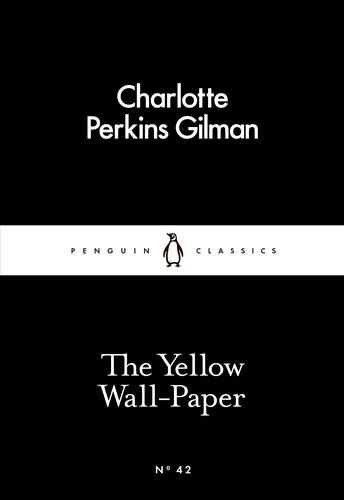
The Yellow Wall-Paper: A short classic that needs context
Author: Charlotte Perkins Gilman
Edition: Penguin, 2015; No. 42; paperback; 64 pp.; ISBN 9780141397436.
Why it matters: The story’s scale makes the series feel generous rather than extractive, and its recovery history exemplifies a modern canon in which feminist writing can move from specialist discussion to ubiquitous classroom reading.
Main limitation: A text so bound to the history of the “rest cure,” gendered medicine and nineteenth-century domestic ideology benefits greatly from notes and contextual documents that this edition does not provide.
Best suited to: General reading or a course that supplies its own historical apparatus.
Exemplary Translation
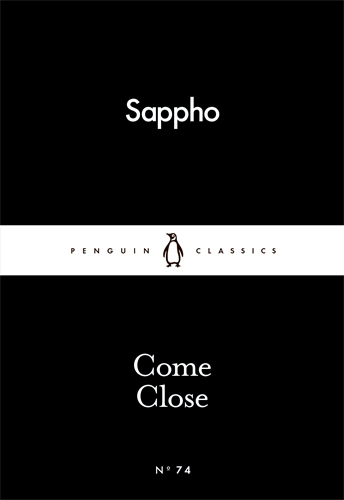
Come Close: Fragment and format in productive tension
Author: Sappho
Translator: Aaron Poochigian
Edition: Penguin Classics, 2015; No. 74; paperback; 64 pp.; ISBN 9780141398693.
Why it matters: Sappho’s surviving lyric fragments expose an unexpected strength of the mini format: incompleteness belongs to the textual tradition itself, not merely to Penguin’s cutting. Poochigian’s English gives the reader a coherent poetic encounter in very little space.
Main limitation: Fragment numbering, papyrological context and alternative translation choices matter enormously in Sappho; a full scholarly edition makes those decisions visible.
Best suited to: First-time poetry readers who will later compare translations.

Strong Teaching Edition
The Meek One: Dostoyevsky without the doorstop
Author: Fyodor Dostoyevsky
Translator: Ronald Meyer
Edition: Penguin Classics, 2015; No. 44; paperback; 64 pp.; ISBN 9780141397481.
Why it matters: The novella gives readers Dostoyevsky’s unstable first-person psychology without asking them to begin with a major novel. It is exactly the kind of lateral entry point the series was built to create.
Main limitation: The work’s publication context and the alternative English title A Gentle Creature matter when comparing criticism and translations, but the mini edition offers little guidance.
Best suited to: Seminars, reading groups and readers intimidated by the novels.

Neglected Strength
The Life of a Stupid Man: A better gateway than the obvious masterpiece
Author: Ryūnosuke Akutagawa
Translator: Jay Rubin
Edition: Penguin Classics, 2015; No. 56; paperback; 64 pp.; ISBN 9780141397726.
Why it matters: Rubin’s compact selection opens onto Japanese modernism through autobiographical and fragmentary prose rather than simply reproducing the most internationally famous story. The volume embodies the series’ capacity to make a side door more inviting than the front entrance.
Main limitation: The relation of these pieces to Akutagawa’s larger career is difficult to reconstruct without the parent collection.
Best suited to: Readers beginning modern Japanese literature.

Revealing Limitation
The Dhammapada: When invisible mediation matters
Author: Anonymous / traditional Buddhist text
Translator: Juan Mascaró
Edition: Penguin Classics, 2015; No. 80; paperback; 64 pp.; ISBN 9780141398815.
Why it matters: The aphoristic form fits the pocket format beautifully, but this is also the clearest warning against confusing elegant presentation with transparent textual history. Library records for this ISBN identify Mascaró’s translation, while Penguin’s current Little Black product page does not name him.
Main limitation: For a translated religious text, source language, translator and interpretive tradition are not secondary metadata; they shape meaning.
Best suited to: Reflective reading, followed by a translation-aware edition for study.
Current-Direction Volume
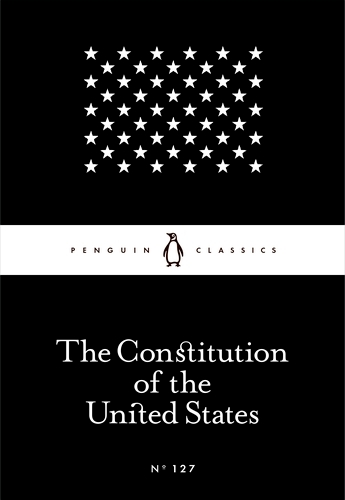
The Constitution of the United States: “Classic” becomes document
Author: Founding Fathers
Edition: Penguin Classics, 2017; No. 127; paperback; 64 pp.; ISBN 9780241318492.
Why it matters: One of the late-numbered additions makes the series’ definition of a classic explicit: literary form is not required. Political consequence, historical durability and continuing public argument can be enough.
Main limitation: A constitutional text without substantial historical notes, amendments context or legal interpretation is a primary document, not a civics handbook.
Best suited to: Readers who want the document itself before turning to constitutional history or case law.
The Series at a Glance
What the Catalogue Calls a Classic
The catalogue’s most revealing choice is not any single author but the permission it gives itself to treat many kinds of writing as equally eligible for the black cover. Poems, stories, letters, travel writing, manifestos, philosophy, sacred texts, speeches and political documents all enter the same physical grammar. The result is a canon of encounters rather than a canon of complete masterpieces. A classic, here, is something durable enough to survive extraction and vivid enough to justify sixty-four pages.
That principle widens the field. Hafez and Sappho can sit beside Swift; Akutagawa beside Austen; the Dhammapada beside a political constitution. It also allows Penguin to recover secondary or youthful work by famous authors instead of repeatedly repackaging the same novels. The Beautifull Cassandra is more interesting in this context than another abridged Austen would have been because it changes what “Austen” means at the point of purchase.
The numbering system strengthens that effect. Numbers convert heterogeneous texts into neighbours, making collection itself a form of comparative reading. No. 27 Hafez and No. 28 Chaucer are not being ranked, and their proximity does not imply historical connection; it creates a browsing sequence in which the reader can move across languages and centuries without passing through the disciplinary shelves that normally separate poetry, philosophy, religion and documentary history. This is canon formation by adjacency. Its intellectual virtue is serendipity; its risk is that historical differences become decorative variety.
Yet breadth should not be mistaken for balance. The original list remained heavily rooted in the European and anglophone inheritance, with the nineteenth century especially visible. Non-European traditions often appear through a small number of already internationally legible figures or anthological selections. The series does expand the ordinary high-street canon; it does not dissolve its structural asymmetries. Its achievement is breadth of invitation, not equal depth across languages and regions.
Translation and Textual Policy
The strongest translated volumes are strong because the underlying Penguin Classics translations are strong. Aaron Poochigian on Sappho, Jay Rubin on Akutagawa, Ronald Meyer on Dostoyevsky and Dick Davis on Hafez represent distinct scholarly and literary decisions made before their work was miniaturised. Little Black Classics does not erase those decisions from the text, but it can make them less visible by stripping away introductions, notes, bibliographies and sometimes prominent translator credit.
The Mascaró Dhammapada makes the point unusually clearly. The current Little Black product page gives the ISBN, date and series membership without naming a translator, while the ISBN-specific Open Library record identifies Juan Mascaró and matches the 2015 Penguin edition. For casual reading this may feel minor. For Buddhist scripture it is not. Translation is interpretation, and the identity and era of the translator belong to the intellectual identity of the book.
Citation therefore requires discrimination. If a seminar is analysing the wording of a Little Black volume, cite that exact edition. If the purpose is textual history, translation comparison, sustained literary criticism or source-language scholarship, the miniature is rarely the best default. Move to the full Penguin parent edition or a critical competitor where the source text, translator’s method and editorial interventions are stated more fully. The black cover is a reading invitation, not a certificate of textual finality.
Introductions, Notes, and Scholarly Apparatus
Minimal mediation is not an accidental omission; it is the reading experience the series sells. The books generally refuse the long prefatory essay, chronology, explanatory note system and bibliography associated with fuller trade classics. That keeps the page clean and the commitment small. It also changes the implied reader from “someone who wants an edition” to “someone who wants an encounter.”
The policy works best when the text is formally self-sufficient. Swift’s satire can generate its own shock. A cluster of Hafez lyrics or Sappho fragments can be read as poetry before the reader understands every historical convention. It works less well when background is part of comprehension: Gilman’s medical context, Gracián’s courtly ethics, constitutional history, or the textual transmission of an ancient work. Teachers can compensate because a syllabus supplies the missing frame. Independent students cannot assume the mini book will do that work for them.
Design, Format, and the Material Idea of the Book
The covers are the most consistent argument the series makes. Art director Jim Stoddart’s portfolio identifies his series art direction and design: black field, white central band, restrained type, Penguin mark, number. The system makes radically unlike texts look collectible without pretending that their contents are alike.
The heritage reference is exact rather than nostalgic decoration. In Design Week’s pre-launch account, Stoddart explained the widened white panel and centred typography as a nod to Penguin’s original tri-band covers of the 1930s and 1940s. The tiny books turn corporate memory into a reading cue: Penguin has done cheap, serious paperbacks before, so this new object asks to be trusted as part of that lineage.
Most of the launch paperbacks are roughly 160 by 110 millimetres and sixty-four pages. At that size, portability is real rather than metaphorical. The design supports quick ownership and serial collecting, though the narrow measure and modest production are not intended to rival a durable library hardback. More important is the epistemic effect of uniformity: the covers flatten differences in genre, translation history and textual status. That is beautiful on a shelf and dangerous if the reader mistakes visual equality for bibliographical equality.
Price, Availability, and Academic Use
The original 80p price was part of the editorial concept, not simply a launch discount: it made experimentation almost frictionless. In September 2026 the sampled Penguin UK product pages for many 2015 and 2017 paperbacks list £4, while The Yellow Wall-Paper is currently listed at £1.99 on its Little Black product page. That means the series remains inexpensive in absolute terms, but the revolutionary gap between “sample” and “full paperback” has narrowed.
Availability is still strong enough to make the project function as a backlist rather than a vanished anniversary stunt. Penguin maintains an active series page, individual product records and the first-eighty box set. What has faded is the sense that every new reader can build the whole shelf casually. At £4 each, collecting 128 titles is a deliberate hobby; the original 80p economics encouraged indiscriminate sampling.
For value, then, buy selectively rather than numerically. A complete novella or short story at £4 can still be an attractive reading copy; a brief extract from a work you already intend to read in full may be poor economy. The box set has a different logic: it preserves the original first-eighty conception as a designed object and makes sense for collectors who value the sequence itself. Readers pursuing one author, translation or course text should compare the parent edition before treating the miniature as the cheaper choice.
Academically, the books are best thought of as primary-text handouts with excellent branding. They can be useful in undergraduate classes when the instructor supplies context, and they are superb for assigning one short work without making students buy a large anthology. Researchers should not cite them by default when a fuller edition documents translation, copy-text, variants or editorial intervention. Collectors, meanwhile, receive something different: a visually disciplined record of Penguin’s own canon-making at a particular moment.
How It Compares with Its Closest Rivals
The closest rival depends on what problem you are trying to solve. Full Penguin Classics is the obvious next step when a Little Black volume has done its job: you want the rest of the work, the translator’s context, an introduction and notes. Within Penguin itself, Penguin Great Ideas is more conceptually focused. Its ninety-four-title list gathers thinkers, radicals and political or philosophical writing around the history of ideas; it is the better mini-series when argument matters more than genre variety.
For academic support, Oxford World’s Classics is a more meaningful competitor than another design-led pocket series. Oxford explicitly foregrounds critical introductions, comprehensive notes, expert translations, chronologies and bibliographies. That apparatus can be excessive for a commuter who wants one Chekhov story; it is precisely what a student of textual or historical questions may require.
The most revealing successor is Penguin’s own 2025 Penguin Archive collection: ninety short books for the publisher’s ninetieth birthday, again curated from its history and again art-directed by Stoddart, now with red-foil visual identities. Archive confirms that the Little Black experiment was not a one-off curiosity. Penguin learned that a compact, anniversary-driven, design-coherent library can make the backlist feel newly browsable.
Limitations and Contradictions
The first contradiction is that a project built to celebrate the diversity of Penguin Classics depends on radical standardisation. The cover system creates equality of attention; the editorial content is much less equal. A complete short story, a handful of poems, a translated sacred text and an excerpt from a longer philosophical work can all look like equivalent sixty-four-page units. They are not equivalent bibliographical objects.
The second is that global range can be genuine and still structurally shallow. Hafez, Sappho, Akutagawa and the Dhammapada widen a British reader’s field, but a few portable representatives cannot provide the density that European traditions receive across the wider Penguin list. The mini-series is best judged as an invitation to move outward, not evidence that the canon has been fully decolonised or balanced.
The third is economic. The original price made incompleteness easy to forgive because the book cost less than many magazines. At £4, readers have more reason to ask what they are buying. A sixty-four-page excerpt can still be worth the price when the selection is intelligent, but the value proposition is no longer automatically overwhelming. The strongest volumes are those where brevity belongs to the work itself.
Finally, the series’ prestige can work against its own experimental spirit. Once the numbered black spines become collectibles, readers may buy for completion rather than reading. That is not a publishing failure—collectability helped the system travel—but it reverses the original logic. A shelf built to make classics less intimidating can become another canon to complete.
Related BookInLight Reading Guides
Editorial research and authorship: This article was researched and written by the BookInLight Department of Publishing History and Book Studies, with bibliographical review, edition checking, source verification, and editorial fact-checking by the BookInLight research team. Readers who identify a factual correction, an overlooked source, a missing volume, a valuable interpretive possibility, or another constructive idea are warmly invited to share their comments and suggestions.
Art direction and rights: The editorial art direction, visual composition, cover selection, and presentation of images were developed by the BookInLight Art Department. Individual book covers remain the property of their respective publishers, designers, artists, and rights holders and are credited below. Complete republication, reproduction, translation, or reuse of this article, whether in print or digital form, is permitted only with prior written authorization from BookInLight.
Sources and Further Reading
Series History and Editorial Mission
Penguin Classics. Penguin Little Black Classics series page. Current catalogue count, product sequence and box-set description.
John Self. “Where to start reading the Penguin Little Black Classics,” Penguin, 28 March 2023. Launch date, anniversary rationale, retrospective count and official framing.
Nicholas Lezard. “Penguin Little Black Classics review – affordable snippets of great literature,” The Guardian, 24 February 2015. Contemporary assessment of price, size, selection and absent apparatus.
Alexander Hawkins. “Penguin redesigns Little Black Classics website and adds 46 titles to the collection,” It’s Nice That, 8 March 2016. Expansion chronology, web redesign and early sales context.
Design and Material Production
Jim Stoddart. Little Black Classics portfolio. Series art direction and design credit; original eighty-book/80p presentation.
Tom Banks. “Penguin’s Little Black Classics,” Design Week, 15 October 2014. Pre-launch format, 64-page concept, pricing and Stoddart’s tri-band design rationale.
Defining Volumes and Edition Records
Penguin Classics. A Modest Proposal, ISBN 9780141398181. Publication date, page count, dimensions and current UK list price.
Penguin Classics. The Beautifull Cassandra, ISBN 9780141397078. Exact-edition metadata.
Penguin Classics. How to Use Your Enemies, ISBN 9780141398273. Exact edition and Jeremy Robbins translator credit.
Penguin Classics. The Nightingales are Drunk, ISBN 9780141980263. Exact edition, series membership and physical metadata.
Penguin. The Yellow Wall-Paper, ISBN 9780141397436. Exact edition, current format and list price.
Penguin Classics. Come Close, ISBN 9780141398693. Exact edition and Aaron Poochigian translator credit.
Penguin Classics. The Meek One, ISBN 9780141397481. Exact edition and Ronald Meyer translator credit.
Penguin Classics. The Life of a Stupid Man, ISBN 9780141397726. Exact edition and Jay Rubin translator credit.
Penguin Classics. The Dhammapada, ISBN 9780141398815. Exact Little Black edition, publication data and current Penguin product metadata.
Open Library. Dhammapada, ISBN 9780141398815. ISBN-specific record identifying Juan Mascaró with the 2015 Penguin edition.
Penguin Classics. The Constitution of the United States, ISBN 9780241318492. 2017 publication date, No. 127 context and exact edition metadata.
Competitor Series and Current Context
Penguin Classics. Penguin Great Ideas. Current series count and stated ideas-focused mission.
Penguin Classics. “Where to start reading the Penguin Archive collection,” 21 August 2025. Ninety-title anniversary successor, editorial rationale and Stoddart’s design role.
Oxford University Press. Oxford World’s Classics. Series scale and explicit provision of introductions, notes, translations, chronologies and bibliographies.
Image Credits
A Modest Proposal, Penguin Classics Little Black Classics paperback, 2015. Cover image: Penguin Classics. Authoritative edition page.
The Beautifull Cassandra, Penguin Classics Little Black Classics paperback, 2015. Cover image: Penguin Classics. Authoritative edition page.
How to Use Your Enemies, Penguin Classics Little Black Classics paperback, 2015. Cover image: Penguin Classics. Authoritative edition page.
The Nightingales are Drunk, Penguin Classics Little Black Classics paperback, 2015. Cover image: Penguin Classics. Authoritative edition page.
The Yellow Wall-Paper, Penguin Little Black Classics paperback, 2015. Cover image: Penguin. Authoritative edition page.
Come Close, Penguin Classics Little Black Classics paperback, 2015. Cover image: Penguin Classics. Authoritative edition page.
The Meek One, Penguin Classics Little Black Classics paperback, 2015. Cover image: Penguin Classics. Authoritative edition page.
The Life of a Stupid Man, Penguin Classics Little Black Classics paperback, 2015. Cover image: Penguin Classics. Authoritative edition page.
The Dhammapada, Penguin Classics Little Black Classics paperback, 2015. Cover image: Penguin Classics. Authoritative edition page.
The Constitution of the United States, Penguin Classics Little Black Classics paperback, 2017. Cover image: Penguin Classics. Authoritative edition page.
Image credit: Stefan Schäfer, Lich — Source: Wikimedia Commons — License: CC BY-SA 4.0