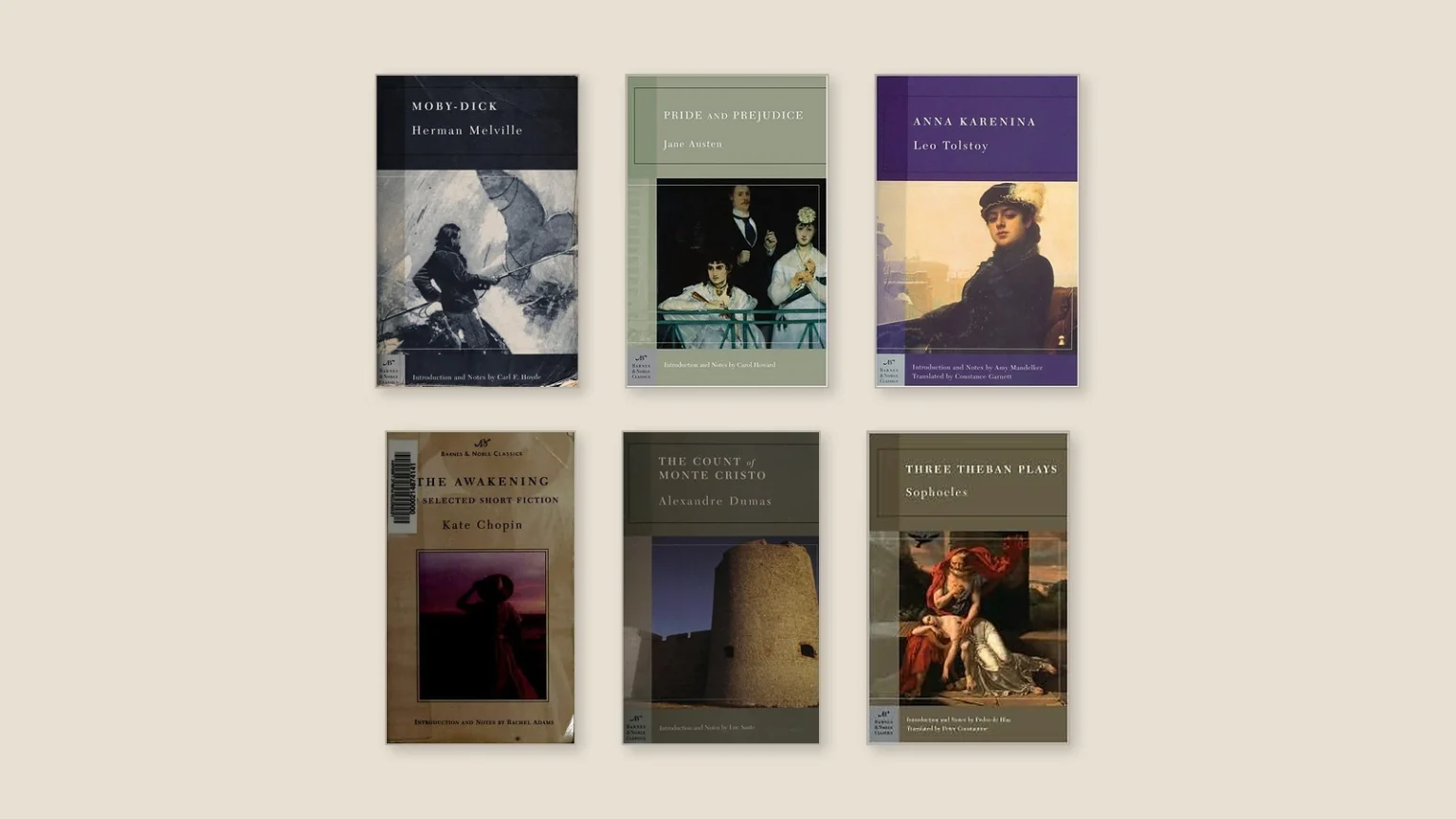
A Barnes & Noble Classics review has to separate the coherent cover system from the books inside it. Launched in 2003 to put inexpensive, annotated classics before students and general readers, the series remains one of the cheapest routes into the canon. Its best volumes are intelligent teaching companions; its weakest recycle dated translations, conceal their textual basis, or abridge the work. The series mark is a useful invitation, never a guarantee.
The Short Answer
Barnes & Noble Classics is best used as a low-cost reading and teaching series, not as an automatic mark of textual authority. Choose it when a volume has a strong specialist introduction, serviceable notes, and a complete or clearly identified text. Choose Penguin, Oxford, Norton, or a critical edition when translation, variants, primary documents, or citation reliability matter.
The series’ real contribution was practical. It placed recognizable, contextualized classics in a national bookselling network at prices close to bare reprints, while adding introductions, chronologies, explanatory notes, study questions, and further reading. That package can turn a cheap copy into a genuinely usable first edition for independent study. The strongest volumes—especially Moby-Dick, Adventures of Huckleberry Finn, and Narrative of the Life of Frederick Douglass—show how much intellectual value a carefully chosen introducer can add without making the book intimidating.
The consequential limitation is inconsistency. Barnes & Noble Classics does not disclose a single, durable series-wide policy governing copy-texts, translation commissioning, revision, abridgment, or textual variants. Some books present newly commissioned translation work; others reuse public-domain English versions whose assumptions belong to another century. A sound Barnes & Noble Classics review therefore cannot grade the brand once and apply the result to every spine. The correct unit of judgment is the exact ISBN: work, translator or source text, editor, apparatus, date, and completeness.
The Editorial Problem Barnes & Noble Classics Set Out to Solve
The line entered a crowded American classics market in spring 2003. Penguin Classics, Oxford World’s Classics, and Modern Library already offered distinct combinations of scholarship, translation, prestige, and design. Barnes & Noble possessed something they did not: hundreds of its own retail locations, college stores, front-of-store display, direct customer data, and an online shop capable of privileging an in-house series. Publishers Weekly reported in October 2003 that forty titles had appeared since May, priced from $3.95 to $8.95 and distributed to the trade by Sterling Publishing.
The problem, as Barnes & Noble defined it, was not that canonical texts were unavailable. Most of the early works were abundant and out of copyright. The problem was that the cheapest copies often supplied little beyond the text, while better-framed student editions cost more and competed for limited shelf space. Barnes & Noble’s answer was a standardized intermediate form: a low-priced paperback with a newly commissioned introduction, author biography, chronology, notes, reception or adaptation material, questions, and bibliography. Its longstanding publisher description still presents the books as “quality editions at affordable prices” for students and general readers and lists this recurring apparatus across individual product pages.
Behind that reader-friendly formula sat a more controversial commercial solution: vertical integration. The retailer could publish the edition, distribute it, place it prominently, and retain a larger portion of the sale. Rival publishers feared that a bookseller’s house line might displace their own editions. The series was thus born from two ambitions that should not be confused. One was democratic and editorial—make contextualized classics cheap. The other was strategic—turn retail power into a proprietary publishing advantage. The books are best understood where those ambitions overlap.
How the Project Took Shape
The contemporary trade record identifies Alan Kahn as president of Barnes & Noble’s publishing group and describes Michael Millman as a central executive editor associated with the launch. The early books also reveal a distributed editorial model: specialist introducers and annotators were commissioned title by title, while George Stade appears as consulting editorial director on many copyright pages. There was no publicly visible equivalent of a single general editor imposing one philological method across the list. That distinction matters. The series was centralized in concept, design, pricing, and ancillary features, but decentralized in the scholarly labor that determined the value of each volume.
Expansion was rapid. A January 2004 Publishers Weekly account of Barnes & Noble’s vertical-integration strategy counted sixty-three titles in print less than a year after launch. Speed helped establish shelf presence, but it also encouraged a production logic based on public-domain works and reusable texts. The series could spend selectively on introductions, notes, resetting, and design while avoiding royalties on many primary texts. That economic architecture explains both its value and its unevenness more convincingly than any abstract claim about editorial standards.
The early catalogue concentrated on works already secure in American school and college culture: Austen, Dickens, Melville, Twain, Tolstoy, Dumas, Brontë, Shakespeare, Greek tragedy, autobiography, and political prose. Later additions widened genres and brought in stronger specialists, but the basic model remained stable. What changed more noticeably was the market around it. Penguin and Oxford refreshed texts and translations; Norton sharpened its division between approachable Norton Library books and document-rich Critical Editions; free digital texts improved; and Barnes & Noble increasingly promoted collectible hardbacks and gift formats. The Classics paperbacks survive as a recognizable backlist, yet current listings look less like a visibly expanding intellectual program than an unevenly stocked legacy catalogue. Continuity of branding should not be mistaken for continuous editorial renewal.
The Volumes That Best Explain the Project
These eight books are not a ranking of the most famous titles in the catalogue. They were selected because together they expose the series’ editorial mechanism: strong commissioned scholarship around a public-domain text, the reuse of an inherited translation, a genuinely new translation, canon recovery, a contested classroom classic, and an abridgment whose very convenience reveals the limit of the bargain model.

Strongest Scholarly Apparatus
Moby-Dick: A Bargain Edition That Actually Helps
Author: Herman Melville
Editor: Introduction and notes by Carl F. Hovde
Edition: Barnes & Noble Classics paperback, 2003; ISBN 9781593080181; 752 pages
Why it matters: Hovde’s framing, key Melville letters, and the unusually substantial dictionary of sea terms address the practical obstacles that defeat first-time readers. The book exemplifies the series at its best: it preserves the novel’s scale while adding aids that are concrete, proportionate, and immediately useful.
Main limitation: The notes are explanatory rather than a critical apparatus; the volume does not provide the textual history, variants, or documentary breadth of a Norton Critical Edition.
Best suited to: Independent readers, survey courses, and book groups wanting a complete, inexpensive reading copy with unusually good navigational help.
Strong Teaching Edition
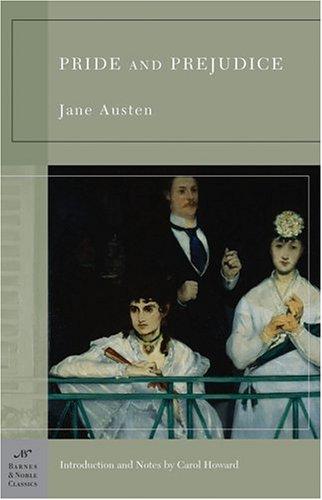
Pride and Prejudice: Context Without Classroom Bulk
Author: Jane Austen
Editor: Introduction by Carol Howard; consulting editorial direction credited to George Stade
Edition: Barnes & Noble Classics trade paperback, 2004; ISBN 9781593082017; 368 pages
Why it matters: Howard’s introduction and the standard chronology, notes, questions, and bibliography make the social machinery of entail, rank, property, and courtship accessible without turning the novel into a dossier. It is exactly the sort of dependable survey-course edition the series was designed to produce.
Main limitation: In a field crowded with excellent Austen editions, this one has no distinctive claim to textual authority and offers less sustained annotation than Oxford or Norton alternatives.
Best suited to: First readings, high-school and introductory undergraduate classes, and readers who want historical orientation at minimal cost.
Competitor-Comparison Volume
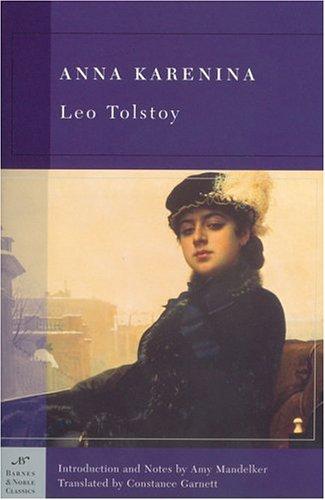
Anna Karenina: Excellent Framing Around an Inherited Translation
Author: Leo Tolstoy
Translator and editor: Constance Garnett; introduction and notes by Amy Mandelker
Edition: Barnes & Noble Classics paperback, 2003; ISBN 9781593080273
Why it matters: Mandelker is a major Tolstoy scholar, and her apparatus makes the volume much more than a naked public-domain reprint. Yet the combination also reveals the series’ characteristic method: invest in current interpretation while economizing through an older translation.
Main limitation: Garnett’s historically important English is not a neutral default. Readers comparing Tolstoy’s repetitions, registers, and syntactic pressure should examine modern versions by Rosamund Bartlett, Marian Schwartz, or Richard Pevear and Larissa Volokhonsky.
Best suited to: Budget readers comfortable with Garnett and students studying the English reception of Russian fiction; not the strongest first choice for translation-conscious reading.

Recovery Volume
The Awakening and Selected Short Fiction: A Canon in Miniature
Author: Kate Chopin
Editor: Introduction by Rachel Adams
Edition: Barnes & Noble Classics paperback, first printing 2003; ISBN 9781593080013; 336 pages
Why it matters: Pairing the novel with thirteen stories lets readers see Chopin beyond one recovered feminist classic. Adams’s introduction and the selection create a compact author portrait, while the reception and discussion materials register how institutional reading helped move Chopin from marginality into the syllabus.
Main limitation: It is a selective reading edition, not a documentary or variorum one. Later Barnes & Noble reissues circulate under different pagination, so buyers should verify the ISBN rather than trust the title alone.
Best suited to: Courses on American realism, women’s writing, short fiction, and canon recovery.

Revealing Limitation
The Count of Monte Cristo: When Portability Becomes Subtraction
Author: Alexandre Dumas
Translator and editor: Anonymous nineteenth-century translation; introduction and notes by Luc Sante
Edition: Abridged Barnes & Noble Classics paperback, 2004; ISBN 9781593081515; 608 pages
Why it matters: Sante’s introduction is lively and the compact volume lowers the intimidation threshold. More importantly, the book makes the series’ commercial compromise visible: a famous long novel is made affordable and portable by removing material, while the familiar title can distract buyers from the abridgment notice.
Main limitation: It is not the complete novel. Plot architecture, pacing, secondary characters, and Dumas’s serial expansiveness are part of the work, not disposable bulk.
Best suited to: Readers who consciously want a shortened first encounter; unsuitable for citation, comparative study, or anyone intending to read Dumas in full.

Exemplary Translation
Three Theban Plays: Proof the Series Could Commission Anew
Author: Sophocles
Translator and editor: Translation by Peter Constantine; introduction and notes by Pedro de Blas
Edition: Barnes & Noble Classics paperback, 2008; ISBN 9781593082352
Why it matters: This volume interrupts the assumption that Barnes & Noble Classics merely wrapped old translations in new covers. Constantine’s commissioned English and de Blas’s apparatus show a more ambitious model: translator visibility, readable dramatic language, and contextual guidance designed as one edition.
Main limitation: There is no facing Greek text or full discussion of textual variants, and a modern translation remains one interpretation among competing approaches to meter, ritual language, and tragic diction.
Best suited to: General readers and introductory drama or classics courses that want a modern English text without specialist apparatus.

Contested-Canon Teaching Edition
Adventures of Huckleberry Finn: The Introduction Changes the Book’s Use
Author: Mark Twain
Editor: Introduction and notes by Robert G. O’Meally
Edition: Barnes & Noble Classics trade paperback, 2008; ISBN 9781593081126; 336 pages
Why it matters: O’Meally’s framing places race, vernacular, minstrelsy, moral evasion, and the novel’s disputed status at the center rather than treating them as classroom complications to be managed later. The volume shows how commissioning the right scholar can alter the ethical adequacy of a cheap edition.
Main limitation: Its compact notes cannot replace the documentary record, textual history, and broad criticism available in specialist editions; instructors still need supplementary scholarship.
Best suited to: Guided first readings, American literature surveys, and readers who want an intellectually responsible introduction before entering the controversy.

Canon-Expanding Volume
Narrative of the Life of Frederick Douglass: Access With Necessary Historical Pressure
Author: Frederick Douglass
Editor: Introduction and notes by Robert G. O’Meally
Edition: Barnes & Noble Classics paperback, 2003; ISBN 9781593080419
Why it matters: Douglass complicates any description of the series as only a shelf of European novels. O’Meally connects rhetoric, literacy, enslavement, abolition, and American self-making, allowing a very inexpensive book to function as an entry into literary form and political history at once.
Main limitation: The slim volume cannot supply the speeches, letters, abolitionist documents, reception history, or editorial debate that a documentary classroom edition can assemble.
Best suited to: General readers, American history and literature surveys, and low-cost course adoption where the instructor can provide additional primary documents.
The Series at a Glance
What the Catalogue Calls a Classic
The catalogue’s operative definition of a classic is conservative but not wholly static: a work is durable, teachable, legally and commercially reproducible, and recognizable enough to earn shelf space under a house design. The early list leaned heavily toward nineteenth-century Anglophone and European fiction because those books sat at the intersection of public-domain economics and established curriculum. Austen, Dickens, Brontë, Melville, Twain, Tolstoy, Dumas, and Dostoevsky were not only canonical; they were reliably searchable, assignable, giftable, and free of primary-text royalties.
That economic base does not invalidate the series, but it does shape its canon more forcefully than the rhetoric of universal literary endurance suggests. A public-domain classics line can expand most easily into older works for which a usable English text already exists. It has more difficulty incorporating twentieth-century writing, contemporary translation, traditions without an inexpensive English version, and works requiring costly permissions or specialist editorial construction. The apparent neutrality of “the classics” therefore conceals a production filter.
Within that filter, the series has made meaningful choices. Chopin is presented through a novel and short fiction rather than one isolated syllabus item. Douglass appears as a literary and political author, not merely a historical witness. Greek drama receives a fresh translation in Three Theban Plays. Volumes of African American writing, women’s writing, political thought, travel, autobiography, and children’s literature complicate the idea that the list is only a Victorian-novel shelf. Yet isolated expansions do not amount to a globally balanced library. Compared with the current breadth claimed and demonstrated by Penguin Classics or Oxford World’s Classics, Barnes & Noble Classics remains structurally Euro-American and strongest where American curricula were already strongest.
Translation and Textual Policy
There is no responsible way to assign one translation score to the series. Anna Karenina reuses Constance Garnett and surrounds her with Amy Mandelker’s current scholarship. Three Theban Plays commissions Peter Constantine. Other translated titles similarly move among inherited public-domain versions, lightly revised texts, and named modern translators. This plurality is not intrinsically defective; large classics lists often evolve through several editorial regimes. The problem is that Barnes & Noble Classics does not make the plurality legible through an easily found series-wide statement explaining when a translation is new, revised, restored, or simply reprinted.
The same caution applies to English-language works. Reset type and a clean page do not establish a copy-text. Most general readers do not need a formal account of every emendation, but scholars and careful students need to know whether spelling has been modernized, which lifetime edition underlies the text, whether disputed passages are included, and whether an abridgment has altered the work. The Count of Monte Cristo makes the danger unusually plain because the shortened status can be confirmed. Less visible textual decisions require inspection of the copyright page and editorial note.
Can the books be cited? Yes, in the ordinary sense that any identified edition can be quoted with exact publication data and page number. That does not make each one the field’s preferred scholarly text. For an undergraduate paper, an assigned Barnes & Noble edition may be entirely proper. For work on translation, variants, composition, or publication history, it is usually the wrong tool. The rule is simple: cite the series when the assignment concerns the reading edition; choose a critical or discipline-standard edition when the argument depends on textual authority.
Introductions, Notes, and Scholarly Apparatus
The apparatus is the series’ most consistent source of added value. The recurring menu—author biography, historical chronology, introduction, endnotes or footnotes, reception and adaptation material, comments and questions, further reading—gives the reader several ways into a difficult book. It is especially effective for solitary readers who do not have a teacher nearby. A chronology situates political and biographical events; short notes remove lexical or historical obstacles; a bibliography offers an exit into deeper study. These are modest interventions, but modest interventions are often what keep a novice reading.
Quality depends heavily on the commissioned scholar. Hovde’s sea-term dictionary in Moby-Dick solves a recurring practical problem. O’Meally’s introductions to Twain and Douglass change the ethical and historical frame within which the texts are read. Mandelker gives Anna Karenina interpretive authority that its inherited translation alone would not possess. Such volumes justify the claim that the series added “new scholarship.” Others offer competent but thinner orientation, and some bibliographies now reflect the early 2000s rather than the scholarship a student should consult in 2026.
The apparatus is also deliberately non-critical in the technical sense. It rarely supplies a large archive of contemporary reviews, legal documents, letters, variant passages, scholarly debates, or competing interpretations. That restraint keeps the books short and cheap. It also explains when Norton Critical Editions become preferable: not because every reader needs more pages, but because some courses are built around contexts and criticism rather than a single introductory essay. Barnes & Noble Classics provides a guided doorway. Norton more often supplies the seminar room behind it.
Design, Format, and the Material Idea of the Book
The original paperbacks established a strong family resemblance without forcing every title into an identical color. Muted fields, inset art or photography, fine rules, restrained serif typography, and a small series mark give the books an academic-trade seriousness. The design communicates that these are reading editions, not luxury objects. It also performs a subtle institutional function: a shelf of heterogeneous authors begins to look like one organized library.
That visual coherence can overstate editorial coherence. Two books that look like siblings may contain radically different kinds of textual labor: a newly translated Greek tragedy and a reprinted nineteenth-century Russian translation; a complete American novel and a heavily abridged French one. The house style is therefore both a virtue and a warning. It reduces intimidation, helps recognition, and gives a cheap paperback dignity, but it can persuade buyers that the scholarship has been standardized more completely than it has.
Most volumes are compact trade or mass-market paperbacks, easy to carry and inexpensive to replace. The format works well for Austen or Douglass. It becomes less comfortable with very long texts: a thick Moby-Dick or Anna Karenina compresses hundreds of pages into a small footprint, reducing margin space and making one-handed reading harder. Those are not failures unique to Barnes & Noble; they are consequences of selling maximal text at minimal price. Readers who annotate heavily or expect years of repeated use may prefer a roomier Oxford or Penguin paperback, a sturdy Modern Library hardback, or the sewn cloth construction promoted by Everyman’s Library.
Price, Availability, and Academic Use
Price remains the clearest competitive advantage. U.S. Barnes & Noble listings checked on 1 August 2026 showed surviving paperbacks across a rough range from $6.95 to $15.95, with many familiar titles between $8.95 and $12.95. Examples included Adventures of Huckleberry Finn at $6.95, Narrative of the Life of Frederick Douglass at $7.95, O Pioneers! at $8.95, Moby-Dick around $11.95, and The Arabian Nights at $12.95. These are listings, not a promise of stock: several pages simultaneously reported online unavailability or store-dependent supply.
A Barnes & Noble Classics review must treat that uneven availability as part of the product’s present identity. The line is widely recognizable in the United States and plentiful on the used market, but it is not consistently stocked title by title, and international readers may face shipping costs that erase the price advantage. Ebook records also require caution. A digital listing bearing the same title may not preserve the identical pagination, images, or ancillary material of the print edition. Verify publisher, ISBN, translator, and contents rather than assuming format equivalence.
Academically, the books are strongest when cost and common pagination matter more than advanced apparatus. An instructor can assign an exact ISBN, supply supplementary criticism, and give an entire class a readable text for less than many competing editions. They are also useful for high-school courses, adult education, book clubs, and survey modules. For graduate seminars, textual editing, translation studies, or research papers dependent on variants, the low price is usually false economy. The better value is the edition that supplies the evidence the assignment actually requires.
Barnes & Noble Classics review: How It Compares with Its Closest Rivals
Penguin Classics is the better default when readers want breadth, active retranslation, stronger international range, and a series that continues to make visible editorial interventions. Its official programme encompasses ancient through contemporary works and multiple subseries. Penguin can still be inconsistent at volume level, but the best editions more often foreground translators, editors, and textual choices. Barnes & Noble wins when an exact volume offers adequate apparatus at a materially lower price.
Oxford World’s Classics is usually preferable for undergraduate study where explanatory notes, scholarly introductions, chronologies, bibliographies, and textual statements must operate as a dependable package. Oxford’s editions are not all critical editions, but its academic identity generally produces greater transparency about source and editorial method. Barnes & Noble is lighter, cheaper, and sometimes friendlier; Oxford is the safer brand-level starting point for citation-conscious teaching.
Norton Critical Editions serve a different function. They combine a text with contextual documents and a substantial selection of criticism. Choose Norton when the course asks how a work was produced, received, disputed, or reinterpreted. Choose Barnes & Noble when students chiefly need the primary text and enough guidance to begin. The former is a teaching archive; the latter is a guided reading copy.
Modern Library occupies a literary trade space, often with strong introductions, major translations, and durable backlist prestige. Its current institutional description explicitly treats the canon as fluid and includes rediscoveries and global works. Modern Library can be a better long-term reading copy, while Barnes & Noble remains the more aggressively economical entry. Everyman’s Library, by contrast, is preferable when the reader values sewn cloth binding, smaller durable volumes, and a permanent personal library. Its price buys material longevity, not automatically superior translation or scholarship.
Limitations and Contradictions
The first contradiction is between scholarly appearance and textual disclosure. The books look standardized and frequently carry serious introductions, yet the primary texts do not arise from one consistent editorial policy. A buyer can move from Constantine’s fresh Sophocles to Garnett’s Tolstoy without the cover system signaling the methodological difference. The series asks the reader to trust the package while supplying the information needed for full comparison only at the volume level.
The second is between accessibility and completeness. Low price, compact format, and brisk apparatus remove barriers. In The Count of Monte Cristo, the same logic produces an abridgment. In long novels, small trim and dense pages can make physical reading less comfortable. In translated works, economy may favor an older version. Accessibility is therefore not one value but a contest among price, readability, completeness, and editorial transparency. The cheapest route into a book can also be the route that changes it most.
The third is canonical. The catalogue genuinely includes women, Black American writers, ancient drama, political texts, autobiography, and non-English literature. Yet its center remains the inherited Euro-American public-domain syllabus. The series widened that syllabus without rebuilding the category of the classic as radically as later Penguin, Oxford, or recovery-oriented presses have attempted. Its global reach is supplementary rather than structural.
Finally, the line’s current commercial position is ambiguous. It remains useful, recognizable, and often exceptionally cheap, but uneven stock and limited visible renewal make it feel like a successful historical solution being maintained rather than an active argument about what readers now need. That does not make the books obsolete. It makes selection more important. The strongest volumes still outperform anonymous reprints decisively; the weakest are outclassed by better documented alternatives.
Related BookInLight Reading Guides
Editorial research and authorship: This article was researched and written by the BookInLight Department of Publishing History, Translation, and Textual Scholarship, with bibliographical review, edition checking, source verification, and editorial fact-checking by the BookInLight research team. Readers who identify a factual correction, an overlooked source, a missing volume, or a valuable interpretive possibility are warmly invited to share their comments, suggestions, and constructive ideas.
Art direction and rights: The editorial art direction, visual composition, cover selection, and presentation of images were developed by the BookInLight Art Department. Individual book covers remain the property of their respective publishers, designers, artists, and rights holders and are credited below. Complete republication, reproduction, translation, or reuse of this article, whether in print or digital form, is permitted only with prior written authorization from BookInLight.
Sources and Further Reading
Series History and Editorial Mission
Judith Rosen, “Classic Strategy, Classic Sales,” Publishers Weekly, 6 October 2003. Used for the launch date, initial forty-title list, price range, distribution, market positioning, and publisher statements.
Jim Milliot, John Mutter, and Karen Holt, “A Vertical Leap,” Publishers Weekly, 5 January 2004. Used for Barnes & Noble’s vertical-integration context and the early total of sixty-three titles.
Barnes & Noble, “Series” directory. Used to confirm the official series name and current institutional listing.
Barnes & Noble, The Collected Oscar Wilde product description. Used for the publisher’s detailed recurring description of introductions, chronologies, notes, reception material, questions, bibliographies, indices, and glossaries.
Defining Volumes and Edition Records
Barnes & Noble, Moby-Dick, ISBN 9781593080181, together with the exact Open Library edition record. Used for editor, date, pagination, format, ISBN, contents, and cover correspondence.
Pride and Prejudice, Open Library edition OL8870229M. Used for Carol Howard’s introduction, George Stade’s consulting credit, 2004 publication, 368-page trade-paperback format, and ISBN 9781593082017.
Anna Karenina, Google Books exact-edition record. Used for the 2003 Barnes & Noble Classics edition, ISBN 9781593080273, and Amy Mandelker’s editorial contribution; translator identification was cross-checked against ISBN-specific bibliographical records.
The Awakening and Selected Short Fiction, Open Library edition OL8870118M. Used for Rachel Adams’s introduction, complete table of contents, 2003 first printing, pagination, and ISBN 9781593080013.
The Count of Monte Cristo, Open Library edition OL8870203M, cross-checked with ISBN-specific trade records. Used for the 2004 paperback, Luc Sante’s introduction, abridgment status, and ISBN 9781593081515.
Three Theban Plays, Internet Archive exact-edition record. Used for the Barnes & Noble Classics edition, Peter Constantine’s translation, Pedro de Blas’s introduction and notes, contents, and ISBN 9781593082352.
Barnes & Noble, Adventures of Huckleberry Finn, ISBN 9781593081126. Used for the exact paperback, Robert G. O’Meally’s introduction and notes, price and availability, and official cover.
Barnes & Noble, Narrative of the Life of Frederick Douglass, An American Slave, ISBN 9781593080419, cross-checked with the Google Books edition record. Used for O’Meally’s role, publication data, price, availability, and official cover.
Competitor Series and Current Position
Penguin Classics, official series page, and official publishing-house profile. Used for current scope, active list structure, and modern-classics distinction.
Oxford World’s Classics, official series page. Used for its academic positioning, global scope, and century-long continuity.
W. W. Norton, Norton Critical Editions. Used for the series’ stated combination of explanatory notes, contexts, and criticism.
The Modern Library, Random House Books. Used for current mission, canon language, global translations, rediscoveries, and institutional history.
Everyman’s Library, “History”. Used for the current imprint identity, in-print scope, and permanent-library positioning.
Barnes & Noble, O Pioneers!, The Arabian Nights, and other live series listings checked 1 August 2026. Used only to establish current U.S. list-price examples and uneven online stock.
Image Credits
Moby-Dick, Barnes & Noble Classics paperback, 2003, ISBN 9781593080181. Cover image served by Open Library; exact-edition details verified through Open Library and Barnes & Noble.
Pride and Prejudice, Barnes & Noble Classics trade paperback, 2004, ISBN 9781593082017. Cover image and exact-edition record: Open Library.
Anna Karenina, Barnes & Noble Classics paperback, 2003, ISBN 9781593080273. Cover image served by Open Library; exact-edition record: Open Library.
The Awakening and Selected Short Fiction, Barnes & Noble Classics paperback, 2003, ISBN 9781593080013. Cover image and exact-edition record: Open Library.
The Count of Monte Cristo, abridged Barnes & Noble Classics paperback, 2004, ISBN 9781593081515. Cover image and exact-edition record: Open Library.
Three Theban Plays, Barnes & Noble Classics paperback, 2008, ISBN 9781593082352. Cover image served by Open Library; exact edition cross-checked through Internet Archive.
Adventures of Huckleberry Finn, Barnes & Noble Classics trade paperback, 2008, ISBN 9781593081126. Official cover image and exact-edition source: Barnes & Noble.
Narrative of the Life of Frederick Douglass, An American Slave, Barnes & Noble Classics paperback, 2003, ISBN 9781593080419. Official cover image and exact-edition source: Barnes & Noble.