Before Gramsci’s Prison Notebooks, understand the fragmentary editorial history, the political context, and the concepts that guide their interpretation.
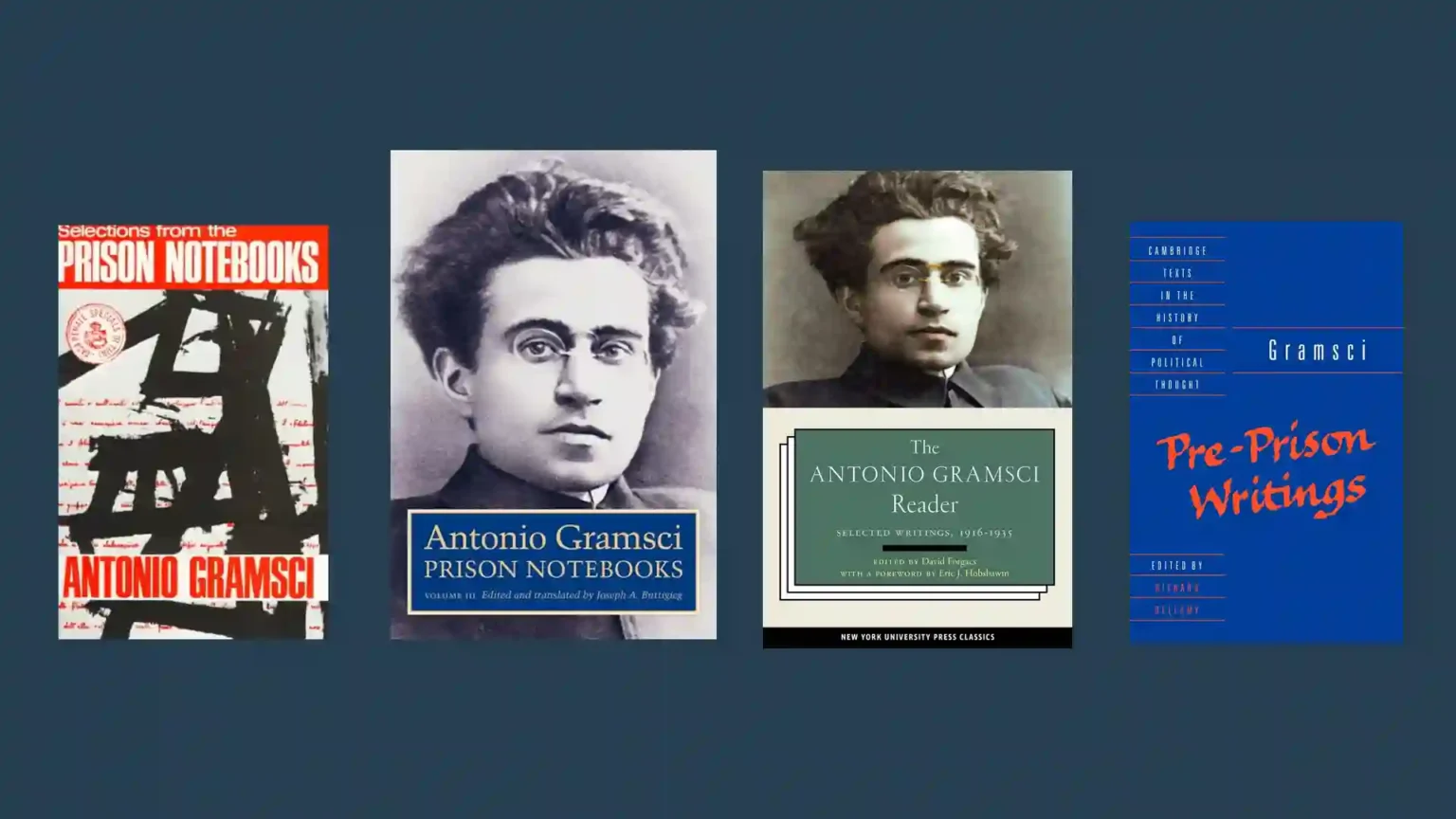
There is a disagreement hidden inside the question “What should I read before Gramsci’s Prison Notebooks?” One answer says: read Marx, Lenin, Italian history, Croce, Machiavelli, the Risorgimento, factory councils, fascism, linguistics, folklore, and the history of the Communist International. Another answer says: read Gramsci. Both can be right, but only if “the Prison Notebooks” is first treated as an archive rather than a single finished book. The English-language problem is editorial before it is philosophical. The familiar Selections from the Prison Notebooks arranges notes thematically; the critical Columbia University Press Prison Notebooks restores notebook sequence and scholarly apparatus. Those formats produce different reading experiences.
The International Gramsci Society concordance exists because English anthologies and critical notebook references do not map neatly onto one another. That fact should govern preparation. Before learning twenty concepts, learn which text you are holding. If your page says “The Modern Prince” or “State and Civil Society,” you are likely reading an editorial thematic arrangement, not a chapter Gramsci composed as such. The Antonio Gramsci Internet Archive itself warns that the Hoare-Nowell Smith selections reorganize material drawn from separate notebooks.
The archive before the concept
Gramsci wrote roughly three thousand pages of notes in prison between 1929 and 1935, and the Stanford Encyclopedia of Philosophy emphasizes that the notebooks were never prepared as a unified book for publication. Some notes were rewritten; others remain provisional; concepts migrate across contexts. This means a beginner should resist definitions that sound too polished. “Hegemony,” “civil society,” “war of position,” “organic intellectual,” “common sense,” and “philosophy of praxis” are not entries in a dictionary Gramsci left behind. They are terms inside a developing research program.
For this reason, the best first companion is not necessarily another theoretical monograph. The Antonio Gramsci Reader edited by David Forgacs spans writings from 1916 to 1935 and lets the reader see how prison concepts emerge from journalism, party politics, cultural criticism, and revolutionary strategy. It is especially useful for breaking the illusion that Gramsci became a “cultural theorist” only after prison.
Read the political Gramsci before the prison philosopher
The most efficient pre-prison sequence is short. Read “The Revolution against Capital” to see Gramsci reacting to the Russian Revolution without treating Marxist development as mechanical. Read writings around the Turin factory councils to understand why organization and working-class self-government mattered to him. Read “Some Aspects of the Southern Question” for the problem of alliances, intellectuals, peasants, and regional inequality. A Duke University Gramsci syllabus makes exactly this move, placing pre-prison writings before sustained notebook study. The Cambridge collection Antonio Gramsci: Pre-Prison Writings provides a broader chronology if those pieces generate questions you want to pursue.
This political route changes how “hegemony” is read. Instead of beginning as a theory of media influence, it becomes an answer to a strategic problem: why did revolutionary expectations fail in Western Europe, and what forms of leadership, alliance, institution-building, education, and culture would be required for a subaltern class to become capable of governing? BookInLight’s guide to Gramsci and cultural hegemony is best used after this shift, because it then becomes a map of interpretations rather than a source of detachable definitions.
How much Marx and Lenin do you need?
Less than a full canon, more than slogans. You should know Marx’s account of class and historical development well enough to recognize when Gramsci is refusing economic reductionism. You should know Lenin’s problem of political organization and revolutionary strategy well enough to see why Gramsci inherits but alters it. BookInLight’s six-book path from Marx to Gramsci provides a workable sequence if this background is missing. The key is not to make Marx and Lenin prerequisites that postpone Gramsci indefinitely. Read enough to identify the problem he is revising.
One useful contrast is state power versus the social organization of consent. A simplified revolutionary model imagines the state primarily as the coercive machinery to be seized. Gramsci increasingly treats advanced societies as protected by a dense field of parties, churches, schools, associations, newspapers, professional organizations, and habits of “common sense.” The strategic consequence is the famous shift toward a war of position. Without the preceding Marxist and revolutionary vocabulary, the metaphor sounds military but vague; with it, the term marks a change in how political transformation is located.
Do you need Croce, Machiavelli, and Italian history first?
You need landmarks, not mastery. Benedetto Croce matters because Gramsci’s “philosophy of praxis” develops in dialogue with Italian idealism and historicism. Machiavelli matters because “the modern prince” becomes a way of thinking about political organization and collective will. The Risorgimento matters because “passive revolution” and the formation of the Italian state are not abstract examples; they are part of Gramsci’s attempt to understand political change without mass transformation from below. Fascism matters because prison itself is not incidental context. Gramsci was arrested by Mussolini’s regime in 1926.
The Stanford account of Gramsci’s life and pre-prison writings is sufficient orientation for a first pass. Do not turn every named interlocutor into another month of preparatory reading. When a notebook passage explicitly leans on Croce, Machiavelli, Sorel, Labriola, Bukharin, or a particular Italian political episode, then deepen that branch. Let the notebook generate the syllabus.
Choose the edition before you choose the reading order
| If you are this reader | Start here | What you gain / what you lose |
|---|---|---|
| First serious encounter | Forgacs, The Antonio Gramsci Reader | Chronology and genre range; less notebook depth |
| Concept-driven political theory reader | Hoare & Nowell Smith, Selections | Efficient thematic route; editorial reordering can look more systematic than the archive |
| Researcher or close reader | Buttigieg, Prison Notebooks (Columbia) | Notebook order, critical apparatus, textual development; slower and incomplete in English as a full critical translation |
| Reader cross-checking anthologies | International Gramsci Society concordance | Ability to map anthology pages to notebook/note references |
Columbia describes its multivolume edition as a critical English edition of the notebooks. The Library of Congress record for the classic Hoare-Nowell Smith Selections shows a different object: a 483-page thematic selection including intellectuals, education, Italian history, the modern prince, state and civil society, Americanism and Fordism, philosophy, and Marxism. Neither format is fraudulent. They answer different reader needs. The danger comes from forgetting which editorial architecture you are interpreting.
A first route through the notebooks
If you are reading the thematic Selections, begin with the material on intellectuals and education, then move to the modern prince and state/civil society, then to the philosophy of praxis. This sequence makes organization, institutions, and intellectual life converge before the densest philosophical disputes. It also prevents “civil society” from becoming an apolitical sphere outside the state; Gramsci’s formulations repeatedly complicate that division.
If you are using the critical notebook order, read more slowly. Track dates, notebook numbers, and rewritten notes. The value of sequence is that concepts visibly change. A phrase that looks like a settled doctrine in an anthology may be one stage in a line of revision. The International Gramsci Society concordance is practical here because it lets you cross-check where famous anthology passages sit in the critical reference system.
Do not begin by collecting definitions
The most common failure is a glossary-only Gramsci: hegemony equals consent, civil society equals institutions outside government, organic intellectual equals activist scholar, war of position equals cultural struggle. Each formula contains something useful and something dangerous. Hegemony also involves organization and leadership; civil society is entangled with political society; intellectuals are functions inside social groups and institutions; war of position remains tied to strategy and state structure. A note that preserves the problem is better than a definition that erases it.
The euphemistic vocabulary of the notebooks adds another reason for caution. Prison censorship and Gramsci’s own strategic habits affected terminology; “philosophy of praxis,” for example, cannot simply be read as a neutral synonym detached from debates about Marxism. The Stanford account is helpful because it places philosophical language beside the political circumstances of writing rather than treating every term as a private code with one fixed translation.
Textual development matters too. Some notes exist in first drafts and later rewritten forms. The point is not that every reader must become a philologist, but that claims about “what Gramsci says” are stronger when they can identify whether a passage is an early note, a revised note, or an anthology excerpt. The International Gramsci Society concordance and the Columbia critical edition make that distinction possible when a question becomes important enough to require it.
A second failure is to read Gramsci as though prison removed immediate politics from his thinking. It changed the conditions of writing, but not the political stakes. The notebooks return obsessively to why some groups lead while others remain fragmented, how common sense becomes organized, how institutions educate, how alliances are built, and why a political force needs an intellectual and moral project as well as coercive capacity. The form is fragmentary; the pressure is persistent.
Three defensible reader routes
Route one – political strategy: read selected pre-prison writings, then “The Modern Prince,” state and civil society, war of position, intellectuals, and passive revolution. Route two – culture and language: use Forgacs for pre-prison journalism, then read intellectuals, education, common sense, folklore, language, and the philosophy of praxis; follow with BookInLight’s hegemony guide. Route three – textual scholarship: begin with the Columbia critical edition and the concordance tables, tracking notebook chronology and rewritten notes before relying on thematic anthologies.
The disagreement at the beginning can now be resolved. You do not need an encyclopedic education before the Prison Notebooks. You need enough Marxism to understand the inherited problem, enough Italian history to recognize the political cases, enough editorial awareness to know how your English text was constructed, and enough patience to let concepts remain provisional. The rest should be learned in response to specific notes. Gramsci is easier to distort by over-preparation than by honest partial knowledge, because a prefabricated system makes fragments look like confirmations.
For research use, keep a simple concordance beside your notes: anthology page, notebook number, note number, and whether the passage is a first draft or a revised text. That small bibliographic habit prevents thematic editions from silently flattening the chronology of Gramsci’s thinking.
Choose the route that matches your purpose, but keep one rule across all three: cite notebook and note references whenever your edition makes them available, and do not assume that a thematic heading is Gramsci’s own chapter title. The best preparation is not the longest bibliography. It is an accurate map of the archive you are about to enter.
Cover artwork: credits and source records
- Selections from the Prison Notebooks — International Publishers (source record)
- Prison Notebooks, Volume 3 — Columbia University Press (source record)
- The Antonio Gramsci Reader — New York University Press (source record)
- Pre-Prison Writings — Cambridge University Press (source record)