Best books on economics should do more than name famous titles. This curated reading list recommends 20 books ordered from easiest to hardest, so beginners, returning readers, and advanced students can quickly decide where to start. Each entry includes difficulty level, page count, verified Amazon and publisher links, and a clear reason for its place in the sequence.
The list moves from visual introductions and lucid general-reader books toward institutional economics, political economy, macroeconomic theory, classical texts, Marx, and formal microeconomic theory. The aim is not a random ranking but a usable path through markets, poverty, capitalism, public policy, inequality, growth, crisis, and the history of economic ideas.
Quick Answer
The best books on economics begin with clear introductions, then move through poverty, institutions, capitalism, political economy, Keynesian theory, classical economics, Marx, and advanced formal theory. This list is ordered from easiest to hardest, helping beginners build confidence while giving advanced readers a disciplined route into deeper economic argument.
The Reading Map
This compact map preserves the article’s reading order, moving from the most accessible starting points toward the most demanding works.
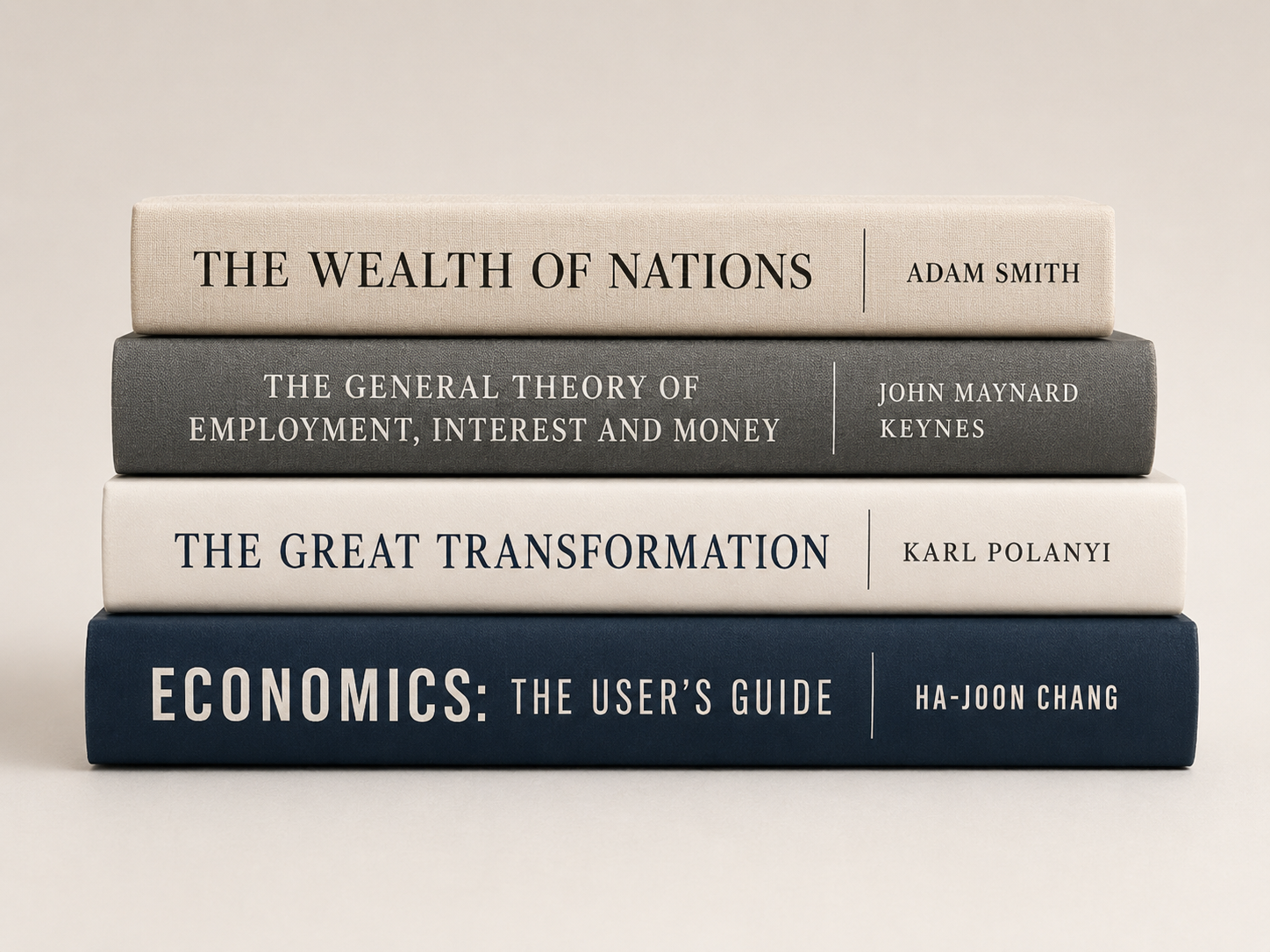
| Book | Difficulty / Pages | Best Use |
|---|---|---|
| The Cartoon Introduction to Economics, Volume I Grady Klein and Yoram Bauman | Beginner 224 pages | Visual first step. |
| Economics: A Very Short Introduction Partha Dasgupta | Beginner 192 pages | Compact framework. |
| Naked Economics Charles Wheelan | Beginner 400 pages | Policy intuition. |
| The Undercover Economist Tim Harford | Beginner 304 pages | Everyday markets. |
| Economics: The User’s Guide Ha-Joon Chang | General 384 pages | Schools of thought. |
| The Armchair Economist Steven E. Landsburg | General 336 pages | Incentive logic. |
| Poor Economics Abhijit V. Banerjee and Esther Duflo | General 320 pages | Development evidence. |
| Good Economics for Hard Times Abhijit V. Banerjee and Esther Duflo | General 432 pages | Modern policy debates. |
| Doughnut Economics Kate Raworth | Intermediate 320 pages | Ecological limits. |
| Why Nations Fail Daron Acemoglu and James A. Robinson | Intermediate 544 pages | Institutions and growth. |
| The Worldly Philosophers Robert L. Heilbroner | Intermediate 368 pages | History of ideas. |
| The Affluent Society John Kenneth Galbraith | Intermediate 288 pages | Public abundance. |
| The Great Transformation Karl Polanyi | Advanced 360 pages | Markets and society. |
| Capitalism and Freedom Milton Friedman | Advanced 272 pages | Market liberalism. |
| The Road to Serfdom F. A. Hayek | Advanced 283 pages | Planning and liberty. |
| Capitalism, Socialism and Democracy Joseph A. Schumpeter | Advanced 460 pages | Creative destruction. |
| The General Theory John Maynard Keynes | Advanced 404 pages | Macroeconomic theory. |
| The Wealth of Nations Adam Smith | Specialist 1,152 pages | Classical foundation. |
| Capital, Volume One Karl Marx | Specialist 1,152 pages | Capital critique. |
| Microeconomic Theory Andreu Mas-Colell, Michael D. Whinston, and Jerry R. Green | Specialist 1,008 pages | Formal graduate theory. |
How to Use This Reading List
Not every reader needs all 20 books. The list is arranged as an intellectual pathway, beginning with accessible explanations and ending with demanding works that shaped economics as a discipline. If you are new to the subject, start near the top and read slowly enough to absorb the concepts of incentives, trade-offs, scarcity, markets, institutions, and public policy.
Advanced readers can move directly into the final third, where economics becomes more historical, theoretical, and mathematically demanding. The best books on economics are not all trying to do the same job: some teach intuition, some explain institutions, some defend markets, some criticize capitalism, and some build the formal machinery used by professional economists.

The Books, Ordered from Easiest to Hardest
1. The Cartoon Introduction to Economics, Volume I: Microeconomics by Grady Klein and Yoram Bauman
The first book earns its place because it removes the fear that often surrounds economics. Klein and Bauman use cartoons not to simplify the subject into jokes, but to make core ideas visible: incentives, opportunity cost, supply and demand, marginal thinking, markets, and trade-offs. For readers searching for best books on economics without a technical background, this is the least intimidating door into the discipline. Its value is orientation rather than depth. It gives the reader a working vocabulary before more argumentative books appear.
Why read it: It turns the basic logic of microeconomics into something memorable, visual, and immediately usable.
2. Economics: A Very Short Introduction by Partha Dasgupta
Dasgupta’s introduction is brief, but it is unusually serious. Instead of treating economics as a set of textbook diagrams, it asks how people live under different institutional, ecological, and social conditions. The book is especially useful because it connects economic reasoning with poverty, environment, trust, social norms, and household life. That makes it a better beginning than many longer introductions. It prepares readers to see economics not merely as prices and markets, but as a way of studying human cooperation under constraint.
Why read it: It gives beginners a compact, humane, and intellectually responsible introduction to economic thinking.
3. Naked Economics: Undressing the Dismal Science by Charles Wheelan
Wheelan writes for readers who want economic concepts without being buried in equations. The book explains markets, incentives, trade, human capital, government, finance, and globalization through examples that feel practical rather than academic. Its place near the beginning is justified by its conversational style and broad coverage. It is not the most theoretical book here, and it should not be treated as the final word on any debate, but it gives readers a large mental map of what economists are often trying to explain.
Why read it: It builds everyday economic intuition before the list turns toward more contested and technical books.
4. The Undercover Economist, Revised and Updated Edition by Tim Harford
Harford’s strength is close observation. Coffee prices, rents, auctions, supermarkets, and city life become small laboratories for economic reasoning. This book is especially good for readers who understand examples faster than abstractions. It explains how scarcity, bargaining power, information, and incentives shape ordinary transactions. Placed after Wheelan, it narrows the lens from broad explanation to the hidden economic structure of daily life. The result is a graceful bridge between popular economics and more analytical thinking.
Why read it: It teaches readers to notice economic forces inside familiar situations rather than treating economics as remote theory.
5. Economics: The User’s Guide by Ha-Joon Chang
Chang is valuable because he refuses to present economics as a single doctrine. He introduces classical, neoclassical, Keynesian, Marxist, developmentalist, institutionalist, Austrian, and behavioral traditions, showing that economics has always been a field of disagreement. This is why the book belongs early but not first: it is readable, yet it asks readers to compare schools of thought. For searchers looking for best books on economics beyond textbook orthodoxy, Chang offers a pluralist map that makes later controversies easier to understand.
Why read it: It helps readers see economics as a debate among traditions rather than a closed technical language.
6. The Armchair Economist: Economics and Everyday Life by Steven E. Landsburg
Landsburg writes with a sharper argumentative edge than many introductory authors. His central gift is showing how economists use incentives and unintended consequences to overturn intuitive moral judgments. Readers may not agree with every conclusion, and that is part of the book’s usefulness. It trains the mind to ask what people actually respond to, not merely what a policy hopes to achieve. It is placed here because it remains accessible while demanding more critical resistance from the reader.
Why read it: It teaches the habit of asking how incentives work beneath public language and moral intention.
7. Poor Economics: A Radical Rethinking of the Way to Fight Global Poverty by Abhijit V. Banerjee and Esther Duflo
Banerjee and Duflo change the scale of economic inquiry. Instead of beginning with grand theories about poverty, they look at how poor households actually make decisions about schooling, health, risk, credit, and work. Their method is empirical, patient, and often surprising. The book matters because it shows economics operating through evidence, field experiments, and institutional detail. It also corrects a common weakness in casual economics reading: the assumption that poverty can be explained by one ideology, one policy, or one moral failure.
Why read it: It gives readers a careful evidence-based view of poverty without reducing poor people to abstractions.
8. Good Economics for Hard Times by Abhijit V. Banerjee and Esther Duflo
This later book widens the authors’ attention from development economics to migration, trade, inequality, climate, growth, and political anger. Its importance lies in tone as much as argument: it resists both technocratic arrogance and populist simplicity. Readers meet economics as an imperfect but necessary tool for public judgment. The book belongs after Poor Economics because it applies empirical discipline to larger political questions. It is especially useful for readers who want economics books that speak to contemporary anxiety without surrendering to slogans.
Why read it: It connects economic evidence to the public problems that dominate modern political debate.
9. Doughnut Economics: Seven Ways to Think Like a 21st-Century Economist by Kate Raworth
Raworth argues that economics needs a new visual and conceptual frame: one that respects both social foundations and ecological ceilings. The book is important because it challenges growth-centered models without abandoning the need for analytical structure. It is more polemical than some earlier entries, but its diagrams, metaphors, and policy imagination make it unusually teachable. Its position in the middle reflects a shift from learning economics to questioning what economics should measure, value, and prioritize in an age of climate constraint.
Why read it: It introduces ecological and social limits into economic thinking with unusual clarity and force.
10. Why Nations Fail: The Origins of Power, Prosperity, and Poverty by Daron Acemoglu and James A. Robinson
Acemoglu and Robinson place institutions at the center of economic development. Their core distinction between inclusive and extractive institutions gives readers a powerful way to think about growth, poverty, political power, and historical divergence. The argument is broad, sometimes debated, and deliberately ambitious. That makes it a useful midpoint: readable enough for general audiences, but large enough to provoke disagreement. It also shows why economics cannot be separated from politics, law, property, coercion, and state capacity.
Why read it: It gives readers a major institutional explanation for why some societies become prosperous while others remain trapped.
11. The Worldly Philosophers: The Lives, Times and Ideas of the Great Economic Thinkers by Robert L. Heilbroner
Heilbroner remains one of the great guides to economics as a drama of ideas. Smith, Malthus, Ricardo, Marx, Veblen, Keynes, and Schumpeter appear not as textbook names but as thinkers responding to industrialization, inequality, crisis, class, uncertainty, and capitalism’s restless motion. The book is accessible, but its historical sweep makes it richer than an introduction. It is placed here because readers who have learned the basic tools now need to understand where those tools came from and why different economists asked different questions.
Why read it: It turns the history of economic thought into a readable intellectual narrative.
12. The Affluent Society by John Kenneth Galbraith
Galbraith’s classic asks what happens when private consumption expands while public goods remain neglected. His famous contrast between private affluence and public squalor still speaks to debates about infrastructure, education, advertising, inequality, and civic investment. The prose is elegant, but the argument requires readers to think beyond narrow market efficiency. The book belongs in the middle of the list because it introduces a broader political and cultural criticism of prosperity. It asks not only how wealth is produced, but what kind of society wealth creates.
Why read it: It shows how economic growth can coexist with public weakness and distorted social priorities.
13. The Great Transformation: The Political and Economic Origins of Our Time by Karl Polanyi
Polanyi is indispensable for readers who want economics in relation to society, history, and political order. His central claim is that the self-regulating market was not natural but politically constructed, and that society responds when land, labor, and money are treated as commodities. The book is more demanding than its page count suggests because it rewrites the story of modern capitalism. It belongs here because the list now moves from explanatory economics into deep political economy. Polanyi forces readers to ask what markets require from states, communities, and social life.
Why read it: It gives one of the most influential critiques of the idea that markets stand apart from society.

14. Capitalism and Freedom by Milton Friedman
Friedman’s book is a concise statement of market liberalism, limited government, monetary discipline, school vouchers, occupational licensing criticism, and the connection he draws between economic and political freedom. Readers do not need to accept Friedman’s conclusions to understand his importance. The book is essential because it shaped late twentieth-century debates about markets, state power, and public policy. It appears in the advanced portion because its simplicity can be deceptive: behind the clear prose stands a large theory of liberty, choice, and institutional design.
Why read it: It gives a powerful and historically influential defense of markets as instruments of freedom.
15. The Road to Serfdom: Text and Documents: The Definitive Edition by F. A. Hayek
Hayek’s argument against central planning became one of the most influential economic and political texts of the twentieth century. The book is not a neutral textbook; it is a warning about how economic control can reshape political freedom. Reading it after Friedman is useful because Hayek’s concerns are more historical, epistemological, and political. He is interested in knowledge, coordination, and the dangers of concentrated authority. Whether one agrees or disagrees, the book is essential for understanding market liberalism as a political philosophy.
Why read it: It clarifies the strongest classical liberal fear about economic planning and political coercion.
16. Capitalism, Socialism and Democracy by Joseph A. Schumpeter
Schumpeter’s great book is best known for creative destruction, but its importance is wider. It treats capitalism as an evolutionary system driven by innovation, entrepreneurship, monopoly, finance, bureaucracy, and social change. Schumpeter is harder than many expect because his argument is historical, sociological, and theoretical at once. He does not simply praise capitalism; he asks whether capitalism’s own success might undermine the social conditions that sustain it. The book belongs late in the list because it requires comfort with both economic argument and historical irony.
Why read it: It gives one of the most influential accounts of capitalism as a dynamic and self-disrupting order.
17. The General Theory of Employment, Interest and Money by John Maynard Keynes
Keynes’s book changed macroeconomics by challenging the assumption that market economies naturally return to full employment. It analyzes aggregate demand, investment, uncertainty, interest, money, and the instability of expectations. The difficulty lies not only in the prose but in the conceptual shift: Keynes asks readers to think at the level of the whole economy, not merely individual markets. It belongs late because it is a primary text, not an introduction. Yet no serious list of best books on economics can avoid it.
Why read it: It gives the foundational argument behind modern macroeconomic policy and crisis management.

18. An Inquiry into the Nature and Causes of the Wealth of Nations by Adam Smith
Smith is often reduced to a slogan about the invisible hand, but The Wealth of Nations is much richer: division of labor, markets, taxation, monopoly, colonial trade, public works, wages, profits, rents, and the moral dangers of concentrated commercial power. It is late in the list because the full text is long and historically layered. Readers who arrive here after modern introductions and political economy will see why Smith founded a tradition rather than merely defended free markets. The book is difficult, but it remains foundational.
Why read it: It lets readers encounter classical political economy at its source rather than through simplified summaries.


19. Capital: A Critique of Political Economy, Volume One by Karl Marx
Marx’s Capital is not simply an attack on capitalism; it is an immense attempt to explain commodity exchange, value, labor, surplus value, machinery, accumulation, crisis, and the social form of capitalist production. It is one of the hardest books here because its argument unfolds through abstraction, historical material, philosophical inheritance, and economic critique. Readers should not begin with it, but serious readers should eventually confront it. Marx remains essential because he asks what market society hides when labor, value, and social power appear as things.
Why read it: It offers the most influential critique of capitalism’s internal logic and social consequences.

20. Microeconomic Theory by Andreu Mas-Colell, Michael D. Whinston, and Jerry R. Green
This is not a general-reader book, and that is precisely why it belongs at the end. Mas-Colell, Whinston, and Green represent the formal graduate-level language of microeconomic theory: consumer choice, producer theory, general equilibrium, game theory, information economics, welfare, and mechanism design. Most readers will not need it. But readers who want to understand how professional economics becomes mathematical theory eventually need to know that this level exists. It closes the list by showing the distance between popular economics and technical economic modeling.
Why read it: It reveals the formal architecture behind advanced microeconomics and modern theoretical research.
Where to Start
If you are completely new, begin with Klein and Bauman, Dasgupta, Wheelan, and Harford. That short route gives you concepts, vocabulary, and everyday examples without making economics feel like a closed profession. If you want a slightly more serious but still readable path, add Chang, Banerjee and Duflo, Raworth, and Acemoglu and Robinson.
If you want the classic foundation, read Heilbroner before moving to Smith, Keynes, Schumpeter, Polanyi, Friedman, Hayek, and Marx. Heilbroner’s historical framing will make the older and more theoretical books much easier to place. If you want contemporary debates, prioritize poverty, institutions, climate, inequality, and policy: Banerjee and Duflo, Raworth, Acemoglu and Robinson, Galbraith, and Polanyi are especially useful.
The most difficult route is Smith, Keynes, Marx, and Mas-Colell, but that path is best taken only after readers have built both historical and conceptual context. The best books on economics reward sequence. A strong order prevents famous works from becoming isolated monuments.
What Most Reading Lists on Economics Miss
Many reading lists treat economics as if it were one subject with one method. That is misleading. Economics is at least five things at once: a way of thinking about choice, a mathematical discipline, a policy language, a history of capitalism, and a field of political conflict over markets, states, labor, money, and power. A list that contains only popular economics will be clear but shallow. A list that contains only classics will be prestigious but unusable for most readers.
The strongest reading path moves between intuition, evidence, institutions, history, and theory. That is why Smith and Marx appear late rather than early, and why modern books on poverty, ecology, and institutions appear before some canonical works. One famous book is never enough because economics is not a single answer. It is a disciplined argument over how societies produce, distribute, value, govern, and imagine material life.
Frequently Asked Questions
Should I Read Primary Texts or Modern Economics Books First?
Most readers should begin with modern guides, then move to primary texts. Smith, Keynes, Marx, Hayek, and Schumpeter are easier to understand after you already know basic concepts such as incentives, markets, money, institutions, public goods, and macroeconomic demand.
Can These Economics Books Be Read Without a University Background?
Yes. The best books on economics include narrative, history, policy, and conceptual explanation, not only mathematics. Readers without university training should avoid starting with the final specialist titles and instead build gradually through the first half of the list.
How Should I Choose Between Different Editions of Classic Economics Books?
For classic works, choose editions with strong introductions, notes, indexes, and reliable translation or editorial history. A cheap edition may be usable, but a scholarly edition often saves time by explaining historical context, terminology, and textual problems.
How Long Would It Take to Read This List Seriously?
A focused reader could read the accessible first half in several months. The full list could take a year or more if read carefully, especially because the final books require note-taking, rereading, and background research.
Are Older Economics Books Still Useful for Modern Policy Debates?
Yes, but not because they answer every modern question directly. Older books reveal the foundations of arguments about markets, labor, capitalism, planning, money, and crisis. They help readers recognize the intellectual ancestry of today’s policy debates.
Should I Buy Physical Copies or Use Library Editions?
For introductory books, borrowing is often enough. For classics such as Smith, Keynes, Polanyi, Marx, Hayek, and Schumpeter, a physical or well-annotated edition is useful because serious reading usually requires marginal notes and repeated consultation.
What Should I Read After Finishing This Economics Reading List?
After this list, choose a branch: behavioral economics, monetary economics, development economics, economic history, public finance, inequality, environmental economics, or formal theory. The right next step depends on whether you prefer policy, history, mathematics, or political economy.
What Remains After the List
A good economics education does not end with knowing what economists say. It begins when a reader can distinguish a model from a metaphor, a policy claim from an ethical claim, and an elegant theory from a historical reality. The best books on economics help build that judgment gradually.
At Book in Light, the point of a reading list is not accumulation but orientation. Economics becomes most interesting when it stops being a set of answers and becomes a disciplined way of asking how human beings live with scarcity, power, exchange, institutions, and hope.