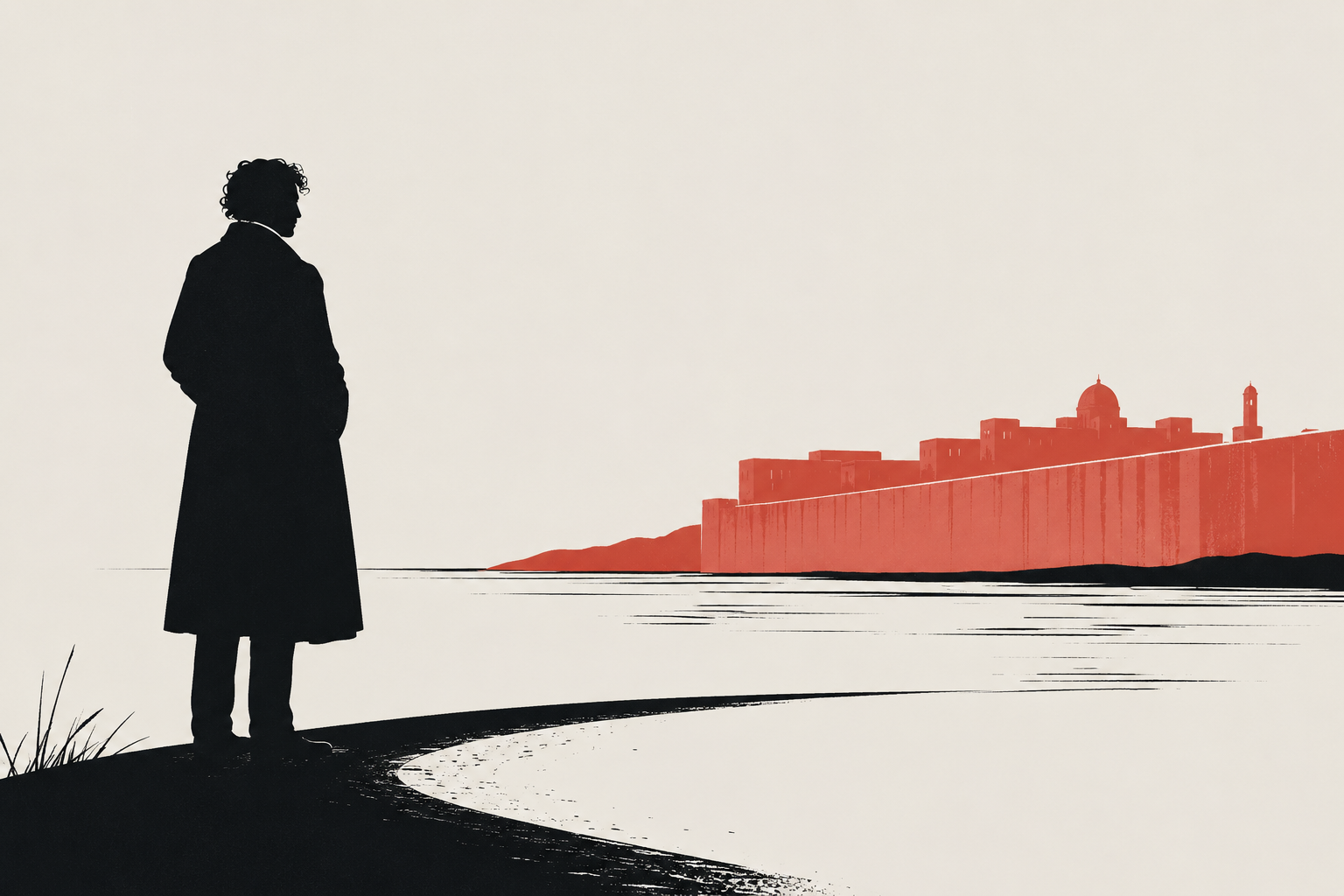
Illustration by Bookinlight Art Desk
Historical Literature
Six Books on the Historical Novel
A reading shelf for understanding why historical fiction is never merely fiction set in the past, but a testing ground for memory, realism, ideology, trauma, and the politics of narrative form.
By Bookinlight


History as Form, Not Backdrop
The best books on the historical novel begin from a deceptively simple problem: what happens when fiction tries to make the past narratively present? The answer is never only a matter of costume, chronology, or archival scenery. The historical novel turns the past into a field of pressure where private lives meet public events, where memory competes with evidence, and where narrative form becomes a theory of history. These six books do not merely define a genre. Together, they show how historical fiction has served as realism, nationalism, critique, romance, postmodern experiment, and ethical response to catastrophe.
Why the Best Books on the Historical Novel Still Matter
Historical fiction has always occupied an uneasy position between popular pleasure and intellectual seriousness. It can console readers with recoverable worlds, but it can also expose the violence behind official memory. It may create the illusion that the past can be entered, while reminding us that every historical account is mediated by language, power, and desire. The books selected here form a disciplined sequence: from Lukacs’s Marxist account of social totality, through Fleishman and Maxwell’s genre histories, to de Groot’s contemporary map, Hutcheon’s postmodern theory, and Elias’s post-traumatic account of historical longing.
The Reading Lens
The Past Becomes Legible Only When Form Gives It Pressure
The historical novel is not a window onto earlier life. It is a machine for organizing distance. Its realism depends on selection; its intimacy depends on absence; its politics depends on the kinds of lives it allows history to touch. Read together, these books show that historical fiction matters because it converts historical time into narrative experience, making visible the unstable relation between event, memory, evidence, and imaginative reconstruction.
Central Question
Can fiction represent the past without turning history into either spectacle or certainty?
Historical Pressure
Modern historical fiction emerges from revolution, nationalism, empire, mass violence, and the collapse of inherited confidence in historical truth.
Why These Books
They trace the genre from classical realism to contemporary uncertainty without reducing it to either entertainment or academic theory.
Six Essential Studies of the Historical Novel
The Historical Novel
Georg Lukacs
Best for: readers seeking the classic theoretical foundation
Difficulty: Advanced
Intellectual role: The genre as social totality and realist historical consciousness
Bookinlight Rating: ★★★★★
Lukacs remains unavoidable because he gives the historical novel its grandest philosophical burden. Beginning with Walter Scott, he argues that historical fiction becomes powerful when it represents individuals as bearers of wider social transformation. His account is marked by Marxist historicism, Hegelian inheritance, and a powerful commitment to realism. Even where the book now feels doctrinaire, it still asks the decisive question: how can fiction make historical process visible through character, plot, and social conflict?
Critical Reception
“Brilliant reflections on Scott, Hugo, Tolstoy, and Flaubert.“
Bookinlight Note: Pair this with Scott’s Waverley or Tolstoy’s War and Peace and ask whether Lukacs values historical depth more than psychological ambiguity.
The English Historical Novel: Walter Scott to Virginia Woolf
Avrom Fleishman
Best for: readers focused on English literary tradition
Difficulty: Intermediate
Intellectual role: The historical novel as an English formal tradition
Bookinlight Rating: ★★★★★★
Fleishman narrows the field in order to clarify it. His study follows the English historical novel from Scott through nineteenth-century and modern transformations, showing how the genre negotiates the relation between public event and private destiny. Compared with Lukacs, Fleishman is less philosophically totalizing and more attentive to literary lineage. The result is especially useful for readers who want to understand how English fiction made historical imagination into a formal practice rather than a mere subject matter.
Critical Reception
“Provides the first comprehensive study not only of this subject.“
Bookinlight Note: Use Fleishman as a bridge between genre history and close reading; it is especially strong for building a syllabus around English historical fiction.
The Historical Novel in Europe, 1650-1950
Richard Maxwell
Best for: readers wanting a wider European genealogy
Difficulty: Advanced
Intellectual role: The genre before and beyond the Scott-centered story
Bookinlight Rating: ★★★★★★
Maxwell complicates the familiar origin story. Instead of treating the historical novel as simply a Scottish invention perfected by Scott, he follows a longer European development, including French narrative experiments and later transnational circulation. The value of this book lies in scale: it shows how the historical novel became both a literary form and a set of reading expectations. For advanced readers, it opens the genre onto translation, reception, and the mobility of narrative models across Europe and the Americas.
Critical Reception
“The first comprehensive study of its subject for many years.“
Bookinlight Note: Read this after Lukacs to see what changes when the genre is understood through transmission rather than philosophical totality.
The Historical Novel
Jerome de Groot
Best for: students, general readers, and syllabus builders
Difficulty: General to Intermediate
Intellectual role: The contemporary critical map of the field
Bookinlight Rating: ★★★★★★
De Groot is the most accessible single-volume introduction here. He treats the historical novel as an enduringly popular genre that raises questions about authenticity, identity, reading, writing, fact, fiction, and cultural authority. The book is especially valuable because it moves beyond high literary examples to include crime fiction, counterfactual writing, audience, adaptation, and contemporary media. It is the best entry point for readers who want a broad critical vocabulary before moving into heavier theoretical texts.
Bookinlight Note: This is the book to begin with if your main question is not “What is the canon?” but “What arguments surround the genre today?”
A Poetics of Postmodernism: History, Theory, Fiction
Linda Hutcheon
Best for: readers interested in historiographic metafiction
Difficulty: Advanced
Intellectual role: The historical novel after postmodern self-consciousness
Bookinlight Rating: ★★★★★
Hutcheon’s book is not limited to the historical novel, but it is indispensable for understanding what happens when historical fiction becomes openly self-aware about the conditions of historical knowledge. Her influential concept of historiographic metafiction names a mode in which fiction both uses and questions history. For readers of the historical novel, Hutcheon shifts attention from realism to representation: not simply how the past is narrated, but how narrative exposes the ideological, textual, and institutional construction of the past.
Critical Reception
“One of the clearest and most incisive introductions to postmodernism.“
Bookinlight Note: Read Hutcheon beside novels such as Midnight’s Children, Foe, or The French Lieutenant’s Woman to see history become a problem of narration itself.
Sublime Desire: History and Post-1960s Fiction
Amy J. Elias
Best for: readers studying postwar fiction, trauma, and historical desire
Difficulty: Advanced
Intellectual role: The historical novel after violence, skepticism, and longing
Bookinlight Rating: ★★★★★★
Elias brings the historical novel into the aftermath of twentieth-century violence and postmodern skepticism. Her central concern is not simply whether the past can be known, but why it remains so urgently desired even when historical certainty has become suspect. The book is especially valuable for linking historical fiction with trauma theory, historiography, romance, and the sublime. It gives the contemporary historical novel a double structure: an ethical need to remember and a dangerous attraction to the imagined fullness of the past.
Critical Reception
“Fresh perspectives on the relationship between literature and traumatic historical experiences.“
Bookinlight Note: Elias is ideal for a discussion question: when does historical fiction become remembrance, and when does it become aesthetic escape?
How These Books Speak to One Another
Read in sequence, these books show a movement from confidence to self-consciousness. Lukacs believes the historical novel can disclose the social logic of history. Fleishman and Maxwell historicize that claim by showing how the genre develops through national and transnational literary traditions. De Groot then opens the form to contemporary debates about audience, authenticity, media, and popular culture. Hutcheon and Elias complete the arc by asking what happens after modern confidence in historical knowledge has been shaken. The genre survives, but its task changes: it no longer simply represents the past; it stages our desire for the past under conditions of doubt.
The Reading Map
| Book | Difficulty | Rating | Why It Matters |
|---|---|---|---|
| The Historical Novel | Advanced | ★★★★★ | Defines the classical theoretical problem. |
| The English Historical Novel | Intermediate | ★★★★★★ | Clarifies the English lineage. |
| The Historical Novel in Europe | Advanced | ★★★★★★ | Expands the European genealogy. |
| The Historical Novel | General to Intermediate | ★★★★★★ | Maps current debates clearly. |
| A Poetics of Postmodernism | Advanced | ★★★★★ | Explains historical self-consciousness. |
| Sublime Desire | Advanced | ★★★★★★ | Links fiction, trauma, and desire. |
Where to Begin
- Entry point: Begin with Jerome de Groot for the clearest contemporary introduction.
- Historical background: Move to Fleishman for the English tradition from Scott to Woolf.
- Conceptual foundation: Read Lukacs for the classic theory of realism and history.
- Critical perspective: Add Maxwell to widen the frame beyond a narrow national origin story.
- Contemporary relevance: Use Hutcheon to understand postmodern historical self-consciousness.
- Advanced reflection: Finish with Elias for trauma, longing, and the postwar historical imagination.
External Sources for Further Reading
University of Nebraska Press on Lukacs’s The Historical Novel
Encyclopedia of Romantic Nationalism in Europe on the Historical Novel
The Last Margin
The best books on the historical novel show that the genre is not a decorative annex to history. It is one of modern literature’s most demanding forms because it asks readers to inhabit the past while recognizing the instability of that inhabitation. Historical fiction can make vanished worlds feel intimate, but its deepest power lies elsewhere: in revealing that every relation to the past is shaped by form, ideology, evidence, longing, and loss. These six books teach us to read the historical novel not as escape from the present, but as one of the most revealing ways the present argues with history.