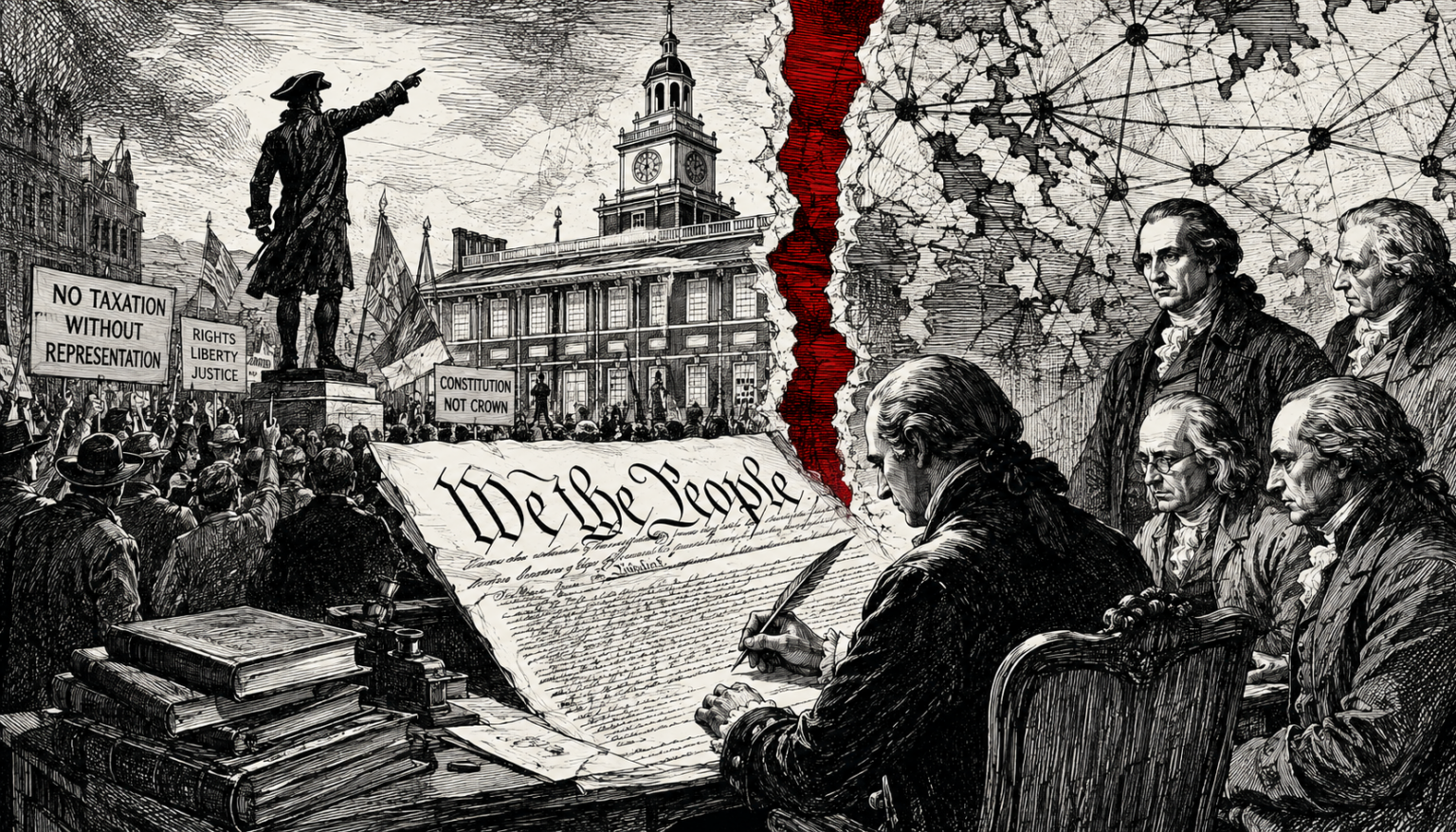
Illustration by Bookinlight Art Desk
Political Philosophy
Seven Books on Constitution-Making, Revolution, and Democratic Beginnings
A reading path through the dangerous hour when “the people” is invoked, institutions are invented, and freedom either becomes a durable public order or retreats into exclusion, charisma, and constitutional myth.
By Bookinlight


Disclosure: This article may contain affiliate links. If you buy through these links, the website may earn a small commission at no extra cost to you.
The Hour Before the Constitution Hardens
Books on constitution-making and revolution are really books about a brief and unstable interval. Before a constitution becomes a revered text, before courts cite it and politicians swear loyalty to it, it is a wager made under pressure. Someone must claim to speak for “the people.” Someone must decide which conflicts can be translated into institutions and which conflicts will be hidden inside them. The democratic beginning is therefore never innocent. It is an act of imagination, but also an act of selection. It promises collective authorship while immediately creating offices, procedures, exclusions, and limits.
The seven books gathered here belong together because each asks what happens when a political community tries to begin again. Some approach the question through the American and French revolutions. Others study constituent power, post-authoritarian transitions, charismatic leadership, or the buried inequalities of constitutional founding. Read together, they suggest that constitution-making is not merely legal drafting. It is the moment when a society gives form to freedom while deciding who will be permitted to appear as its author.
Why Constitution-Making and Revolution Still Matter
Constitutions are often described as settlements, but the deeper drama is that they are born from unsettlement. Revolutions break the apparent naturalness of old authority. Constitution-making then tries to prevent revolutionary energy from dissolving into either disorder or domination. The central question is not whether democracy needs institutions. It does. The harder question is whether institutions can preserve the experience of collective beginning without freezing it into a mythology of founders, judges, leaders, or sacred texts. These books give readers a way to think about that question without romanticizing revolution or reducing democracy to procedure.
A Voice Worth Hearing
“Constitutional politics has become a major terrain of contemporary struggles.“
Seven Books for the Democratic Founding Problem
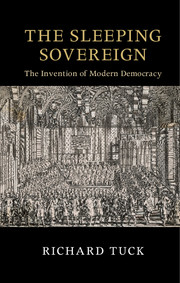
The Sleeping Sovereign: The Invention of Modern Democracy
Richard Tuck
Best for: Readers who want the genealogy of popular sovereignty before modern constitutional politics.
Difficulty: Advanced
Intellectual role: Explains why democratic peoples are often imagined as sovereign authors who appear rarely and govern indirectly.
Bookinlight Rating: ★★★★★★
Tuck’s book is the best place to begin if the phrase “the people” seems too obvious. His distinction between sovereignty and government clarifies a recurring constitutional puzzle: the people may authorize a regime, but they cannot be permanently assembled to govern it. The result is a strange democratic temporality. The people awaken at foundational moments, referendums, revolutions, or constitutional ratifications, then recede while institutions act in their name. For anyone studying constitution-making and revolution, this is crucial because it reveals why every founding moment contains both democratic force and democratic absence.
Critical Reception
“His new book does not disappoint. Indeed, I warmly commend it.“
Bookinlight Note: Read this before reading constitutional case law. It teaches you to ask not only what a constitution says, but what kind of democratic author it imagines.
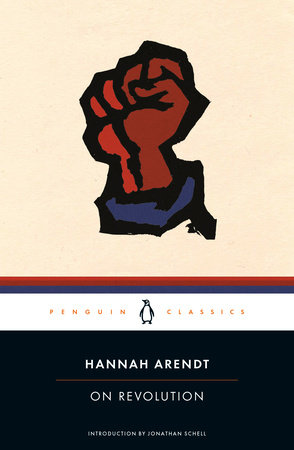
On Revolution
Hannah Arendt
Best for: Readers seeking a philosophical account of revolutionary freedom.
Difficulty: Intermediate
Intellectual role: Separates liberation from the harder task of founding a space for public freedom.
Bookinlight Rating: ★★★★★
Arendt’s central gift is her refusal to make revolution synonymous with violence, necessity, or social explosion. She is interested in the rarer achievement of foundation: the construction of durable public freedom after the old order collapses. Her contrast between the American and French revolutionary traditions remains controversial, but it is enormously productive. It forces readers to ask whether revolution is judged by the suffering it overthrows or by the institutions it manages to create. In this list, Arendt supplies the normative intensity: the beginning matters because politics, at its best, allows human beings to appear together as initiators.
Critical Reception
“She is never dull, enormously erudite, always imaginative, original and full of insights.“
Bookinlight Note: Pair Arendt with Gargarella to test the difference between founding freedom and founding equality. The tension is the heart of modern constitutionalism.
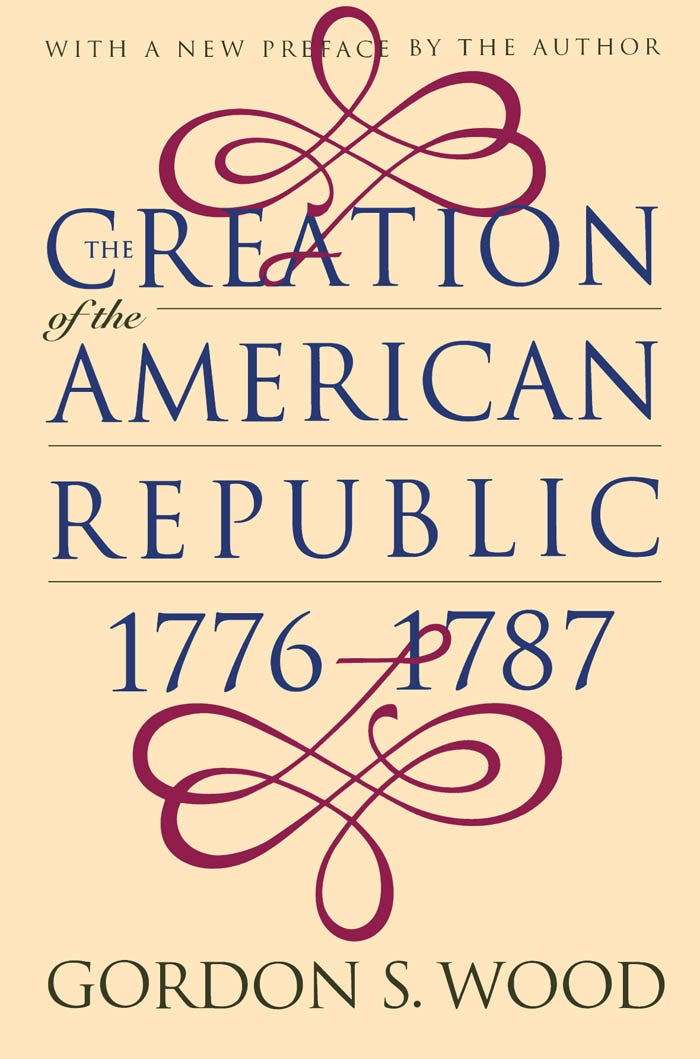
The Creation of the American Republic, 1776-1787
Gordon S. Wood
Best for: Readers who want dense historical reconstruction of republican thought.
Difficulty: Advanced
Intellectual role: Shows how constitutional form emerged from arguments about virtue, representation, power, and corruption.
Bookinlight Rating: ★★★★★★
Wood’s classic study makes the American founding feel intellectually alive rather than ceremonially frozen. Its great value is that it reconstructs the conceptual movement from revolutionary republican suspicion of power toward the constitutional architecture of representation, checks, and institutional balance. The book is demanding, but it rewards patience by showing that constitutional design was not a technical afterthought. It was a transformation in political language. Wood helps readers understand how a revolutionary generation converted fear of domination into a new theory of legitimate government.
Critical Reception
“One of the half dozen most important books ever written about the American Revolution.“
Bookinlight Note: Use Wood to slow down the word “founding.” He shows that a beginning is less an event than a prolonged argument about authority.
The Paradox of Constitutionalism: Constituent Power and Constitutional Form
Edited by Martin Loughlin and Neil Walker
Best for: Readers interested in constituent power, legitimacy, and constitutional theory.
Difficulty: Advanced
Intellectual role: Names the paradox at the center of democratic beginnings.
Bookinlight Rating: ★★★★
This collection addresses the basic contradiction that haunts modern constitutionalism: the people are said to make the constitution, but once the constitution exists, popular power is channeled through the institutions it has created. Does constituent power survive its own constitutionalization, or does it disappear into constituted authority? The volume is not an easy read, yet it is essential for anyone who wants the vocabulary of the problem. It keeps constitution-making from becoming a purely procedural topic and restores its philosophical difficulty.
Critical Reception
“This book provides a fresh look at the rhetorical structure, genealogy, normative underpinnings, and political contexts.“
Bookinlight Note: Read one chapter at a time. Treat the book as a conceptual workshop rather than a linear narrative.
Post Sovereign Constitution Making: Learning and Legitimacy
Andrew Arato
Best for: Students of democratic transition and negotiated constitution-making.
Difficulty: Advanced
Intellectual role: Replaces heroic founding with a multi-stage, democratic, learning-based model.
Bookinlight Rating: ★★★★★★
Arato is indispensable because he moves beyond the old image of a sovereign constituent assembly speaking with one pure voice. His account of post-sovereign constitution-making emphasizes negotiated transitions, interim arrangements, roundtables, participation, legality, and political learning. This matters because many modern democratic beginnings occur after dictatorship, civil conflict, military rule, or authoritarian breakdown. They do not begin on a clean slate. Arato’s book teaches that legitimacy can be generated through process rather than merely declared by a revolutionary subject.
Critical Reception
“A critical intervention in what is likely the debate of our generation.“
Bookinlight Note: This is the book to read when “the people” has been claimed too easily by leaders, parties, or crowds.
Revolutionary Constitutions: Charismatic Leadership and the Rule of Law
Bruce Ackerman
Best for: Readers interested in constitutional revolutions beyond one national model.
Difficulty: Intermediate
Intellectual role: Explores how revolutionary movements can translate charismatic authority into constitutional legality.
Bookinlight Rating: ★★★★
Ackerman’s book is bold because it refuses to identify populism only with democratic pathology. His interest is in revolutionary constitutionalism as a sequence: mobilization, charismatic leadership, institutionalization, and legal consolidation. The book’s comparative reach makes it valuable, even for readers who disagree with its optimism about democratic populism. In a field often split between legal formalism and anti-populist anxiety, Ackerman insists that some constitutional breakthroughs arise from mass political movements that must later discipline their own founding energy.
Bookinlight Note: Read Ackerman against Arato. One gives revolutionary charisma more credit. The other worries about how easily it becomes plebiscitary domination.
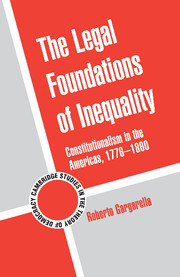
The Legal Foundations of Inequality: Constitutionalism in the Americas, 1776-1860
Roberto Gargarella
Best for: Readers who want a critical account of founding exclusions in the Americas.
Difficulty: Intermediate
Intellectual role: Shows how egalitarian revolutionary language can coexist with exclusionary constitutional design.
Bookinlight Rating: ★★★★★★
Gargarella is the necessary corrective to every triumphant story of constitutional founding. He examines how revolutionary ideals of equality and self-government in the Americas were often displaced by institutional arrangements that restricted majority rule, protected elites, or preserved inherited hierarchies. The book’s power lies in its refusal to separate rights from the “engine room” of power. It asks whether a constitution can sincerely affirm equality while organizing authority in ways that keep ordinary citizens at a distance from decision-making.
Critical Reception
“The long revolutionary movements were founded on egalitarian constitutional ideals.“
Bookinlight Note: This is the book to bring into any seminar where founders are praised without asking who was structurally excluded from founding.
How These Books Speak to One Another
The sequence moves from sovereignty to revolution, from revolution to constitutional form, and from constitutional form to democratic disappointment. Tuck asks how the people can be sovereign without constantly governing. Arendt asks what kind of freedom revolution should found. Wood gives the historical density of one successful constitutional beginning. Loughlin and Walker name the theoretical paradox. Arato turns that paradox into a procedural problem of legitimacy and learning. Ackerman reopens the question of charismatic popular mobilization. Gargarella then forces the whole tradition to face the inequalities that founding moments often leave inside the constitutional machine. Together, these books make constitution-making and revolution visible as a single problem: how a people begins politically without handing its beginning over to myth, elite control, or authoritarian simplification.
The Reading Map
| Book | Author | Difficulty | Rating | Why It Matters |
|---|---|---|---|---|
| The Sleeping Sovereign | Richard Tuck | Advanced | ★★★★★★ | Clarifies popular sovereignty before the founding moment. |
| On Revolution | Hannah Arendt | Intermediate | ★★★★★ | Restores founding freedom to revolutionary theory. |
| The Creation of the American Republic | Gordon S. Wood | Advanced | ★★★★★★ | Shows constitutional design emerging from republican argument. |
| The Paradox of Constitutionalism | Loughlin and Walker | Advanced | ★★★★ | Names the tension between constituent power and constitutional form. |
| Post Sovereign Constitution Making | Andrew Arato | Advanced | ★★★★★★ | Turns democratic legitimacy into a process of learning. |
| Revolutionary Constitutions | Bruce Ackerman | Intermediate | ★★★★ | Connects popular mobilization, leadership, and rule of law. |
| The Legal Foundations of Inequality | Roberto Gargarella | Intermediate | ★★★★★★ | Reveals how founding equality can be institutionally betrayed. |
Where to Begin
- Entry point: Start with Hannah Arendt for the moral and philosophical stakes of revolution.
- Historical background: Move to Gordon S. Wood to see a revolutionary constitution taking shape inside political language.
- Conceptual foundation: Read Richard Tuck and then The Paradox of Constitutionalism for sovereignty and constituent power.
- Critical perspective: Use Roberto Gargarella to test founding narratives against inequality and exclusion.
- Contemporary relevance: Read Andrew Arato for negotiated democratic transitions and constitutional learning.
- Advanced reflection: Finish with Bruce Ackerman to debate whether revolutionary charisma can serve constitutional democracy.
External Sources for Further Reading
The Endurance of National Constitutions at Cambridge University Press
The Paradox of Constitutionalism at Oxford Academic
The Original Theory of Constitutionalism in the Yale Law Journal
The Last Margin
The best books on constitution-making and revolution do not ask us to worship beginnings. They ask us to inspect them. A democratic beginning is never simply a sunrise after darkness. It is a contested translation of fear, hope, memory, conflict, and aspiration into rules that will later appear calmer than the struggles that produced them. These seven works show why the founding moment remains one of the central problems of political philosophy: a people must appear as author, but the form it creates can either preserve that appearance, domesticate it, or betray it. To read constitution-making and revolution seriously is therefore to keep asking who was present at the beginning, who was missing, and whether democracy can still reopen the promise written in its first margin.