best books of 1800 belong to a year poised awkwardly between historical periods. The French Revolution had formally ended with Napoleon’s coup of 18 Brumaire only months before the calendar turned, yet its arguments about sovereignty, equality, religion, reason and social order remained unsettled. Britain and Ireland moved toward political union. German intellectual life was producing one of the most concentrated episodes in the history of philosophy, as post-Kantian thinkers tried to understand freedom, consciousness, nature and the limits of systematic reason. Romanticism was simultaneously becoming less a literary fashion than a new account of imagination, individuality, history and the relation between human beings and the natural world. Science, meanwhile, was being reorganized through chemistry, physiology and increasingly experimental approaches to life. To read 1800 seriously is therefore to encounter not a ceremonial opening of a century, but an intellectual world in transition: Enlightenment categories remained powerful, revolutionary politics had made abstraction dangerous, and new forms of historical, biological and psychological thinking were beginning to displace older certainties.
The ten works gathered here treat that transition from sharply different directions. Philosophy dominates because 1800 was an extraordinary year for German Idealism and its rivals, but the best books of 1800 cannot be understood through philosophy alone. Germaine de Staël asked how literature changes with institutions and social forms; Maria Edgeworth reinvented the political possibilities of regional fiction; Elizabeth Hamilton turned ideological conflict into satirical narrative. Xavier Bichat and Humphry Davy pushed investigation toward living systems and experimental chemistry, while Erasmus Darwin tried to join botany, physiology and agricultural practice. The sequence therefore moves between abstractions and bodies, nations and individuals, literary form and scientific experiment. These books were selected for what they actually accomplished in 1800, not simply for the later fame of their authors. Where surviving first editions lack modern covers, verified title pages or historically legitimate edition images serve as the book visual. Together they show a publishing year in which the nineteenth century was already beginning to think in its characteristic languages: history, system, organism, culture, nationality, inwardness and transformation.
De la littérature considérée dans ses rapports avec les institutions sociales
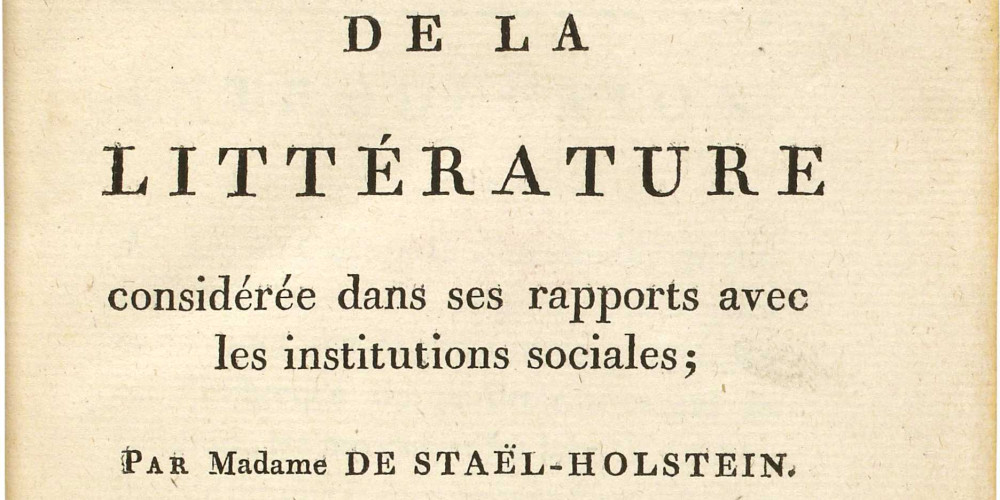
Staël’s great innovation was to refuse the idea that literature can be judged apart from the society that produces it. Political institutions, religion, climate, manners, historical experience and collective character all enter her account of literary form. The argument is recognizably Enlightenment in its ambition to classify civilizations, yet strikingly modern in treating literature as historically embedded rather than governed by one timeless classical norm.
This is also a book written after revolutionary catastrophe. Staël wanted to preserve intellectual liberty without pretending that ideas float harmlessly above political life. Her comparative attention to northern and southern Europe, republican and monarchical societies, ancient and modern literatures helped enlarge the conceptual space in which nineteenth-century literary history would operate.
Among the best books of 1800, it is the work that most clearly anticipates sociology of literature, comparative literature and cultural history at once. Its categories are often those of its period, but the governing question remains formidable: what happens to imagination when institutions change?
Die Bestimmung des Menschen

Fichte transformed an intimidating philosophical system into a drama of intellectual development. The Vocation of Man moves through doubt, knowledge and faith, beginning with the destabilizing possibility that nature may be an all-encompassing causal mechanism and ending with a practical conception of freedom grounded in moral activity.
The accessible form matters. Fichte is not merely simplifying his earlier Wissenschaftslehre; he is asking what philosophy means for a person forced to live after skepticism has dissolved naive certainty. Freedom becomes less a metaphysical possession than an ethical task. The self discovers its vocation in acting according to rational obligation rather than in securing theoretical mastery of an external world.
No account of the best books of 1800 can ignore the density of German Idealism that year. Fichte’s volume is especially valuable because its philosophical stakes remain visible beneath the terminology: how can we regard ourselves as responsible agents in a world apparently governed by necessity?
System des transcendentalen Idealismus

Schelling’s System attempts one of the boldest reconciliations in post-Kantian philosophy. If consciousness seems divided between knowing subject and known object, how can philosophy explain their correspondence without simply assuming it? Schelling reconstructs consciousness as a developmental process in which nature, intelligence and self-awareness belong to one larger movement.
The book culminates unexpectedly in art. Artistic production matters because it appears to reconcile conscious intention and unconscious creativity, freedom and necessity, subject and object. Aesthetics therefore becomes structural rather than ornamental: art reveals something philosophy has been trying to conceptualize throughout the system.
Within the best books of 1800, Schelling’s work captures the era’s appetite for total explanation more completely than almost anything else. It also exposes the ambition and danger of that appetite. Nature, history, consciousness and art are not separate specialist domains here; they are different manifestations of a single philosophical problem.
Kalligone

Herder wrote Kalligone partly against Kantian aesthetics, but its importance exceeds philosophical controversy. He resisted accounts of beauty that seemed to abstract judgment from embodied sensation, historical culture and the full range of human faculties. Art, for Herder, cannot be understood by isolating a supposedly pure spectator from the world that formed perception.
This emphasis places the book close to later historicist and anthropological approaches to aesthetics. Herder’s criticism can be combative, yet his positive intuition is powerful: artistic experience depends upon living bodies, inherited forms, language and culturally shaped sensibilities. Beauty is not merely a formal problem.
That makes Kalligone one of the best books of 1800 for understanding the transition from Enlightenment aesthetics toward the historically saturated humanities of the nineteenth century. It reminds readers that German Idealism did not advance without resistance, and that some of its most consequential alternatives arose from arguments about art.
Recherches physiologiques sur la vie et la mort

Bichat’s investigation of life and death helped shift medicine toward a physiological understanding of organisms organized through differentiated functions. He famously distinguished forms of life associated with organic processes from those involving relation, sensation and voluntary activity, and approached death as a sequence of physiological failures rather than a single mysterious instant.
Not all of his conceptual distinctions survived later biology. What matters historically is the method: life should be studied through organs, tissues, functions and experiments, while disease and death can reveal the organization normally hidden by successful living processes. The human body becomes a system whose breakdown can itself produce knowledge.
The inclusion of Bichat among the best books of 1800 prevents the year from looking like an exclusively literary-philosophical event. The same period that was rethinking consciousness and culture was also developing new ways to ask what a living organism actually is.
Researches, Chemical and Philosophical; Chiefly Concerning Nitrous Oxide
Davy’s first major book belongs to the heroic and occasionally reckless age of experimental chemistry. Working at the Pneumatic Institution in Bristol, he investigated nitrous oxide through systematic chemical experiments and repeated human inhalation, including experiments upon himself. The result combined laboratory description, physiological observation and unusually vivid reports of altered sensation.
The book matters beyond the later medical history of nitrous oxide. It embodies a new culture of experiment in which gases, bodily states and subjective reports could enter the same evidentiary field. Davy treated chemistry not as the manipulation of inert substances alone but as a discipline capable of crossing into physiology and medicine.
Few of the best books of 1800 make scientific discovery feel so immediate. Its procedures would not satisfy modern safety standards, but the intellectual energy is unmistakable: matter, consciousness and bodily experience could all be investigated through controlled intervention.
Phytologia; or, The Philosophy of Agriculture and Gardening

Erasmus Darwin’s enormous agricultural treatise tries to make cultivation answerable to physiology, chemistry and experimental reasoning. Roots, sap, plant reproduction, soils, fertilizers, drainage, disease and agricultural machinery appear within one continuous explanatory project. Farming is treated as an applied science of living systems.
The book can look eccentric from a modern disciplinary perspective because botany, medicine, chemistry, practical engineering and speculation remain intertwined. That mixture is precisely what makes it historically revealing. Knowledge had not yet hardened into the professional boundaries that would define later nineteenth-century science.
Among the best books of 1800, Phytologia represents the practical Enlightenment at its most ambitious: understanding nature should improve cultivation, technology and material life. It also illuminates the intellectual environment from which later evolutionary debates would emerge, without requiring us to read Charles Darwin’s theory backward into his grandfather’s very different biological framework.
Castle Rackrent

Edgeworth compresses generations of Anglo-Irish landlord failure into the voice of Thady Quirk, the apparently loyal steward whose narration is affectionate, selective and far from transparent. Property, debt, inheritance and colonial hierarchy become comic material without losing their political force. The reader is made to interpret a narrator who does not fully interpret himself.
The formal achievement is remarkable. Regional speech, glossary, pseudo-editorial framing and unreliable narration allow the novel to stage the problem of representing Ireland to readers across the Irish Sea. Published in the year of the Acts of Union, it cannot be detached from questions about who possesses land, who possesses historical memory and who gets to define national character.
Castle Rackrent is arguably the most consequential literary work among the best books of 1800. Its influence reaches toward the regional and historical novel, yet its lasting pleasure lies in the precision with which voice becomes political evidence.
Memoirs of Modern Philosophers

Hamilton’s novel belongs to the British ideological wars that followed the French Revolution. Rather than writing political theory directly, she dramatizes the social consequences of fashionable radical ideas associated with debates over reason, gender, education, marriage and individual autonomy.
Its polemical commitments are conservative, and modern readers need not share them to find the novel intellectually useful. Hamilton understood that arguments migrate from treatises into friendships, romances, households and expectations about how people ought to live. Philosophy becomes social behavior. The novel is therefore an unusually vivid document of the anxiety produced by the radical intellectual culture of the 1790s.
Two editions appeared during 1800, evidence of immediate demand. In a list of the best books of 1800, Hamilton deserves a place not because her political conclusions prevailed, but because she shows how revolutionary philosophy was received, caricatured and domesticated within popular fiction.
Monologen: Eine Neujahrsgabe
Published anonymously at the beginning of 1800, Schleiermacher’s Monologues turns philosophy inward without collapsing into private confession. Across a sequence of self-addresses, the individual considers reflection, testing, worldview, futurity, youth and age. The central concern is how a unique person can become fully individual while remaining part of an ethical and social world.
The prose belongs to the same Romantic environment that produced Schleiermacher’s writings on religion and his relationships with the Schlegel circle. Yet its individuality is not simple self-expression. The self must continually form itself through reflection and action; freedom becomes a practice of giving coherence to one’s life rather than withdrawing from common existence.
As the final selection among the best books of 1800, Monologen reveals how decisive inwardness had become at the threshold of the nineteenth century. Alongside Fichte’s vocation and Schelling’s system, it offers another answer to the post-Kantian question of what a free human being might be.
Related Book in Light Reading Guides
Prepare for Hegel’s Phenomenology of Spirit — a selective route through Kant and German Idealism.
Thinking Begins Here: Twenty Books That Teach You How to Read Philosophy.
Reason After the Barricades: Kant, Revolution, and the Discipline of Enthusiasm — further context for the political-philosophical world surrounding 1800.
Image Credits
De la littérature considérée dans ses rapports avec les institutions sociales — title-page image supplied by Bibliothèque nationale de France, BnF Essentiels.
Die Bestimmung des Menschen — 1800 title-page photograph surfaced through the ZVAB / AbeBooks antiquarian network.
System des transcendentalen Idealismus — digitized 1800 edition via Google Books; bibliographic first-edition identification cross-checked against Finarte.
Kalligone — first-edition volumes photographed by the bookseller and presented on ZVAB / Norddeutsches Antiquariat.
Recherches physiologiques sur la vie et la mort — historical title-page scan preserved through Wikimedia Commons and a digitized library copy.
Researches, Chemical and Philosophical; Chiefly Concerning Nitrous Oxide — digitized Oxford University copy via Google Books.
Phytologia — 1800 title-page photograph supplied by The Literary Lion and displayed through AbeBooks.
Castle Rackrent — first-edition 1800 title page from Eighteenth Century Collections Online, reproduced on Wikimedia Commons; public-domain historical work.
Memoirs of Modern Philosophers — 1800 second-edition title page from Jarndyce, displayed through AbeBooks.
Monologen: Eine Neujahrsgabe — digitized historical book image via Google Books / Google Play Books; 1800 first-publication record verified through Schleiermacher Digital.
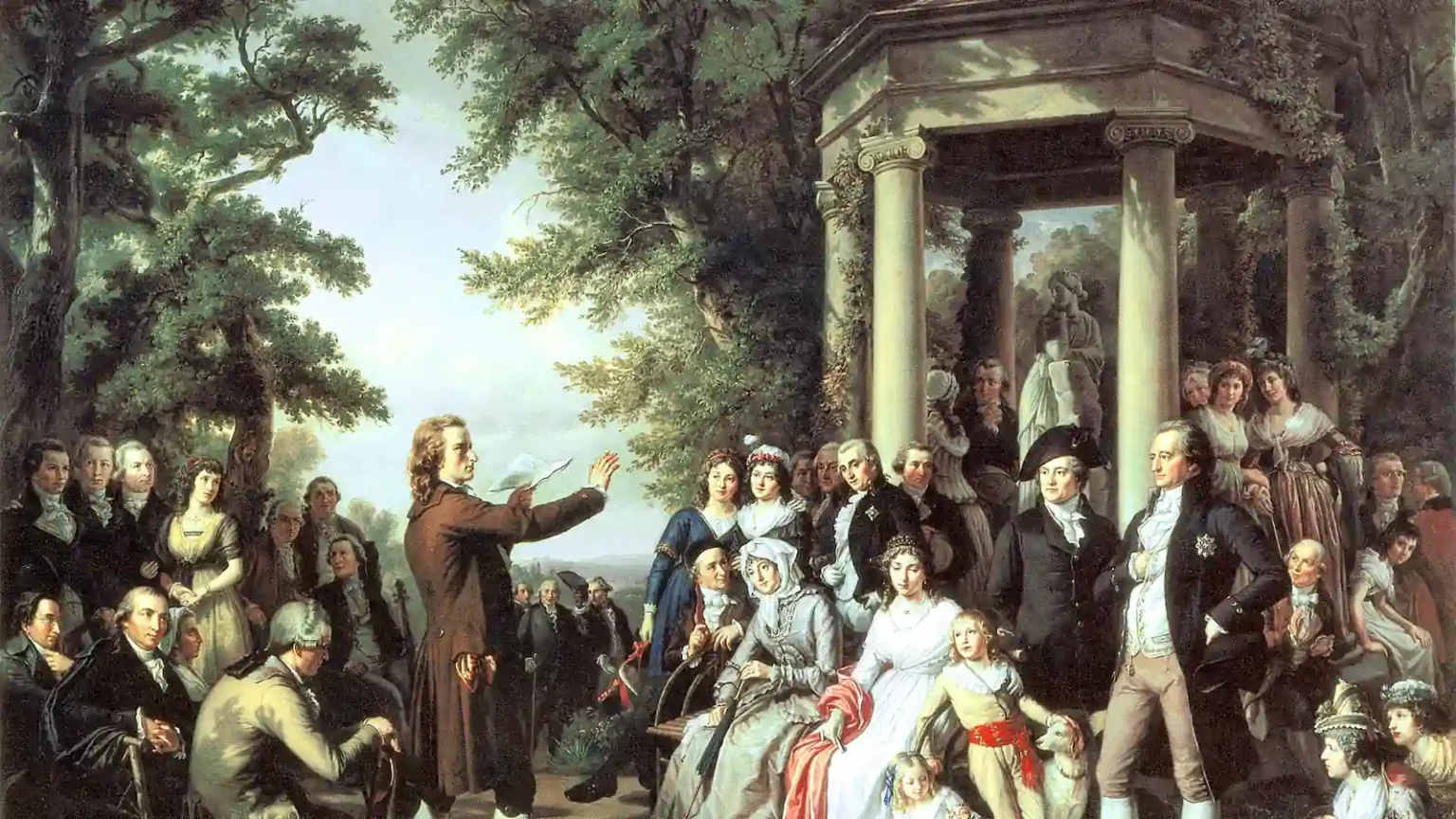
Image credit: Theobald von Oer — Source: Wikimedia Commons — License: Public Domain