Featured image credit: The Metropolitan Museum of Art. Rights: Public Domain / Open Access.
Ancient Philosophy
Estimated reading time: 28 minutes
The book often enters modern life disguised as a manual of serenity: a small volume of aphorisms, pale beside the large systems of philosophy, available for consolation whenever force has exhausted itself. Yet its enduring power lies in something sharper. It is not merely a poem of quietness; it is a discipline of de-intensification. It asks what remains of wisdom when ambition, language, government, morality, and even spiritual striving begin to harden into forms of coercion. Its central wager is that the world is not saved by stronger declarations, but by a more exact relation to what cannot be mastered.
Reading Lens
A theory of power that distrusts force, display, and the ambition to make reality fully legible.
Central Tension
A book of political counsel that repeatedly undermines the prestige of command.
Why Reread Now
Because contemporary life confuses optimization with wisdom and visibility with truth.
The common misunderstanding is to read this classic as an argument against action. That is too simple. Its deeper argument is against over-action: against the impulse to force a name onto what exceeds naming, to force social order into theatrical morality, to force leadership into spectacle, to force the self into a project of permanent improvement. Its doctrine of wuwei, often rendered as non-action or effortless action, is not passivity. It is the intelligence of limits. It is the art of not adding violence to the shape of things.

Page from a 1770 Japanese Wang Bi edition of the Dao De Jing, via Wikimedia Commons.
A Small Book Against the Empire of Forcing
The first thing to notice is its smallness. The work is brief, even austere, made of compact chapters whose density can deceive readers into treating them as isolated sayings. But the smallness is part of the form’s authority. It refuses the architecture of system. It does not build a palace of concepts in which each term is secured by definition. It moves by pressure, echo, reversal, and return. The reader is asked to inhabit a rhythm rather than master a doctrine. That rhythm is inseparable from the book’s philosophical force: the more it speaks of the way, the more it warns against capturing the way in speech.
The familiar opening, preserved in James Legge’s public-domain translation at Project Gutenberg, begins by undoing the authority of naming. This is not a decorative paradox. It establishes the intellectual conditions of the whole work. A name is useful; without names there is no shared world. But a name also freezes, isolates, and gives the mind the illusion that it has grasped the real. The book therefore begins by teaching suspicion toward its own medium. It speaks, but it speaks under discipline. It names, but it does not worship names. It gives counsel, but it mistrusts the kind of counsel that becomes command.
That suspicion gives the book its freshness today. We live in cultures that adore the explicit: policy statements, brand narratives, metrics, profiles, manifests, rankings, diagnoses, optimized routines. The unspoken assumption is that what can be made visible can be controlled, and what can be controlled can be improved. The book turns this assumption inside out. It does not deny that human beings need distinctions; it asks what happens when distinction becomes domination. It does not reject governance; it asks what governance becomes when it cannot stop intervening. It does not reject knowledge; it asks what knowledge becomes when it forgets mystery.
The book’s deepest argument is not that nothing should be done, but that action becomes wise only when it ceases to be intoxicated by its own force.
This is why the text has survived so many contrary appropriations. It can sound mystical, political, ethical, ecological, therapeutic, and poetic, sometimes in the same chapter. But its unity lies beneath those uses. It is a critique of excess intentionality: the will that presses too hard, the ruler who legislates too much, the moralist who turns virtue into performance, the thinker who mistakes explanation for contact, the ambitious person who destroys their object by trying to possess it. In this sense the book is not outside the world. It is a manual for inhabiting the world without tightening one’s fist around it.
The Problem of Laozi and the Authority of a Legendary Voice
Any serious reading must begin with a historical caution. The traditional image of Laozi as a single sage, older contemporary of Confucius, authoring the text in a moment of withdrawal from civilization, belongs to the symbolic life of the book; it cannot simply be treated as settled biography. The Stanford Encyclopedia of Philosophy entry on Laozi emphasizes the difficulty of separating the historical figure from legend, textual tradition, and later religious reverence. This uncertainty is not a defect external to the work. It shapes the way the work should be read.
The book’s voice does not behave like the voice of a modern author defending a thesis. It is more like a condensed archive of insight: courtly and anti-courtly, metaphysical and practical, aristocratic and anti-heroic, skeptical of ritual yet capable of immense spiritual gravity. Its authority does not depend on a stable authorial biography. Indeed, the absence of a fully recoverable author may suit the text better than a firm biography would. A book that distrusts named possession has itself entered history through uncertain names, competing arrangements, and long traditions of commentary.
This does not make the book vague. On the contrary, it gives its sentences an impersonal exactness. They speak from a place where individual brilliance has been pared down. The effect is not anonymity as weakness, but anonymity as philosophical style. The voice is memorable because it does not dramatize itself. Even when it is severe, it does not ask to be admired. It continually redirects attention away from the sage, the ruler, the teacher, the victor, the possessor of knowledge. What matters is not the personality of wisdom, but the pattern by which wisdom withdraws from spectacle.
The historical complexity is deepened by the manuscript record. The Library of Congress record for a Song edition of the Laozi Dao de jing notes the importance of the Heshanggong tradition and also identifies the Guodian bamboo texts and the Mawangdui silk texts as among the earliest surviving witnesses. These discoveries matter because they remind us that the book was not delivered to posterity as a finished monument. It was transmitted, arranged, reversed, commented upon, and re-situated. The book’s history is a history of formation.
That formation should make us more attentive, not less. A modern reader may be tempted to ask which version is the real one, as if textual history were an inconvenience to be eliminated. But the book itself teaches another habit: the real is not always what appears in the firmest outline. The tradition’s instability is not a license for careless interpretation; it is a demand for humility. We should read slowly, knowing that each English rendering is a crossing, each chapter a node in a long history, each key term a field of tension rather than a verbal object safely owned by translation.
Dao: Not a Concept to Possess, but a Limit to Conceptual Possession
The most serious mistake is to translate the central term into a familiar Western abstraction and then proceed as though the problem were solved. To call Dao the Way is useful, but only if usefulness does not become closure. Way suggests path, process, pattern, course, and movement. It suggests that reality is not a dead object but an ongoing unfolding. Yet the book resists turning Dao into an object of doctrine. The moment Dao becomes a thing one can claim, display, or define, it has already been reduced.
This is why the text’s metaphysical subtlety cannot be separated from its ethical discipline. The world, for this book, is injured when the mind converts relational reality into rigid possession. Names create boundaries; boundaries create manipulation; manipulation invites force. But the answer is not speechlessness. The book itself speaks with unforgettable compression. Its lesson is more difficult: use names without surrendering to them. Distinguish without absolutizing distinction. Act within form while remembering what exceeds form.
The Dao is therefore not simply hidden. It is hidden by overexposure. It is what the mind misses when the mind insists too aggressively on seeing. This is one reason the book returns to images of the valley, the watercourse, the uncarved block, the infant, the feminine, the low place. These are not sentimental decorations. They are counter-images to mastery. The valley receives without proclaiming. Water nourishes without theatrical assertion. The infant has power before self-conscious competition. The uncarved block names potential before social carving. The feminine, in the text’s ancient symbolic register, often indicates generative receptivity rather than public domination.
Some modern readers are rightly cautious about essentializing gendered imagery. The book’s symbolic use of the feminine belongs to a historical world very different from ours, and it should not be converted into a simplistic doctrine about women or men. Yet the conceptual point remains potent: the text uses culturally available images of receptivity to criticize the prestige of aggression. It asks why human beings repeatedly mistake hardness for strength. It asks why rulers, moralists, and ambitious persons believe that effectiveness must announce itself. It asks why the loud form of power so often destroys the conditions of life it claims to secure.
In this light, Dao is not merely a metaphysical principle. It is a critique of epistemic arrogance. To know the Dao is not to possess a map of totality. It is to learn how not to mistake a map for the real. This is why the book remains philosophically serious. Its paradoxes are not riddles designed to sound profound. They enact a precise pressure on habits of cognition. The reader is not invited to abandon reason, but to notice where reason becomes domination disguised as clarity.

A fragment associated with the Mawangdui Taoist manuscripts, a reminder that the text’s history is material as well as philosophical. Image via Wikimedia Commons.
De: Power Without Exhibition
The second term in the title is often translated as virtue, but the English word can mislead. Virtue easily suggests moral excellence as a property of the individual character, perhaps even as something visible, admirable, and socially approved. The book’s de is stranger. It refers to potency, efficacy, integrity, and the manner in which the Dao is embodied in things. It is not primarily moral exhibition. It is power that has not become theatrical.
This distinction is crucial. The book repeatedly distrusts the moment when virtue becomes conscious of itself as virtue. Once goodness becomes performance, it is already declining. Once righteousness must announce itself, something more primary has been lost. This is not cynicism. It is a diagnosis of moral inflation. In a society where spontaneous alignment has failed, moral categories proliferate as compensation. The louder the language of virtue becomes, the more it may testify to the disappearance of a deeper order.
The point is unsettling because it cuts against both ancient and modern forms of moral publicity. We are accustomed to thinking that ethical life improves when values are declared more explicitly. Sometimes it does. Silence can protect cruelty, and public norms can restrain harm. The book does not give us an easy rule against moral language. It gives us a warning: when moral language becomes a substitute for transformed relation, it produces vanity. It allows people to possess goodness as identity rather than practice it as attunement.
Here the book’s critique of virtue joins its critique of rule. The ruler who constantly displays authority produces dependence, resentment, or fear. The moralist who constantly displays virtue produces imitation without depth. The thinker who constantly displays knowledge produces disciples of vocabulary rather than wisdom. The book’s ideal figure is effective precisely because their effectiveness is not staged. They do not disappear from responsibility; they disappear from vanity.
This is one of the reasons the book can be read as a philosophy of leadership, though not in the shallow managerial sense that often absorbs ancient texts into modern self-help. Its leadership teaching is radical because it questions the egoic basis of leadership itself. The best ruler is not the most charismatic presence, the most articulate policy maker, or the strongest central will. The best ruler creates conditions under which life can order itself with minimal distortion. This is not a celebration of incompetence. It is a discipline of restraint so demanding that most ambitious people will never tolerate it.
Wuwei and the Intelligence of Not Adding Violence
No term has been more easily simplified than wuwei. Rendered as non-action, it can sound like withdrawal from responsibility. Rendered as effortless action, it can sound like a graceful psychological state. Both renderings contain something, but neither is enough. The term names an action freed from the compulsion to impose. It is not a refusal to respond; it is a refusal to force response into the shape of ego.
A useful way to understand it is to distinguish intervention from attunement. Intervention begins with the will’s plan and presses the world toward that plan. Attunement begins by reading the configuration of things: timing, resistance, tendency, proportion, mood, and consequence. The book does not deny that intervention may sometimes be necessary. But it sees the human appetite for intervention as dangerously self-justifying. Once people are convinced that they alone know the proper form of order, coercion becomes easy to describe as care.
The Internet Encyclopedia of Philosophy’s discussion of Laozi helps clarify why the text should be read both as a philosophical work and as a text whose authorial identity has been shaped by later tradition. That double status matters for wuwei. The idea is not merely private spirituality; it is woven into a broader vision of cosmology, ethics, and statecraft. To practice wuwei is to recognize that the same pattern that damages personal life also damages political life: over-assertion produces counterforce.
The book’s political chapters are sometimes shocking because they refuse the heroic imagination of rule. They distrust conquest, legal severity, ostentatious wealth, ambitious reform, and moralized control. They understand that power often creates the disorder it then claims to cure. A ruler multiplies prohibitions; people become ingenious in evasion. A society glorifies weapons; violence acquires prestige. Leaders impose grand designs; the texture of ordinary life is torn. The book’s answer is not anarchy, if by anarchy we mean mere chaos. Its answer is a lighter, subtler, less self-intoxicated order.
This is why wuwei should not be confused with laziness. Laziness avoids effort because effort is burdensome. Wuwei refuses forcing because forcing is inaccurate. It demands attention, discipline, patience, and a willingness to let go of the prestige of visible agency. It may be one of the most difficult forms of action precisely because it deprives the actor of theatrical self-confirmation. To act without forcing is to act without constantly proving that one is acting.
Wuwei is not the absence of responsibility; it is responsibility purified of the need to dominate the scene.
The Anti-Heroic Politics of the Low Place
The book’s political imagination is inseparable from its imagery. Water is powerful because it seeks the low place. The valley is fertile because it receives. The sage does not compete, and therefore is difficult to defeat. The ruler who remains behind may preserve what the ruler who rushes forward destroys. These are not merely moral maxims; they amount to an anti-heroic theory of political order.
Heroic politics depends on display. It needs dramatic acts, visible enemies, narratives of conquest, and figures who condense collective anxiety into personal command. The book distrusts this structure at its root. It sees that the desire to appear strong often makes states brittle. It sees that the craving for decisive intervention may emerge less from wisdom than from impatience. It sees that rulers who cannot tolerate obscurity will create crises in order to appear necessary.
Chad Hansen’s Stanford Encyclopedia of Philosophy entry on Daoism situates Daoist thought among the classical Chinese schools and highlights its distinctive resistance to war and punishment. That context matters because the book was not written for an abstract world of private contemplation. It emerged from a civilization of competing states, ritual traditions, administrative ambitions, military violence, and intellectual schools arguing over order. Its quietness is not naïve. It is quietness against a background of historical noise.
Seen in that background, the book’s preference for softness becomes a form of realism. Hard power appears decisive until it meets resistance, decay, succession, resentment, scarcity, or chance. Softness appears weak until one recognizes its capacity to endure, adapt, and enter what hardness cannot enter. Water is not sentimental. It erodes stone. The low place is not humiliation. It is where the streams gather. The book’s anti-heroism is therefore not a fantasy of harmlessness. It is a different account of efficacy.
This account has obvious dangers if flattened into a universal rule. There are moments when passivity serves injustice, when the language of harmony masks domination, when counsel against resistance benefits the powerful. A responsible modern reading must acknowledge this. The book cannot be mechanically applied to every political crisis. But its warning remains indispensable precisely because modern politics so often suffers from the opposite disease: the compulsion to escalate, announce, polarize, classify, mobilize, and overwhelm. The book offers not a complete political program, but a severe corrective to the intoxication of command.
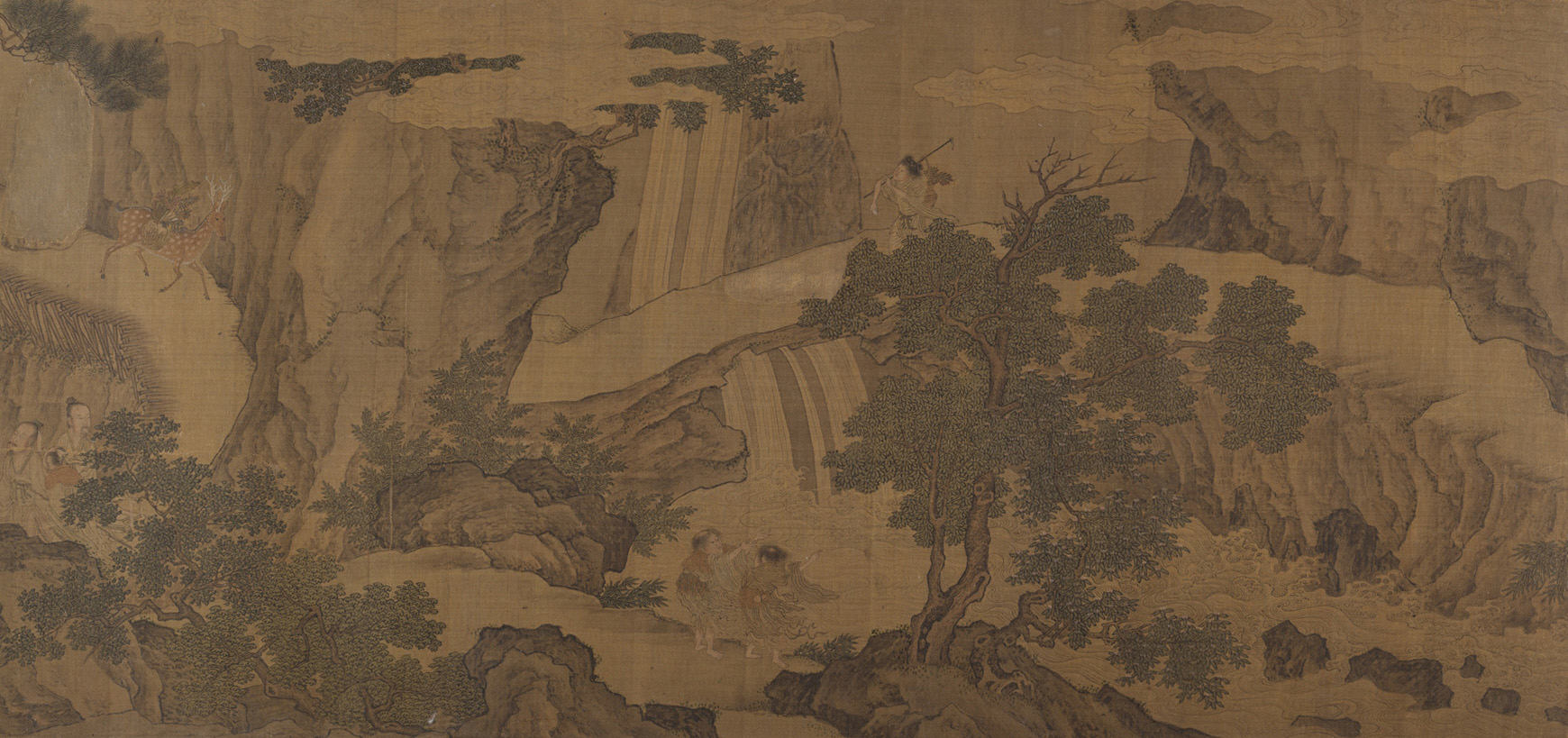
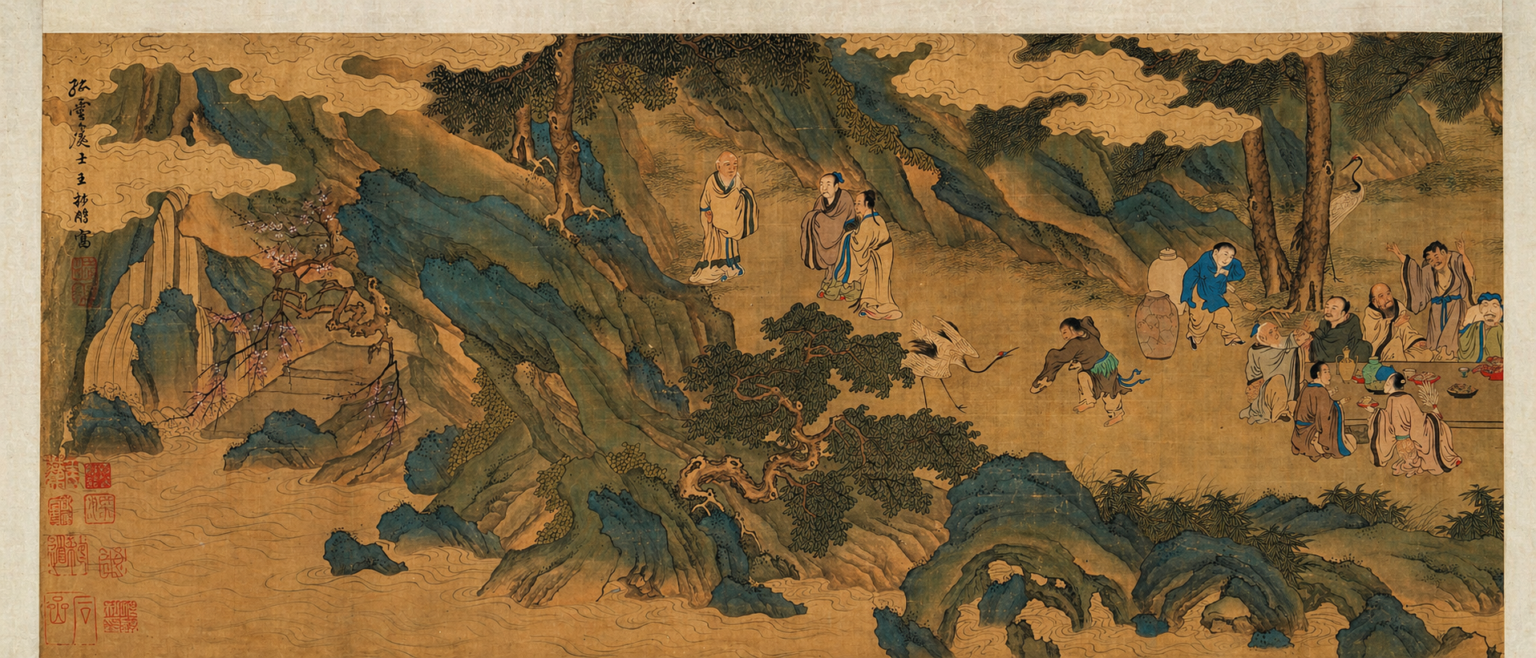
Daoist immortals in a landscape, a Ming-dynasty handscroll that visualizes a later Daoist imaginary of retreat, cultivated perception, and mountain otherworlds. Image from The Metropolitan Museum of Art.
Against the Career of the Self
The book’s political critique has a personal counterpart. Just as the ruler damages the world by imposing too much, the self damages itself by making identity into a project of force. The modern reader may recognize this immediately. We are surrounded by languages of self-construction: productivity systems, personal brands, quantified habits, curated vulnerability, disciplined bodies, optimized sleep, optimized attention, optimized emotion. Some of this can be useful. Much of it becomes a softer tyranny. The self becomes both ruler and subject, constantly governing itself under the sign of improvement.
The book would not simply tell such a person to abandon discipline. It is not a hymn to chaos. Rather, it would ask whether the discipline is making the person more alive or more rigid. It would ask whether effort has become self-violence. It would ask whether clarity has become control. It would ask whether the person is cultivating life or curating evidence of life. The difference is immense.
One reason the book’s style remains powerful is that it refuses to flatter ambition even when ambition takes refined forms. Spiritual ambition is still ambition. The desire to be known as wise is still the desire to be known. The desire to conquer desire may become another conquest. The desire to be natural may become the most artificial performance of all. The book’s irony is gentle but devastating: the ego can use even humility as ornament.
This is why the text repeatedly turns toward images prior to social carving. The infant, the uncarved block, the plain cloth, the valley, the root: each image asks the reader to imagine a form of life before the anxieties of status have seized it. The point is not nostalgia for biological infancy or primitive society. It is a critique of second-order consciousness: the mind watching itself being good, strong, spiritual, efficient, admirable. The book seeks a return, but not a childish return. It seeks a mature return from theatrical selfhood to responsive presence.
Such a return is not anti-intellectual. It is anti-vanity. The learned person may need it as much as the politician or merchant. Scholarship can also become a form of possession: possessing references, possessing distinctions, possessing superiority over simpler readers. The book quietly humiliates that impulse. It does not despise learning; it despises the pride that attaches itself to learning. Its wisdom is not ignorance. It is knowledge released from the compulsion to dominate.
Translation, Loss, and the Necessity of Humble Reading
No English reader encounters the book without mediation. This is not a minor technical point; it is central to the book’s fate. The text’s Chinese is compressed, multivalent, and rhythmically forceful. Key terms do not map cleanly onto English metaphysical vocabulary. The same line may invite philosophical, political, cosmological, and practical readings. Translation is therefore not a transparent window. It is an interpretation with consequences.
This has produced a remarkable history of English versions: missionary, poetic, philosophical, popular, scholarly, experimental. Some emphasize mysticism, some politics, some naturalness, some linguistic precision, some contemporary readability. The result can be confusing, but the confusion is instructive. The book teaches that naming is necessary and insufficient; translation becomes the living proof of that lesson. Each translation names the text again, and each name both reveals and conceals.
The discoveries of the Mawangdui and Guodian materials intensified these questions. Alan Chan’s Stanford discussion of Laozi notes the importance of the Mawangdui arrangement, where the sections associated with virtue precede those associated with the way in some manuscripts. This reversal matters because it unsettles the assumption that the received title and order are simply natural. It does not destroy the received text; it reminds us that textual authority is historical, layered, and contested. A modern scholarly article such as Thomas Michael’s open-access study on debated questions in early Chinese manuscript interpretation, published in Religions, shows how alive these questions remain.
What follows for the general reader? Not paralysis. One need not become a specialist in early Chinese philology to read the book seriously. But one should give up the fantasy of the perfect, final, transparent English version. Better to read comparatively when possible. Better to notice where translators differ on a key term. Better to treat aphorisms not as detachable motivational lines but as elements in a difficult economy of thought. Better to resist the temptation to make the book say exactly what one already believes.
This last temptation is especially strong because the book is hospitable. It seems to welcome many modern concerns: ecology, anti-authoritarianism, psychological balance, spiritual practice, feminist critique of hardness, skepticism toward technocracy. But hospitality is not permission to reduce. The book is not a mirror for our preferences. It is an ancient challenge to our preferences. To read it well is to let it interrupt us.
Nature Without Sentimentality
Modern readers often approach the book as a text of nature, and there is good reason for this. Its images of water, valley, root, tree, infant, and uncarved wood make the human world answerable to a more-than-human order. It asks human institutions to remember proportion. It refuses the fantasy that society can be remade entirely by will. In that sense it offers a powerful antidote to technological arrogance.
But the book’s nature is not a romantic garden. It is not scenery for the exhausted urban mind. It is pattern, process, and impersonal generativity. Nature is not praised because it is cute, innocent, or emotionally comforting. It is authoritative because it acts without vanity. It produces without self-advertisement. It transforms without manifesto. It lets things arise and pass. Its power is not sentimental softness but unforced continuity.
This matters for ecological readings. The book can certainly deepen ecological humility, but not because it offers modern environmental policy in ancient form. It matters because it attacks the metaphysical arrogance beneath ecological crisis: the assumption that the world is raw material for projects of accumulation, extraction, and display. It asks us to see that domination is not merely a political problem. It is a way of perceiving. To perceive the world as possession is already to begin damaging it.
The book’s ecological force, then, lies in its discipline of scale. It repeatedly draws human beings away from inflation. The sage does not stand at the center. The ruler does not own the order. The thinker does not exhaust reality with names. The self is not sovereign over the world. This decentralization is severe. It reduces the human ego, yet it also releases human life from the impossible burden of mastery.
In an age of climate anxiety, artificial intelligence, surveillance systems, and managerial metrics, this lesson is not quaint. The desire to control complex systems often produces new layers of fragility. The answer is not to abandon intelligence, science, or institution-building. The answer is to ask whether intelligence has become domination, whether measurement has become blindness, whether action has become forcing. The book’s old language gives us an unusually modern question: what would it mean to act within complexity without pretending to stand above it?
The Book’s Religious Afterlife and Its Philosophical Core
The book did not remain only a philosophical text. Laozi became a sacred figure in religious Daoist traditions; the text was recited, commented upon, ritualized, and absorbed into wider cosmologies of body, heaven, governance, alchemy, and immortality. The Stanford entry on religious Daoism helps distinguish the later religious developments from a narrow philosophical reading. For modern readers, this afterlife should neither be ignored nor collapsed into the original text.
The distinction between philosophical Daoism and religious Daoism can be useful, but it can also become too neat. Traditions do not live in the tidy compartments created by modern curricula. A sentence that begins as political counsel may become ritual wisdom; a cosmological image may become bodily practice; a metaphysical term may enter devotional life. The book’s compactness made it unusually available to transformation. It could be read by rulers, hermits, poets, monks, translators, rebels, scholars, and seekers because it did not exhaust itself in one institutional home.
Yet its philosophical core remains legible through these transformations. Again and again, it returns to the same pressure: do not confuse the secondary with the primary. Ritual can become empty display. Law can become violence. Knowledge can become pride. Desire can become compulsion. Rule can become overreach. Even religion can become grasping. The book’s religious afterlife is therefore fascinating partly because the text itself contains a discipline that can criticize religious inflation from within.
This may explain why it continues to move readers who do not belong to any Daoist community. Its power does not require conversion into a creed. It asks for a change in posture. The shoulders lower. The mind stops rushing to possess. The will notices its own violence. The reader begins to feel how much of ordinary life is organized around unnecessary tightening. That change is philosophical, ethical, and almost spiritual, but it remains difficult to confine to any one category.
What Is Misunderstood About the Book
The most persistent misunderstanding is that the book recommends withdrawal from the world. It is easy to see why. The text praises simplicity, lowliness, softness, silence, and non-contention. It criticizes ambition, war, cleverness, luxury, and over-government. But withdrawal is not the whole of the matter. The book is addressed again and again to rulers, sages, communities, and people acting in relation. It is deeply concerned with the conditions under which life can flourish without being crushed by imposed design.
A second misunderstanding is that the book is anti-moral. It criticizes visible righteousness, but that does not make it nihilistic. Rather, it asks whether moral vocabulary can become a symptom of moral loss. When genuine attunement declines, societies compensate with codes, displays, and punishments. This diagnosis is uncomfortable because it suggests that the loudest moral cultures may not be the healthiest ones. But it does not excuse cruelty. It calls for a deeper form of ethical life, one less dependent on performance.
A third misunderstanding is that the book is irrational. Its suspicion of names is not a rejection of thought; it is a refinement of thought. It asks thought to recognize its own edges. It exposes the violence by which concepts pretend to totality. This is not the enemy of reason. It is reason becoming more honest about its conditions.
A fourth misunderstanding is that the book’s softness is politically harmless. In fact, the text’s softness is often sharper than open rebellion. It undermines the glamour of domination at the level of imagination. It deprives conquest of metaphysical prestige. It makes the ruler’s desire to appear necessary look childish. It treats war not as glory but as failure. It questions the entire theatre by which power persuades people that force is wisdom.
Finally, the book is misunderstood when it is treated as a collection of decorative quotations. Its sentences are memorable, but they are not ornaments. They belong to a sustained critique of forcing. Detached from that critique, they become soothing fragments. Returned to that critique, they become demanding.
Why It Still Matters
The book matters because it speaks to a crisis deeper than policy, mood, or fashion. It speaks to the human tendency to turn contact into possession. We do this with ideas, people, institutions, nature, and ourselves. We name in order to understand, then forget that the name is not the thing. We act in order to help, then forget how easily help becomes control. We cultivate virtue, then begin admiring ourselves for being virtuous. We seek order, then produce deadness. We seek clarity, then flatten the real.
The book offers no escape from this tendency. It offers a discipline against it. Its sentences return the reader to a threshold: speak, but know that speech is partial; act, but do not force; govern, but do not suffocate; learn, but do not worship knowledge; desire, but notice when desire becomes captivity; be strong, but do not confuse strength with hardness. This is not a doctrine of weakness. It is a doctrine of exactness.
Its value today is especially clear in a culture of acceleration. The faster systems move, the more valuable restraint becomes. The more institutions rely on metrics, the more important it becomes to remember what metrics cannot see. The more identities are performed, the more liberating it becomes to imagine a self not organized around display. The more politics becomes theatrical force, the more urgent it becomes to recover forms of power that do not need constant spectacle.
To reread the book now is not to retreat into ancient wisdom as a decorative refuge. It is to submit our modern certainties to an older and more patient intelligence. The text will not solve our problems for us. It will not give us a ready-made politics, psychology, ecology, or metaphysics. But it can change the quality of attention with which we approach all of them. That may be its most durable gift.
The book endures because it asks a question every age must answer again: how much damage is done by people certain that they are bringing order?
The Lasting Lesson of the Unforced
The book’s final lesson is not quietism, though it loves quiet. It is not mystification, though it protects mystery. It is not anti-politics, though it mistrusts domination. It is not anti-knowledge, though it wounds intellectual pride. Its lesson is the unforced: a way of being in which action arises from attention rather than compulsion, speech from necessity rather than vanity, leadership from restraint rather than appetite, and wisdom from contact rather than possession.
The unforced is difficult because it cannot be faked. One can perform humility, but performance betrays itself. One can praise simplicity while building an identity around simplicity. One can quote the book as proof of depth while using it as ornament. The text is severe toward all such secondary gestures. It asks not what we admire, but how we move. It asks not what we claim to know, but whether knowledge has made us less violent toward what exceeds us.
This is why the book remains alive after centuries of commentary, translation, appropriation, and misreading. It continues to resist possession. Every generation tries to name it: mystical manual, political treatise, metaphysical poem, proto-ecological text, handbook of leadership, scripture of simplicity. Each name is partly right. None is enough. The book survives by exceeding the names that carry it.
To read it well is to accept that excess. The reader does not come away with a doctrine to display, but with a changed sensitivity to force. One begins to hear the violence in excessive explanation, the vanity in excessive virtue, the fragility in excessive control, the fear beneath excessive ambition. One begins to suspect that wisdom may not always look like assertion. It may look like timing, silence, proportion, retreat, or care that does not advertise itself.
The book still matters because the world is full of people trying to save things by forcing them. It asks for another possibility: not inaction, not surrender, not vagueness, but action so accurate that it no longer needs to exaggerate itself. That is why this ancient text remains more than a classic. It is a continuing rebuke to every age that mistakes pressure for power.