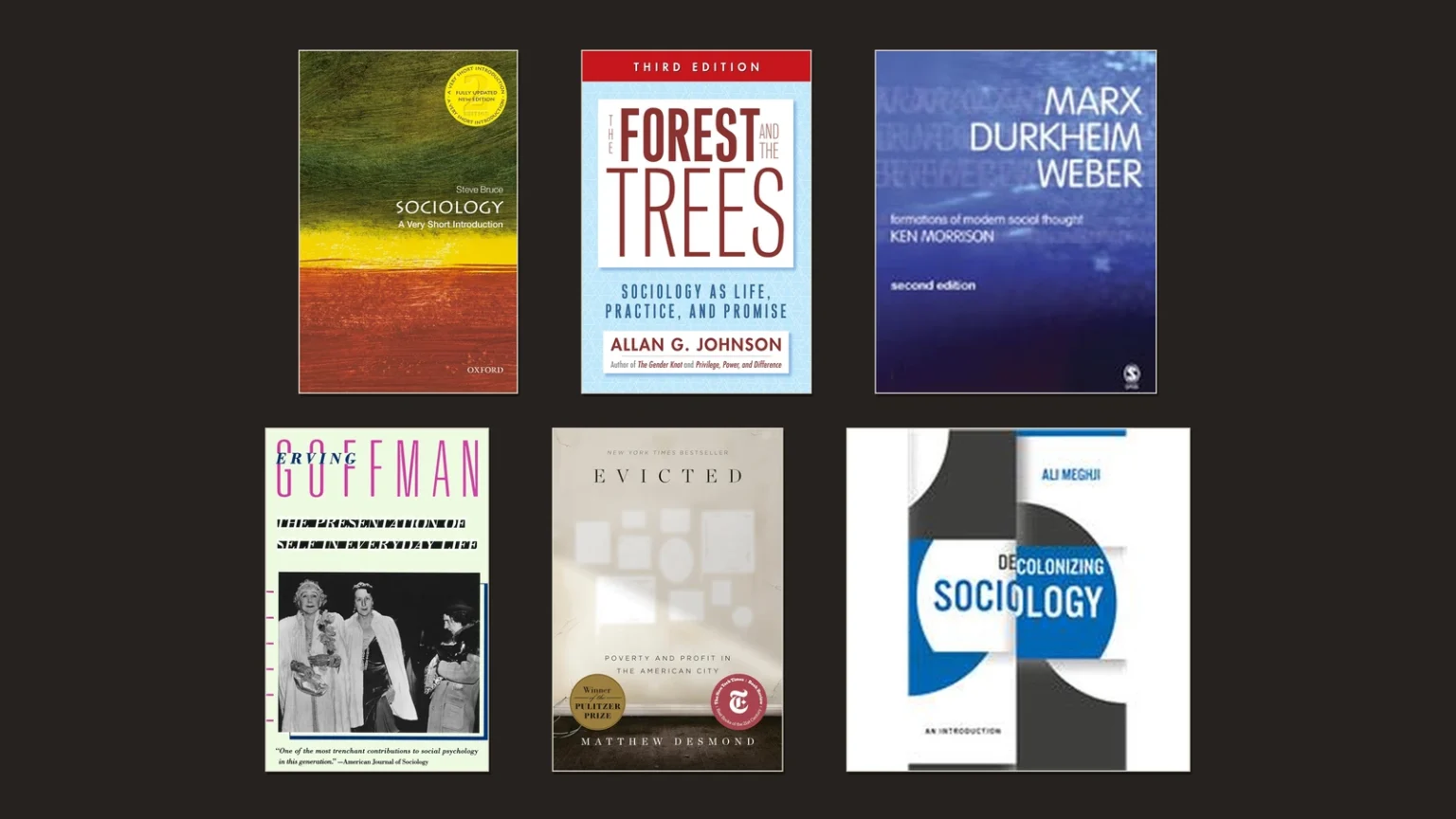
The best sociology books for beginners should teach a way of seeing, not merely supply famous names. These 20 curated books move from accessible orientation to classical theory, contemporary inequality, and decolonial critique, with exact publisher and Amazon links for every edition. The sequence helps first-time readers decide what to read now while giving advanced readers a clear route toward demanding primary texts.
Affiliate note: Book in Light may earn a small commission if you buy through some of the links on this page, at no extra cost to you. We include books only when they serve the editorial purpose of the reading guide.
Quick Answer
Among the best sociology books for beginners, start with Steve Bruce’s Sociology: A Very Short Introduction; use The Sociology Book as a visual reference and Allan Johnson for structure and agency. For deeper study, move to C. Wright Mills, then Morrison’s guide to Marx, Durkheim, and Weber. Do not read all 20 mechanically: follow the pathway that matches your question.
How to Use This Reading List
Not every reader needs all 20 books. A complete beginner should first acquire three things: a vocabulary, a sense of sociology’s questions, and the habit of moving between individual experience and social structure. Books 1–3 do that work. Book 4 is a reference to consult by topic, while Books 5–7 develop the discipline’s characteristic stance toward reality and institutions.
The classical route begins with Mills and Morrison before turning to Durkheim and Weber. This order matters. Primary texts are not automatically the best sociology books for beginners simply because they are canonical; an interpretive bridge prevents difficult historical arguments from becoming slogans. The International Sociological Association’s twentieth-century ranking shows the continuing prominence of several classics, but prominence and accessibility are different judgments.
Readers interested in everyday life can move from Goffman to Hochschild. Those focused on inequality can follow Bourdieu, Collins, Fields and Fields, Desmond, and Alexander. The final route, through Meghji and Bhambra and Holmwood, reopens the history and institutional organization of sociology itself. The American Sociological Association’s account of the discipline and its current sections make clear why no single linear sequence can represent the field. Use the Reading Map to choose a route, not to obey a ranking.
Best Sociology Books for Beginners: The 20 Books

Book 1 of 20 · BEGINNER
1. The Sociology Book: Big Ideas Simply Explained by Sarah Tomley, Mitchell Hobbs, Megan Todd, and Marcus Weeks
Publisher: DK | First published: 2015 | Edition shown: 2019 US trade paperback, ISBN 9781465478542
Beginner
This is the most useful visual orientation on the list. Its short entries, timelines, diagrams, and cross-references introduce major concepts—socialization, bureaucracy, class, deviance, gender, race, globalization—while showing how particular thinkers entered larger debates. That architecture makes it especially good for readers who do not yet know which branch of sociology interests them. The trade-off is compression: arguments that occupy whole books appear here as a few pages, and disagreement can look cleaner than it really is. Use it as a map, not as the territory. Read several entries before beginning Steve Bruce or Allan Johnson, then return whenever a name or school becomes confusing. Unlike a conventional textbook, it rewards browsing; unlike a primary classic, it does not demand prior historical knowledge. A complete beginner can gain vocabulary and orientation quickly, but should resist treating its summaries as final interpretations.
Best for: Visual learners who want a broad map before reading theory in full.
Why read it: It turns an unfamiliar discipline into a navigable set of concepts without pretending that diagrams can replace sustained reading.

Book 2 of 20 · BEGINNER
2. Sociology: A Very Short Introduction by Steve Bruce
Publisher: Oxford University Press | First published: 2000 | Edition shown: 2018 second-edition paperback, ISBN 9780198822967
Beginner
For most readers, this is the best single starting point. Bruce presents sociology as an evidence-seeking discipline concerned with patterned social relations, institutions, inequality, belief, and change. He is particularly good at distinguishing sociological explanation from moral commentary and everyday common sense. The book is concise without becoming a glossary: examples carry the argument, and methodological questions remain visible throughout. It therefore performs a different function from the more pictorial DK volume and the larger Giddens textbook. Bruce gives you a disciplined sense of what counts as a sociological question and what kinds of evidence might answer it. His selections inevitably reflect one scholar’s priorities, so no pocket introduction can represent the field’s full theoretical or global diversity. Read it first, then move to Mills for the discipline’s imaginative vocation and Johnson for the relation between individuals and social systems. Its brevity also makes it a useful reread after several classics.
Best for: The reader who wants one compact, serious first book.
Why read it: Bruce explains what sociologists actually do, not merely what famous sociologists once said.

Book 3 of 20 · BEGINNER
3. The Forest and the Trees: Sociology as Life, Practice, and Promise by Allan G. Johnson
Publisher: Temple University Press | First published: 1997 | Edition shown: 2014 third-edition paperback, ISBN 9781439911877
Beginner
Johnson’s central metaphor is simple but powerful: people are the trees, social systems the forest, and neither can be understood in isolation. From that premise he explains participation, paths of least resistance, privilege, culture, and institutional patterns. The result is an unusually clear introduction to the structure–agency problem—the question of how people make choices within conditions they did not choose. Johnson is also more explicit than many introductory books about how inequality persists without requiring every participant to hold consciously malicious intentions. That makes the book valuable before reading Collins, Fields and Fields, or Desmond. Its strength is conceptual clarification rather than a survey of sociology’s entire history, so it should accompany, not replace, Bruce or a textbook. Some examples are rooted in the United States, but the analytical distinction between individuals and systems travels well. Read it early and slowly; the vocabulary is accessible, yet its implications become more demanding as the argument proceeds.
Best for: Readers struggling to connect personal choices with institutions and inequality.
Why read it: Johnson makes the structure–agency problem intelligible through ordinary situations rather than abstract vocabulary.

Book 4 of 20 · GENERAL
4. Sociology, 10th Edition by Anthony Giddens and Philip W. Sutton
Publisher: Polity | First published: 1989 | Edition shown: 2026 tenth-edition paperback, ISBN 9781509564125
General
A large textbook is useful when treated as a reference rather than a test of endurance. Giddens and Sutton range across social interaction, families, education, work, class, gender, race, media, politics, globalization, environment, and social change, linking concepts to research and contemporary cases. The tenth edition is the most current broad survey in this list, which matters in a discipline whose empirical material changes faster than its classics. Its scale is also its limitation: reading from page one to the end can flatten the difference between foundational questions and specialist subfields. Begin with the chapters that match your interests, use the index aggressively, and pair topical chapters with one primary or research-based book. Compared with Bruce, this volume offers far more coverage; compared with Mills, it is less a manifesto for sociological thinking than an organized account of what the field studies. It belongs on a beginner’s desk, but not necessarily at the beginning of every reading session.
Best for: Students who want a current, full-scale reference covering the discipline’s major domains.
Why read it: It supplies breadth, empirical examples, and disciplinary organization that shorter introductions cannot provide.
Book 5 of 20 · GENERAL
5. Invitation to Sociology: A Humanistic Perspective by Peter L. Berger
Publisher: Anchor Books | First published: 1963 | Edition shown: 1963 Anchor paperback, ISBN 9780385065290
General
Berger offers an invitation in the literal sense: not a comprehensive course, but an account of the curiosity, skepticism, and intellectual pleasure that animate sociological inquiry. He asks readers to look behind respectable appearances, examine institutions as human productions, and notice how roles and social expectations organize conduct. The prose is lively, sometimes mischievous, and far less technical than the primary classics. That makes the book an excellent bridge from a brief introduction to more conceptual works such as Berger and Luckmann’s The Social Construction of Reality. It also shows its age. Some examples, assumptions, and formulations belong unmistakably to early-1960s American sociology, and the discipline has changed profoundly in its treatment of race, gender, colonialism, and standpoint. Read Berger for the stance he models, not as a complete picture of present-day sociology. Pair him with Collins or Meghji so that the question “who gets to define reality?” remains attached to power and institutional exclusion.
Best for: Readers drawn to sociology as a way of seeing beneath official explanations.
Why read it: Berger conveys the intellectual temperament of sociology with more wit than most introductory manuals.

Book 6 of 20 · GENERAL
6. The Sociological Imagination by C. Wright Mills
Publisher: Oxford University Press | First published: 1959 | Edition shown: 2000 fortieth-anniversary paperback, ISBN 9780195133738
General
Mills names the capacity sociology tries to cultivate: seeing how biography and history meet within social structure. Unemployment, debt, divorce, anxiety, or military service may feel private, yet their distribution and meaning depend on institutions and historical change. That movement from individual experience to public issue remains the book’s great pedagogical achievement. Mills also attacks two tendencies in mid-century American sociology—abstract systems detached from lived problems and data collection without a consequential question. Those polemics are historically specific, and later chapters are harder than the celebrated opening. Beginners should read the first chapter carefully, continue through the critique, and return after gaining familiarity with classical theory. This is not the broadest overview and not the easiest first book; Bruce and Johnson prepare the ground better. But it is the classic foundation for understanding sociology as a disciplined imagination rather than a pile of facts. Its standard should accompany every later book on this list.
Best for: Readers ready to connect biography, history, and social structure.
Why read it: Mills gives the beginner sociology’s most memorable account of why private troubles become public issues.

Book 7 of 20 · INTERMEDIATE
7. The Social Construction of Reality: A Treatise in the Sociology of Knowledge by Peter L. Berger and Thomas Luckmann
Publisher: Vintage Books | First published: 1966 | Edition shown: 1967 Vintage paperback, ISBN 9780385058988
Intermediate
Berger and Luckmann ask how a socially produced world comes to be experienced as natural, objective, and self-evident. Their answer traces a cycle: people create practices; repeated practices become institutions; institutions are justified through language and legitimating stories; new generations internalize them as reality. This framework clarifies how roles, norms, classifications, and bodies of knowledge acquire authority. The book is frequently cited loosely to imply that anything can be invented at will, but its argument is almost the opposite: constructions become durable, coercive, and materially consequential. Its vocabulary—externalization, objectivation, internalization—requires patience, so it should follow Berger’s Invitation and Johnson’s systems approach. Compared with Goffman, it works at a more abstract level; compared with Bourdieu, it pays less attention to unequal resources and embodied dispositions. Read it as a sociology of knowledge and institutionalization, then test its limits against Collins, Racecraft, and colonial critiques that ask whose reality gains official standing.
Best for: Readers interested in knowledge, institutions, norms, and taken-for-granted reality.
Why read it: It explains how human practices harden into institutions that later confront people as objective facts.

Book 8 of 20 · INTERMEDIATE
8. Marx, Durkheim, Weber: Formations of Modern Social Thought by Ken Morrison
Publisher: SAGE Publications | First published: 1995 | Edition shown: 2006 second-edition paperback, ISBN 9780761970569
Intermediate
Primary classics are easier when the reader understands the problems to which they responded. Morrison reconstructs the intellectual and social settings of Marx, Durkheim, and Weber, then compares their accounts of capitalism, division of labor, social order, religion, method, and modernity. He is especially useful for correcting caricatures: Marx is not reducible to economic determinism, Durkheim to consensus, or Weber to a single thesis about Protestantism. The book is substantial, so beginners should use it as a guided bridge rather than trying to master every chapter at once. Read the relevant section before and after a primary text; the second reading will reveal how interpretation changes once you have encountered the original argument. Morrison differs from a general textbook because classical theory is the object, not one chapter among many. He also prepares readers to notice what the traditional canon excludes—an issue addressed directly by Meghji and Bhambra and Holmwood near the end of this map.
Best for: Beginners approaching classical theory who need historical and conceptual guidance.
Why read it: Morrison compares the classical founders without dissolving their differences into textbook slogans.

Book 9 of 20 · INTERMEDIATE
9. On Suicide by Émile Durkheim
Publisher: Penguin Classics | First published: 1897 | Edition shown: 2006 paperback; translated by Robin Buss; edited and introduced by Richard Sennett; ISBN 9780140449679
Intermediate
Durkheim’s famous study matters less as a source of current suicide statistics than as a demonstration of sociological reasoning. He compares rates across groups and periods, rejects explanations he regards as insufficient, and develops the concepts of social integration and regulation. The achievement is methodological: an act usually understood through individual psychology becomes patterned by religious affiliation, family life, political upheaval, and social organization. Modern readers should remain critical. The reliability and comparability of nineteenth-century records are contested, several causal steps are difficult to establish, and the typology can become tidier than the evidence. Those limitations make the book more instructive, not less, when read as an argument to interrogate. Begin with Morrison’s Durkheim chapters and an authoritative account of Durkheim’s social theory, then ask how each table supports the claim built upon it. This is the first demanding primary classic on the route, and it teaches evidence-conscious reading better than reverential summary does.
Best for: Readers wanting to see a classical sociologist build an empirical explanation.
Why read it: Durkheim demonstrates how even an intensely personal act can display social patterns requiring social explanation.

Book 10 of 20 · INTERMEDIATE
10. The Protestant Ethic and the “Spirit” of Capitalism and Other Writings by Max Weber
Publisher: Penguin Classics | First published: 1905 | Edition shown: 2002 paperback; edited and translated by Peter Baehr and Gordon C. Wells; ISBN 9780140439212
Intermediate
Weber investigates an elective affinity between certain Protestant forms of disciplined life and the ethos of modern capitalism. His concern is not the crude claim that religion single-handedly caused capitalism. He asks how doctrines of vocation, salvation anxiety, worldly asceticism, and methodical conduct helped form a distinctive orientation toward work and accumulation, within a much larger historical process. That makes the book a model of interpretive and comparative sociology, as well as a continuing source of dispute. The Baehr and Wells edition helps by preserving Weber’s terminology and surrounding the text with explanatory material. Read Morrison first, then track Weber’s qualifications: they prevent the argument from collapsing into a slogan. Compare this book with Durkheim on religion and with Marxian accounts of capitalism’s material relations. It is more accessible than Economy and Society, but still assumes patience with historical detail and conceptual nuance. For beginners, its value lies as much in learning how to state a complex causal argument as in accepting Weber’s conclusion.
Best for: Readers interested in religion, capitalism, culture, and comparative historical explanation.
Why read it: Weber shows how meanings and disciplined conduct can matter to economic history without reducing capitalism to belief alone.

Book 11 of 20 · SPECIALIST
11. Economy and Society: A New Translation by Max Weber
Publisher: Harvard University Press | First published: 1922 | Edition shown: 2019 hardcover; translated and edited by Keith Tribe; ISBN 9780674916548
Specialist
This edition presents Weber’s conceptual architecture in a new translation designed to clarify the German terminology and the text’s editorial history. Weber distinguishes types of social action, legitimate domination, status, class, party, bureaucracy, and economic organization—concepts that still organize sociological and political analysis. Yet the book is posthumous, composite, and difficult. Its definitions are compressed, its examples range widely, and the temptation to convert ideal types into rigid classifications is strong. A beginner should not start here. Read The Protestant Ethic, Morrison, and a strong overview of Weber first; then select chapters according to a question, especially social action, authority, or bureaucracy. Compared with Giddens and Sutton, this is not a survey of contemporary sociology. Compared with Mills, it offers a technical vocabulary rather than an invitation. Its position at the center of the list marks a threshold: readers who can explain how Weber’s ideal types function are ready to move from introductory familiarity toward serious theoretical study.
Best for: Advanced readers studying social action, authority, organization, and sociological concepts in depth.
Why read it: It is the list’s most demanding conceptual workshop and should be approached selectively, not treated as a beginner’s cover-to-cover assignment.

Book 12 of 20 · GENERAL
12. The Presentation of Self in Everyday Life by Erving Goffman
Publisher: Anchor Books | First published: 1956 | Edition shown: 1959 Anchor paperback, ISBN 9780385094023
General
Goffman treats face-to-face life through a dramaturgical vocabulary: performances, teams, fronts, regions, audiences, and impression management. The metaphor reveals how people coordinate definitions of situations and protect fragile social identities. Its examples are concrete and memorable, which makes the book one of the easiest primary works for a beginner to enter. The important caution is that dramaturgy is an analytical lens, not a claim that everyone is insincere or that social life is merely theatrical. People can believe in a role while still managing its presentation. Goffman differs from Berger and Luckmann by working close to interaction rather than at the level of institutional reality, and from Hochschild by paying less attention to how employers direct feeling. Read it after Mills or Johnson, then observe a service counter, meeting, classroom, or family gathering with its concepts in mind. The result should be sharper questions about coordination and power, not amateur mind-reading about hidden motives.
Best for: Readers interested in interaction, identity, impression management, and everyday situations.
Why read it: Goffman makes ordinary encounters analytically strange without requiring a large theoretical apparatus.

Book 13 of 20 · INTERMEDIATE
13. The Managed Heart: Commercialization of Human Feeling by Arlie Russell Hochschild
Publisher: University of California Press | First published: 1983 | Edition shown: 2012 updated paperback, ISBN 9780520272941
Intermediate
Hochschild’s concept of emotional labor names the paid management of feeling and display: workers are expected not only to perform tasks but to produce a prescribed emotional atmosphere. Through research on flight attendants and bill collectors, she distinguishes surface acting, deep acting, feeling rules, and the organizational control of emotion. The book extends Goffman by asking who owns the performance and what happens when a commercial institution specifies the worker’s inner stance. It also joins micro-level interaction to gender and political economy, making it a model of sociological scale-shifting. Some workplaces have changed since the original research, yet emotional labor has expanded across healthcare, hospitality, retail, education, digital platforms, and managerial work. Read Goffman first for interactional vocabulary, then Hochschild for labor, commodification, and unequal expectations. The prose is accessible, but the argument rewards attention to method: concepts emerge from interviews, observations, occupational history, and a theoretical conversation rather than from catchy terminology alone.
Best for: Readers interested in work, gender, service economies, and the sociology of emotion.
Why read it: Hochschild shows that feelings can become organized labor without reducing emotion to either biology or private psychology.

Book 14 of 20 · ADVANCED
14. Distinction: A Social Critique of the Judgement of Taste by Pierre Bourdieu
Publisher: Harvard University Press | First published: 1979 | Edition shown: 1987 paperback; translated by Richard Nice; ISBN 9780674212770
Advanced
Bourdieu examines taste not as free-floating preference but as a social practice shaped by class position, education, cultural capital, and habitus. Food, music, art, furniture, speech, and bodily style become ways of drawing distinctions and making hierarchy appear natural. The book combines survey data, correspondence analysis, historical interpretation, and theoretical argument; its method is inseparable from its claims. That density makes Distinction brilliant but unsuitable as a first sociology book. Begin with Johnson on systems, a textbook chapter on stratification, and perhaps Goffman on presentation before attempting it. Readers should also remember that the empirical world is 1960s and 1970s France. The concepts travel, but applications require fresh evidence rather than automatic transfer. Compared with Weber’s status groups, Bourdieu gives a more embodied account of classification; compared with Collins, his framework is less centered on intersecting structures and marginalized standpoints. Read selectively at first, especially the introduction and concluding theoretical sections, then return to the empirical chapters.
Best for: Readers ready to study class, taste, cultural capital, and social reproduction at an advanced level.
Why read it: Bourdieu explains how preferences that feel personal become patterned by position, resources, and embodied history.

Book 15 of 20 · INTERMEDIATE
15. Black Feminist Thought: Knowledge, Consciousness, and the Politics of Empowerment by Patricia Hill Collins
Publisher: Routledge | First published: 1990 | Edition shown: 2022 thirtieth-anniversary paperback, ISBN 9781032157832
Intermediate
Collins develops Black feminist thought as a critical social theory grounded in Black women’s intellectual traditions, lived experience, collective struggle, and knowledge-making. Her account of a matrix of domination resists treating race, class, gender, sexuality, and nation as separate layers that can simply be added together. Equally important is the epistemological question: who is recognized as a knower, by what institutions, and under which standards of credibility? This makes the book a necessary challenge to introductory narratives that move from European founders to contemporary sociology without examining how canons are built. The argument is broad, historically informed, and conceptually demanding, but Collins writes with greater signposting than many classical theorists. Read it after Berger and Luckmann so the sociology of knowledge is already familiar, then compare its account of power with Bourdieu and Racecraft. Beginners should not rush to extract a few famous terms; the book’s force lies in the relation among knowledge, institutions, identity, community, and political transformation.
Best for: Readers studying standpoint, intersecting power, knowledge, race, gender, and resistance.
Why read it: Collins changes the sociology of knowledge by treating Black women as producers of theory, not merely objects of research.

Book 16 of 20 · INTERMEDIATE
16. Racecraft: The Soul of Inequality in American Life by Karen E. Fields and Barbara J. Fields
Publisher: Verso | First published: 2012 | Edition shown: 2022 paperback, ISBN 9781839765643
Intermediate
Racecraft argues that race should not be treated as an independent thing that then causes racism. Historical practices of domination, classification, unequal treatment, and explanation produce race as an apparently self-evident reality. The analogy with witchcraft is deliberately unsettling: the point is not that racial oppression is imaginary, but that people often explain real effects by invoking the very fiction generated through those effects. Essays move across slavery, everyday language, social science, medicine, and public debate, demanding close attention to causal grammar. This is not a standard introductory survey, and readers may disagree with how sharply the authors distinguish racism from other uses of racial categories. That disagreement is intellectually productive. Pair the book with Collins, whose standpoint framework emphasizes intersecting power and Black women’s knowledge, and with Alexander, whose institutional argument traces racialized consequences through criminal law. Racecraft belongs after a basic introduction because it revises the beginner’s vocabulary at the moment when familiar categories risk hardening into explanations.
Best for: Readers who want to understand race as a social practice rather than a biological substance.
Why read it: The Fields sisters expose how racism produces the illusion of race, reversing a common but misleading causal story.

Book 17 of 20 · GENERAL
17. Evicted: Poverty and Profit in the American City by Matthew Desmond
Publisher: Crown | First published: 2016 | Edition shown: 2017 paperback, ISBN 9780553447453
General
Desmond follows tenants and landlords in Milwaukee to show how housing insecurity reorganizes work, schooling, health, family ties, possessions, and political voice. The narrative makes the book highly accessible, but its sociological contribution goes beyond vivid lives: eviction is analyzed as a market relationship, legal process, neighborhood force, and cause of further deprivation. That causal reversal—poverty can be produced through displacement, not only precede it—is the book’s central information gain. Read it after Mills to see private troubles become a public issue and after Johnson to track how individual decisions move through unequal systems. It also offers a practical lesson in method, combining long-term fieldwork with administrative and quantitative evidence. The focus is the United States, so readers should not universalize its legal details, but the questions about rent, property, precarity, and institutional extraction travel widely. The companion work of the Eviction Lab can help readers distinguish the book’s original field site from later national research.
Best for: Readers who want an accessible example of contemporary ethnography and inequality research.
Why read it: Desmond shows eviction as a mechanism that produces poverty, not merely a symptom appearing after poverty already exists.

Book 18 of 20 · GENERAL
18. The New Jim Crow: Mass Incarceration in the Age of Colorblindness by Michelle Alexander
Publisher: The New Press | First published: 2010 | Edition shown: 2020 tenth-anniversary paperback, ISBN 9781620971932
General
Alexander argues that mass incarceration functions as a racial caste system through policing, drug enforcement, plea bargaining, imprisonment, and the civil penalties attached to a criminal record. The book’s power comes from connecting legal rules and policy choices to patterned exclusion from employment, housing, voting, and public benefits. It is written for a broad audience and therefore makes a stronger beginner entry than many technical studies of punishment. Its “new Jim Crow” analogy has also generated serious debate about historical comparison, class, gender, violence, and the heterogeneity of incarceration. Readers should treat those debates as an invitation to further research rather than a reason to ignore the thesis. Pair Alexander with Racecraft for conceptual analysis, Collins for intersecting power, and Desmond for a different institutional mechanism of inequality. The book demonstrates a central sociological principle: formal neutrality does not settle the question of social effect. Institutions must be studied through their operation, distribution, and historical development.
Best for: Readers examining race, law, punishment, citizenship, and institutional continuity.
Why read it: Alexander supplies a clear structural argument about how formally race-neutral systems can generate durable racial hierarchy.
Book 19 of 20 · INTERMEDIATE
19. Decolonizing Sociology: An Introduction by Ali Meghji
Publisher: Polity | First published: 2020 | Edition shown: 2021 paperback, ISBN 9781509541959
Intermediate
Meghji introduces decolonizing sociology as more than adding non-European names to an unchanged syllabus. He asks how colonial histories shaped the discipline’s objects, categories, institutions, methods, and claims to universality. The book distinguishes intellectual inclusion from deeper changes in how sociological knowledge is produced and evaluated. That makes it particularly useful after Morrison: readers can appreciate the classical canon’s achievements while asking why its standard genealogy is so narrow. Meghji also connects disciplinary history to teaching, research practice, and institutional hierarchy, keeping the discussion concrete. The argument is contemporary and accessible, though it assumes some familiarity with classical theory and debates about race and empire. Pair it with Collins on standpoint and with Bhambra and Holmwood’s detailed reconstruction of colonialism within modern social theory. Its place near the end is deliberate. Decolonization is not an optional “perspective” to append after learning supposedly neutral foundations; it is a critical re-examination of what those foundations selected, obscured, and universalized.
Best for: Readers ready to examine sociology’s canon, institutions, concepts, and research practices critically.
Why read it: Meghji turns decolonization from a slogan into a set of questions about knowledge production and disciplinary power.
Book 20 of 20 · ADVANCED
20. Colonialism and Modern Social Theory by Gurminder K. Bhambra and John Holmwood
Publisher: Polity | First published: 2021 | Edition shown: 2021 paperback, ISBN 9781509541300
Advanced
Bhambra and Holmwood reread the formation of modern social theory by placing colonialism, enslavement, dispossession, and imperial governance inside the story of modernity. Their argument is not simply that Marx, Durkheim, and Weber failed to discuss enough non-European cases. It is that standard concepts of capitalism, statehood, citizenship, solidarity, and rationalization were constructed through histories that canonical narratives often separate from Europe’s internal development. This is the list’s advanced capstone because it requires familiarity with the theorists being reconsidered. Read Morrison and at least Durkheim and Weber first; then the force of the revision becomes specific rather than rhetorical. The book also challenges a common reading-order mistake: treating colonial and postcolonial sociology as a contemporary supplement after the “real” foundations. Instead, it asks readers to reconstruct the foundations themselves. Paired with Meghji, it offers the strongest route from beginner sociology into current disputes about disciplinary history, universalism, and the politics of knowledge.
Best for: Advanced readers revisiting the classical canon through empire, slavery, race, and colonial political economy.
Why read it: It demonstrates that colonialism is constitutive of modernity and social theory, not an external topic omitted by accident.
The Reading Map
The table condenses function rather than quality. Difficulty tells you how much conceptual or historical preparation a book assumes; “Best For” identifies the problem it solves in a reading sequence.
Where to Start
If you are completely new, read Bruce, Johnson, and the opening chapter of Mills. Keep the DK volume nearby for names and concepts. This route produces a working sociological lens before asking you to reconstruct a century of theory.
If you want the classical foundation, begin with Morrison, then read Durkheim’s On Suicide and Weber’s Protestant Ethic. The Stanford Encyclopedia of Philosophy entry on Durkheim and its entry on Weber provide reliable conceptual orientation. Postpone Economy and Society until you have a specific question about action, authority, status, or bureaucracy.
If you want contemporary debates, move from Collins to Racecraft, Evicted, and The New Jim Crow. The Stanford Encyclopedia discussion of feminist perspectives on class and work helps locate several disputes, while the Eviction Lab extends Desmond’s housing research beyond the original ethnography.
If you want the most demanding route, read Bourdieu and selected Weber, then Meghji and Bhambra and Holmwood. This sequence combines conceptual difficulty with a critical reconstruction of the canon. It is best attempted after you can compare structure, interaction, culture, political economy, and knowledge production without treating them as interchangeable levels of explanation.
What Most Reading Lists on Sociology Miss
Many lists confuse four different kinds of book: an orientation, a textbook, an interpretive guide, and a primary classic. They then rank them as though they performed the same job. They do not. Bruce tells a new reader what sociology is; Giddens and Sutton survey what it studies; Morrison reconstructs a theoretical tradition; Durkheim and Weber ask the reader to enter historical arguments with their own methods and vocabularies. Reading order should reflect those differences.
A second omission is scale. Sociology moves among interaction, organization, institution, class, state, empire, and historical transformation. Goffman’s performance metaphor cannot by itself explain eviction law; Desmond’s housing analysis cannot replace a theory of knowledge; Bourdieu’s class analysis does not settle Collins’s questions about standpoint. The strongest best sociology books for beginners list therefore teaches comparison: which level is being explained, by what mechanism, using what evidence?
Finally, familiar canons often treat race, gender, colonialism, and non-European histories as later specializations. That produces a false chronology in which neutral foundations are established first and power is added afterward. Collins, Meghji, and Bhambra and Holmwood show why the production of knowledge belongs inside introductory sociology. Their inclusion does not require discarding the classics. It requires reading the classics as historically situated achievements whose silences and categories are themselves sociological evidence.
Frequently Asked Questions
What is the best sociology book for a complete beginner?
Steve Bruce’s Sociology: A Very Short Introduction is the best single starting point because it explains the discipline’s questions, evidence, and explanatory habits in a compact form. Visual learners can begin with The Sociology Book, but should follow it with Bruce.
Should a beginner read the classical sociologists first?
Not immediately. Read Mills and Morrison before Durkheim or Weber. A guide supplies historical context and prevents complex arguments from being reduced to one-line definitions. The classic becomes more intelligible, and you become better able to disagree with it.
Which sociology book is the most accessible primary text?
Goffman’s The Presentation of Self in Everyday Life is the easiest primary work here to enter because its examples arise from familiar encounters. Mills’s opening chapter is equally accessible, though the rest of his book becomes more polemical and historically specific.
Which book gives the broadest overview of sociology?
Giddens and Sutton’s Sociology offers the broadest current coverage. It is best used by topic, not necessarily read straight through. The DK volume is quicker and more visual, while Bruce is more concise and argumentative.
What order should these sociology books be read in?
Begin with Books 1–3, read Mills, choose either the classical route through Morrison or the everyday-life route through Goffman, then move into inequality and critical sociology. Save Weber’s Economy and Society, Bourdieu, and Bhambra and Holmwood for later.
How many books are necessary for a serious introduction?
Five well-chosen books can establish a strong base: Bruce, Johnson, Mills, Morrison, and one contemporary research book such as Evicted. Add Goffman or Hochschild for interaction, and Collins for knowledge and intersecting power. The full 20-book map is for breadth and progression.
Are classic sociology books still necessary?
Yes, because later arguments inherit, revise, or reject their concepts. But classics should not monopolize the field. Read them alongside works that expose excluded histories, unequal standpoints, and institutional consequences. Canonical importance is a reason for critical reading, not ceremonial agreement.
Which book is best for advanced study?
For conceptual depth, Weber’s Economy and Society is the most demanding. For class and culture, choose Bourdieu’s Distinction. For an advanced reconstruction of sociology’s foundations through empire, read Bhambra and Holmwood after the classical texts.
The First Question Sociology Teaches You to Ask
The durable lesson of these 20 books is not that society determines everything. It is that experiences acquire shape within relations, institutions, classifications, histories, and unequal distributions of resources. Sociology begins when “Why did this person do that?” is joined by “What patterned conditions made this action likely, intelligible, rewarded, or punished?”
For beginners, Bruce, Johnson, and Mills provide the clearest entrance. For serious theory, Morrison should precede Durkheim and Weber. For contemporary sociology, Collins, Desmond, Fields and Fields, and Alexander show how knowledge and institutions produce unequal outcomes. Advanced readers should end not with a closed canon but with Meghji and Bhambra and Holmwood, who turn sociology’s questions back upon the discipline itself. That is the proper endpoint for a list of the best sociology books for beginners: not mastery, but a more exacting way to begin.
Editorial research and authorship: This reading guide was researched and written by the BookInLight Department of Social Theory and the History of Ideas, with bibliographical review, source verification, edition checking, link checking, and editorial fact-checking by the BookInLight research team. Readers who identify a factual correction, an overlooked source, a valuable interpretive possibility, or another constructive idea are warmly invited to share their comments and suggestions.
Art direction and rights: The editorial art direction, visual composition, cover selection, and image presentation were developed by the BookInLight Art Department. Individual book covers remain the property of their respective publishers, designers, artists, and other rights holders and are credited below. Complete republication, reproduction, translation, or reuse of this article, whether in print or digital form, requires prior written permission from BookInLight.
Sources and Further Reading
Disciplinary Scope and Reference
American Sociological Association, “What Is Sociology?” — Used to verify the discipline’s scope and its emphasis on social life, change, and patterned consequences.
American Sociological Association, current sections — Supports the article’s account of sociology’s subfield breadth.
International Sociological Association, Books of the Twentieth Century — Used as evidence of canonical reception, not as an automatic selection rule.
Classical Theory and Interpretation
Stanford Encyclopedia of Philosophy, “Émile Durkheim” — Supports the explanation of social facts, integration, regulation, and Durkheim’s method.
Stanford Encyclopedia of Philosophy, “Max Weber” — Supports the discussion of interpretive sociology, rationalization, authority, and ideal types.
Oxford University Press, The Sociological Imagination — Edition record and support for Mills’s relationship among personal, social, and historical dimensions.
SAGE, Ken Morrison’s Marx, Durkheim, Weber — Edition record and comparative-theory framework.
Harvard University Press, Economy and Society: A New Translation — Supports translation, editorial, and bibliographical details for Weber’s advanced text.
Inequality, Knowledge, and Contemporary Research
Harvard University Press, Distinction — Edition verification and support for Bourdieu’s analysis of taste and class.
Routledge, Black Feminist Thought — Edition verification and support for standpoint, knowledge, and the matrix of domination.
Stanford Encyclopedia of Philosophy, “Feminist Perspectives on Class and Work” — Context for feminist analyses of labor, class, and social reproduction.
Verso, Racecraft — Edition record and support for the distinction between racism as practice and race as its ideological effect.
Eviction Lab — Supports the broader empirical context for eviction, housing instability, and poverty.
The New Press, The New Jim Crow — Edition record and the book’s institutional argument about mass incarceration.
Decolonial Revisions of the Discipline
Polity, Decolonizing Sociology — Supports the discussion of disciplinary canons, institutions, and knowledge production.
Polity, Colonialism and Modern Social Theory — Supports the reconstruction of modern social theory through empire, enslavement, and colonialism.
Image Credits
1. The Sociology Book: Big Ideas Simply Explained. 2019 US trade paperback, ISBN 9781465478542; DK. Image source: Amazon product-image asset, checked against the official publisher edition page. Authoritative edition page.
2. Sociology: A Very Short Introduction. 2018 second-edition paperback, ISBN 9780198822967; Oxford University Press. Image source: Amazon product-image asset, checked against the official publisher edition page. Authoritative edition page.
3. The Forest and the Trees: Sociology as Life, Practice, and Promise. 2014 third-edition paperback, ISBN 9781439911877; Temple University Press. Image source: Amazon product-image asset, checked against the official publisher edition page. Authoritative edition page.
4. Sociology, 10th Edition. 2026 tenth-edition paperback, ISBN 9781509564125; Polity. Image source: Amazon product-image asset, checked against the official publisher edition page. Authoritative edition page.
5. Invitation to Sociology: A Humanistic Perspective. 1963 Anchor paperback, ISBN 9780385065290; Anchor Books. Image source: Amazon product-image asset, checked against the official publisher edition page. Authoritative edition page.
6. The Sociological Imagination. 2000 fortieth-anniversary paperback, ISBN 9780195133738; Oxford University Press. Image source: Amazon product-image asset, checked against the official publisher edition page. Authoritative edition page.
7. The Social Construction of Reality: A Treatise in the Sociology of Knowledge. 1967 Vintage paperback, ISBN 9780385058988; Vintage Books. Image source: Amazon product-image asset, checked against the official publisher edition page. Authoritative edition page.
8. Marx, Durkheim, Weber: Formations of Modern Social Thought. 2006 second-edition paperback, ISBN 9780761970569; SAGE Publications. Image source: SAGE Publications official image server. Authoritative edition page.
9. On Suicide. 2006 paperback, translated by Robin Buss and edited by Richard Sennett, ISBN 9780140449679; Penguin Classics. Image source: Amazon product-image asset, checked against the official publisher edition page. Authoritative edition page.
10. The Protestant Ethic and the “Spirit” of Capitalism and Other Writings. 2002 paperback, edited and translated by Peter Baehr and Gordon C. Wells, ISBN 9780140439212; Penguin Classics. Image source: Amazon product-image asset, checked against the official publisher edition page. Authoritative edition page.
11. Economy and Society: A New Translation. 2019 hardcover, translated and edited by Keith Tribe, ISBN 9780674916548; Harvard University Press. Image source: Amazon product-image asset, checked against the official publisher edition page. Authoritative edition page.
12. The Presentation of Self in Everyday Life. 1959 Anchor paperback, ISBN 9780385094023; Anchor Books. Image source: Amazon product-image asset, checked against the official publisher edition page. Authoritative edition page.
13. The Managed Heart: Commercialization of Human Feeling. 2012 updated paperback, ISBN 9780520272941; University of California Press. Image source: Amazon product-image asset, checked against the official publisher edition page. Authoritative edition page.
14. Distinction: A Social Critique of the Judgement of Taste. 1987 paperback, translated by Richard Nice, ISBN 9780674212770; Harvard University Press. Image source: Amazon product-image asset, checked against the official publisher edition page. Authoritative edition page.
15. Black Feminist Thought: Knowledge, Consciousness, and the Politics of Empowerment. 2022 thirtieth-anniversary paperback, ISBN 9781032157832; Routledge. Image source: Amazon product-image asset, checked against the official publisher edition page. Authoritative edition page.
16. Racecraft: The Soul of Inequality in American Life. 2022 paperback, ISBN 9781839765643; Verso. Image source: Amazon product-image asset, checked against the official publisher edition page. Authoritative edition page.
17. Evicted: Poverty and Profit in the American City. 2017 paperback, ISBN 9780553447453; Crown. Image source: Amazon product-image asset, checked against the official publisher edition page. Authoritative edition page.
18. The New Jim Crow: Mass Incarceration in the Age of Colorblindness. 2020 tenth-anniversary paperback, ISBN 9781620971932; The New Press. Image source: Amazon product-image asset, checked against the official publisher edition page. Authoritative edition page.
19. Decolonizing Sociology: An Introduction. 2021 paperback, ISBN 9781509541959; Polity. Image source: BiggerBooks ISBN-specific cover asset, checked against the Polity edition page. Authoritative edition page.
20. Colonialism and Modern Social Theory. 2021 paperback, ISBN 9781509541300; Polity. Image source: BiggerBooks ISBN-specific cover asset, checked against the Polity edition page. Authoritative edition page.