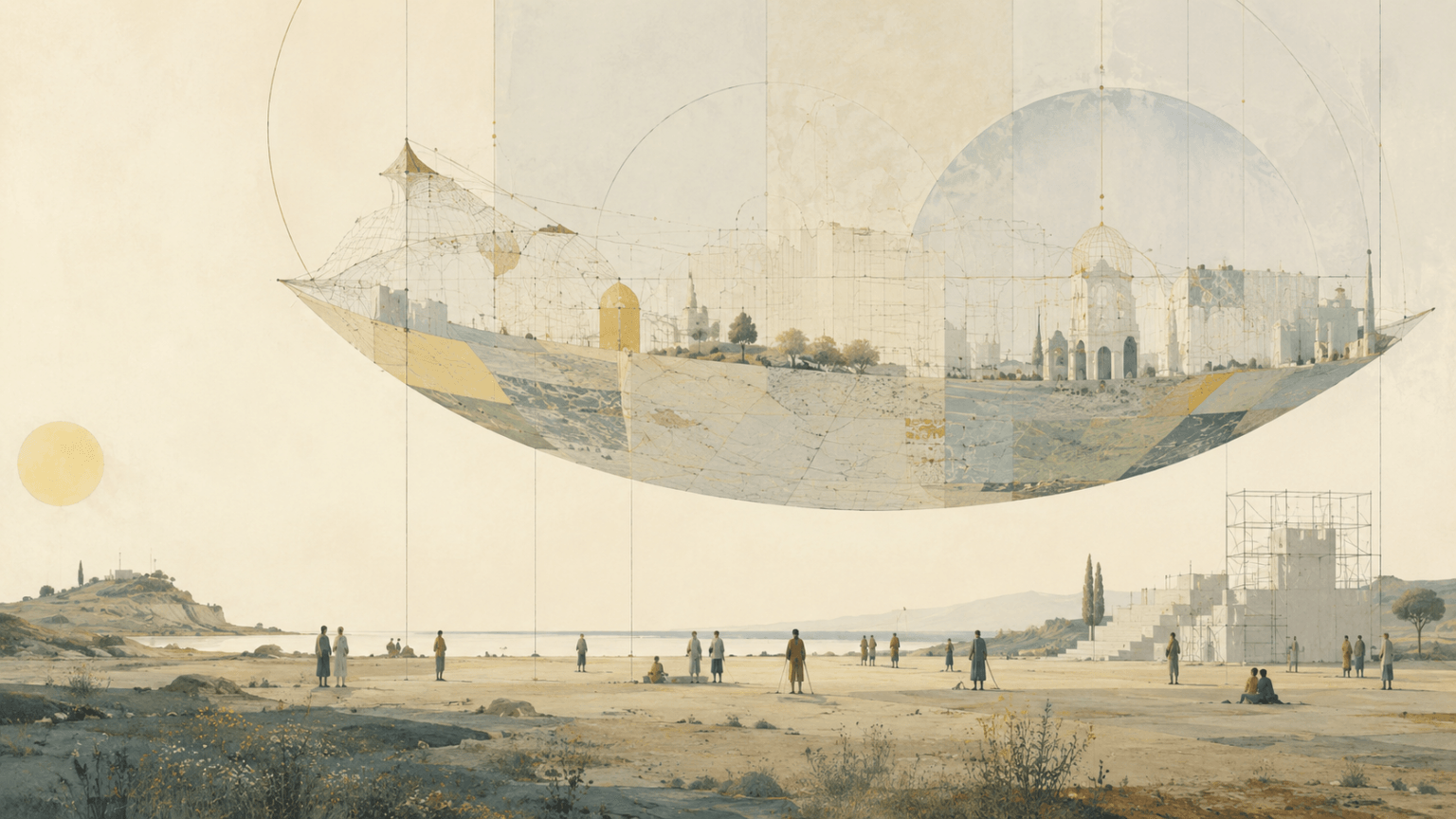
Illustration by Bookinlight Art Desk
Culture, Literature & Political Thought
Five Books on Utopian Fiction
Utopian fiction is not escapism. At its strongest, it is a disciplined experiment in social design, asking what must change in property, work, gender, education, freedom, and desire before a better world can become imaginable.
By Bookinlight


The Island, the Future, and the Social Experiment
The best books on utopian fiction do not simply imagine happiness. They invent a social order and then test it against human friction. A utopia is always double: it offers a promise and exposes the cost of promising too much. From Thomas More’s island commonwealth to Ursula K. Le Guin’s anarchist moon, these books ask whether justice can be narrated without becoming coercion, and whether freedom can be designed without being domesticated by design itself. Their imagined societies are not blueprints to be copied. They are laboratories for thinking about property, labor, gender, education, habit, scarcity, and moral formation.
Why the Best Books on Utopian Fiction Are Never Merely Optimistic
Utopian fiction becomes serious when it gives form to contradiction. More stages utopia as travel report and satire. Bellamy converts social reform into a dream of national organization. Morris answers Bellamy by making beauty, craft, and unalienated labor central. Gilman uses feminist estrangement to expose how ordinary gender assumptions deform social imagination. Le Guin, writing after the triumphs and failures of twentieth-century revolutionary hope, refuses the perfect society altogether and gives us an “ambiguous utopia.” Read together, these works show utopia not as a finished destination, but as a demanding literary method: the discipline of making the world strange enough to judge it.
The Reading Lens
Utopia as a Test of Human Arrangements
These books matter because each treats society as something made, not merely inherited. The island, the sleeping future, the pastoral communist England, the women’s country, and the anarchist moon all ask the same unsettling question: which arrangements feel natural only because power has trained us to mistake them for nature? Utopian fiction becomes most useful when it is neither naïve nor cynical, when it lets hope survive scrutiny and lets criticism become imaginative rather than merely denunciatory.
Central Question
Can a better society be imagined without turning human plurality into a managed ideal?
Historical Pressure
The genre intensifies whenever inherited institutions can no longer explain inequality, labor, gender, or political obedience.
Why These Books
They trace the movement from Renaissance civic satire to socialist planning, feminist estrangement, and anarchist ambiguity.
Five Essential Works of Utopian Fiction
Utopia
Thomas More
Best for: Readers who want the origin point of modern utopian argument.
Difficulty: Intermediate
Intellectual role: The foundational island where satire, political philosophy, and fictional travel meet.
Bookinlight Rating: ★★★★★
More’s Utopia remains indispensable because it refuses to declare exactly how it should be read. Is the island a model, a provocation, a joke, a critique of Europe, or a warning about rationalized order? Its power lies in that uncertainty. Communal property, regulated labor, religious toleration, education, slavery, war, and colonial expansion all appear inside one imagined commonwealth. The book is therefore not a simple origin myth of progressive hope; it is a tense Renaissance machine for making political judgment uncomfortable.
Bookinlight Note: Read it as a political mirror: the strangest thing in the book may not be the island, but the Europe reflected beside it.
Looking Backward
Edward Bellamy
Best for: Readers interested in utopia as social reform and economic organization.
Difficulty: General to Intermediate
Intellectual role: The managerial socialist dream of the industrial age.
Bookinlight Rating: ★★★★★
Bellamy’s sleeping protagonist, Julian West, awakens in the year 2000 to find full employment, public coordination, and social harmony where Gilded Age conflict once stood. The prose can feel schematic, but that is also why the book matters: it reveals the dream of rational coordination at the heart of late nineteenth-century reform. Bellamy’s utopia is powerful because it makes inequality appear administratively solvable. It is troubling for the same reason. The novel imagines justice through organization, abundance, and national integration.
Critical Reception
“an imaginative picturing of a utopia achieved by a collectivist society“
Bookinlight Note: Pair it with Morris immediately. The argument becomes sharper when Bellamy’s order meets Morris’s insistence on beauty and freely chosen work.
News from Nowhere
William Morris
Best for: Readers drawn to art, labor, ecology, and anti-industrial socialism.
Difficulty: Intermediate
Intellectual role: The pastoral and aesthetic counter-utopia to bureaucratic planning.
Bookinlight Rating: ★★★★★★
Morris’s future is not the polished administrative order of Bellamy. It is a world in which useful labor, aesthetic pleasure, local community, and non-coercive social relations have replaced industrial ugliness and class domination. News from Nowhere can feel dreamlike, even fragile, but its softness is argumentative. Morris insists that a society is not just if it distributes goods while leaving work spiritually dead. Utopia must also transform the texture of daily life: houses, rivers, gardens, craft, manners, and the relation between necessity and joy.
Critical Reception
“the only significant English utopia to be written since Thomas More’s“
Bookinlight Note: Ask one question while reading: does Morris imagine freedom from work, or freedom through a different meaning of work?
Herland
Charlotte Perkins Gilman
Best for: Readers looking for feminist utopia, gender critique, and social satire.
Difficulty: General
Intellectual role: The feminist estrangement of ordinary male assumptions.
Bookinlight Rating: ★★★★★★
Gilman’s premise is blunt and brilliant: three male explorers discover a society of women without men. The comedy comes from the explorers’ confidence collapsing under the pressure of a civilization that does not need their categories. Herland is not free of the limitations of its time, and modern readers should approach it critically. Yet its central achievement remains striking: it makes patriarchy look provincial. By reorganizing motherhood, education, cooperation, and social virtue, Gilman turns gender ideology into something that can be studied from the outside.
Bookinlight Note: Use the explorers as a reading instrument: their misunderstandings reveal the hidden grammar of the world they came from.
The Dispossessed
Ursula K. Le Guin
Best for: Readers seeking mature utopian fiction after the age of ideological certainty.
Difficulty: Intermediate
Intellectual role: The ambiguous anarchist utopia that tests freedom against scarcity, habit, and institutions.
Bookinlight Rating: ★★★★★
Le Guin’s subtitle, “An Ambiguous Utopia,” is one of the great acts of genre self-criticism. Anarres is anarchist, anti-possessive, and morally serious, but it is not innocent. Scarcity, conformity, informal authority, and bureaucratic habit still appear. Urras, its capitalist counterpart, is richer and more corrupt, seductive and violent. The novel’s brilliance lies in refusing to let either world become a slogan. Through Shevek’s journey, utopia becomes a practice of crossing walls: between planets, systems, loyalties, languages, and versions of freedom.
Bookinlight Note: The wall at the spaceport is the key image: every utopia must ask what it keeps out and what it keeps in.
How These Books Speak to One Another
The sequence matters. More invents a place from which Europe can be judged. Bellamy moves utopia into the future and makes coordination the answer to industrial injustice. Morris objects that a well-administered future is not enough if labor remains spiritually thin. Gilman shifts the axis from class and production to gender and social formation. Le Guin inherits all these ambitions and distrusts them, asking whether any ideal order can remain open to dissent, motion, and self-correction. Together, these books show utopian fiction as a conversation about the conditions under which hope avoids becoming domination.
The Reading Map
| Book | Difficulty | Rating | Why It Matters |
|---|---|---|---|
| Utopia | Intermediate | ★★★★★ | The genre’s founding political mirror. |
| Looking Backward | General to Intermediate | ★★★★★ | Industrial reform imagined as order. |
| News from Nowhere | Intermediate | ★★★★★★ | Beauty and labor become political. |
| Herland | General | ★★★★★★ | Gender becomes social architecture. |
| The Dispossessed | Intermediate | ★★★★★ | Perfect society becomes ambiguous. |
Where to Begin
- Entry point: Begin with The Dispossessed if you want the richest modern version of utopian doubt.
- Historical background: Read Utopia to understand why the genre begins in satire and political estrangement.
- Conceptual foundation: Move to Looking Backward for the dream of coordinated industrial justice.
- Critical perspective: Follow with News from Nowhere as Morris’s answer to administrative utopia.
- Contemporary relevance: Read Herland for gender, education, and social reproduction as utopian questions.
- Advanced reflection: Return to Le Guin after the earlier works; the word “ambiguous” will feel historically earned.
External Sources for Further Reading
Stanford Encyclopedia of Philosophy: Thomas More
The Last Margin
The best books on utopian fiction endure because they do not let us rest inside either hope or suspicion. They require a harder intellectual posture: the willingness to imagine institutions differently while asking what forms of discipline, exclusion, or blindness any imagined order may conceal. More gives us the island as mirror; Bellamy, the future as system; Morris, the future as craft; Gilman, the future as gender estrangement; Le Guin, the future as unfinished argument. Utopia remains valuable when it does not close the world, but reopens the question of how human beings might live otherwise.