
Illustration by Bookinlight Art Desk
Ethics & Moral Philosophy
Six Books on the Philosophy of Friendship
A serious guide to friendship as moral education, self-discovery, political risk, and a form of life that resists easy definition.
By Bookinlight




Friendship as a Test of the Self
The best books on philosophy of friendship begin from a deceptively simple fact: friendship is ordinary enough to be overlooked and strange enough to unsettle every theory of the good life. Unlike justice, duty, or rights, friendship is difficult to legislate; unlike romantic love, it rarely receives a grand public grammar; unlike family, it is usually chosen. Yet it shapes conduct, memory, judgment, courage, taste, and identity with unusual force. The six books gathered here treat friendship as more than affection. They read it as a school of character, a philosophical problem of self-love, a historical inheritance, an aesthetic experience, and, in modern political thought, a possible resistance to managed identity.
Together, these works show why friendship refuses to remain private. Aristotle makes it central to ethics. Nehamas asks why friends partly create who we become. Pangle restores the classical problem of friendship and self-love. Pakaluk offers the tradition in its own voices. Derrida exposes the political and mournful underside of fraternity. Roach carries the question into Foucault, AIDS, queer politics, and shared estrangement.
Why the Best Books on Philosophy of Friendship Resist Sentimentality
A sentimental account of friendship treats it as warmth, loyalty, and mutual support. Serious philosophy asks harder questions. Are friends loved for themselves or for the life they make possible? Does friendship perfect the self or reveal its incompleteness? Can friendship survive inequality, politics, secrecy, desire, betrayal, and death? The strength of this reading list lies in its refusal to make friendship innocent. In these books, friendship can be noble, formative, dangerous, exclusionary, democratic, erotic, philosophical, or impersonal. It is one of the few human relations in which ethics, politics, and everyday life meet without becoming fully identical.
The Reading Lens
Friendship Is Where Ethics Becomes Personal Without Becoming Private
Read together, these books shift friendship from a soft moral topic into a demanding philosophical site. Friendship asks how one self becomes answerable to another without dissolving into duty, possession, or sameness. It also asks whether a political community can imagine bonds that do not depend on blood, nation, utility, or uniform identity. The deepest thread here is that friendship is never merely interpersonal; it reorganizes the boundary between selfhood and world.
Central Question
Can friendship form a self without turning the friend into an instrument of self-completion?
Historical Pressure
From classical virtue ethics to modern identity politics, friendship has carried unresolved tensions between intimacy and public life.
Why These Books
They move from ancient moral psychology to contemporary political estrangement without reducing friendship to comfort.
Six Serious Books on Friendship
On Friendship
Alexander Nehamas
Best for: Readers who want philosophy in conversation with literature, art, and lived experience.
Difficulty: General to Intermediate
Intellectual role: The most graceful contemporary entry point into friendship as self-formation.
Bookinlight Rating: ★★★★★
Nehamas writes with the unusual ease of a philosopher who knows that friendship cannot be reduced to a definition. His central insight is that friends matter partly because they disclose possibilities of life that were not fully available before the friendship existed. The book moves from Aristotle and Montaigne to drama, painting, and personal reflection, arguing that friendship resembles aesthetic appreciation: we love the friend as a particular, irreducible presence. Its ideal reader is someone suspicious of both self-help sentimentality and arid moral theory.
Critical Reception
“Accessible philosophical writing for general readers who want to understand better an essential feature of our lives.“
Bookinlight Note: Pair this with Montaigne’s essay “Of Friendship” and ask whether friendship can ever be fully explained without betraying its singularity.
The Philosophy of Friendship
Mark Vernon
Best for: Readers seeking a thematic map across sex, work, politics, spirituality, and modern life.
Difficulty: General
Intellectual role: A broad modern orientation to friendship as a full way of life.
Bookinlight Rating: ★★★★★
Vernon’s book is valuable because it refuses to treat friendship as a niche ethical problem. It asks how friendship intersects with eros, vocation, civic life, religion, and the modern hunger for authenticity. Its accessibility is part of its seriousness: the book opens philosophical friendship to readers who want the tradition without losing contact with contemporary anxieties. Vernon is especially useful as a bridge between classical accounts of virtue and the fractured social environments in which friendship now has to survive.
Critical Reception
“Mark Vernon links the resources of the philosophical tradition with numerous illustrations from modern culture.“
Bookinlight Note: Use this as the “orientation seminar” before entering Aristotle or Derrida; it gives the reader a humane vocabulary for the whole field.
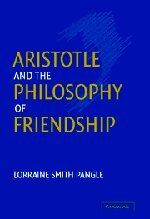
Aristotle and the Philosophy of Friendship
Lorraine Smith Pangle
Best for: Readers ready for a rigorous classical account of friendship, self-love, and the good life.
Difficulty: Advanced
Intellectual role: The deepest guide to Aristotle’s place at the center of the tradition.
Bookinlight Rating: ★★★★★
Pangle’s study is indispensable because it treats Aristotle’s account of friendship as a philosophical architecture rather than a pleasant moral appendix. She reads friendship alongside self-love, need, nobility, political community, and contemplation. The result is a demanding but clarifying account of why Aristotle devotes so much attention to friends in the Nicomachean Ethics. Pangle also places Aristotle among Plato, Cicero, Epicurus, Seneca, Montaigne, and Bacon, showing that friendship has always tested the relation between human incompleteness and human excellence.
Critical Reception
“Beautifully written, lucid in its arguments, responsible in its scholarship.“
Bookinlight Note: Read this beside Books VIII and IX of the Nicomachean Ethics; the central question is whether the best friend is another self or a challenge to the self.
Other Selves: Philosophers on Friendship
Michael Pakaluk
Best for: Readers who want primary philosophical texts in one compact tradition-facing volume.
Difficulty: Intermediate
Intellectual role: The anthology that lets the history of friendship speak in many registers.
Bookinlight Rating: ★★★★★★
Pakaluk’s anthology remains one of the most useful gateways into the tradition because it gives the reader Plato, Aristotle, Cicero, Seneca, Aelred, Aquinas, Montaigne, Bacon, Kant, Emerson, Kierkegaard, and Elizabeth Telfer in one arc. Its importance is pedagogical as much as philosophical. The anthology shows that friendship has never belonged to one discipline: it crosses rhetoric, theology, ethics, politics, and existential reflection. For classrooms, reading groups, and public humanities programs, it is unusually adaptable.
Bookinlight Note: Treat this book as a conversation table: assign each thinker one claim about why friendship matters, then compare the hidden anthropology behind each claim.
The Politics of Friendship
Jacques Derrida
Best for: Advanced readers of political philosophy, deconstruction, democracy, and fraternity.
Difficulty: Advanced
Intellectual role: The book that makes friendship inseparable from exclusion, mourning, and democracy.
Bookinlight Rating: ★★★★★★
Derrida’s book is not an easy “philosophy of friendship” in the ordinary sense. It is a meditation on the political grammar hidden inside friendship, brotherhood, fraternity, enmity, inheritance, and democracy. Beginning from the enigmatic tradition of the friend who may not exist, Derrida asks what political life has smuggled into the language of friendship. The book matters because it refuses to leave friendship as a moral consolation. It shows how appeals to friendship can create community while silently defining who remains outside it.
Critical Reception
“Many great meditations on friendship are also meditations on mourning.“
Bookinlight Note: Read Derrida after Aristotle, not before; the shock is stronger when the classical confidence in civic friendship has already been built.
Friendship as a Way of Life: Foucault, AIDS, and the Politics of Shared Estrangement
Tom Roach
Best for: Readers interested in Foucault, queer theory, AIDS politics, and alternative forms of relation.
Difficulty: Advanced
Intellectual role: The contemporary extension of friendship into biopolitics and shared estrangement.
Bookinlight Rating: ★★★★★★
Roach turns friendship into a modern political experiment. Drawing from Foucault’s late reflections, AIDS activism, Hervé Guibert, David Wojnarowicz, queer theory, and biopolitics, the book develops friendship as “shared estrangement.” This is a powerful counterpoint to idealized friendship. Roach asks what kinds of relation become possible when identity, confession, and normalizing recognition no longer define the terms of intimacy. The book is demanding, but it gives contemporary friendship a political vocabulary equal to its vulnerability.
Critical Reception
“Friendship as a Way of Life is a pulsing and intriguing volume.“
Bookinlight Note: This is the best final book in the sequence: it asks what friendship can do after the classical language of virtue and fraternity has been destabilized.
How These Books Speak to One Another
The sequence matters. Pakaluk gives the inherited conversation; Pangle gives it classical depth; Vernon opens it to contemporary readers; Nehamas makes it existential and aesthetic; Derrida unsettles its political innocence; Roach rebuilds friendship under modern conditions of identity, power, illness, and estrangement. Across the six books, friendship moves from virtue to relation, from relation to politics, and from politics to forms of life. The result is a philosophy of friendship that is neither merely ancient nor merely modern. It becomes a way of asking how human beings can be bound to one another without being absorbed, ranked, normalized, or abandoned.
The Reading Map
| Book | Difficulty | Rating | Why It Matters |
|---|---|---|---|
| On Friendship | General to Intermediate | ★★★★★ | Shows friendship as self-making. |
| The Philosophy of Friendship | General | ★★★★★ | Maps the topic broadly. |
| Aristotle and the Philosophy of Friendship | Advanced | ★★★★★ | Deepens Aristotle’s ethical vision. |
| Other Selves | Intermediate | ★★★★★★ | Collects the tradition’s voices. |
| The Politics of Friendship | Advanced | ★★★★★★ | Politicizes fraternity and loss. |
| Friendship as a Way of Life | Advanced | ★★★★★★ | Reimagines relation after identity. |
Where to Begin
- Entry point: Start with On Friendship for elegance, clarity, and philosophical warmth.
- Historical background: Use Other Selves to hear the tradition across periods.
- Conceptual foundation: Read Aristotle and the Philosophy of Friendship when you are ready for depth.
- Critical perspective: Turn to The Politics of Friendship to unsettle fraternity, democracy, and exclusion.
- Contemporary relevance: Read Friendship as a Way of Life for Foucault, AIDS politics, and queer relationality.
- Advanced reflection: Return to Vernon as a synthesizing companion across ordinary modern life.
External Sources for Further Reading
Basic Books on Alexander Nehamas, On Friendship
Cambridge University Press on Aristotle and the Philosophy of Friendship
The Last Margin
The best books on philosophy of friendship teach that friendship is never a decorative addition to ethics. It is one of the places where a life becomes visible to itself. A friend may console, challenge, misrecognize, transform, betray, preserve, or outlive us. That is why the theme belongs equally to moral philosophy, political theory, literature, theology, and queer thought. To read these six books together is to see friendship as a fragile institution without official walls: intimate enough to shape the self, public enough to disturb politics, and mysterious enough to keep philosophy from closing its account of human life.