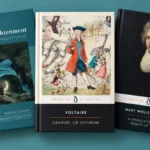
Illustration by Bookinlight Art Desk
The best books on Charles Taylor and secularism do not merely explain why religious authority declined in parts of the modern West. They ask a deeper question: how did belief itself become newly fragile, newly optional, and newly conscious of its alternatives?
Taylor’s importance lies in his refusal of the simplest secularization story. Modern secularity is not, for him, the residue left after religion disappears. It is a historically formed condition in which belief and unbelief inhabit a shared field of pressure. These five books belong together because they move from Taylor’s moral genealogy of the modern self to his account of social imaginaries, then to the massive architecture of A Secular Age, its major critical reception, and one lucid guide for readers entering the debate for the first time.
By Bookinlight
The Reading Lens for Books on Charles Taylor and Secularism
Taylor’s central achievement is to make secularism experiential as well as institutional. His work asks how a world once saturated by transcendence became a world in which religious commitment must speak from inside contestable conditions. The books below therefore form a sequence: moral sources, collective imagination, secular modernity, interdisciplinary critique, and accessible orientation.
The Reading Map
| Book | Difficulty | Rating | Why It Matters |
|---|---|---|---|
| A Secular Age | Advanced | ★★★ ★★ | The indispensable account of belief under modern conditions. |
| Sources of the Self | Advanced | ★★★ ★½ | Reconstructs the moral background of modern identity. |
| Modern Social Imaginaries | Intermediate | ★★★ ★½ | Explains the shared background that makes modern social life intelligible. |
| Varieties of Secularism in a Secular Age | Advanced | ★★★ ★½ | Places Taylor in debate with sociology, theology, politics, and anthropology. |
| How (Not) to Be Secular | General to Intermediate | ★★★ ★ | A clear entrance into Taylor’s difficult vocabulary and argument. |
Taylor’s A Secular Age is the necessary center of any serious reading list on Charles Taylor and secularism. Its famous question is not whether modern societies have fewer believers, weaker churches, or more neutral states. Taylor asks how the conditions of belief changed so radically that faith now appears as one possibility among many, while unbelief can feel equally natural, demanding, and morally serious. Against the “subtraction” story, in which modern people simply cast off illusion and discover reason underneath, Taylor reconstructs a dense history of Reform, discipline, providential deism, the buffered self, the rise of exclusive humanism, and the modern culture of authenticity.
The book belongs here because it gives the article’s theme its full conceptual grammar. “Secular” becomes not only a constitutional arrangement or a decline in practice but a lived atmosphere: a background in which transcendence is both available and contested. Patient readers will benefit most—especially philosophers, theologians, sociologists of religion, intellectual historians, and anyone dissatisfied with flat stories about science simply replacing faith. The book changes the reader’s understanding by shifting secularism from an event to a condition. After Taylor, belief and unbelief are not opposites standing outside history; they are rival ways of inhabiting the same modern pressure.
Read this slowly, not as a continuous argument alone, but as a historical map of how modern consciousness learned to experience belief as contestable.
Sources of the Self is not a book about secularism in the narrow sense, yet it is indispensable for understanding why Taylor’s secularism is never merely sociological. Taylor’s great concern is the moral shape of modern identity: how human beings come to understand themselves as inward, free, responsible, expressive, and oriented toward goods they do not simply choose from nowhere. His argument resists two temptations at once. He refuses nostalgia for premodern moral orders, but he also refuses the modern fantasy that the self can be understood without deep moral sources.
The book belongs in this article because A Secular Age depends on a prior account of the modern subject. A world in which belief is optional is also a world in which the self has been reimagined: less porous, more inward, more disciplined, more expressive, and more vulnerable to the burdens of authenticity. Readers who benefit most are those willing to follow Taylor through Augustine, Descartes, Locke, Romanticism, and modern moral philosophy in order to see secularity as a transformation in selfhood. It changes the reader’s understanding of secularism by showing that secular modernity is not only about institutions or doctrines. It is about the kind of agent who can ask whether transcendence is credible, whether ordinary life is enough, and whether moral meaning can survive without a shared cosmic order.
This is the best companion to Taylor’s later work if the reader wants to understand why secularity is also a drama of moral identity.
In Modern Social Imaginaries, Taylor gives readers one of the most useful concepts for approaching secularism: the social imaginary. He does not mean a formal theory held by intellectuals, but the background understanding through which ordinary people imagine their shared social existence. Modernity, in this account, is not simply a set of institutions; it is a way of picturing collective life through the economy, the public sphere, popular sovereignty, rights, mutual benefit, and self-governance.
The book belongs here because secularism cannot be understood apart from the wider imaginary that makes modern society feel plausible. A neutral public sphere, a self-regulating economy, and a people capable of collective self-rule all depend on forms of imagination that are historically produced. Taylor’s later account of the secular age rests on this same insight: what changes is not only what people believe but what they can take for granted about the world they share. This book is especially valuable for readers who find A Secular Age too massive as a starting point. It offers a compact, conceptually powerful account of how modern Western societies came to understand themselves without needing direct theological authorization for every social practice. It changes the theme by making secularism less like an isolated doctrine and more like part of a broader transformation in the background picture of social order.
This is the most efficient Taylor text for readers who want to understand how shared background assumptions shape politics, religion, and modern identity.
Varieties of Secularism in a Secular Age is the essential companion volume for readers who want to see Taylor’s thesis tested, extended, and disputed by major scholars. Its contributors approach secularism from sociology, political theory, theology, intellectual history, anthropology, gender studies, and religious studies. The result is not a simple tribute to A Secular Age, but a disciplined conversation about what Taylor’s account clarifies and what it may leave unresolved.
The book belongs here because Taylor’s secularism has become a field of debate, not merely an individual philosophical position. The essays press on the Christian and Western emphasis of Taylor’s narrative, the political powers of secularism, the meaning of enchantment, the relation between secularism and neoliberal order, and the question of whether secular modernity can be interpreted otherwise outside Taylor’s preferred genealogy. Readers who benefit most are those already familiar with the outline of A Secular Age and ready to encounter serious critique. It changes the reader’s understanding by showing that Taylor’s categories—immanent frame, exclusive humanism, fullness, disenchantment, authenticity—are not final answers. They are tools for argument. The volume is valuable precisely because it keeps Taylor’s work intellectually alive: admired, questioned, provincialized, and expanded.
Use this after reading the main Taylor text; it prevents reverence from becoming passivity and turns the book into an active scholarly debate.
James K. A. Smith’s How (Not) to Be Secular is the most approachable guide to Taylor’s difficult and capacious argument. Smith writes with sympathy for Taylor’s project, but his real service is pedagogical. He translates the architecture of A Secular Age into a more navigable set of terms: the buffered self, the immanent frame, cross-pressures, exclusive humanism, the nova effect, and the persistent search for fullness. The book is not a substitute for Taylor, but it is an excellent preparation for reading him without being overwhelmed.
It belongs in this article because many readers encounter Taylor through the reputation of A Secular Age before they are ready for its scale. Smith gives them a map, especially from a Christian philosophical perspective, while still making the analysis useful to skeptics, believers, and intellectually curious readers alike. The book’s value lies in showing that secularity is not simply unbelief. It is a cultural condition marked by pressure, fragility, longing, and rival accounts of meaning. Readers who benefit most are those seeking orientation before entering the primary works. It changes the theme by making Taylor’s grand historical argument existentially legible: the secular age is not only outside us in institutions and public discourse; it is inside the way modern people experience doubt, faith, aspiration, and unease.
Begin here if the goal is orientation; return to it later to check whether Taylor’s technical vocabulary has become clearer.
FAQ
What is the best book to start with on Charles Taylor and secularism?
For direct access, start with James K. A. Smith’s How (Not) to Be Secular. For the definitive argument, move to Taylor’s A Secular Age.
What does Charles Taylor mean by a secular age?
Taylor means a condition in which belief in God is no longer socially axiomatic. Belief and unbelief both become options within a shared field of contestability.
Is Taylor arguing that religion simply declined?
No. Taylor rejects simple subtraction narratives. He argues that modern secularity emerged through transformations inside Western Christianity, moral order, social imagination, and modern identity.
Which Taylor book explains the immanent frame?
A Secular Age is the key text. Smith’s How (Not) to Be Secular is the clearest introductory guide to the concept.
What Reading Still Keeps Open
The strongest books on Charles Taylor and secularism leave readers with a sharper sense of modernity’s unresolved tensions. Taylor helps us see why secularism is not simply the victory of reason over faith, nor the disappearance of transcendence from public life. It is a condition in which meanings compete under new pressures, and in which both belief and unbelief must explain themselves.
Read together, these five books make secular modernity appear less obvious and more historically strange. That is their lasting value: they return difficulty to a word that modern culture often uses too quickly.