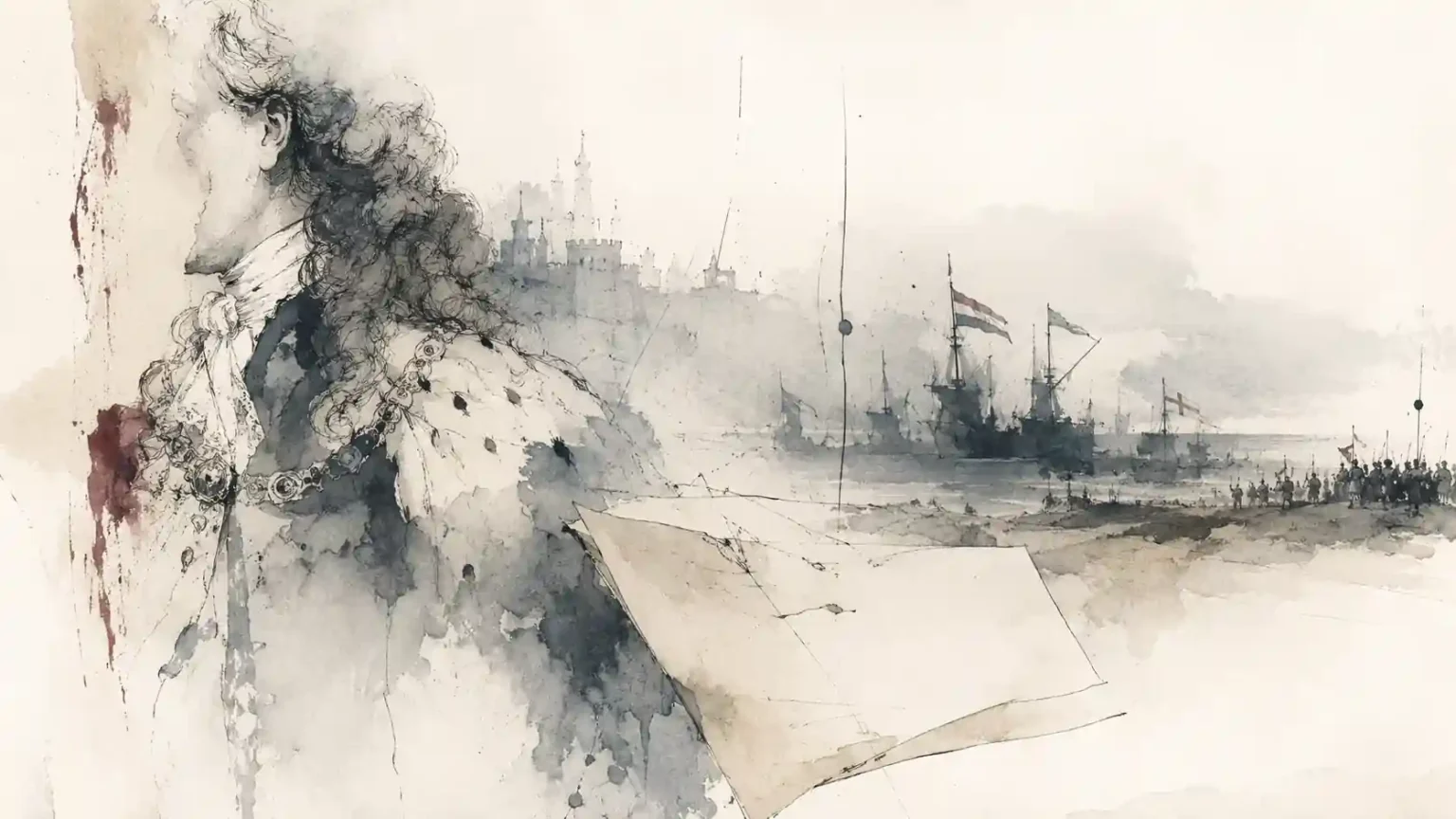
Illustration by Bookinlight Art Desk
The best books on the Glorious Revolution do not treat 1688 as a tidy constitutional miracle. They ask harder questions: Was this a Protestant rescue, a Dutch invasion, a parliamentary settlement, a fiscal-military transformation, or a remembered story polished into national myth?
The five books below belong together because each interrupts one part of the inherited legend. One book restores violence and contingency; another reopens the case for modern revolution; another studies liberty as political language; another follows the constitutional document itself; and another places England inside a wider Anglo-Dutch, Atlantic, and European world.
By Bookinlight
The Reading Lens
A revolution disguised as settlement
The Glorious Revolution is most revealing when read as a crisis of legitimacy rather than a single event. James II’s fall, William’s invasion, the Convention Parliament, the Bill of Rights, and the wars in Ireland and Scotland formed one unstable chain. These books show how constitutional memory often simplifies what political actors experienced as emergency, propaganda, negotiation, and armed power.
Central Question
How did a dynastic crisis become a constitutional founding story?
Historical Pressure
Religion, war finance, parliamentary authority, and Dutch military intervention converged.
Why These Books
Together they move from narrative to revision, rights, law, and international context.
Revolution: The Great Crisis of the British Monarchy, 1685-1720
Author: Tim Harris
Best for: Readers who want the fullest political narrative of the crisis across England, Scotland, and Ireland.
Difficulty: Intermediate
Intellectual role: Restores contingency, violence, and multi-kingdom politics to the Revolution.
Bookinlight Rating: ★★★★★
Tim Harris gives the Glorious Revolution the scale that Whig memory often denied it. Instead of a brief, almost frictionless transfer of power from James II to William and Mary, Harris presents a prolonged crisis of monarchy from 1685 to 1720. The book’s strength is narrative density: court politics, confessional fear, parliamentary maneuver, crowd action, military force, and regional divergence all matter. England does not stand alone. Scotland and Ireland are not footnotes. The Revolution becomes a crisis of the composite monarchy, not simply the birth of English constitutionalism.
This belongs first because it gives readers the necessary ground: James II’s Catholicizing policies, the politics of toleration, Protestant alarm, the invitation to William, the Convention settlement, and the aftershocks of war. Harris is especially valuable for readers suspicious of celebratory shorthand. He shows how the Revolution could be experienced simultaneously as liberation, invasion, civil war, dynastic replacement, and religious emergency.
For general readers moving toward serious scholarship, this is the best starting point. It changes the theme by forcing one central recognition: the “glory” of the Glorious Revolution was partly a retrospective achievement. The event had to be narrated into order after being lived as danger.
Bookinlight Note
Read Harris for the political weather of the period: pressure, uncertainty, negotiation, and the fear that one wrong settlement might reopen civil war.
1688: The First Modern Revolution
Author: Steve Pincus
Best for: Readers interested in revisionist history, political economy, and the origins of modern state power.
Difficulty: Advanced
Intellectual role: Recasts 1688 as a genuinely modern revolution rather than a conservative restoration.
Bookinlight Rating: ★★★★½
Steve Pincus’s book is the most ambitious reinterpretation in this reading packet. Its central claim is not merely that 1688 mattered, but that it should be understood as the first modern revolution. Pincus challenges the older view of the Revolution as aristocratic, moderate, bloodless, and defensive. He links it instead to competing programs for political economy, overseas empire, public finance, religious policy, and state formation. James II is not simply a doomed absolutist; he becomes the advocate of one modernizing project. Williamite politics, by contrast, becomes another path toward modernity.
The book belongs here because it widens the interpretive field. Readers who know the Glorious Revolution only through the Bill of Rights or Protestant succession will find a more structural argument: revolutions are not defined only by barricades or declarations, but by the reorganization of political possibility. Pincus’s emphasis on commerce, credit, party politics, print, and imperial rivalry makes 1688 look less like a national inheritance ceremony and more like a transformation in the machinery of power.
This is demanding but rewarding. It changes the reader’s understanding by refusing the comfort of the word “settlement.” The Revolution becomes an argument over the future: what kind of state, what kind of empire, and what kind of Protestant political order Britain would become.
Bookinlight Note
Pincus is most useful when read as an argument, not merely a narrative: mark where he redefines what counts as revolutionary.
The Glorious Revolution: 1688 – Britain’s Fight for Liberty
Author: Edward Vallance
Best for: Readers seeking an accessible but revision-minded account of liberty, violence, and political memory.
Difficulty: General to Intermediate
Intellectual role: Tests the moral language of liberty against the Revolution’s coercive realities.
Bookinlight Rating: ★★★★
Edward Vallance writes with a sharper sense of political drama than many institutional histories. His title foregrounds liberty, but the book’s real work is to complicate that word. The Revolution did create a durable language of Protestant liberties, parliamentary rights, and resistance to arbitrary power. Yet Vallance keeps asking what that language excluded, what violence made it possible, and how different the Revolution looked from England, Scotland, and Ireland.
This book belongs in the middle of the sequence because it is both approachable and morally alert. Vallance is useful for readers who want a serious introduction without surrendering the revisionist questions that now shape the field. He does not reduce 1688 to a cynical coup, but neither does he allow the old story of bloodless liberty to stand untouched. The political imagination of the period was full of appeals to conscience, contract, ancient rights, Protestant deliverance, and national danger. Vallance lets those ideas speak while also placing them under pressure.
For readers coming from political theory, the value is especially clear: liberty here is not an abstract noun but a contested historical weapon. The book changes the reader’s understanding by showing that freedom in 1688 was not simply proclaimed; it was fought over, bounded, narrated, and remembered.
Bookinlight Note
Vallance is the best bridge between narrative history and the ethical problem of calling a revolution “glorious.”
The Declaration of Rights, 1689
Author: Lois G. Schwoerer
Best for: Readers focused on constitutional language, parliamentary procedure, and the Bill of Rights.
Difficulty: Advanced
Intellectual role: Moves from revolution as event to revolution as legal and political text.
Bookinlight Rating: ★★★★½
Lois G. Schwoerer’s study narrows the focus from the battlefield and court to the document that helped give the Revolution its constitutional form. The Declaration of Rights was not merely a ceremonial statement attached to the accession of William and Mary. Schwoerer treats it as a political artifact: drafted, debated, shortened, defended, ritualized, and later transformed into the statutory Bill of Rights. Her attention to procedure matters because constitutional history often hides its own making. Rights appear timeless only after political struggle has made them look inevitable.
This book belongs here because it prevents the reader from speaking too loosely about “the settlement.” Schwoerer asks what the Convention Parliament actually claimed, how radical Whig ambitions were modified, and why the final wording mattered. The reader sees that phrases about dispensing power, elections, parliamentary speech, taxation, standing armies, and petitioning were not ornamental clauses. They were answers to specific Stuart conflicts, but also instruments for reshaping the future relation between crown and Parliament.
This is the most specialized book on the list, and it rewards readers willing to move slowly. It changes the theme by showing that the Revolution’s afterlife depended on textual authority. 1688 became constitutional memory because political actors learned how to bind crisis to language.
Bookinlight Note
Schwoerer is essential for understanding how a contested political moment was converted into constitutional grammar.
The Anglo-Dutch Moment: Essays on the Glorious Revolution and its World Impact
Editor: Jonathan I. Israel
Best for: Readers who want the Revolution placed in European, Atlantic, and imperial perspective.
Difficulty: Advanced
Intellectual role: Expands 1688 beyond England into a Dutch, British, European, and colonial transformation.
Bookinlight Rating: ★★★★½
Edited by Jonathan I. Israel, this substantial collection is the best corrective to an insular reading of the Glorious Revolution. Its premise is simple but powerful: the events of 1688-91 cannot be understood if England is treated as a self-contained political stage. William of Orange was not only a Protestant deliverer in English memory; he was also a Dutch stadholder operating inside the strategic emergencies of European war, finance, commerce, and confessional rivalry. The Revolution was Anglo-Dutch, British, Irish, Scottish, Atlantic, and European at once.
The book belongs at the end because it opens the frame outward. After reading Harris on crisis, Pincus on modernity, Vallance on liberty, and Schwoerer on constitutional language, Israel’s volume shows how all those dimensions were connected to wider structures. The Dutch Republic, North America, Ireland, Scotland, France, Protestant internationalism, and imperial rivalry become part of the same historical field.
This is not the easiest entry point, but it is indispensable for readers who want to escape the island story. It changes the theme by making “the Glorious Revolution” less a purely English achievement than a moment in the remaking of power across the late seventeenth-century world. The Revolution’s meaning was never confined to Westminster.
Bookinlight Note
Read this volume when the English story starts to feel too neat; its great gift is scale.
The Reading Map: best books on the Glorious Revolution
| Book | Difficulty | Rating | Why It Matters |
|---|---|---|---|
| Revolution | Intermediate | ★★★★★ | The best full narrative of crisis, violence, and settlement. |
| 1688 | Advanced | ★★★★½ | Reframes the event as a modern revolution of state and economy. |
| The Glorious Revolution | General to Intermediate | ★★★★ | Makes liberty readable without hiding coercion and conflict. |
| The Declaration of Rights | Advanced | ★★★★½ | Shows how crisis became constitutional language. |
| The Anglo-Dutch Moment | Advanced | ★★★★½ | Places 1688 in European, Atlantic, and Dutch context. |
FAQ
What is the best first book on the Glorious Revolution?
Tim Harris is the strongest first choice for readers who want a broad, serious narrative before moving into more specialized debates.
Was the Glorious Revolution really bloodless?
Not in any full historical sense. England’s transition was less bloody than later revolutions, but Ireland, Scotland, military invasion, and political coercion complicate the legend.
Which book best explains the Bill of Rights?
Lois G. Schwoerer’s study is the most focused choice for the Declaration of Rights and its transformation into constitutional settlement.
Why does the Dutch context matter?
William’s invasion, Dutch finance, European war, and Protestant strategy all shaped the Revolution. Without that frame, 1688 becomes too narrowly English.
The Last Margin
The best books on the Glorious Revolution teach one disciplined habit: never let the serenity of constitutional memory erase the instability of political time. 1688 matters because it was both settlement and rupture, both legal text and armed intervention, both English inheritance and European event. Read together, these five books make the Revolution harder to praise simply, but much easier to understand.