What to Read Before Critique of Pure Reason is a smaller question than Kant’s reputation suggests. The book presupposes one decisive problem—how necessary, universal knowledge can concern objects of experience—plus a disciplined grasp of his vocabulary. Hume matters; the entire history of philosophy does not. The best preparation is selective, concept-led, and short enough that Kant remains the main event.

Target text
Critique of Pure Reason: the edition to build the reading project around
Author: Immanuel Kant
Translator or editor: Edited by Paul Guyer; edited and translated by Allen W. Wood
Edition: Cambridge University Press, second edition, 2025; hardback; ISBN 9781009600064
Why this edition: It retains standard A/B pagination, records important first- and second-edition variants, and updates the translation, introduction, notes, and bibliography.
Main limitation: Its scholarly apparatus is helpful but substantial; beginners should not feel obliged to read every note on a first pass.
Best suited to: Serious first-time readers, students, teachers, and anyone who may later consult secondary scholarship.
The Short Answer What to Read Before Critique of Pure Reason
You do not need to read the whole early-modern canon before Kant. Learn the analytic–synthetic and a priori–a posteriori distinctions, read Hume’s brief treatment of causation, understand that Kant is testing the conditions of possible experience, and use an edition that prints both A and B pagination. Everything else can be added selectively.
The most useful prior primary reading is David Hume’s Enquiry Concerning Human Understanding, especially the sections on the origin of ideas, causal inference, and necessary connection. Kant’s own Prolegomena is the best compact orientation, although it is not a neutral synopsis: written after the first edition of the Critique, it reorganizes the project and sometimes sharpens positions whose presentation in 1781 had caused confusion. A brief overview of the rationalist–empiricist dispute helps, but reading Descartes, Locke, Leibniz, Berkeley, and Hume complete would postpone the real work for little gain.
The preparation problem is therefore one of calibration. Too little background makes Kant’s questions appear arbitrary; too much makes the first reading a hostage to later interpretations and inherited slogans. Begin once you can explain why Hume’s account of causation threatens claims of necessity, why mathematics seems to extend knowledge independently of particular experience, and why Kant distinguishes the mind’s receptive and spontaneous powers. That foundation is enough to start intelligently.
Why Critique of Pure Reason Is Difficult
Kant’s difficulty begins with architecture. The book does not advance one argument in a straight line. It constructs a “doctrine of elements,” divides cognition into sensibility and understanding, investigates the legitimate use of concepts, then turns to reason’s recurrent temptation to exceed possible experience. The Transcendental Aesthetic, Analytic, and Dialectic answer different questions, yet each depends on distinctions introduced elsewhere. A reader who treats every chapter as another installment in a single proof soon loses the map.
The vocabulary compounds the problem. “Intuition” does not mean a hunch; it means a singular, immediate representation. “Transcendental” does not mean mystical or otherworldly; it concerns our mode of knowing objects insofar as that mode is possible a priori. “Deduction” names a juridical vindication of a claim to legitimacy, not merely an inference from premises. “Idealism” does not imply that empirical objects are fantasies. Ordinary-looking words—object, experience, unity, synthesis, reason—carry technical burdens that shift with their place in the system.
There are also hidden interlocutors. Kant writes against dogmatic metaphysics, skeptical empiricism, Leibnizian-Wolffian rationalism, and competing accounts of space, time, causation, and the soul. He seldom pauses to reconstruct each opponent at textbook length. The reader must recognize the pressure exerted by Hume without reducing the Critique to an answer to Hume alone. The historically familiar “rationalists versus empiricists” story is useful as an orientation, but the Stanford Encyclopedia’s account of the distinction rightly warns that actual early-modern positions do not fit two tidy camps.
Finally, there are two editions of Kant’s text. The 1787 B edition substantially rewrites the Preface, Introduction, Transcendental Deduction, and several other passages, while retaining much of the 1781 A edition. B is not simply a corrected replacement for A; some first-edition formulations remain philosophically indispensable. An edition with A/B pagination and clearly marked variants is therefore not a luxury. It is part of understanding what work the text is doing.
The Dependency Map at a Glance
Essential Before Reading
The problem Hume leaves behind
Essential before reading
Kant famously credited Hume with interrupting his “dogmatic slumber,” but the preparation required is narrower than that phrase has encouraged generations of reading lists to suppose. You need Hume’s challenge to causal necessity: experience gives repeated conjunctions, yet no impression of a necessary connection binding cause to effect. Our expectation that one event will follow another arises from habit, not rational insight into an objective power. This threatens metaphysical claims about causes and raises a more general question: how can thought legitimately claim necessity beyond what particular sensations deliver? The specialist overview of Kant and Hume on causality is useful for seeing where historians agree and where the relation remains contested.
Essential prerequisite
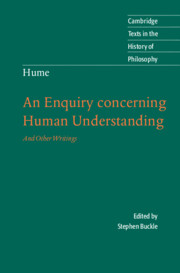
An Enquiry Concerning Human Understanding: the skeptical pressure Kant must answer
Author: David Hume
Translator or editor: Edited by Stephen Buckle
Edition: Cambridge University Press, 2007; hardback; ISBN 9780521843409
Dependency level: Essential before reading
Why it matters: It supplies the clearest short route into the problems of causal inference, necessity, and the limits of reason from which Kant’s project gains urgency.
How much to read: Sections 2, 4, 5, and 7; add section 12 for Hume’s mitigated skepticism. The whole book is not required.
Kant’s four opening distinctions
Essential before reading
Before entering the Aesthetic, be able to distinguish knowledge that is a priori from knowledge that is a posteriori, and analytic judgments from synthetic judgments. Kant’s central question is how synthetic a priori cognition is possible: how a judgment can extend knowledge while claiming necessity and universality independently of particular experience. Mathematics and the fundamental principles of natural science are his leading cases; metaphysics claims the same authority but repeatedly collapses into dispute. This formulation is more important than memorizing a catalogue of predecessors.
You must also know the difference between sensibility and understanding. Sensibility receives; understanding thinks through concepts. Kant’s point is not that raw sensations arrive fully formed and the mind labels them afterward. Experience itself requires their cooperation. The famous formulas about intuitions without concepts and thoughts without content should be read as statements of reciprocal dependence, not as permission to rank one faculty above the other.
The A/B textual situation
Essential before reading
Know what A and B mean before opening the book. A refers to the 1781 first edition; B to the revised 1787 edition. Read both Prefaces, then use the B Introduction as the principal route while checking A’s formulations where your edition supplies them. In the Deduction, the two versions are sufficiently different that serious reading eventually requires both, though not on the same sitting. The Cambridge edition page explains the value of preserving variants and standard pagination.
Strongly Recommended Background
Kant is often presented as the great synthesis of rationalism and empiricism. That slogan is serviceable only if “synthesis” does not mean compromise. Kant accepts the empiricist insistence that human knowledge begins with experience, yet denies that all of it arises from experience. He shares the rationalist demand for necessity and universality, yet rejects the attempt to derive substantive knowledge of supersensible objects from pure concepts alone. A concise historical overview is usually more valuable than reading five systems end to end.
Strongly recommended
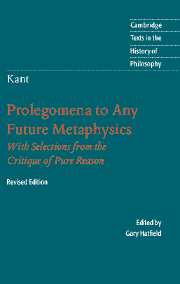
Prolegomena to Any Future Metaphysics: Kant’s compact re-entry into his own project
Author: Immanuel Kant
Translator or editor: Translated and edited by Gary Hatfield
Edition: Cambridge University Press, revised edition, 2004; hardback; ISBN 9780521828246
Dependency level: Strongly recommended
Why it matters: Written after the first Critique, it states the problem of synthetic a priori knowledge more schematically and clarifies Kant’s response to hostile early reception.
How much to read: Preface, Preamble and §§1–5, then §§27–30. Read the remainder after, or alongside, the corresponding parts of the Critique.
The Prolegomena is a substitute for preliminary orientation, not for the Critique itself. Because it proceeds analytically from accepted bodies of knowledge toward their conditions, whereas the Critique attempts a fuller synthetic exposition of those conditions, it can make the project look cleaner than the main text actually is. Use it to identify the destination, then allow the larger book to establish the route.
Strongly recommended
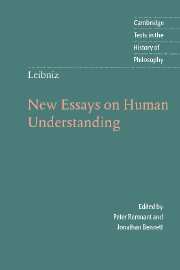
New Essays on Human Understanding: the rationalist counterpoint to Locke
Author: G. W. Leibniz
Translator or editor: Edited and translated by Peter Remnant and Jonathan Bennett
Edition: Cambridge University Press, second edition, 1996; paperback; ISBN 9780521576604
Dependency level: Strongly recommended
Why it matters: Its dialogue with Locke clarifies disputes about innateness, necessity, concepts, and what the mind contributes to cognition—questions transformed in Kant’s critical philosophy.
How much to read: The Preface and selected portions of Book I. Full reading is appropriate for advanced historical study, not first-pass preparation.
Locke supplies the empiricist question of how ideas arise and how knowledge is bounded; Leibniz resists the claim that experience alone explains the structures of thought. A serious beginner can read Locke’s Essay, Book II, chapters 1 and 8, and Book IV, chapters 1–4, then Leibniz’s Preface and opening reply. This is enough to see that Kant’s categories are not simply innate ideas waiting inside the mind. They are rules whose objective validity must be justified through their role in possible experience.
Helpful but Optional Context
Newton, geometry, and the eighteenth-century science of nature
Helpful background
Kant’s confidence that mathematics and mathematical physics yield necessary, objective cognition belongs to a historical setting shaped by Euclidean geometry and Newtonian mechanics. You need the epistemic role of these sciences, not technical mastery of their proofs. Understand why geometry appeared to describe spatial structure with necessity, why Newtonian laws seemed universally valid, and why action, force, substance, and causation posed metaphysical questions. The scholarly overview of Kant on space and time is a better preparatory route than reading Newton’s Principia or the Leibniz–Clarke correspondence in full.
The school metaphysics Kant learned and resisted
Relevant only for specialists
Christian Wolff and Alexander Baumgarten matter because Kant inherited their classifications, terminology, and classroom problems. They do not deserve to become a gate through which every reader must pass. The first Critique is intelligible without mastering eighteenth-century German textbooks, but scholars investigating Kant’s treatment of ontology, rational psychology, cosmology, and natural theology will benefit from targeted source comparison. The Cambridge background-source collection makes this feasible without demanding entire systems.
Specialist text
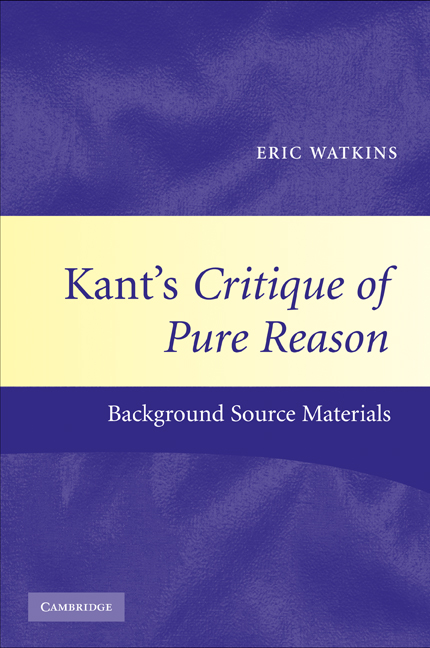
Kant’s Critique of Pure Reason: Background Source Materials: the archive in manageable form
Author: Selected, translated, and edited by Eric Watkins
Translator or editor: Eric Watkins
Edition: Cambridge University Press, 2009; paperback; ISBN 9780521787017
Dependency level: Relevant only for specialists
Why it matters: It gathers relevant passages from Wolff, Baumgarten, Crusius, Euler, Lambert, Herz, Tetens, and others whose debates often remain invisible in translation.
How much to read: Use the index and editorial introductions to follow specific problems; do not read it cover to cover before Kant.
The 1770 Dissertation and the letter to Herz
Kant’s Inaugural Dissertation of 1770 separates sensible from intelligible cognition and presents space and time as forms of sensible apprehension. The famous 1772 letter to Marcus Herz then exposes the unresolved question that drives the “silent decade”: how can pure concepts refer to objects? These writings are illuminating for intellectual biography and the genesis of the Deduction. They are not prerequisites for a first encounter, because the mature book must justify itself independently of its developmental history.
Concepts to Learn First
A priori and a posteriori
A priori cognition is justified independently of particular experiences; a posteriori cognition depends on experience. “Independent” does not mean temporally present before any learning, nor does it mean innate in the crude sense of a proposition already written in the mind. Kant’s tests are necessity and strict universality. Preliminary mastery is required because the entire critical project concerns the scope and limits of a priori cognition.
Analytic and synthetic judgments
An analytic judgment makes explicit what is already contained in the subject-concept; a synthetic judgment adds a predicate not contained there. Do not equate analytic with trivial or synthetic with empirical. Kant’s provocative class is the synthetic a priori. Learn the distinction before reading, but allow the Introduction to teach its exact formulation and examples.
Intuition, concept, sensibility, understanding
An intuition is a singular and immediate representation; a concept is general and mediate. Sensibility is the receptive capacity through which objects are given, while understanding is the spontaneous capacity to think them through rules. The words “given” and “spontaneous” are technical, not psychological descriptions of passivity and personal creativity. This distinction must be available from the start, because the Aesthetic and Analytic divide their labor around it.
Transcendental and transcendent
“Transcendental” concerns a priori conditions under which cognition of objects is possible. “Transcendent” describes a use that goes beyond the bounds of possible experience. Confusing them turns Kant’s investigation of cognitive conditions into metaphysical speculation of the very sort he is criticizing. Learn this distinction before the first page and keep checking it throughout the Dialectic.
Categories and transcendental deduction
The categories are pure concepts of the understanding—such as causality, substance, and unity—through which objects of possible experience are thought. The Deduction asks by what right they apply objectively. It is not a historical story about how humans acquired concepts, and it is not simply a list derived from grammar. Learn the question of legitimacy beforehand; learn Kant’s answer through the text, because advance summaries often conceal how disputed the argument is.
Synthesis and transcendental apperception
Synthesis is the act of combining a manifold into a representation of unity. Transcendental apperception is the formal self-consciousness expressed by the possibility that “I think” accompany one’s representations. It is not introspective knowledge of a substantial soul. Kant uses it to argue that objective experience requires a unified standpoint governed by rules. A rough definition is enough in advance; the Deduction must supply the argumentative content.
Appearances, things in themselves, and transcendental idealism
Appearances are objects as they are given under the forms and conditions of human cognition; they are not illusions. Things in themselves name things considered apart from those conditions, though how this contrast should be interpreted remains disputed. Two-world readings, two-aspect readings, and epistemic or metaphysical variants compete. The overview of Kant’s critique of metaphysics maps the stakes. Before reading, learn only that transcendental idealism is paired with empirical realism; postpone allegiance to a modern interpretation.
The Texts You Do Not Need to Read First
You do not need all of Descartes, Spinoza, Leibniz, Locke, Berkeley, and Hume. Their complete systems become valuable when the research question is Kant’s exact relation to a predecessor; they are inefficient as a general entrance requirement. Selected passages and a reliable historical account are sufficient. Nor must you read Wolff’s or Baumgarten’s metaphysics before recognizing Kant’s attack on dogmatic metaphysics. Their terminology matters more than their total architecture for a first reading.
You do not need Newton’s Principia, a history of non-Euclidean geometry, or contemporary cognitive science. Kant’s scientific examples are historically located, and later science changes how we assess them, but the immediate task is reconstructive: understand what claims to necessity and objectivity meant within his project. Modern physics can illuminate limits afterward; introduced too early, it encourages the irrelevant verdict that Kant simply failed to anticipate later discoveries.
You also do not need the whole pre-critical corpus, a biography, or Kant’s moral philosophy. The Groundwork and second Critique answer different questions and presuppose parts of the critical framework rather than preparing it. Fichte, Schelling, Hegel, Schopenhauer, Nietzsche, Heidegger, and twentieth-century analytic reconstructions belong chiefly to the book’s afterlife. Reading them first risks mistaking a forceful appropriation for Kant’s own argument.
Finally, resist line-by-line commentaries at the beginning. They can make each sentence appear to demand adjudication before the section’s larger purpose is visible. Read a division of Kant first, formulate the problem in your own words, and consult commentary only then. The exception is a concise orientation that tells you what the division is trying to establish without deciding every interpretive controversy in advance.
The Full Scholarly Preparation Route
The scholarly route is justified for graduate research, teaching, translation, or a project on Kant’s historical interlocutors. Its sequence should remain problem-driven.
- Reconstruct the early-modern dispute. Read a critical overview of rationalism and empiricism, noting the limits of the labels. Then select Descartes on clear and distinct cognition, Locke on ideas and knowledge, Leibniz on innate dispositions and necessary truths, and Hume on relations of ideas, matters of fact, causation, and skepticism.
- Recover Kant’s scientific horizon. Study eighteenth-century debates over absolute and relational space, Newtonian laws, force, and the status of geometry. The aim is to understand why Kant could treat mathematics and pure natural science as secure achievements requiring a transcendental explanation.
- Sample the German school tradition. Use Watkins’s source collection for Wolff, Baumgarten, Crusius, Lambert, and Tetens. Follow terms that appear in the Critique rather than reading the anthology consecutively.
- Trace the genesis of the critical problem. Read the 1770 Dissertation and Kant’s 1772 letter to Herz. Observe the shift from distinguishing sensible and intelligible worlds to asking how representations can have objective reference.
- Read the Prolegomena in full. Compare its analytic procedure, examples, and polemical posture with the B Preface and Introduction. Note where it clarifies and where it simplifies.
- Read the Critique with textual discipline. Compare A and B versions of the Deduction, the Paralogisms, and other revised passages. Keep separate notes for Kant’s explicit claims, your reconstruction of the argument, and later commentators’ interpretations.
- Enter modern debates only after the primary reconstruction. Study competing accounts of transcendental idealism, conceptualism, self-consciousness, and the transcendental deduction. At this stage disagreement is evidence of the text’s live philosophical structure, not a problem to eliminate prematurely.
Recommended Companions While Reading
A companion is useful, but it should be subordinate to the primary text. The best first companion identifies the project and architecture in relatively few pages. A multi-author volume becomes valuable when you have reached a specific argument and need to compare reconstructions. Michelle Grier’s and Paul Guyer’s contributions to the Cambridge literature, Henry Allison’s systematic interpretation, and Béatrice Longuenesse’s work on judgment are indispensable to specialists, but none should become the lens through which every first sentence is seen.
Recommended companion
Introducing Kant’s Critique of Pure Reason: the compact architectural guide
Author: Paul Guyer and Allen W. Wood
Translator or editor: Not applicable
Edition: Cambridge University Press, 2021; paperback; ISBN 9781108795296
Dependency level: Helpful background
Why it matters: It presents the genesis, project, and main arguments in a scale that does not overwhelm a first reading.
How much to read: Read the opening overview before Kant, then return to the corresponding discussions after each major division.

Recommended companion
The Cambridge Companion to Kant’s Critique of Pure Reason: expert essays for strategic consultation
Author: Edited by Paul Guyer
Translator or editor: Paul Guyer, editor
Edition: Cambridge University Press, 2010; paperback; ISBN 9780521710114
Dependency level: Relevant only for specialists
Why it matters: Its chapters cover historical background, every principal division of the work, and major lines of reception by scholars with distinct interpretive commitments.
How much to read: Select the chapter matching the section just completed. Reading all seventeen essays first would overdetermine the encounter.
For a single-author introduction at greater length, Jill Vance Buroker’s Kant’s Critique of Pure Reason: An Introduction is lucid and argument-centered; the publisher’s description and contents show its systematic coverage. Its limitation is the same as every strong introduction: clarity comes through reconstruction, and reconstruction makes choices. Compare the guide with the text, not the text with the guide.
Suggested Reading Sequence
A practical answer to What to Read Before Critique of Pure Reason must include when to stop preparing and start reading. Use this sequence.
- Initial preparation: Learn the core distinctions; read Hume §§2, 4, 5, and 7; read the selected opening portions of the Prolegomena.
- First encounter: Read the A and B Prefaces, B Introduction, and Transcendental Aesthetic without commentary beside every paragraph. Write a one-page account of Kant’s question and his claims about space and time.
- First strategic pause: Consult a concise introduction on the transition from Aesthetic to Analytic. Review judgment, categories, synthesis, and objective validity. Then read the Metaphysical Deduction and Schematism.
- Second strategic pause: Read the B Deduction continuously; consult a companion; then read the A Deduction. Do not demand immediate consensus between interpretations. State what each version appears to establish.
- Complete the book: Continue through the Analytic of Principles and Dialectic. Track the difference between constitutive principles of experience and reason’s regulative use. The Paralogisms, Antinomies, and Ideal of Pure Reason should be read as distinct diagnoses.
- Post-reading interpretation: Re-read the Prefaces and Introduction, then choose one modern interpretation and one major critique. Only now widen the route toward German Idealism, phenomenology, analytic reconstruction, or contemporary epistemology.
What to Read Afterward
Better read afterward
Begin the afterlife with a disagreement about what remains philosophically defensible. P. F. Strawson’s The Bounds of Sense separates what he regards as Kant’s powerful account of experience from transcendental idealism, creating a hugely influential analytic reconstruction. Paul Guyer’s Kant and the Claims of Knowledge offers a historically learned but critical account of the arguments for idealism and objectivity. Henry Allison’s Kant’s Transcendental Idealism responds by interpreting idealism as a methodological distinction between ways of considering objects, not a doctrine about two sets of entities. None is a neutral guide; that is precisely why they are valuable after the primary text.
Lucy Allais’s Manifest Reality presses for an interpretation in which Kant’s idealism and realism have genuine metaphysical as well as epistemological force. Reading it after Allison makes the contemporary terrain visible without pretending the one-world/two-world vocabulary settles everything. The Oxford University Press account of Allais’s study identifies this dual emphasis.
For continental reception, Heidegger’s Kant and the Problem of Metaphysics is brilliant and aggressively selective: it makes the imagination and finitude central to a fundamental ontology. Read it as an appropriation, not as a transparent restatement. For the immediate post-Kantian transformation, move to Fichte and then to the disputes reconstructed in Frederick Beiser’s German Idealism: The Struggle against Subjectivism, 1781–1801. These successors reveal how quickly the Critique became a problem to be completed, corrected, or overcome.
Kant’s later critical works also belong here. The Critique of Practical Reason and Critique of the Power of Judgment expand the system’s treatment of freedom, morality, nature, aesthetics, and teleology. They are not preliminaries to the first Critique. Read afterward, they show why theoretical reason’s limits are constructive boundaries within a larger critical philosophy, not merely skeptical defeats.
Sources and Further Reading
Primary Texts and Editions
- Immanuel Kant, Critique of Pure Reason, edited by Paul Guyer, edited and translated by Allen W. Wood, second edition, Cambridge University Press, 2025. Supports the target text, A/B apparatus, translation choice, and edition recommendation.
- Immanuel Kant, Prolegomena to Any Future Metaphysics, translated and edited by Gary Hatfield, revised edition, Cambridge University Press, 2004. Supports the shorter preparatory route and its relation to the first Critique.
- David Hume, An Enquiry Concerning Human Understanding and Other Writings, edited by Stephen Buckle, Cambridge University Press, 2007. Supports the sections recommended on ideas, causal inference, necessary connection, and skepticism.
- John Locke, An Essay Concerning Human Understanding, abridged and edited by Kenneth P. Winkler, Hackett. Supports selective background on ideas, qualities, and the limits of knowledge.
- G. W. Leibniz, New Essays on Human Understanding, edited and translated by Peter Remnant and Jonathan Bennett, second edition, Cambridge University Press, 1996. Supports the rationalist response to Locke and the treatment of innateness and necessity.
Historical and Conceptual Context
- Eric Watkins, ed. and trans., Kant’s Critique of Pure Reason: Background Source Materials, Cambridge University Press, 2009. Supports the treatment of German school metaphysics and Kant’s lesser-known interlocutors.
- Paul Guyer and Allen W. Wood, Introducing Kant’s Critique of Pure Reason, Cambridge University Press, 2021. Supports the concise account of the project’s genesis and architecture.
- Garrath Williams, “Immanuel Kant”, Stanford Encyclopedia of Philosophy. Supports chronology, critical-philosophy context, and relations among Kant’s major works.
- Peter Markie and M. Folescu, “Rationalism vs. Empiricism”, Stanford Encyclopedia of Philosophy. Supports the qualified use of the standard historiographical opposition.
- Eric Watkins, “Kant and Hume on Causality”, Stanford Encyclopedia of Philosophy. Supports the account of Hume’s challenge and the limits of simple influence narratives.
Companions, Interpretation, and Reception
- Paul Guyer, ed., The Cambridge Companion to Kant’s Critique of Pure Reason, Cambridge University Press, 2010. Supports section-specific companion recommendations and the range of current interpretive problems.
- Jill Vance Buroker, Kant’s Critique of Pure Reason: An Introduction, Cambridge University Press, 2006. Supports the recommendation of a sustained single-author guide.
- Henry E. Allison, Kant’s Transcendental Idealism: An Interpretation and Defense, revised and enlarged edition, Yale University Press, 2004. Supports the influential two-aspect and epistemic interpretation discussed as post-reading scholarship.
- P. F. Strawson, The Bounds of Sense, Routledge. Supports the account of influential analytic reconstruction and critique.
- Paul Guyer, Kant and the Claims of Knowledge, Cambridge University Press, 1987. Supports the discussion of objectivity, idealism, and the Deduction in later scholarship.
- Lucy Allais, Manifest Reality: Kant’s Idealism and His Realism, Oxford University Press, 2015. Supports the contemporary metaphysical interpretation of appearance and things in themselves.
- Frederick C. Beiser, German Idealism: The Struggle against Subjectivism, 1781–1801, Harvard University Press. Supports the account of the first Critique’s immediate post-Kantian reception.
- Nick Stang, “Kant’s Transcendental Idealism”, Stanford Encyclopedia of Philosophy. Supports the map of major interpretive families concerning appearances and things in themselves.
Image Credits
- Critique of Pure Reason, Cambridge University Press hardback, second edition, 2025. Cover image supplied on the authoritative Cambridge edition page.
- An Enquiry Concerning Human Understanding and Other Writings, Cambridge University Press hardback, 2007. Cover image supplied on the authoritative Cambridge edition page.
- Prolegomena to Any Future Metaphysics, Cambridge University Press hardback, revised edition, 2004. Cover image supplied on the authoritative Cambridge edition page.
- New Essays on Human Understanding, Cambridge University Press paperback, second edition, 1996. Cover image supplied on the authoritative Cambridge edition page.
- Kant’s Critique of Pure Reason: Background Source Materials, Cambridge University Press paperback, 2009. Cover image supplied on the authoritative Cambridge edition page.
- Introducing Kant’s Critique of Pure Reason, Cambridge University Press paperback, 2021. Cover image supplied on the authoritative Cambridge edition page.
- The Cambridge Companion to Kant’s Critique of Pure Reason, Cambridge University Press paperback, 2010. Cover image supplied on the authoritative Cambridge edition page.