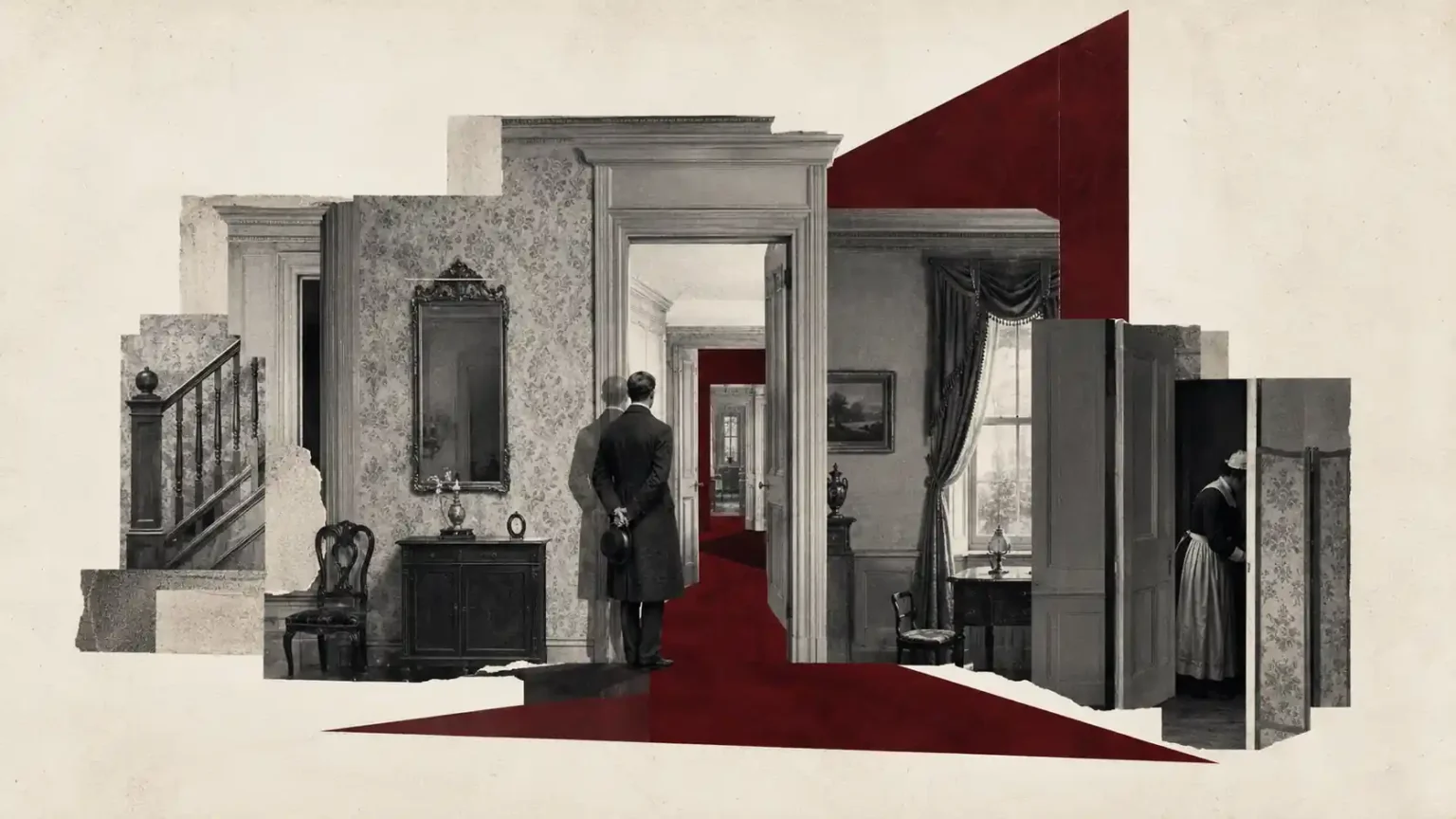
The most disturbing house is not the obviously haunted one. It is the orderly house whose doors close properly, whose portraits remain straight, whose possessions testify to taste and continuity—and in which something intimate nevertheless returns in an alien form. Freud’s uncanny and the bourgeois home belong together because the uncanny does not simply invade domestic security from outside. It reveals that security was never psychologically complete. The home promises privacy, inheritance, identity, and shelter; Freud’s argument begins where those promises become reversible, so that what was meant to remain concealed within the familiar world comes back as fear.
Freud’s 1919 essay “The Uncanny” is often read as a theory of eerie effects: dolls that seem alive, doubles, repeated numbers, severed limbs, involuntary returns, ghosts, and the fear of losing one’s eyes. The Freud Museum’s account of the essay emphasizes the semantic instability of heimlich and unheimlich, while the complete English text hosted by MIT shows how Freud moves among dictionaries, literary criticism, clinical inference, and autobiography. Yet the essay becomes more historically revealing when placed inside modern domestic life. The uncanny is the crisis of a world organized around inside and outside, family and stranger, property and intrusion, consciousness and repression.
Psychoanalysis, as the Internet Encyclopedia of Philosophy’s overview of Freud explains, treats the mind not as transparent self-possession but as a conflictual system in which wishes, prohibitions, memories, and defenses act without becoming fully conscious. The uncanny gives that divided mind an environment. It turns psychic conflict into a room, a corridor, a returning figure, an inherited object, an almost-recognized face.
Freud’s Uncanny and the Bourgeois Home
The decisive word is unheimlich. Its apparent opposite, heimlich, suggests what belongs to the home: the familiar, intimate, comfortable, domesticated. But Freud lingers over a semantic complication. Heimlich can also mean concealed, secret, withdrawn from strangers, hidden within a house or closed circle. The homely therefore names both what is safely known and what is privately kept from view. Under pressure, the second meaning approaches its opposite. The uncanny is not the absolutely foreign; it is the familiar encountered when its secrecy can no longer be maintained [1].
This reversal gives Freud a model of repression. Repression does not annihilate an idea or affect. It prevents ordinary conscious recognition while leaving the repressed capable of indirect return. What comes back is therefore both known and unknown, intimate and estranged. The uncanny feeling is the affective signature of that contradiction.
The bourgeois home is especially vulnerable to this reversal because it asks architecture to guarantee a psychological distinction: outside lies exposure, exchange, labor, crowds, and danger; inside lies identity, continuity, intimacy, and control. The uncanny begins when the house ceases to uphold the distinction on which its moral authority depends.
Freud did not invent the association between interiority and domestic space, but he gave it a radical twist: the subject is not master in its own house. The outlines of his life, including the Viennese medical career summarized by Encyclopaedia Britannica, place psychoanalysis within a world of apartments, professional households, patients, servants, consulting rooms, and cultivated objects. Freud’s conceptual house was never merely abstract. It was furnished.
The Historical Pressure Behind the Interior
During the long nineteenth century, the bourgeois home became property, family institution, display of respectability, school of gender, archive of ancestry, and refuge from the market. Rooms separated drawing room from bedroom, family from servants, adults from children, public reception from private withdrawal. Domestic order promised that social identity could be stabilized through space: the family name occupied the address, possessions accumulated memory, and doors regulated access.
The promise was never innocent. Servants moved through back stairs and concealed corridors; women were idealized as guardians of intimacy while being confined by it; children embodied innocence while absorbing adult rivalries and prohibitions. Imported plants, textiles, ceramics, carpets, woods, and curiosities brought empire and commerce into rooms imagined as retreats from history. The visual culture of domesticity preserves this tension. A discussion of Frances Jones Bannerman’s In the Conservatory on Smarthistory shows a scene of bourgeois feminine solitude materially connected to colonial trade and family wealth. The Victoria and Albert Museum’s history of William Morris wallpaper likewise reveals how domestic surfaces participated in arguments about taste, craft, mass production, and distinction.
In Freud’s household, domestic and professional life were unusually porous. The family moved to Berggasse 19 in 1891, and the consulting rooms operated within the home; the Freud Museum’s account of Freud at home makes the overlap explicit. The Sigmund Freud Museum in Vienna identifies the apartment as the place where he lived and worked for forty-seven years before Nazi persecution forced the family into exile. Psychoanalysis was born not in a clinic isolated from ordinary life but in a home where illness, interpretation, family routine, antiquities, professional authority, and service occupied adjacent spaces.
A Concept Born Between Uncertainty and Repression
Freud begins as a critic of the psychiatrist Ernst Jentsch. In “On the Psychology of the Uncanny” (1906), Jentsch associated uncanniness with intellectual uncertainty, especially doubt about whether an apparently animate being is alive or an apparently living being is mechanical [2]. Wax figures, dolls, automata, seizures, and altered states unsettle because classification falters. Freud does not reject this explanation; he denies that it reaches the deepest cases. Uncertainty can produce uncanny effects, but it cannot explain why some ambiguities penetrate while others remain merely puzzling.
Their disagreement turns on E. T. A. Hoffmann’s “The Sandman,” available in English through Project Gutenberg’s collection of German tales. Jentsch emphasizes Olympia, the automaton whom Nathanael mistakes for a living woman. Freud shifts attention to the Sandman who steals children’s eyes, the threatening father figures Coppelius and Coppola, and childhood terror returning in adult obsession. The tale’s deepest force, he argues, lies in revived infantile anxiety, interpreted through the castration complex [1].
The reading is brilliant and coercive. Freud sees that the story is organized by repetition, substitution, and displaced paternal threat. But he also reduces the automaton and the woman-as-automaton to secondary status. Olympia unsettles another boundary: woman and projection, desire and narcissism. Nathanael loves a figure who returns his own speech in minimal signs. The uncanny woman exposes the possibility that romantic recognition is a relation to a compliant mirror.
Freud’s move from uncertainty to repression nevertheless transforms the concept. The uncanny is no longer an accident of incomplete knowledge. It is generated by knowledge the subject has had to disown. The apparent stranger carries an intimate history; the repeated street, familiar face, double, coincidence, and animated object become forms in which psychic material crosses a border consciousness believed secure.
Why the House Is More Than a Metaphor
Houses convert psychic distinctions into physical ones. They have façades and interiors, thresholds and forbidden rooms, upper floors and cellars, family spaces and service spaces. They store objects beyond the memory of current inhabitants. They make absence perceptible: an unused chair, a locked door, a room preserved after death. Architecture can therefore materialize repression without merely illustrating it.
The uncanny house does not become frightening because it ceases to be a home. It becomes frightening because it remains recognizably a home while disclosing that intimacy has always included secrecy, dependence, inheritance, and fear.
Gaston Bachelard later treated the house as a privileged space of memory, imagination, protection, and intimate being [8]. His phenomenology is more tender than Freud’s: attic and cellar, nest and corner become poetic condensations of inhabited life. Yet Bachelard’s house can feel socially weightless. Who owns it? Who cleans it? Who is permitted privacy? Freud’s uncanny prevents intimacy from becoming pure refuge. The shelter remembers conflict.
Anthony Vidler’s The Architectural Uncanny sharpens this historical dimension by treating unhomeliness as a modern condition rather than a timeless taste for haunted buildings [7]. The MIT Press description of Vidler’s study places architecture, politics, and social thought in the same field. The more confidently the house is designed as an instrument of privacy and identity, the more disturbing its reversals become.
Gothic fiction understood this before theory named it. Inheritance can be accusation; family continuity can transmit violence; property can contain a crime; marriage can become imprisonment; the dead may retain claims on the living. The haunted house is not premodern superstition surviving inside progress. It is modern domestic order thinking against itself.
The Interior as a Machine of Repression
Walter Benjamin saw the nineteenth-century interior as the bourgeois subject’s casing: a space in which objects, fabrics, traces, and collections protected individuality from the metropolis [9]. Freud traces symptoms to conflicts of desire, childhood, prohibition, and defense; Benjamin reads the interior through capitalism, collecting, commodity culture, and urban shock. Their projects differ, but neither permits the room to remain innocent.
The collector believes possessions have been rescued from exchange by receiving a personal home. Yet the commodity carries histories of labor and circulation that attachment cannot abolish. Velvet curtains, cabinets, souvenirs, antiquities, clocks, and photographs make the room singular while thickening it with displaced worlds. Readers can place this argument beside Book in Light’s guide to where to read Benjamin’s “Work of Art” essay. Reproduction changes the status of images; commodity circulation changes the status of domestic things. A strong account needs both psychoanalysis and material history: objects carry memory and desire, but the room’s serenity also depends on relations it does not display.
The servant who is present by disappearing
Servants know the household intimately without belonging to its official self-image. They enter bedrooms, handle clothing, hear quarrels, tend children, and move between visible and concealed zones. The well-run home requires this labor to be effective but unobtrusive: present enough to sustain domestic life, absent enough to preserve the fantasy that the household reproduces itself naturally.
A Cambridge Core study titled “Not at Home: Servants, Scholars, and the Uncanny” makes the class dimension explicit. The familiar stranger inside the house is not only a fantasy figure; it is a social role produced by domestic intimacy without equality. Freud’s universal vocabulary must therefore be handled carefully. Particular societies supply the architecture through which anxiety becomes legible.
Gender, Hysteria, and the Domestic Scene
Psychoanalysis emerged from domestic stories told under clinical conditions: stories of fathers, mothers, siblings, marriages, governesses, bedrooms, seductions, jealousies, and prohibitions. These cases interpret how authority enters the psyche through intimate relations. Yet Freud’s categories often reproduce the asymmetries of the world they diagnose.
Dora’s case is exemplary [5]. Freud reads symptoms, dreams, family alliances, erotic attachments, and refusals with extraordinary attention, but he underestimates the force of her protest against adult arrangements in which her father’s affair, Herr K.’s advances, and Frau K.’s place in the family economy are treated as interpretive material more readily than as forms of power. The analytic room offers speech, yet the analyst can still make a woman’s refusal into evidence for the theory she resists.
Feminist histories of psychiatry and domestic fiction have therefore argued that the home was not merely the setting of female illness. It helped produce femininity, dependence, sexuality, respectability, and nervous disorder [10][11]. Privacy could shelter abuse as easily as intimacy. A woman’s breakdown might express family conflict without being reducible to fantasy about the family.
This redistributes the uncanny. Freud organizes “The Sandman” around the male child’s fear of bodily loss. A feminist reading asks what happens to Olympia, Clara, the mother, the nurse, and the women whose roles stabilize male development. The uncanny may arise not only when paternal authority returns in monstrous form but when the supposedly passive figures of domestic life cease to remain passive. The doll looks back. The patient ends treatment. The household secret becomes articulate.
The Double and the Failure of Self-Possession
The double is especially disturbing to bourgeois individuality. The modern legal and economic person is imagined as continuous, responsible, self-identical, capable of owning property and intention. The double gives the subject an exterior counterpart: mirror image, rival, ghost, portrait, twin, automaton, repeated name, second life. What once promised immortality becomes a herald of death [3].
Otto Rank traced the double through myth, literature, narcissism, shadows, reflections, and death [3]. Freud places it within development: duplication first protects the ego, then returns after that phase has been disavowed. The pattern repeats the logic of the uncanny itself—an earlier reassurance reappearing as threat.
The double also opens the philosophical question of what makes a self one self across time. Book in Light’s guide to personal identity and the self maps accounts based on memory, bodily continuity, narrative, agency, and responsibility. Freud complicates them by insisting that continuity can conceal internal foreignness. I remember, but do not know why the memory returns; I act, but the act carries an intention I cannot avow.
Jacques Lacan radicalized this instability by describing ego formation through misrecognition and reading the unconscious through language; the Stanford Encyclopedia of Philosophy’s account of Lacan situates this return to Freud within twentieth-century theory. The uncanny double is no longer merely another person who resembles me. It is evidence that “me” was never a perfectly enclosed origin.
Interpretation After Freud: Suspicion and Its Limits
Freud’s uncanny invites interpretation because it assumes fear has a history. The apparently inexplicable sensation is not meaningless; it is overdetermined. A literary figure may carry childhood anxiety, taboo, linguistic ambiguity, social contradiction, and formal repetition at once. This portability explains the concept’s influence in literature, film, architecture, art history, and cultural criticism.
Paul Ricoeur placed Freud within a “hermeneutics of suspicion,” alongside Marx and Nietzsche, while arguing that psychoanalysis is an archaeology of the subject rather than a complete philosophy of human possibility [12]. The Stanford Encyclopedia’s discussion of Ricoeur clarifies how his engagement with Freud connects interpretation, symbol, memory, and agency. Readers can place this debate beside Book in Light’s guide to books on hermeneutics and the discipline of understanding.
Suspicion is necessary because domestic order depends on managed appearances. But suspicion becomes imperial when every surface is forced to hide the meaning the interpreter already expects. Freud’s Hoffmann reading demonstrates both powers: it discovers structures of repetition and paternal dread, then subordinates competing meanings to castration anxiety. Psychoanalytic interpretation remains strongest when answerable to textual form, history, gender, class, and the resistance of the object.
What Freud’s Account Cannot Fully Resolve
Freud gains force by moving from a German word and literary motifs toward a general theory of psychic return. The movement also universalizes the bourgeois home too quickly. Its anxieties—inheritance, paternal authority, private property, servants, cultivated interiors, family secrecy, gendered dependence—begin to stand for the psyche without remainder.
Class matters because not everyone experiences home primarily as a protected interior threatened by intrusion. For tenants, lodgers, domestic workers, migrants, the displaced, and the homeless, unhomeliness may be a political condition before it becomes an aesthetic sensation. Gender matters because the room that shelters one person can confine another. Empire matters because the European interior gathered distant materials while suppressing histories of acquisition. Race matters because the familiar has often been secured by marking certain bodies as permanently strange.
The date matters too. “The Uncanny” appeared in 1919, after a war that shattered European confidence in progress, damaged bodies industrially, displaced populations, and returned soldiers to homes unable to restore the world they had left. Freud does not present the essay as a direct diagnosis of postwar Europe; treating every motif as trench allegory would be crude. Still, the atmosphere sharpens his intuition that civilization’s apparent outside can return from within its own institutions.
The home’s fragility became literal when the Nazi regime entered Austria, searched Berggasse 19, arrested Anna Freud for interrogation, and forced the family into exile. Political terror must not be reduced to psychic metaphor. Yet the event exposes the limit of domestic privacy as a bourgeois guarantee. The state can cross the threshold; property, status, assimilation, and cultural eminence cannot make the home sovereign.
Why the Uncanny Has Not Become Obsolete
Contemporary homes differ from Freud’s apartment, but the old tension has intensified. The house is still asked to provide privacy, identity, safety, memory, and control, while remote work, domestic cameras, voice assistants, platform delivery, biometric access, and data extraction blur inside and outside. Devices become useful by making intimate habits legible to distant infrastructures.
The resulting unease is not simply fear of technology. It becomes Freudian when a device knows too much, responds without being addressed, repeats private speech, misidentifies a face, or acts with an agency both mechanical and personal. Jentsch’s uncertainty returns inside commercial surveillance. Freud’s correction returns as well: the strongest discomfort concerns not only whether the machine is alive, but what wishes for obedience, companionship, omniscience, and protection have been built into it.
The uncanny remains useful when kept historically specific. It names a breakdown in the familiar, but it should also prompt the questions: familiar to whom, secured by whose labor, owned under what conditions, threatened by what power? Without them, the concept becomes a stylish synonym for eeriness. With them, it illuminates how psychic life attaches itself to institutions, objects, rooms, and unequal relations.
References and Further Reading
- Sigmund Freud, “The Uncanny” (1919), in The Standard Edition of the Complete Psychological Works of Sigmund Freud, Vol. XVII, translated and edited by James Strachey, London: Hogarth Press, 1955, pp. 217–256.
- Ernst Jentsch, “On the Psychology of the Uncanny” (1906), translated by Roy Sellars, Angelaki 2, no. 1 (1995): 7–16.
- Otto Rank, The Double: A Psychoanalytic Study, translated and edited by Harry Tucker Jr., Chapel Hill: University of North Carolina Press, 1971.
- E. T. A. Hoffmann, “The Sandman” (1816), in Tales of Hoffmann, translated by R. J. Hollingdale, Harmondsworth: Penguin, 1982.
- Sigmund Freud, Fragment of an Analysis of a Case of Hysteria (1905), in The Standard Edition, Vol. VII, London: Hogarth Press, 1953.
- Nicholas Royle, The Uncanny, Manchester: Manchester University Press, 2003.
- Anthony Vidler, The Architectural Uncanny: Essays in the Modern Unhomely, Cambridge, MA: MIT Press, 1992.
- Gaston Bachelard, The Poetics of Space, translated by Maria Jolas, Boston: Beacon Press, 1964.
- Walter Benjamin, The Arcades Project, translated by Howard Eiland and Kevin McLaughlin, Cambridge, MA: Harvard University Press, 1999.
- Elaine Showalter, The Female Malady: Women, Madness, and English Culture, 1830–1980, New York: Pantheon Books, 1985.
- Nancy Armstrong, Desire and Domestic Fiction: A Political History of the Novel, New York: Oxford University Press, 1987.
- Paul Ricoeur, Freud and Philosophy: An Essay on Interpretation, translated by Denis Savage, New Haven: Yale University Press, 1970.
- Anneleen Masschelein, The Unconcept: The Freudian Uncanny in Late-Twentieth-Century Theory, Albany: State University of New York Press, 2011.
- Maria Tatar, “The Houses of Fiction: Toward a Definition of the Uncanny,” Comparative Literature 33, no. 2 (1981): 167–182.
- Michelle Perrot, ed., A History of Private Life, Volume IV: From the Fires of Revolution to the Great War, translated by Arthur Goldhammer, Cambridge, MA: Belknap Press of Harvard University Press, 1990.
The House That Does Not Stay Closed
Freud’s durable insight is not that familiar things can sometimes look strange. It is that familiarity is an achievement maintained by exclusion, habit, repression, and interpretation. The bourgeois home concentrates that achievement in material form. It arranges bodies, objects, labor, memory, and authority so that the interior can appear coherent. The uncanny arrives when coherence becomes disclosure.
Read in this way, Freud’s uncanny and the bourgeois home name the same unfinished problem at different scales. The psyche is not a sovereign interior, and the household is not a sealed refuge. Each is crossed by histories it cannot fully master. What returns through the locked room, the double, the animated object, the servant’s knowledge, the patient’s refusal, or the state’s intrusion is evidence that the boundaries of modern selfhood were always more fragile—and more political—than the well-furnished room allowed itself to believe