Before Against Method, the important preparation is how Feyerabend challenged competing accounts of scientific rationality.
This article will not explain every chapter of Paul Feyerabend’s Against Method, and it will not defend or refute “epistemological anarchism” in the abstract. The narrower task is historical: identify the philosophical disputes that make the book intelligible. The crucial background is not a generic conflict between “reason” and “relativism.” It is Feyerabend’s movement through Popperian critical rationalism, Wittgensteinian concerns about meaning, debates over quantum theory, and the Kuhnian turn to scientific history. The revised Stanford Encyclopedia entry on Feyerabend is especially useful because it reconstructs that development rather than beginning with the slogan “anything goes.”
The publisher’s current edition of Against Method describes it as an attack on the idea that scientific progress can be captured by a stable method. That description is accurate but incomplete. Feyerabend’s argument has force only because he once wanted methodological rules to do serious work. His later pluralism is not the thought of someone who never cared about rational criticism. It is the conclusion of someone who came to believe that rules strong enough to legislate scientific practice would condemn episodes we regard as major achievements.
1. Popper: criticism without foundations
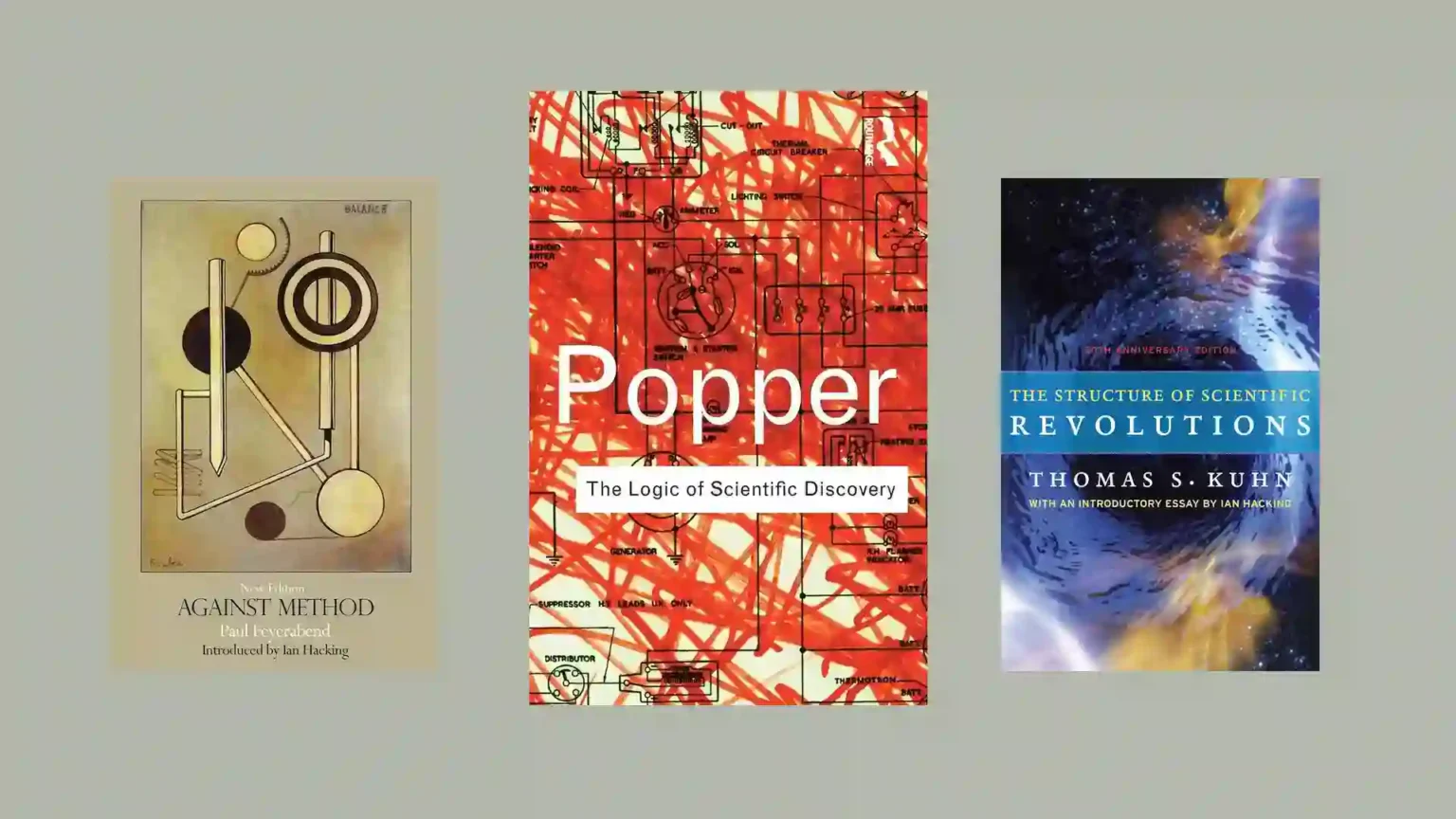
Feyerabend began close to Karl Popper’s critical rationalism. Popper’s The Logic of Scientific Discovery rejects induction as the logic of scientific justification and treats severe criticism as the engine of growth. Feyerabend inherited the anti-foundational impulse: theories are not built securely upward from neutral observations. But he increasingly doubted that falsificationist norms could describe how major changes actually happen. The Stanford entry on Popper is worth reading alongside Feyerabend because it shows how much sophistication already exists inside Popper’s distinction between logical falsifiability and methodological practice.
The disagreement therefore cannot be reduced to “Popper likes rules; Feyerabend hates rules.” Both reject the picture of science as passive accumulation of observations. Both value bold theoretical invention. The split concerns what methodological criticism can legitimately demand in advance. Feyerabend begins to suspect that a rule forbidding ad hoc defenses, speculative metaphysics, or theory-protecting moves may exclude precisely the historical maneuvers by which new traditions acquire enough strength to become testable rivals.
2. Wittgenstein: facts do not arrive already interpreted
A second strand is philosophical language. Feyerabend’s early work combined Popperian testability with the thought that what counts as an observation statement depends partly on the conceptual resources through which a situation is described. The Stanford account of Feyerabend traces his engagement with Wittgenstein and his claim that one apparently stable observation sentence can function differently inside incompatible theories. The broader Wittgenstein entry supplies the background: meaning is not a label simply attached to an independently carved world.
This matters because methodological comparison assumes that rival theories can be tested against shared descriptions. If theory change alters not just answers but the language in which evidence is articulated, then “compare both theories to the same facts” becomes less straightforward. Feyerabend’s later arguments for theoretical pluralism grow from this pressure. An alternative theory may be necessary not merely to explain an anomaly but to make the anomaly describable as evidence against the dominant theory.
3. Kuhn: history changes the unit of criticism
Thomas Kuhn’s The Structure of Scientific Revolutions provided a neighboring historical challenge. Normal science, paradigms, crisis, revolution, and incommensurability all undermine the expectation that scientists continually subject fundamental assumptions to symmetrical tests. The Stanford entry on Kuhn stresses that standards of evaluation themselves may change across scientific revolutions. Feyerabend and Kuhn both used the language of incommensurability, although they did not mean exactly the same thing and Feyerabend resisted turning historical patterns into a new orthodoxy.
Their disagreement is as important as their similarity. Kuhn offered a structured account of mature science: normal puzzle-solving punctuated by revolutionary change. Feyerabend worried that this picture could become descriptively conservative, making paradigm-bound conformity look like the normal condition of good science. Where Kuhn identified a historical pattern, Feyerabend asked whether methodological pluralism should actively encourage alternatives even before crisis makes them respectable.
4. Quantum theory: method becomes concrete
Feyerabend’s philosophy was also shaped by disputes over quantum mechanics, not only by abstract epistemology. He interacted with Niels Bohr and David Bohm and attacked what he saw as dogmatic uses of the Copenhagen interpretation. The SEP discussion of the Copenhagen interpretation is useful background because complementarity, measurement, and the status of alternative formulations made questions about theoretical language and methodological tolerance concrete. A philosophy that allows only one respectable interpretive framework risks converting temporary success into methodological monopoly.
This helps explain why Against Method repeatedly returns to scientific episodes instead of remaining at the level of rules. Feyerabend wants historical cases to function as counterexamples to methodological legislation. Galileo becomes the most famous case because rhetorical tactics, reinterpretation of experience, theoretical audacity, and selective use of evidence can be portrayed as intellectually productive even when they violate a sanitized picture of how rational science is supposed to proceed.
5. The debate that produced “Against Method”
The 1965 London debate published as Criticism and the Growth of Knowledge is the best single documentary bridge. It puts Kuhn’s account of normal and revolutionary science beside Lakatos’s reconstruction of falsification and the critical reactions that followed. Feyerabend’s contribution belongs to a field in which philosophers were already fighting over whether rationality could be encoded as method, whether history supported that method, and how disagreement between frameworks could be adjudicated.
Against this background, “anything goes” becomes easier to read accurately. It is not a recommendation that every belief is equally good, that evidence never matters, or that science should abandon criticism. It is a polemical attack on the attempt to formulate a universal methodological rule that has never been violated by productive science. Feyerabend’s own historical argument is itself discriminating: he spends pages trying to show that episodes usually celebrated as rational progress depended on practices methodological textbooks tend to suppress.
Galileo is not a decorative case study
The long Galileo material in Against Method is where Feyerabend tries to make his methodological challenge concrete. His point is not that Galileo possessed no evidence or that propaganda replaces reason. It is that an emerging theory may initially conflict with entrenched observations precisely because the observations are interpreted through older conceptual and instrumental assumptions. The new theory can need rhetorical defense, auxiliary hypotheses, new instruments, and even temporary tolerance of unresolved difficulties before its evidential advantages become visible.
This is the counterexample-driven core of Feyerabend’s pluralism. If an accepted theory determines what counts as a relevant fact, then testing it may require developing an alternative far enough to generate a rival description of the facts. Methodological monism can block that process by demanding that the challenger satisfy standards whose authority derives from the incumbent framework. Feyerabend’s conclusion is not that standards never matter; it is that a plural ecology of theories may be epistemically valuable before any one theory has earned victory.
What changes once you know the background
Three interpretive camps become visible. One treats Feyerabend as extending Popperian criticism until methodology turns against itself: every rule must be open to criticism too. Another reads him through Kuhnian history, emphasizing incommensurability and the contingency of standards. A third emphasizes political pluralism and the later attack on the cultural authority of science. The SEP chronology supports a developmental reading in which these emphases emerge at different stages rather than forming one timeless doctrine.
This history also limits easy comparisons with later anti-foundational thinkers. BookInLight’s reading guide to Richard Rorty is a useful neighboring route because Rorty also challenges representational and foundational pictures of knowledge. But Feyerabend’s route runs much more directly through concrete philosophy-of-science disputes, quantum theory, and scientific historiography. Similar anti-foundational conclusions do not erase different argumentative genealogies.
The historical sequence also warns against reading the 1975 book as if every sentence expressed an unchanged lifetime position. Feyerabend revised his views repeatedly, and the Stanford chronology documents those reversals. Development is part of the evidence.
What the background rules out is the caricature of Against Method as a manifesto for intellectual chaos. What it leaves in is a harder challenge: if historical science repeatedly advances by breaking rules formulated from earlier success, how can methodological criticism remain binding without becoming retrospective mythology? Feyerabend never makes that question comfortable, which is why the book still provokes more than its slogan explains.
Cover artwork: credits and source records
- Against Method — Verso (source record)
- The Logic of Scientific Discovery — Routledge (source record)
- The Structure of Scientific Revolutions — University of Chicago Press (source record)