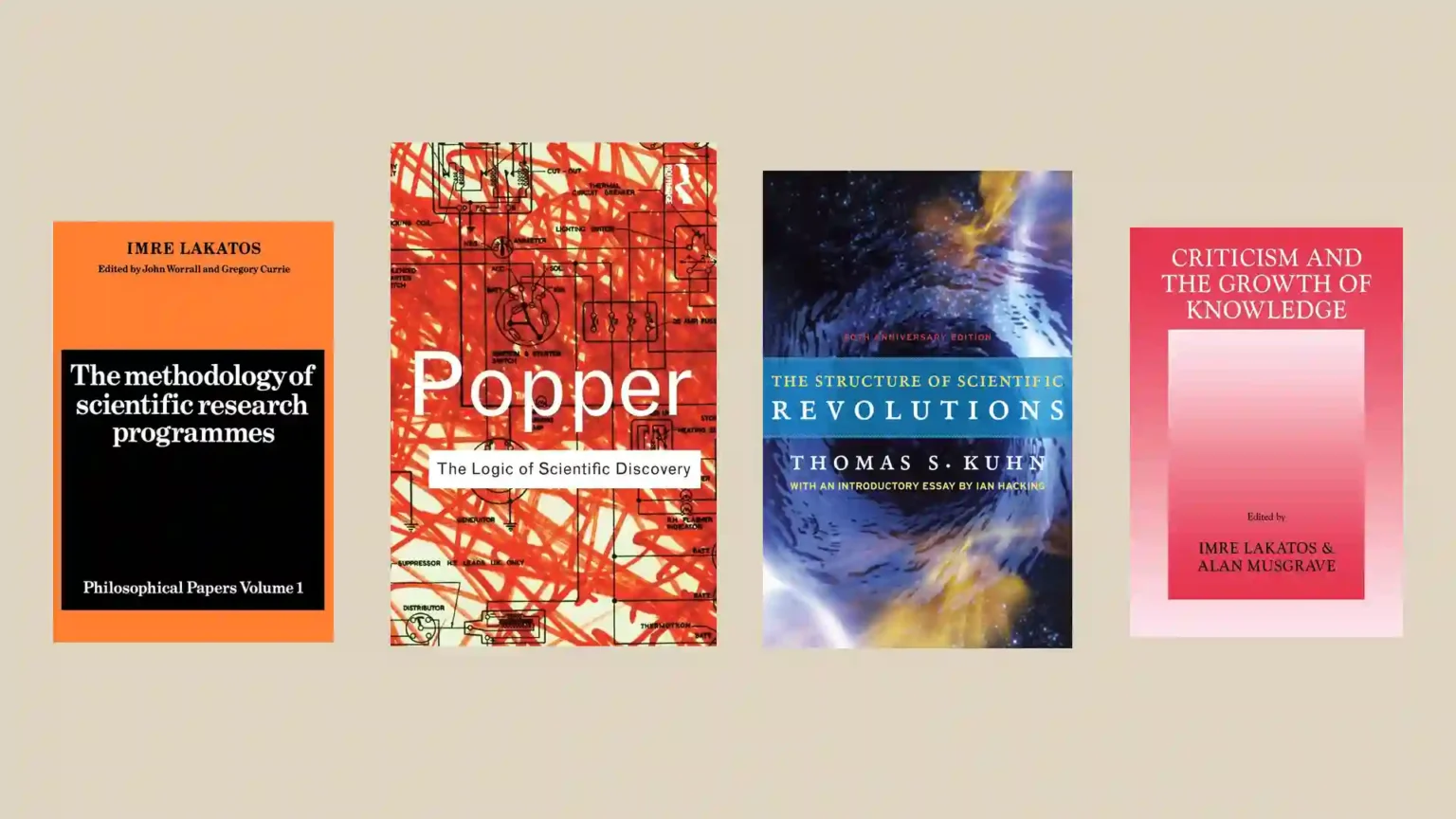
Before Lakatos’s research programmes, distinguish Popper’s testing model from Kuhn’s account of scientific change and Lakatos’s own amendments.
Recommendation first: do not spend months “preparing” for Lakatos. Read Popper selectively, read Kuhn selectively, skim the confrontation collected in Criticism and the Growth of Knowledge, and then begin The Methodology of Scientific Research Programmes. Lakatos becomes difficult when readers mistake his vocabulary for a new list of definitions. It is easier when the terms “hard core,” “protective belt,” “positive heuristic,” “negative heuristic,” progressive problemshift, and degenerating problemshift are seen as an attempt to solve a live problem between Popperian criticism and Kuhnian history.
First: learn what Lakatos is revising
Start with Karl Popper, but do not read all of The Logic of Scientific Discovery before moving on. You need four ideas: falsifiability, severe testing, the asymmetry between verification and refutation, and the role of auxiliary assumptions in actual tests. The Stanford account of Popper is enough to clarify the distinction between the simple logic of falsification and the much messier methodology of deciding when a theory has genuinely failed. That gap is exactly where Lakatos enters.
If you already know the classroom slogan “one counterexample falsifies a theory,” concentrate instead on what makes that slogan unreliable as a picture of scientific practice. Scientific theories are rarely tested alone. Apparatus, measurement assumptions, background theories, and auxiliary hypotheses all help generate a prediction. Lakatos does not abandon criticism; he changes its unit. The object to appraise becomes a sequence of theories organized as a research programme.
Second: read Kuhn for the historical pressure
Then read selected chapters of Thomas Kuhn’s The Structure of Scientific Revolutions: normal science, anomaly and crisis, scientific revolutions, and the sections on paradigms and incommensurability. You do not need every historical example on the first pass. What matters is Kuhn’s challenge to the idea that scientists routinely expose central commitments to instant refutation. Mature research communities often protect a paradigm while solving puzzles inside it. The Stanford entry on Kuhn explains why changes in standards of evaluation make theory comparison more complicated than a neutral scoreboard of observations.
This is where introductory summaries can mislead. Popper is not simply “logic” and Kuhn “sociology.” Both are asking how scientific criticism and change occur, but they assign different roles to methodological norms, historical practice, and communal standards. Lakatos wants a framework that respects Kuhn’s historical observation that major theories survive anomalies while resisting the implication that scientific development is merely conversion between communities.
Third: watch the argument happen
The best bridge is Criticism and the Growth of Knowledge, the volume that grew from the 1965 London colloquium. Its value is not that every chapter must be mastered. Its value is that Kuhn, Popper’s allies and critics, Lakatos, and Feyerabend appear as participants in one dispute. Read selectively: Kuhn on discovery versus research practice, Lakatos on falsification and research programmes, and the exchanges that reveal how much disagreement hides behind the word “rational.”
Once you see that dispute, Lakatos’s own “Falsification and the Methodology of Scientific Research Programmes” stops looking like an arbitrary taxonomy. A programme’s “hard core” is not declared true; it is protected by a methodological decision while researchers modify a surrounding belt of auxiliary hypotheses. The crucial question becomes whether those modifications produce new explanatory and predictive successes or merely chase already-known anomalies. That is why “progressive” and “degenerating” matter more than the cartoon opposition of “falsified” and “not falsified.”
What can you safely skip?
You can postpone detailed debates about Duhem, Quine, Bayesian confirmation, structural realism, and contemporary philosophy of statistics. They are relevant to the larger philosophy-of-science landscape, but they are not prerequisites for the first reading. You can also postpone Lakatos’s philosophy of mathematics unless you want to understand the continuity between his work on proofs and his work on scientific criticism. The Stanford entry on Lakatos gives enough intellectual biography to see that the continuity is real without turning it into another preliminary syllabus.
Do not skip history altogether. Lakatos’s chapter “History of Science and Its Rational Reconstructions” states the famous methodological reciprocity between history and philosophy of science. His claim is not that historians should force episodes into a philosophical scheme. It is that competing methodologies can themselves be tested partly by how well they reconstruct major scientific developments without turning great science into irrational rule-breaking.
Progressive and degenerating are not labels for winners and losers
The heart of Lakatos’s proposal is often reduced to another binary: progressive programmes are good, degenerating programmes are bad. That is too fast. A programme is progressive when theoretical development anticipates novel facts and empirical work corroborates some of that surplus content; degeneration occurs when changes mainly accommodate facts already known. The distinction is temporal. It asks whether a line of research keeps generating risky new content rather than whether it currently has anomalies. The Cambridge chapter on falsification and research programmes is indispensable because the technical vocabulary is introduced inside an argument about how real theories develop through sequences rather than isolated tests.
This also explains why the “protective belt” is not automatically a vice. Every serious theory depends on auxiliary assumptions. Adjusting them can be intellectually productive when the adjustment leads to new tests; it becomes suspect when modification is purely defensive. Lakatos is trying to distinguish creative theory repair from immunization without pretending that scientists can always tell the difference instantly. His methodology is therefore less a rule for one experiment than an appraisal of competing trajectories.
Why Newton, Copernicus, and history keep appearing
Lakatos repeatedly uses episodes from physics because his methodology must show that its rules are not invented after the fact to flatter philosophy. The chapters collected in The Methodology of Scientific Research Programmes include a study of why the Copernican programme superseded the Ptolemaic one and an essay on Newton’s effect on scientific standards. These are not illustrations pasted onto a theory; they are tests of whether a methodology can reconstruct scientific achievement without declaring its greatest episodes irrational.
That is also why the relation to Kuhn remains tense. Kuhn’s history shows that communities can persist through anomalies and that revolutions reorganize standards. Lakatos accepts the persistence but wants comparative rational criteria at the programme level. The question is whether “progressive problemshift” genuinely explains why one tradition deserves preference or simply redescribes successful history in philosophical language. Keep that question open while reading; it prevents Lakatos from becoming another vocabulary exercise.
A four-stage route
Use this sequence rather than a shelf of prerequisites:
Popper — falsifiability, severe tests, corroboration, and the problem of auxiliary assumptions.
Kuhn — normal science, anomaly, crisis, revolution, and changing standards.
Criticism and the Growth of Knowledge — see the rival pictures confront one another.
Lakatos — begin with “Science and Pseudoscience,” then “Falsification and the Methodology of Scientific Research Programmes,” and only then the historical-reconstruction essay.
Lakatos’s own introductory “Science and Pseudoscience” chapter is deliberately sharper than a neutral textbook opening. It asks what distinguishes knowledge from ideology and superstition, then argues that no degree of confidence turns a belief into science. Read it as a statement of the problem, not as a complete solution.
Use one modern map, not five
If you want a secondary guide while reading, one broad survey is enough. Peter Godfrey-Smith’s Theory and Reality is useful because it places Popper, Kuhn, Lakatos, and Feyerabend inside the same twentieth-century sequence without pretending that their positions are interchangeable. Use it after a difficult chapter, not before every primary text. Lakatos is easier to understand when the reader has first felt the pressure of the original disagreements rather than receiving them already reconciled by a textbook.
The same principle applies to terminology. Do not memorize “hard core,” “protective belt,” and “heuristic” in isolation. For each term ask what problem it solves. The hard core explains why scientists can rationally persist with central commitments; the protective belt explains where revisions occur; the positive heuristic explains how a programme directs future work; progressive and degenerating shifts supply the comparative test. Vocabulary becomes useful only when attached to those methodological jobs.
One final warning: Lakatos’s language is comparative. The relevant comparison is between developing programmes across time and against rivals, not between isolated sentences frozen at one moment. A programme is assessed against rivals and over time, not by asking whether it contains one anomaly or one successful prediction. If you forget the comparative dimension, the method collapses back into a checklist.
When you are ready
Begin the book before you feel completely prepared. If “protective belt” starts sounding like an excuse to save any favored theory, return to Popper. If “research programme” sounds like Kuhn’s paradigm under a new name, return to Kuhn. If “progressive” sounds like a purely retrospective compliment, return to the historical-reconstruction chapter. Those three confusions are more useful guides than another preparatory reading list.
This route rules out two bad preparations: treating Lakatos as a softened Popper and treating him as a rationalized Kuhn. What remains is the harder question his methodology creates: can we judge research programmes rationally while they are still alive, or only after history has already told us which ones succeeded?
Cover artwork: credits and source records
- The Methodology of Scientific Research Programmes — Cambridge University Press (source record)
- The Logic of Scientific Discovery — Routledge (source record)
- The Structure of Scientific Revolutions — University of Chicago Press (source record)
- Criticism and the Growth of Knowledge — Cambridge University Press (source record)